DRIFT AUDIO
Listen to this story
Choose a voice, then press play.
A new experimental bag from Coperni and bio-designer Arevik Hakobyan carries a living fungal culture inside its walls, one that keeps growing long after purchase.
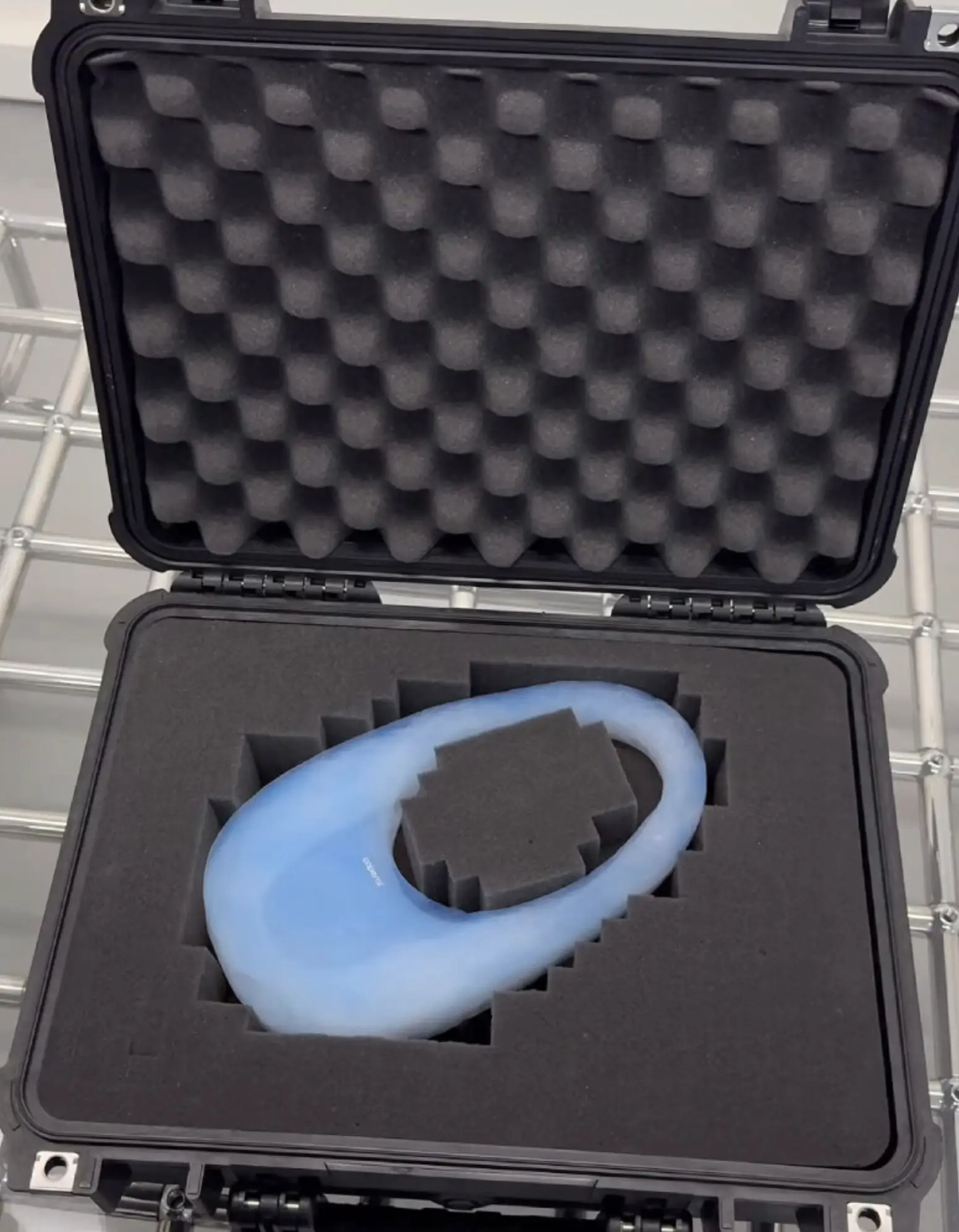
Every panel on Coperni’s newest handbag holds something that is, in the most literal sense, alive. The Paris house has unveiled an experimental version of its Swipe Bag built in collaboration with Arevik Hakobyan, an artist and researcher working in biodesign, and the surface decoration on the bag is not printed, embroidered, or dyed. It is grown. Living mycology cultures, cultivated from plant tissue, sit packed inside the wall structure of each bag, and the visible pattern that results is a direct record of how that fungal growth has spread through the material during production.
What makes the piece unusual is not just the ingredients. Plenty of fashion houses have flirted with mushroom leather and lab grown textiles over the past few years, mostly as a sustain play. What Coperni and Hakobyan describe is different in kind: the culture is not killed off or stabilized before the bag ships. It stays alive. That means the pattern a buyer sees on day one is not necessarily the pattern that will still be there months later, since the organism inside the bag’s walls is capable of continuing to develop after the accessory has left the workshop.
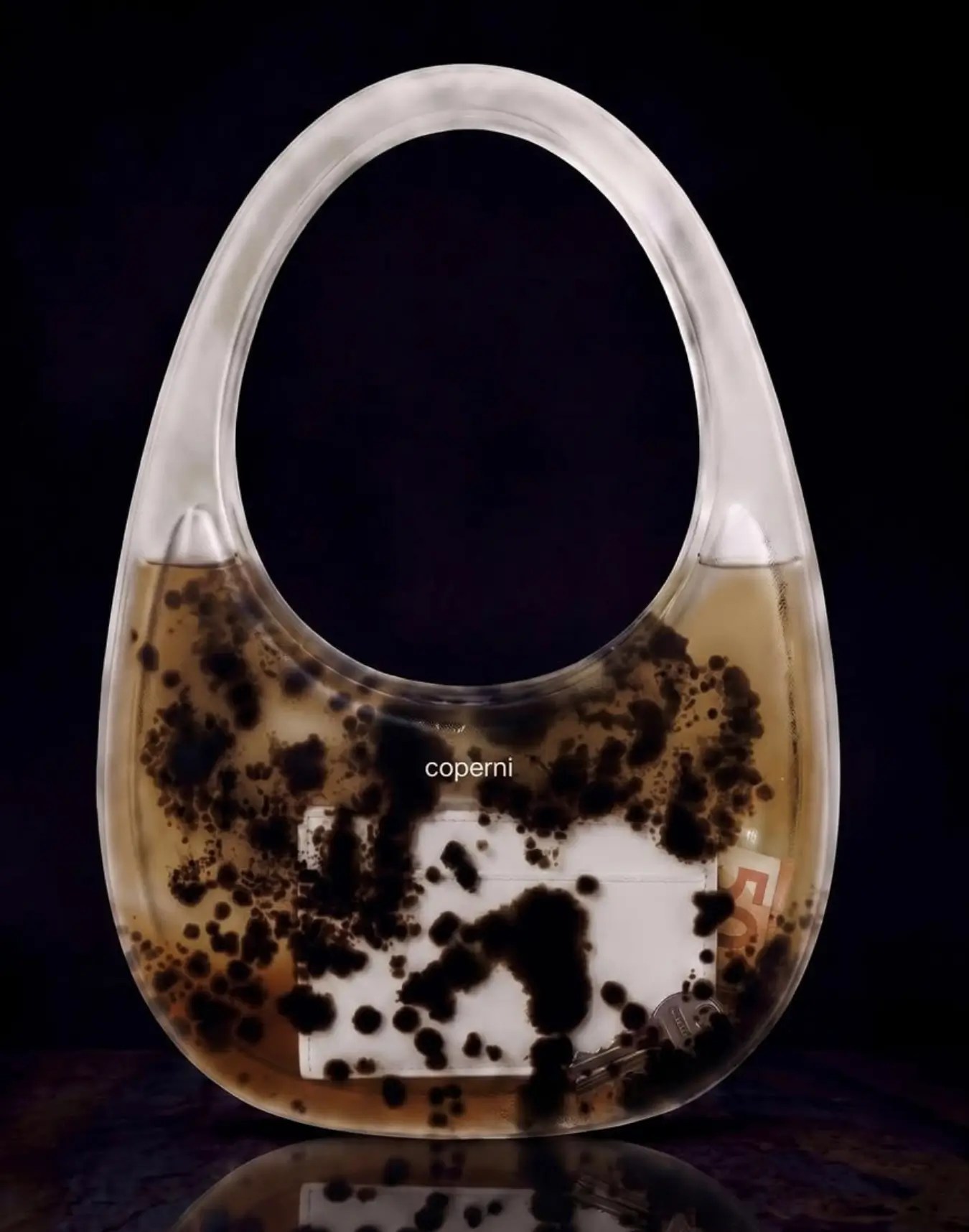
Coperni’s transparent swipe bag becomes a living design object, encasing personal belongings within a fluid-filled shell marked by organic black formations.
It is a strange thing to sit with. A handbag is usually understood as a finished object, something that gets carried, scuffed, and eventually replaced, but never something that keeps developing on its own timeline independent of its owner. Here, the object is framed less as a static accessory and more as a small, contained ecosystem. The design brief was reportedly less about achieving a specific look than about setting conditions for one to emerge, letting the fungal culture do work that a printer or an embroiderer normally would.
There is also a practical question sitting underneath the poetic one, which is how a house keeps a living organism contained inside a consumer product without the whole thing becoming unstable or unsafe to handle. Fungal growth is not a predictable printing process. It responds to temperature, humidity, and time in ways a factory line usually tries to eliminate rather than court. Building a structure that can house that kind of variability, while still holding its shape as a bag someone can sling over a shoulder, is closer to a materials engineering problem than a styling one, and it is exactly the kind of problem Coperni has built its reputation on chasing rather than avoiding.
The result, at least as described, is a piece that resists being photographed once and fully understood. A single image of the bag captures one moment in an ongoing process, and the house has been explicit that the pattern is not fixed. That framing turns the object into something closer to a slow motion artwork than a finished accessory, closer in spirit to a living terrarium than to a monogrammed tote.
View this post on Instagram
stir
Public information on Arevik Hakobyan beyond her own account and the Coperni project itself is thin, which is fairly typical for a researcher working at the edge of art and material science rather than inside the fashion press cycle. What is confirmed is her role: she is credited as the artist and researcher behind the biodesign work, the person who determined how a living plant tissue culture could be seeded and contained inside a wearable accessory without collapsing the object’s structure or making it unsafe to carry.
Biodesign of this kind sits at an odd crossroads. It borrows the patience of a lab process, since fungal growth cannot be rushed the way a print run can, and it borrows the showmanship of a fashion collaboration, since the final object still has to function as a bag people want to be seen with. Hakobyan’s contribution appears to be exactly that bridge: translating a living organism’s behavior into something that reads, at a glance, as a fashion pattern, while never fully domesticating the organism into something inert.
The project was first shared through Hakobyan’s own Instagram account before Coperni’s channel picked it up, a rollout order that suggests the collaboration originated on the design and research side rather than as a brand marketing exercise bolted onto an existing product. That sequencing matters for how the piece reads. It is being presented less as a seasonal drop and more as a shared experiment between a fashion house that has a track record of chasing unconventional materials and a researcher whose entire practice is built around them.
frame
Coperni chose to run this experiment on its most recognizable shape rather than inventing a new silhouette for the occasion. The Swipe Bag debuted in the brand’s Fall/Winter 2019-20 collection, its name and closure both nodding to the swipe to unlock gesture on a smartphone screen, and it has since become one of the more recognizable accessories to come out of Paris in the past several years. It has been carried by Bella Hadid, Kylie Jenner, Doja Cat, and Dua Lipa, among others, and its relatively accessible pricing compared to bags from older heritage houses helped it cross over from runway curiosity to a genuinely widespread carry item.
That existing familiarity is part of why the mycology version lands as effectively as it does. Anyone who already recognizes the Swipe Bag’s boxy, structured shape has an immediate point of comparison for just how strange the surface treatment is. The bag’s outline stays legible and commercial, while its skin behaves like nothing else on the market. Coperni has used this same trick before: rather than building a brand new object every time it wants to test a new material or technology, it keeps returning to the Swipe Bag as a stable base, swapping out only the material logic underneath.
View this post on Instagram
habit
Coperni was founded in 2013 by Sébastien Meyer and Arnaud Vaillant, who met while studying at Mod’Art International in Paris and named the label after the astronomer Nicolaus Copernicus, a reference the founders have said reflects their interest in shifting how people see something familiar. The brand was relaunched in 2019 after the pair spent several years as creative directors at Courrèges, and it has spent the years since building a reputation less on classic tailoring than on turning each product drop into a small piece of applied science.
Before Coperni existed at all, Meyer grew up in the south of France and attended a military school, while Vaillant grew up in Sanary-sur-Mer in a family of doctors. Vaillant spent time at Balenciaga and Chanel before the pair launched their own label in 2013, and that early run earned them the ANDAM First Collection Prize in 2014, a fairly early signal that the industry saw something in their approach beyond a typical debut collection. The Courrèges chapter that followed, from 2015 onward, gave both designers a chance to practice reviving a historic house’s identity before turning that same instinct back on their own label a few years later.
The mycology bag is the latest entry in a list that already reads like a materials science syllabus. Coperni has released a version of the Swipe Bag made from 99 percent air, using a NASA developed silica aerogel that made it, by weight, one of the lightest objects of its kind ever produced. It has built bags incorporating meteorite fragments and apple derived leather. It has worked with the design studio Heven on hand blown glass bags finished in 18 carat gold. A robot dog has trotted down one of its runways as a show companion. And in 2022, during Paris Fashion Week, the brand staged what is still probably its most viral moment: spraying a liquid fiber material directly onto Bella Hadid’s body on stage, using Fabrican’s sprayable textile technology, until it hardened into a wearable dress in front of a live audience.
Seen against that history, the mycology collaboration is not really a departure. It is the same instinct applied to a new discipline. Where the air bag borrowed from aerospace materials and the spray on dress borrowed from textile chemistry, this project borrows from biology, treating a living organism as a legitimate design material rather than a novelty ingredient meant to be neutralized before it reaches a customer.

A runway model greets a yellow robotic dog in a play moment, blending fashion presentation with robotics and performance art.
fin
Coperni and Hakobyan’s bag arrives inside a broader shift that has been building across design and art circles for a few years now, one in which mycelium, the thread like network that makes up the bulk of a fungus’s body, has stopped being treated purely as a leather substitute and started being treated as a medium in its own right. Designers have grown mycelium into acoustic panels, architectural surfaces, and gallery installations, and the practice has picked up enough momentum that outlets covering the space describe fungi as having a genuine cultural moment that runs in parallel with the scientific interest in the same organisms, as detailed in a recent overview of the trend.
Some of that momentum has already touched fashion directly. Designers working with living fungal materials have produced garments meant to be worn briefly and then returned to the earth, a use case that treats decomposition as a feature rather than a flaw. Academic and art institutions have also started building tools specifically for artists working with living filamentous fungi as a creative medium, including systems that use light sensitivity to steer how a fungal culture grows into a pre-planned shape, a discipline sometimes grouped under the broader label of bioart.
What sets the Coperni and Hakobyan project apart from most of that earlier work is the refusal to stabilize the material at the end of the process. Where a lot of biodesign work treats the living stage as a step on the way to a finished, inert product, this bag keeps the organism active inside a commercial accessory people are expected to buy and carry. It is a smaller gesture than a gallery installation, and a much stranger one for a fashion label to put a price tag on. Whether it ships as a limited runway piece or ever becomes something closer to a retail product has not been detailed, and the collaboration is being presented for now as an experimental concept sitting at the meeting point of fashion, science, and material design rather than a confirmed commercial release.
For a house that has spent years turning its runway into something closer to a demo stage, that ambiguity feels almost deliberate. Coperni’s biggest cultural moments, the spray on dress, the air bag, the glass and gold pieces, have tended to arrive as proofs of concept first and commercial products second, if at all. Some eventually made their way into limited retail runs, others stayed closer to spectacle. Treating the mycology Swipe Bag the same way, as an open question rather than a settled product launch, keeps the collaboration in step with how the brand has always handled its most unusual ideas.
What the piece does settle, at least for now, is a point about where the line between material and organism sits in contemporary fashion. A pattern that used to require a printer, a dye vat, or a needle can, in this case, be handed over to something that eats, grows, and changes shape on its own schedule. Coperni and Hakobyan are not claiming to have solved anything about how such an object should be cared for, displayed, or eventually retired. They have simply built one and let it keep doing what a living culture does.
Related Articles
Polo Ralph Lauren Put A Silk Slim And Called It Tuxedo
Silk-Bib Tuxedo Shirt. Style 100068378. Silk front. Band collar. Elongated. UK site lists it unavailable. […]