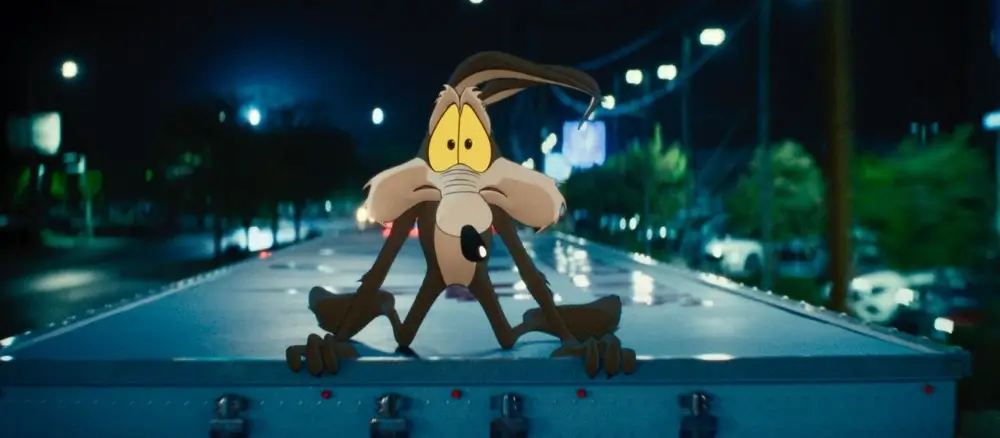
Produced by Warner Bros., Coyote vs. Acme begins with a premise that feels both overdue and quietly radical. Wile E. Coyote—voiced by Eric Bauza—steps out of the desert and into a legal system, filing suit against Acme Corporation for the countless defective products that have defined his existence. Rockets that misfire. Springs that collapse. Devices that promise precision and deliver collapse at the exact moment of use.
For decades, these failures read as inevitability. The coyote fell because that was the joke. The ground met him because gravity demanded it. The Road Runner escaped because that was the structure of the world.
This film refuses that neutrality. It asks a different question: what if failure wasn’t random? What if it was manufactured?
arch
The Looney Tunes shorts built Wile E. Coyote as a system of repetition. Attempt, device, miscalculation, fall—then reset. Each sequence functioned as a closed loop, sealed from consequence. No memory carried forward. No accountability extended beyond the frame.
Acme Corporation existed within that loop as a silent facilitator. A catalog of solutions, endlessly available, endlessly unreliable. The brand became shorthand for possibility without guarantee.
Coyote vs. Acme breaks the loop by introducing continuity. The failures accumulate. They stack. The desert is no longer empty; it is marked by impact points, each one evidence of a prior attempt. The coyote’s history becomes visible.
Repetition turns into record.
stir
The shift in setting—from open desert to enclosed courtroom—does more than change geography. It alters the rules of engagement.
The desert allowed for infinite possibility. Space stretched without limit. The coyote could attempt anything because nothing constrained him beyond physics—and even that bent under cartoon logic.
The courtroom imposes structure. Language governs action. Evidence replaces instinct. Timing shifts from instantaneous gag delivery to procedural rhythm.
In this space, failure must be articulated. It must be proven.
The coyote, long defined by silence and gesture, enters a system that requires translation. His experience—once visual, immediate, ephemeral—becomes verbal, documented, and contested.
flow
Casting Eric Bauza as Wile E. Coyote introduces a delicate balance. The character has historically communicated through expression, not speech. Signs held up to the audience. Eyes widening before impression. Limbs extending in impossible arcs.
The film doesn’t abandon that physical language. Instead, it builds around it.
Legal representation becomes essential. The coyote’s case requires advocates—figures who can interpret his history, frame his argument, and navigate the complexities of corporate liability. Dialogue enters not as a replacement for silence, but as a supplement.
The result preserves the character’s core while allowing him to operate within a new system.
He doesn’t need to speak more. The world speaks differently around him.
consider
Acme Corporation has always existed as abstraction. No headquarters. No visible leadership. Just a name stamped onto crates containing improbable solutions.
In Coyote vs. Acme, abstraction gains dimension. The company becomes a functioning entity, subject to scrutiny. Its products are no longer isolated gags; they form a pattern.
Each device shares a common trait: failure at the moment of execution. Not random malfunction, but precise collapse. The rocket accelerates perfectly—until it doesn’t. The spring holds tension—until it releases prematurely. The anvil falls—always onto the coyote, never onto the target.
This consistency suggests design.
The lawsuit doesn’t accuse Acme of occasional defect. It accuses it of systemic unreliability.
visit
The film reframes failure as data. Every fall, every explosion, every miscalculation becomes part of a larger archive.
In the original shorts, failure erased itself. The next scene began fresh, unburdened by what came before. Here, nothing disappears. The coyote’s history follows him.
The courtroom becomes a site of reconstruction. Past events are replayed, reinterpreted, repositioned as evidence rather than entertainment. The audience, once laughing at the immediacy of each gag, now confronts its accumulation.
What changes when laughter meets continuity?
The humor remains, but it deepens. Each failure carries residue. Each impact contributes to a larger argument.
scope
Visually, Coyote vs. Acme operates within a hybrid framework. Animation coexists with live-action environments, creating a deliberate friction.
Wile E. Coyote retains his animated form—elastic, expressive, governed by cartoon physics—while the world around him adheres to physical constraints. Buildings stand rigid. Vehicles move with weight. People respond within realistic parameters.
This contrast highlights the character’s displacement. He doesn’t belong to the world he now inhabits. His movements disrupt its logic. When he stretches or pauses mid-air, the environment resists.
The visual tension mirrors the narrative one. A character built for infinite resets enters a system defined by consequence.
shh
The shift from open desert to structured courtroom changes the nature of comedy.
The original shorts relied on timing and physical exaggeration. Gags landed instantly. The audience processed them in real time, then moved on.
In the courtroom, humor emerges through language and juxtaposition. Legal terminology collides with cartoon memory. Terms like “defective design” and “user error” gain new meaning when applied to rockets that explode on command.
The comedy becomes layered. It operates on recognition as much as reaction.
A rocket misfiring is no longer just funny. It is evidence.
culture
The film arrives within a broader cultural moment that questions systems once taken for granted. Corporations, institutions, and long-standing structures face renewed scrutiny. Accountability becomes a central theme across industries.
Coyote vs. Acme taps into that discourse without abandoning its origins. It doesn’t transform Wile E. Coyote into a symbol through force. Instead, it reveals that the symbolism was always present.
A character repeatedly failed by purchased solutions becomes a figure navigating systemic breakdown. The humor remains intact, but its implications expand.
The film doesn’t impose relevance. It uncovers it.
frame
Wile E. Coyote’s defining trait has always been persistence. No matter how many times he fell, he tried again. That persistence once read as obsession—an inability to learn, to adapt, to stop.
Within the context of Coyote vs. Acme, persistence takes on new meaning. It becomes endurance.
The coyote didn’t continue because he lacked awareness. He continued because he believed in the promise of the tools he used. Each purchase represented hope—misplaced, perhaps, but genuine.
The lawsuit reframes that belief. It acknowledges that the system he trusted may have been fundamentally flawed.
Persistence remains. Its context shifts.
allure
Notably, the Road Runner exists more as absence than presence within the legal framework. The pursuit that defined the coyote’s existence recedes into the background.
This absence matters. It removes the immediate goal, allowing the film to focus on process rather than outcome.
The Road Runner becomes a constant, but no longer the sole driver. The coyote’s attention turns inward, toward the mechanisms that have shaped his attempts.
The chase pauses. The analysis begins.
show
Images within the film often place the coyote in moments of suspended motion—on the edge of a fall, balanced precariously, caught between action and consequence.
These moments, once fleeting, gain emphasis. They represent transition points—instances where the outcome has not yet been determined.
In the courtroom, these moments translate into deliberation. The pause before impact becomes the pause before verdict.
Motion slows. Meaning expands.
fin
Coyote vs. Acme operates on two levels simultaneously. It delivers the visual language, timing, and character fidelity that define Wile E. Coyote. At the same time, it interrogates the structures that have shaped his narrative.
Failure becomes traceable. Systems become visible. Humor carries consequence.
The coyote still falls. That part remains unchanged.
What shifts is the understanding of why—and what it means to stand back up, not just to try again, but to question the ground itself.
Previous article
← UCXS Synthetics: Rewriting the Arch of Flight FashRelated Articles

France Just Banned Social Media for Kids Under 15, and the Fight Over Anonymity Is Only Getting Started
France becomes the first EU nation to bar under 15s from social platforms, and critics […]