DRIFT AUDIO
Listen to this story
Choose a voice, then press play.
It began, as most culture reckonings do, with a spreadsheet. Spotify, the great Swedish streaming leviathan that has colonized the ears of half the globe, recently divulged a peculiar statistic: in the first four months of the year of our Lord 2026, roughly one in every three songs played on its platform was at least a decade old. One in six was at least twenty years old. The company’s own spokesperson — presumably a young person who had never heard a stylus meet vinyl — declared it, with apparent pride, Spotify’s “most nostalgic year.”
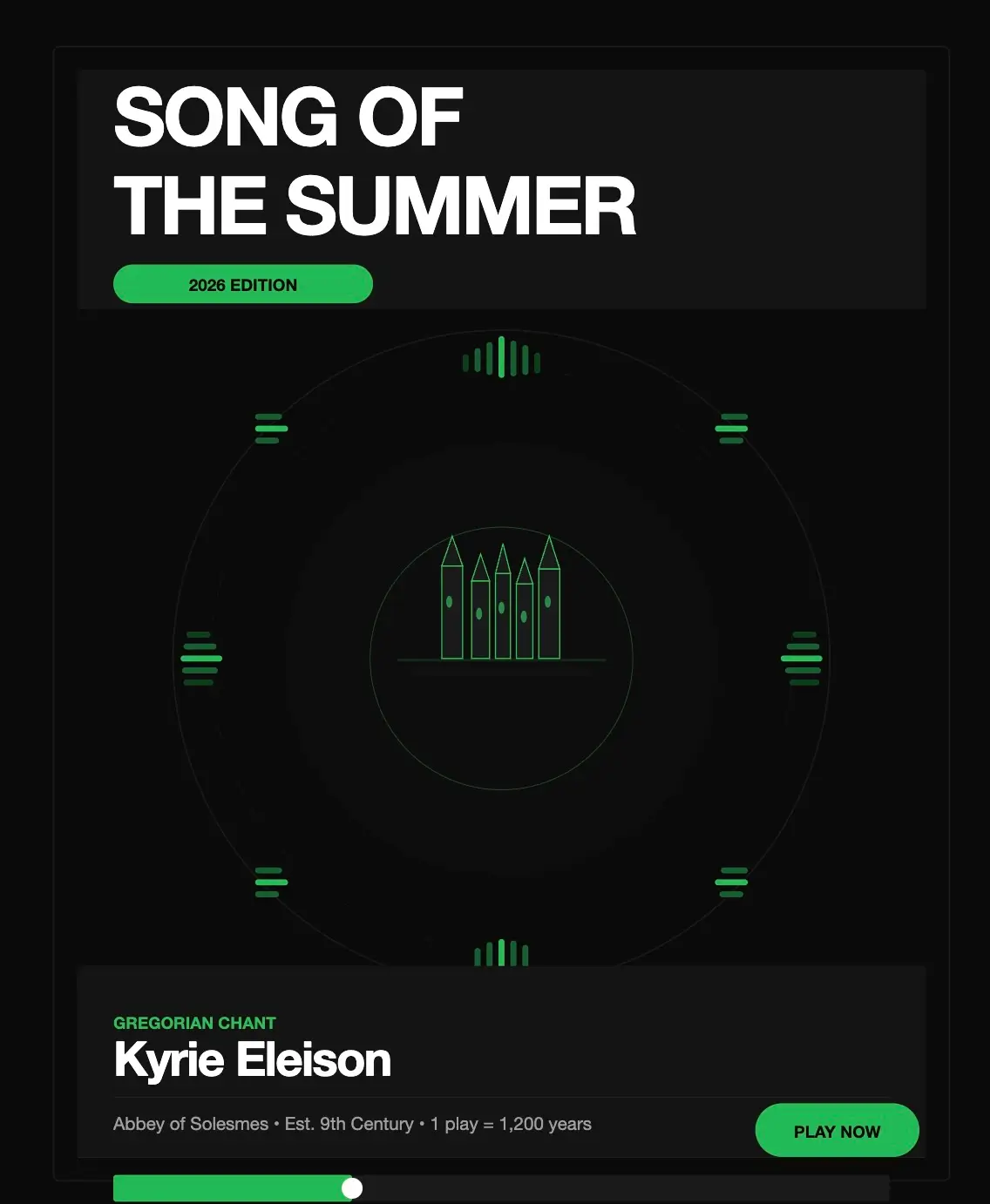
We read this news and felt, as the monks of Cluny once felt upon hearing the divine office, a trembling sense of vocation. If nostalgia is what the people want — if they will scroll past the algorithmic new releases and the machine-made pop confections to find the battered comfort of the familiar — then we say: do not stop at a decade. Do not stop at two. Follow the yearning to its logical conclusion, through the mists of modernity, past the crackle of early radio, beyond the first scratched cylinder recording, all the way back to the cold stone corridors of ninth-century monasteries. The song of the summer 2026 should be a Gregorian chant.
stir
Every summer spawns its appointed song. The process has become almost liturgical in its own right: a breezy track emerges from some poolside session, catches fire on short-form video, and for three months becomes acoustically inescapable — at grocery stores, rooftop bars, and the earbuds of strangers on the subway. Then it is gone, replaced by next summer’s hymn, and the cycle begins anew.
View this post on Instagram
But the listeners, it seems, have grown weary of the cycle. The Spotify numbers are not merely a statistic; they are a confession. People are admitting, through the anonymous testimony of the play button, that the present is exhausting and the past is warm. They are listening to what their older siblings played in college, what their parents slow-danced to at weddings, what they themselves first heard in the backseat of a station wagon twenty years ago. Nostalgia, that bittersweet ache, has become the dominant aesthetic of the streaming age.
And yet the nostalgia being peddled is timid. A twenty-year-old pop song is not ancient. It was recorded in a climate-controlled studio with Pro Tools and session musicians drinking bottled water. It has production credits and publishing rights and a Genius annotations page. It is, in the grand sweep of human music-making, practically brand new. We can do better. We can go further.
flow
Gregorian chant — named, somewhat loosely, for Pope Gregory I, though the tradition both predates and postdates his pontificate — is a body of monophonic sacred music that served as the soundtrack of Western European religious life for centuries. It is unmetered, or rather it follows the natural rhythm of the Latin text rather than the steady beat of a drum. It is, famously, unaccompanied — no guitars, no bass, no synthesizers, just the human voice rising through vaulted stone and candlelight. It is the ancestor of every melody you have ever heard in the Western tradition, the primordial soup from which Palestrina and Bach and eventually the entire pop canon emerged.
It is also, objectively, very good. The “Kyrie” from the Missa de Angelis hangs in the air with a gravitas that no amount of reverb plugin can replicate. The “Lux Aeterna” dissolves time. The “Salve Regina” makes even confirmed atheists sit quietly for a moment and reconsider their certainties. There is a reason these melodies survived in living use for over a thousand years, long after most of the literature, fashion, and political arrangements of their era had crumbled to dust.
scope
The skeptic will object on rhythmic grounds. Summer songs, the argument goes, require a beat. You cannot dance to Gregorian chant at a rooftop party. You cannot blast it from a convertible with the windows down. Its tempo is glacial, its mood contemplative, its Latin text requiring a degree of know commitment that the average poolside playlist listener may not possess.
To this we say: have you considered that this is, in fact, the point? The summer of 2026 is a summer in which people are voluntarily retreating from the new, from the loud, from the algorithmically optimized. They are choosing songs that existed before their own lifetimes, songs with the patina of age and use. Gregorian chant takes that impulse to its ecstatic extreme. A song that existed before the printing press, before the nation-state, before the concept of intellectual property — this is not a nostalgia trip. This is a pilgrimage.
Moreover, the danceability argument underestimates the versatility of the form. “Dies Irae,” the great medieval sequence describing the Day of Wrath, has already appeared in the soundtracks of The Lion King, the Shining, and dozens of action films. Its eight descending notes constitute perhaps the most recognizable motif in Western music outside of Beethoven’s Fifth. The bones of chant are everywhere; we are merely proposing that we acknowledge the source material.
hx
One might assume that chant would find no audience in the era of algorithmic discovery. One would be wrong. The Abbey of Santo Domingo de Silos, a Benedictine monastery in rural Spain, released a chant album in 1994 that sold over six million copies worldwide and spent more than two years on the Billboard charts. It arrived during a period of acute culture anxiety — the Cold War had ended, the internet was nascent, people were uncertain — and the market responded to the offer of something ancient and still.
Sound familiar? The anxieties of 2026 make 1994 look positively serene. If one-in-three streams is already a decade-old song, the audience for something twelve centuries old is merely waiting to be found. The monks are still there. The Abbey of Solesmes in France, custodians of the scholarly chant revival since the nineteenth century, has produced recordings of luminous quality. The monks of Heiligenkreuz in Austria went viral in 2008. The infrastructure for a chant renaissance exists; only the culture permission is lacking.
theory
Spotify’s recommendation engine, that invisible hand that guides so many listening hours, is a creature of behavioral pattern. It notes that you played “Creep” three times on a Tuesday and deduces that you are, perhaps, a person of melancholy disposition who might enjoy other brooding guitar music from 1992. Scale this logic outward. If the platform’s most nostalgic year is defined by a hunger for the past, the algorithm should, in good conscience, be willing to reach back further than it currently does.
We envision a Spotify mood category called “Pre-Millennium” — not the Y2K nostalgia of 2015, but the genuine article, stretching back past the Renaissance madrigal, past the troubadour, past the organum, to the clean monophonic line of plainchant. There could be a “Deep Time” playlist. There could be a “Before Notation Existed” category, though that raises its own editorial challenges. At minimum, the Missa de Angelis deserves to sit alongside “Dreams” by Fleetwood Mac in the “chill throwback” vertical. Both are, in their way, songs about yearning for something that cannot quite be recovered.
fin
In the end, the case for Gregorian chant as song of the summer 2026 is the same case the listeners are already making with their play counts: the past offers something the present cannot. Not escape, exactly, but perspective — the knowledge that human beings have been singing through their confusion and grief and joy for a very long time, that the need to make music preceded the recording contract and the streaming royalty and the viral moment. When a monk in ninth-century France opened his mouth in the pre-dawn dark and chanted a phrase that had no composer, no copyright, no radio play — he was doing something that a person in 2026, headphones on, commuting toward whatever this year holds, is still doing. Reaching for something larger than the moment. That, in the end, is what summer songs are for.
Related Articles
Two Chicago Lifers, One Wave: Kaicrewsade and Luke Titus on ‘#SWAG SURF’
Kaicrewsade's new album RAINBOW_ arrived on October 14, and its second track pulls in Chicago drummer and singer Luke Titus.