DRIFT AUDIO
Listen to this story
Choose a voice, then press play.
In the Gothic pithy of the Hudson Valley, shrouded by a permanent fog and whispered legend, stands Nevermore Academy—a place where outcasts are not just accepted but celebrated, honed, and sometimes feared. This isn’t the kind of prep school that earns glossy spreads in Ivy League brochures or boasts lacrosse championships. No, Nevermore is a haven for the peculiar, the magical, and the morbidly gifted—a place for seers, sirens, gorgons, and werewolves. But perhaps its most famous student isn’t a creature of myth at all. She’s flesh and blood, braids and black—Wednesday Addams, the daughter of darkness.
This is not the Addams Family’s pastiche of cobweb-covered nostalgia. It is a reawakening. Through the lens of Wednesday’s arrival, Nevermore becomes more than a school for the strange; it becomes a mirror to society’s deepest discomfort with difference. To attend Nevermore is to willingly abandon normalcy, to sharpen the tools of defiance, to embrace the romantic poetry of alienation. And Wednesday, with her chilling wit and psychic unease, makes the perfect guide through its hallowed and haunted halls.
The Invitation
The journey to Nevermore begins not with an acceptance letter, but with an incident—an act of unrepentant rebellion against the banal rules of the outside world. For Wednesday, it was a piranha-filled pool at her former school and a brother bullied once too often. Her expulsion became her emancipation. Nevermore did not just tolerate her vengeance; it admired her style.
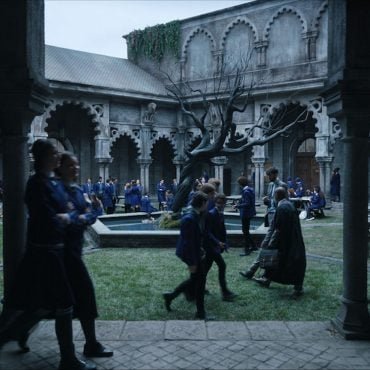
The academy is cloaked in gray stone and gothic filigree, framed by claw-like trees that never quite lose their leaves. The iron gates squeal like tortured violins. Within, students drift between disciplines like wraiths—alchemy, fencing, botanical manipulation, divination. Here, academia meets the arcane. Unlike typical high schools, Nevermore demands no assimilation. Individuality is sacred. Oddity is currency. The very walls of the school seem to hum with secrets, as though the building itself is a living, breathing outlier.
Lessons in the Macabre
To attend Nevermore with Wednesday Addams is to sit beside her in a classroom where Edgar Allan Poe is not just studied but exalted. The Poe Cup—an annual challenge of brains, brawn, and betrayal—echoes through the academy’s blood-stained traditions. It’s more “Battle Royale” than debate club. And yet, the students understand the stakes. To survive Nevermore is to understand that peril is part of the pedagogy.
Wednesday herself is not merely a student; she is a seer whose visions intrude like shards of lightning. These aren’t the romanticized clairvoyances of fantasy novels—they are violent, volatile bursts of insight that leave her trembling and pale. Her psychic gift becomes both compass and curse, dragging her into the abyss of a mystery older than the academy itself. Ghosts are not the scariest thing at Nevermore; legacies are.
In biology, she dissects not frogs but reputations. In fencing, she lunges not for medals but for motives. She unravels conspiracies between chemistry classes and cello recitals. Each interaction, each slow turn of her stare, burns through pretense like acid.
Solitude and Sympathy
Despite her disdain for company, Nevermore forces Wednesday into communion—with her pastel-wearing werewolf roommate Enid, with the complicated boys who hover on the edge of menace, and with the living archive of teachers who have seen enough prophecy to fear it. The genius of Nevermore is that even the most alienated must eventually contend with proximity. There are no shadows deep enough to disappear in forever.
Enid, the counterbalance to Wednesday’s funeral monochrome, teaches a lesson beyond sorcery: that empathy, no matter how obnoxiously colorful, is a form of resilience. Their odd-couple dynamic becomes a metaphor for co-existence in a fractured world. Tolerance isn’t just inclusion—it’s endurance.
But it is in her moments alone, writing macabre fiction by candlelight or practicing cello under moonlight, that Wednesday becomes most magnetic. She isn’t trying to be understood; she’s trying to understand the world through a prism no one else dares peer into. Her truths are laced with venom, but also with clarity.
The Curse of Legacy
Nevermore is stitched together by the histories of families like the Addamses—unorthodox, accused, persecuted, powerful. Wednesday’s arrival is not incidental; it is predestined. Her parents, Gomez and Morticia, once stalked these halls, carved their initials into its stone walls, and enacted the same rituals of rebellion and romance.
Yet Wednesday rejects this inheritance. She is not content to play out her mother’s storyline or wear her father’s smirk. She claws at the very foundations of the institution, unearthing its buried sins, challenging the convenient myths of good and evil.
It is here, in this narrative rebellion, that Nevermore becomes more than a setting—it becomes a theater of contradiction. It promises sanctuary but hides monsters. It encourages independence but reveres bloodlines. And it must be dismantled before it can be reborn.
The New Gothic Heroine
To attend Nevermore alongside Wednesday is to witness the evolution of a Gothic heroine who does not faint but fights. Her stoicism is not performative; it is forged in a furnace of constant scrutiny and isolation. She wields language like a dagger, humor like poison. And yet, she is not without vulnerability. Her loneliness is palpable, even when disguised by disdain. Her anger is righteous, even when expressed with surgical coldness.
The age of pastel-colored protagonists is over. Wednesday is the heroine of the algorithmic age—dark, analytical, skeptical of institutions, and yet compelled by justice. She does not dream of prom dresses or popularity. She dreams of unsolved murders and the entropy of human behavior.
The show, as imagined by showrunners Alfred Gough and Miles Millar and laced with Tim Burton’s visual surrealism, distills this ethos with precision. The world around Wednesday is strange, yes, but it’s her unwavering sense of self that makes it bearable. In a society addicted to reinvention, Wednesday clings to identity like a blade.
What It Means to Belong
Nevermore, in the end, is a metaphor for the places we create when we cannot find our place in the real world. It’s the dorm room where queerness feels unthreatened. The desk where a neurodivergent student maps stars instead of math problems. The moment when introversion stops being shameful and starts being sacred. And Wednesday is the patron saint of this pantheon. She gives permission to those who refuse to perform joy for the comfort of others. She finds power not in approval, but in authenticity.
To enroll at Nevermore is to accept that life will not be easy, nor fair, nor particularly welcoming. But it will be yours. It will be peculiar and poetic and, if you are brave enough, filled with meaning. Wednesday’s journey shows that power comes not from being liked, but from being undeniable.
Ideologue
The final bell at Nevermore never really rings. Its lessons linger—inscriptions on tombstones, notes in the margins of a poisoned diary. Attending with Wednesday is not a one-season affair; it’s an awakening. We carry her with us, in eyeliner and in eye rolls, in deadpan truths and undying loyalty.
And so, as you pass through the gate and the mist envelopes you, ask yourself not what kind of student you were, but what kind of monster you were brave enough to become. Because at Nevermore, monsters aren’t hunted—they graduate with honors.
For related context, see Wednesday Addams and The Thing Bring the Crocs Stomp Clog to Life: A Dark and Whimsical Fashion Connection.
Drift has also covered The Paradox of Pop Culture Outsiders: How Wednesday Addams Became the Icon She Would Despise.
Related Articles

Ten Bags Sitting In The Same Week As The Shows
Pearl egg. Fringe mini. Kelly Doll. Holdall. Pigeon. Speedy. Alex tote. Aluminum case. Cassandre pouch. […]