DRIFT AUDIO
Listen to this story
Choose a voice, then press play.
Dolly Parton’s biomusical heads to the St. James Theatre this December, with an opening night timed to land on her 81st birthday.
recall
- The Broadway Dates
- From Nashville Premiere to Broadway Transfer
- The Story: A Biomusical Told in Her Own Words
- The Songs and the Creative Team
- Parton’s History with Broadway
- What’s Still Unknown: Casting and Beyond
- Tickets and How to See It
- Why This Run Matters
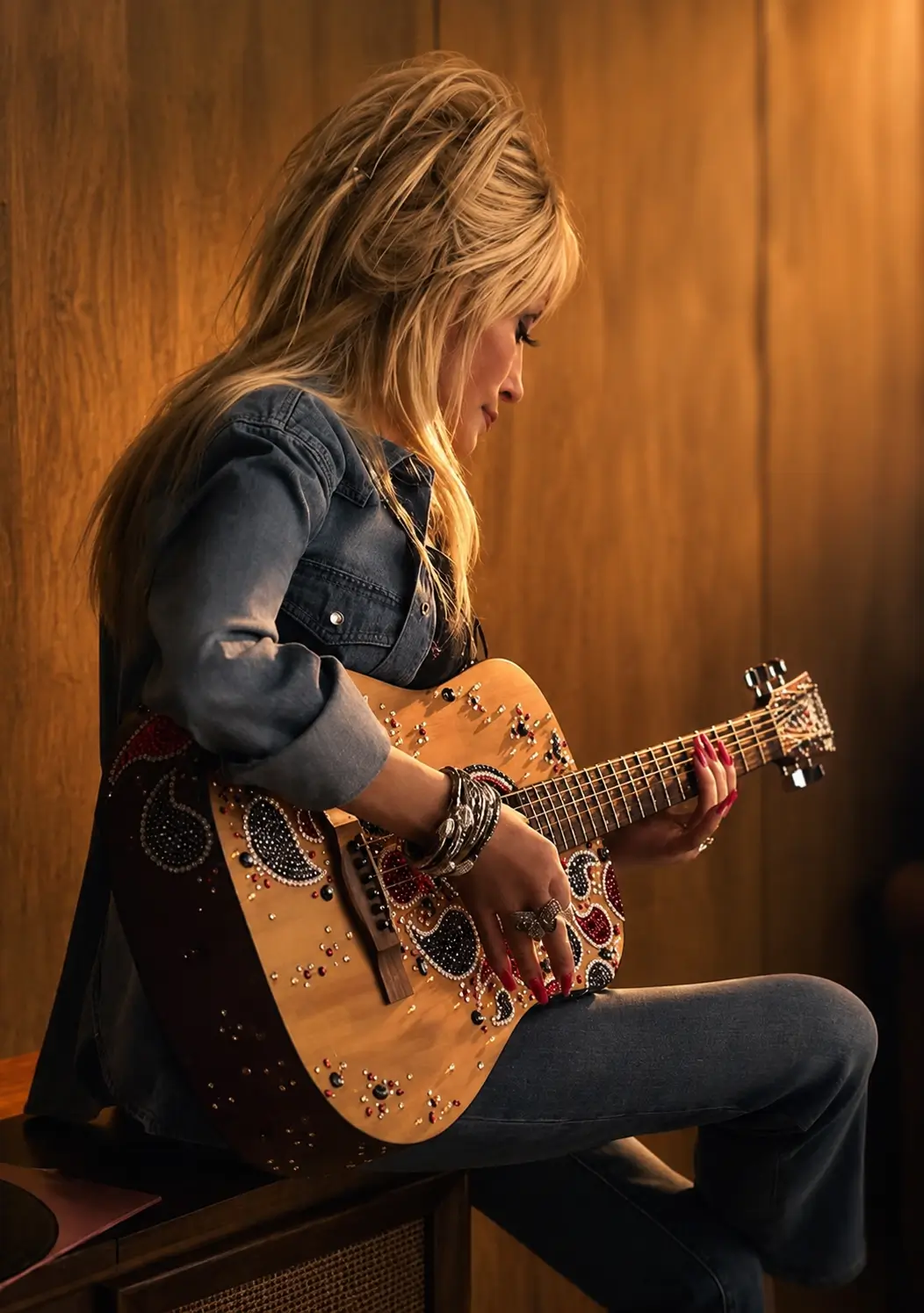
DOLLY: A True Original Musical will begin preview show at Broadway’s St. James Theatre on December 7, ahead of an official opening night on January 19, 2027 — a date the production has deliberately timed to coincide with Dolly Parton’s 81st birthday. The show takes over the St. James from Titanique, which is currently scheduled to close in September, clearing the venue in time for the new production’s arrival.
The musical previously ran under a slightly different title, Dolly: An Original Musical, during its world premiere at Nashville’s Fisher Center for the Performing Arts on the campus of Belmont University in the summer of 2025. That Nashville run — which opened in August 2025 after a run of previews starting in July — sold out its original engagement and was extended from four weeks to six in response to demand, before closing at the end of August.
View this post on Instagram
otw
The Broadway production arrives with much of its Nashville creative team intact. Tony Award winner Bartlett Sher, who directed the world premiere, returns to direct the New York run, and choreographer Mandy Moore continues in her role as well. The production is helmed on the producing side by Parton herself alongside Danny Nozell, Adam Speers for ATG Productions, and Gavin Kalin Productions.
That continuity between the Nashville and Broadway versions of the show is notable in an industry where pre-Broadway tryouts often see significant creative turnover before a New York transfer — new directors brought in to punch up pacing, choreographers swapped out, or entire creative teams reshuffled based on out-of-town reviews. Keeping Sher and Moore in place, along with much of the design team, suggests the production’s backers were satisfied enough with the Nashville version’s fundamentals that the Broadway run is being treated more as a refinement and scale-up of an already-working show than a ground-up reconception.
In a statement, Sher described being struck by how deeply audiences connected with Parton during the Nashville run, noting that she has never fully told her own story before and that the musical lets her do so in her own words. Producer Adam Speers, who has also worked with Parton on the West End revival of 9 to 5, framed the Broadway transfer similarly, tying the January opening date to “a life shaped by generosity, courage, and purpose” that he described as feeling essential in this moment.
narr
The musical charts Parton’s life from her childhood in the Smoky Mountains of East Tennessee through her rise to global stardom, structured as a first-person account rather than a conventional jukebox biography assembled by outside writers. Parton has said in press statements that she wanted to oversee her own life story being told on stage while she’s still able to shape how it’s presented, rather than leaving that task to others after the fact.
The show is scored entirely with Parton’s own music — a mix of her most widely known hits alongside new songs written specifically for the production. Confirmed numbers in the current score include “I Will Always Love You,” “Jolene,” “Coat of Many Colors,” and “9 to 5,” alongside additional new material Parton has written to fill out the narrative. The book is co-written by Parton and Maria S. Schlatter, an Emmy-winning writer who previously worked with Parton on the TV film Christmas on the Square.
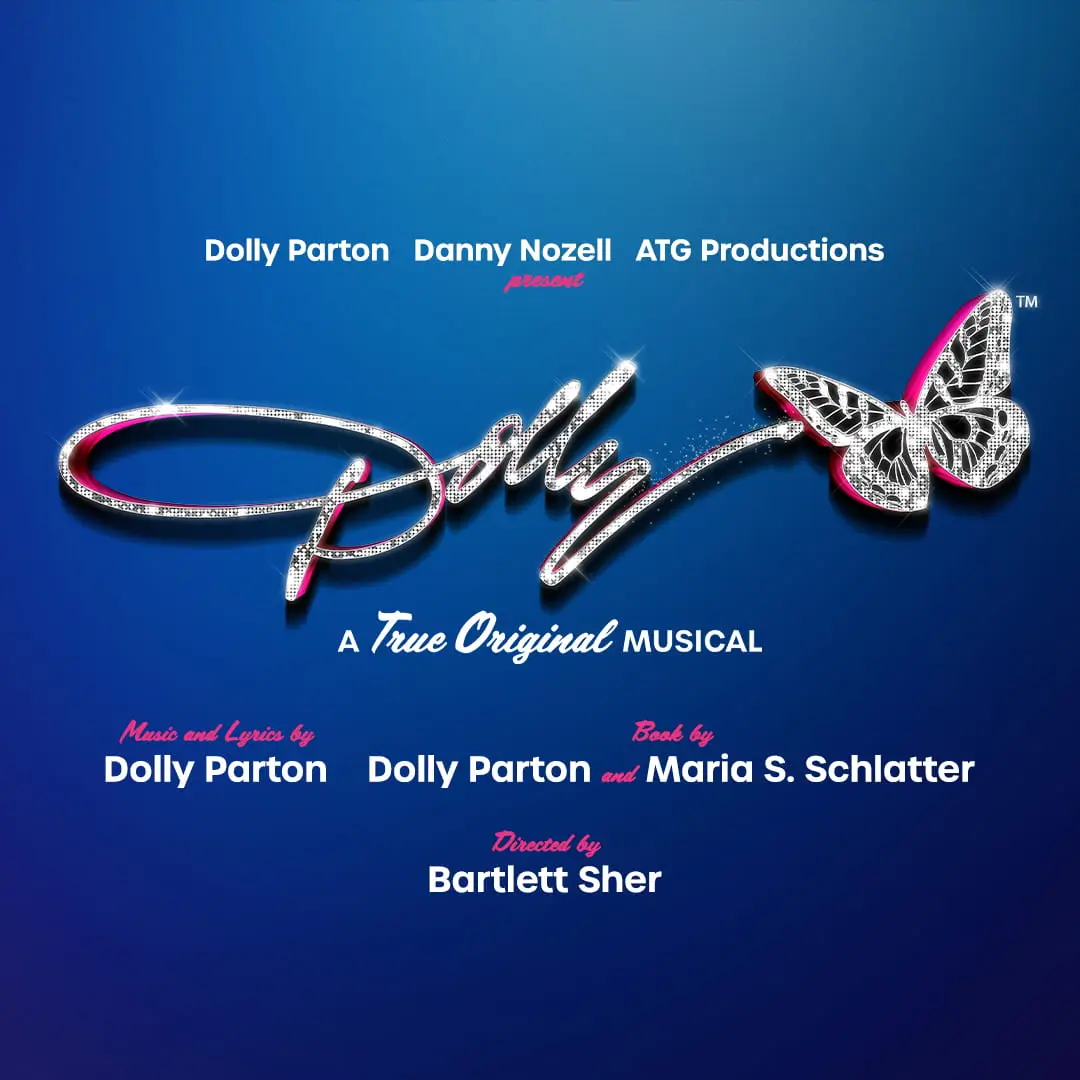
Official promotional artwork for Dolly: A True Original Musical, highlighting the show’s signature butterfly logo and creative team, including Dolly Parton, Maria S. Schlatter, and director Bartlett Sher.
In her own statement announcing the Broadway transfer, Parton described the show as being about where she really comes from — what she’s lived, lost, and loved — rather than a story built purely around spectacle. That framing has been echoed across the show’s marketing, which has consistently drawn a distinction between Parton’s glamorous public image and the more personal material the musical is built around.
That distinction matters given how closely Parton’s public persona has historically been tied to a very deliberately constructed image — one she has spoken about shaping intentionally over decades, down to the wigs, the rhinestones, and the exaggerated glamour she’s often said was inspired by a “town tramp” she admired as a child growing up poor in rural Tennessee. A show built around her own account of that journey, rather than a surface-level jukebox retrospective of her hits, gives the production a different task than most celebrity biomusicals: it has to reconcile the built persona with the more private story underneath it, using her own songs as the connective tissue between the two.
muse
Behind the scenes, the production’s music team draws heavily on people who have worked with Parton for years. Stephen Oremus, known for his music supervision work on Wicked, serves as music supervisor, with Charity Wicks as music director and John Clancy handling orchestrations. Kent Wells, a longtime Parton collaborator, serves as musical consultant, while Richard Dennison and Gregg Perry — two other longtime members of Parton’s musical circle — share vocal and music arrangement duties. Between the three of them, Parton, Dennison, and Perry have reportedly worked together on her music for close to a century combined, giving the show’s sound a continuity with her recorded catalog rather than a reinterpretation by unfamiliar arrangers.
The design side of the production is similarly stacked with Broadway veterans: scenic design comes from Tony winner Derek McLane, costumes from Jennifer Moeller, lighting from Tony winner Donald Holder, sound from Tony winner Peter Hylenski, and video design from Nathan Amzi and Joe Ransom, with hair and makeup design handled by Robert Pickens and Studio Pickens, respectively.
hx
This marks Parton’s second Broadway credit. Her first, 9 to 5: The Musical, adapted the hit 1980 film and opened on Broadway in 2009, where it ran for roughly six months before going on to further life on London’s West End and on U.S. and U.K. tours. Unlike that production, which set songs to an existing film narrative written by other screenwriters, DOLLY is built from the ground up as Parton’s own account of her life, co-written by her rather than adapted from prior source material.
Parton has said in prior press statements around the show’s development that she has long wanted to see her life told as a musical, and that doing it now, while she’s able to guide the process directly, mattered more to her than waiting. That framing has shaped how the production has been marketed throughout its development — less as a jukebox tribute act built around her catalog, and more as an authorized, first-person account she has had direct creative control over from the book through the score.
extent
No casting has yet been confirmed for the Broadway production. In Nashville, the role of Dolly was split across three actresses — Katie Rose Clarke, Carrie St. Louis, and Quinn Titcomb — each playing Parton at a different stage of her life, alongside additional cast members added during the Nashville run through a national open-casting search the production called “Search for Dolly.” Whether that same three-actress structure, or the same performers, will carry over to Broadway has not been announced, with casting and additional creative team details expected in the coming weeks.
The Broadway run also arrives at a moment when Parton’s own live performing has been more limited than usual. She announced in May that she was canceling a planned Las Vegas residency due to ongoing health issues, saying at the time that she had been responding well to treatment but that the medication left her feeling less steady on her feet — not an ideal state, by her own account, for a performer known for wearing five-inch heels on stage. For the time being, the Broadway musical stands as one of the more direct ways for audiences to experience her story and music live, alongside “Dolly Parton’s Threads: My Songs in Symphony,” a separate touring production featuring guest vocalists interpreting her catalog.
That context adds a layer of significance to the show beyond its own merits as a piece of theater. With a planned residency shelved and her own touring schedule scaled back, a Broadway production she co-wrote and has actively shaped becomes one of the clearest remaining vehicles through which audiences can engage with her story on a stage, even without Parton herself performing in it nightly. It’s a distinction the production’s marketing has been careful about: this is a musical inspired by and co-written with Parton, played by other performers portraying her at different ages, rather than a one-woman show or concert residency built around Parton appearing in person.
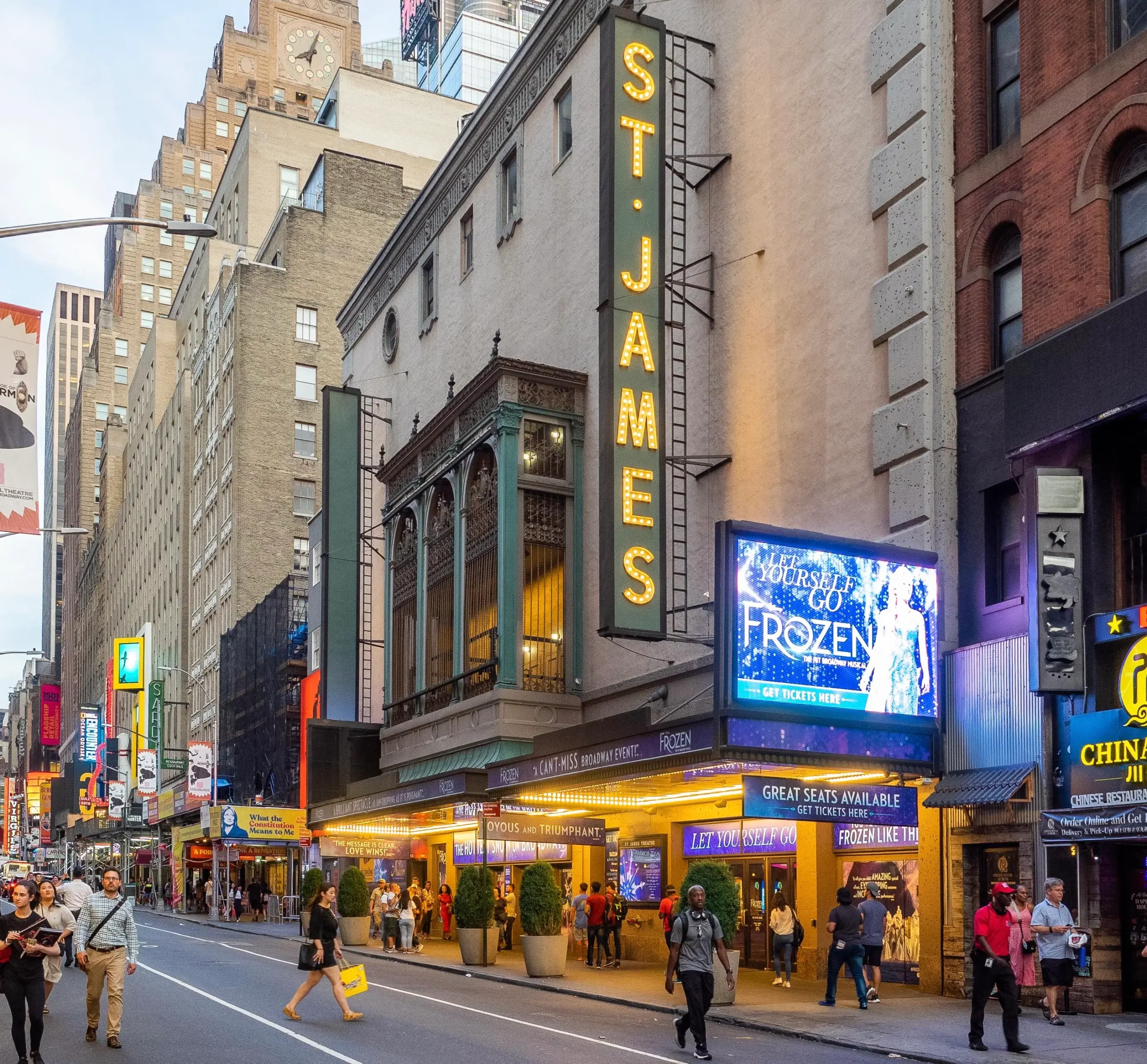
Street-level exterior of Broadway’s St. James Theatre, showcasing its iconic marquee, restored architectural details, and lively Theater District atmosphere along West 44th Street in Manhattan.
avail
A ticket presale for fans who register at DollyMusical.com, along with eligible Capital One cardholders, opened this week, ahead of a general on-sale to the public. Performances are currently listed as available through November 2027, giving the show more than a year of scheduled dates from its December opening. The St. James Theatre, where the production will play, is located in the heart of Broadway’s Theatre District and has previously hosted long runs of major musicals throughout its history.
why
For a performer whose career has spanned country radio, film, television, theme parks, and philanthropy, a self-authored Broadway biomusical represents a different kind of milestone than a hit single or a box-office run — a chance to control the frame of her own life story on one of the most view stages in American entertainment, rather than leaving that account to biographers or documentarians. Opening on her 81st birthday adds a symbolic weight to the timing that the production’s own marketing has leaned into directly, treating the date less as a coincidence and more as the point of the whole undertaking.
Whatever the eventual reviews, the sheer density of Broadway veterans working on the show — a Tony-winning director, a Tony-winning music supervisor, and design leads with multiple Tony wins between them — signals that this isn’t being treated as a vanity project built around a beloved catalog of songs. It’s being staged as a full-scale Broadway production in its own right, timed to a date that turns opening night into something closer to a public celebration of Parton herself than a conventional theater premiere.
There’s also a commercial dimension worth watching. Jukebox-style biomusicals built around a single artist’s catalog have had a mixed track record on Broadway in recent years — some have become long-running hits, while others have closed quickly despite strong brand recognition going in. What sets this production apart from a typical jukebox show is the degree of direct authorial control: Parton co-wrote the book herself rather than licensing her catalog to outside writers building a story around it after the fact, and she’s held creative oversight from the Nashville tryout through the New York transfer. Whether that hands-on approach translates into a show that resonates as a piece of theater, independent of the built-in audience goodwill toward Parton herself, will likely be one of the more closely watched questions once reviews start coming in after the January opening.