Eyes on the City: Facial Recognition, Art, and Youth Resistance in Palestine

June 30, 2025
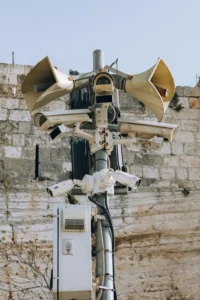
In the labyrinthine streets of East Jerusalem and across the vibrant avenues of Ramallah, a new form of silent warfare unfolds daily. A constellation of facial recognition cameras looms above bustling markets, ancient stone archways, and the intimate alleyways of Palestinian neighborhoods. Installed ostensibly for “security,” these technological eyes are less about crime prevention and more about control—reconfiguring public space into a web of surveillance that pierces the very soul of Palestinian life.
In 2021, these cameras stood as watchful sentinels near the Old City of Jerusalem, mapping faces with cold precision. To outsiders, they may appear as mere infrastructure, another modern convenience for a digitally reliant age. But to Palestinians, they represent an unblinking reminder of their constant monitoring, a technological extension of a decades-long occupation.
Unlike the limited use of facial recognition in Western airports or shopping malls, in Palestine, the stakes are existential. A full biometric scan is not simply an optional pass through expedited security; it is mandatory for nearly every aspect of movement and existence. Upon applying for a permit to seek medical treatment, to pray at Al-Aqsa Mosque, or to dip a toe in the Mediterranean Sea, Palestinians must submit their most intimate data to a system designed to track and limit their bodies.
The number of CCTV cameras across the West Bank, particularly in East Jerusalem, is deliberately opaque. Hundreds are known to exist, concentrated in Palestinian neighborhoods rather than Israeli settlements. This distribution pattern reveals the true function of these devices: not universal safety but targeted domination. Surveillance becomes a performance of power, converting public squares into stages for unending observation.
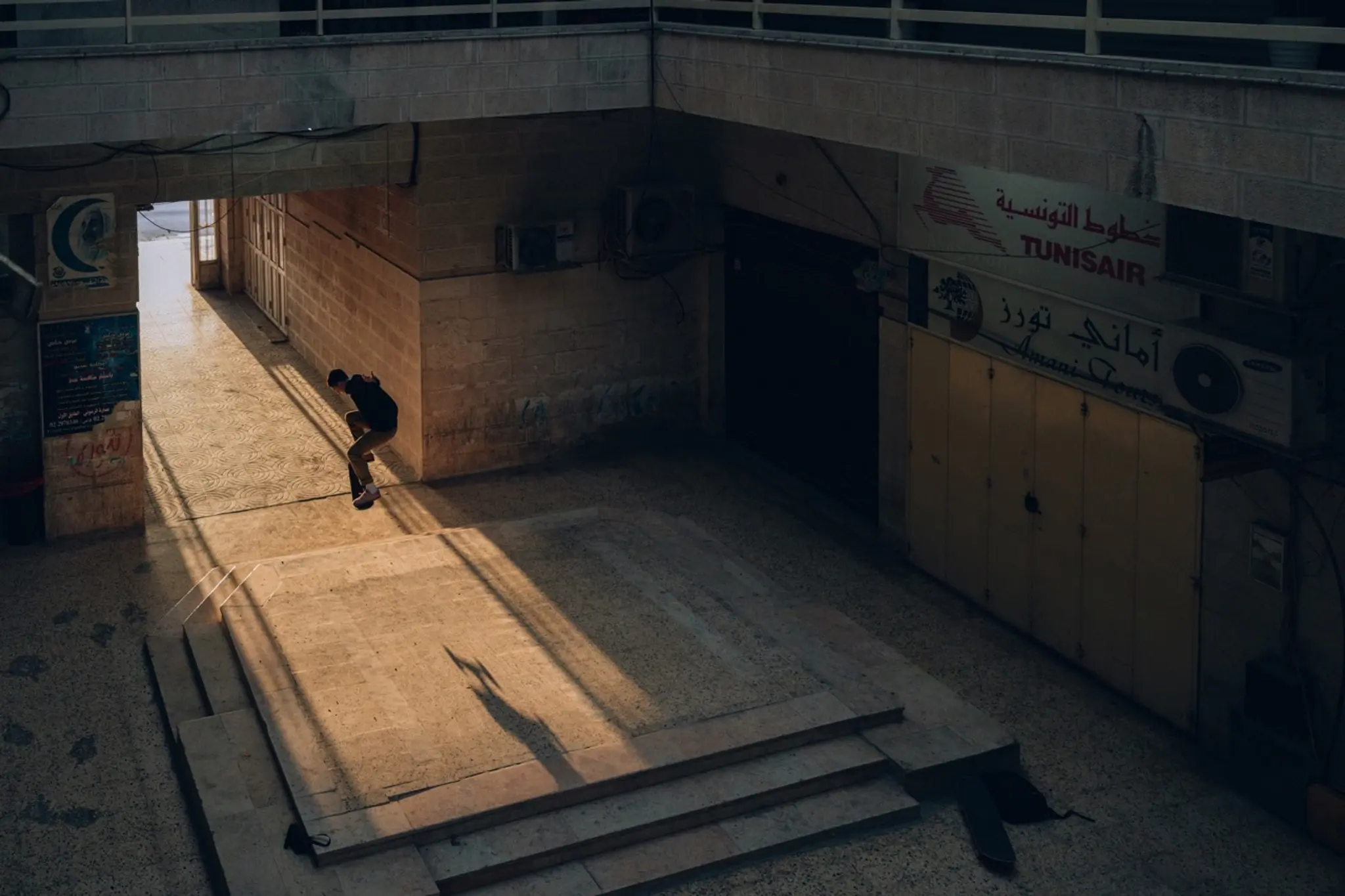
Amid this landscape of technological oppression, a different narrative pulses through the veins of Ramallah. Photographer Hammad offers us a counterpoint to the cold gaze of cameras. His first monograph, Landing, created in flows with designer Roï Saade and published by Huwawa Books, acts as an intimate visual diary of Palestinian youth—particularly those carving freedom on four wheels through the city’s uneven sidewalks and abandoned lots.
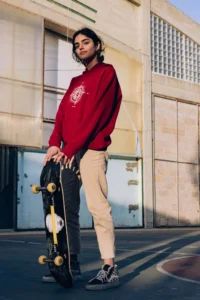
Hammad’s journey to Landing began long before its formal conception in 2020. Abandoning what he called “the American Dream,” he returned to Palestine not as an exile yearning for nostalgic fragments, but as a witness to the living, breathing present. From 2015 onward, Hammad immersed himself in the daily rhythms of Ramallah, befriending young skaters like Aram, Kareem, Kilani, and Zaina. These portraits formed the emotional backbone of Landing.
The young skaters of Ramallah embody an unorthodox form of resistance. In the simple act of skateboarding—an activity that might seem trivial or purely recreational elsewhere—they claim fleeting sovereignty over their movement and bodies. As Hammad poignantly observes, “Skateboarding gives Palestinians this moment of escape in the midst of colonial violence from the Israeli régime. For that hour or two with your friends, you’re free. You can build a crew and have that process of creating together, as opposed to being fragmented and ripped apart in the way that the occupation tries to do to us psychically.”
This ephemeral freedom is fragile. During the 2021 uprising—known as the Uprising of Dignity or Unity Intifada—skateboards were set aside. The youth confronted police stations in cities like Akka, Haifa, and Lydd, channeling their collective frustration into acts of defiance. In these moments, the camera’s role was twofold: as an oppressive surveillance tool and as a documentary witness. The same lenses that record joyous ollies on a dusty Ramallah street also catalog faces for future interrogation.
The duality of cameras—both artistic and authoritarian—runs through every page of Landing. Zaina, one of the book’s featured skaters, is captured not as an object of pity or victimhood, but as a radiant testament to possibility. Her portrait vibrates with life, a stark antithesis to the mechanical eye of surveillance devices. In her posture, viewers sense a grounded strength; in her gaze, a quiet challenge to the observer.
Hammad’s work refuses to exoticize Palestinian suffering. Instead, he insists on portraying Palestine as a lived reality rather than an abstract political symbol. This is particularly powerful given the tendency in global media to flatten Palestinian identity into a singular narrative of despair. Landing resists this reduction, presenting a tapestry woven from laughter, rebellion, boredom, tenderness, and the raw adrenaline of late-night skate sessions.
The artistic lineage of Landing can be traced back to documentary traditions, yet it also pulls from contemporary photography movements that blur the line between documentary and personal essay. Photographers like Nan Goldin and Larry Clark have long used their cameras to explore subcultural intimacy, focusing on lives often relegated to the margins. Hammad extends this tradition, situating it within the uniquely Palestinian experience of existence under occupation.
At the same time, Landing taps into a global conversation around surveillance and biometric data. The proliferation of facial recognition technology worldwide has sparked intense debates about privacy, civil liberties, and the future of human agency. From London’s ubiquitous CCTV network to China’s facial recognition checkpoints, governments everywhere are racing to normalize total visibility. Palestine represents an extreme, dystopian endpoint of these trends—a chilling preview of where unchecked surveillance can lead.
Artists and activists across the globe have started to respond creatively to this encroachment. In New York, artist Trevor Paglen has worked on facial obfuscation techniques. In Berlin, hacker collectives design anti-surveillance fashion that confuses camera algorithms. In Seoul, performers experiment with masks and facial projections to reclaim bodily autonomy in monitored public spaces. Hammad’s photography slots into this global movement, offering an image-based critique while simultaneously celebrating the micro-rebellions that make life under surveillance bearable.
The design of Landing by Roï Saade further reinforces this tension. The layout alternates between full-bleed portraits and fragmented vignettes, echoing the ways surveillance parses and manipulates identity. Just as surveillance networks reduce people to data points, Saade’s design reassembles them as nuanced human stories. The book’s tactile quality — grainy textures, layered paper stocks, handwritten elements — reclaims a sense of material intimacy lost in digital surveillance ecosystems.
In recent years, the resurgence of skateboarding as a cultural force in Palestine mirrors wider global trends. Skateboarding has historically been associated with counterculture and nonconformity. In Palestinian cities, where public space is frequently contested and militarized, skateboarding becomes an act of spatial reclamation. Each kickflip is a small declaration that Palestinians, despite external pressures, refuse to be still.
The juxtaposition of these two elements — omnipresent surveillance and youthful skate culture — creates a powerful narrative tension. Cameras monitor every intersection, yet the skaters keep moving, carving ephemeral lines of freedom that vanish as quickly as they appear. In this delicate dance, the Palestinian youth embody an ancient truth: joy itself can be a form of resistance.
Hammad’s approach as a photographer is non-intrusive, almost reverent. He walks the streets at all hours, blending into the fabric of daily life rather than imposing an external frame. His subjects are collaborators rather than passive models; their stories shape the image as much as the lens does. This methodology stands in stark contrast to the faceless extraction of data by surveillance cameras, which seek to catalogue rather than understand.
Ultimately, Landing is more than a photography book. It is an argument against erasure, a collective diary, and a love letter to Palestinian youthhood in all its contradictions. It insists that even in spaces of profound oppression, life persists in unpredictable, vibrant, and utterly human ways.
Through Hammad’s lens, Palestine is not just a place of checkpoints and barriers but also of friendships, late-night laughter, improvised skate ramps, and the enduring belief in a shared future. The book becomes a counter-surveillance device in itself — an archive that witnesses without objectifying, that records without dehumanizing.
As surveillance technologies continue to expand globally, the lessons embedded in Landing resonate far beyond Palestine. The struggle for privacy, freedom of movement, and the right to simply exist without constant observation is increasingly universal. By centering Palestinian voices and experiences, Hammad offers a localized, deeply personal articulation of a global anxiety.
In the end, “Eyes on the City” — both as a literal condition and as a metaphor — challenges us to ask difficult questions about who watches, who is watched, and what is ultimately at stake when we surrender our visibility to systems of power. Through art, photography, and the irrepressible spirit of Ramallah’s youth, the contours of resistance come sharply into focus, reminding us that even in the age of biometric dominance, there remain pockets of freedom waiting to be claimed.
Related Articles

The Heart Association Just Told Millions of Coffee Drinkers to Relax a Little
New guidance from the American Heart Association says up to five cups a day is […]