DRIFT AUDIO
Listen to this story
Choose a voice, then press play.
In 2025, Mary Shelley’s legendary creation is born anew. Directed by Guillermo del Toro and distributed by A24, the upcoming film “Frankenstein” promises not merely another retelling, but a cinematic reckoning—a resurrection with sinew, sorrow, and synaptic terror. The trailer, which dropped to immense buzz in May, has set the stage for what might be the most psychologically resonant and aesthetically evocative adaptation yet. A fever dream in shadow and organ music, the Frankenstein (2025) trailer does not seek to inform, but to unnerve. And in doing so, it revives not just Victor’s monstrous progeny, but the full, unholy weight of Shelley’s original vision.
This editorial deconstructs the 2025 trailer frame by frame, context by context. From casting choices and visual motifs to its thematic signals and philosophical provocations, we’ll dissect what the trailer reveals—and what it intentionally withholds. Here, Frankenstein is not merely science fiction or horror; it is an aesthetic manifesto and a cultural barometer, a story of unnatural life in an increasingly unnatural world.
Casting the Cursed: The Reanimated Ensemble
The most immediate ripple across the cinematic world came from the cast itself. The trailer confirms a trinity of tortured souls:
- Oscar Isaac as Victor Frankenstein, the tormented creator who tiptoes across the divine.
- Jacob Elordi as the Creature, reimagined not as a mute brute, but a sensual, tragic specter of unwanted humanity.
- Mia Goth as Elizabeth Lavenza, embodying the duality of affection and fear, a Gothic muse caught between loyalty and dread.
Each actor comes with cultural weight. Isaac, fresh from cerebral sci-fi roles in Dune and Ex Machina, brings gravitas to Frankenstein’s God complex. Elordi, the breakout heartthrob from Saltburn and Euphoria, is weaponized here as a beautiful ruin—a tall, sculptural horror, whose stitched flesh barely conceals the ache beneath. Goth, already an A24 mainstay with Pearl and X, channels feminine fragility as a cracked mirror—adoring yet frightened, devout yet damned.
Together, they don’t form a traditional horror cast. They form a tragic opera, and the trailer wisely leans into that operatic aesthetic—less jump-scare, more chamber music for the soul.
Aesthetic Architecture: Shadows, Flesh, and Ruin
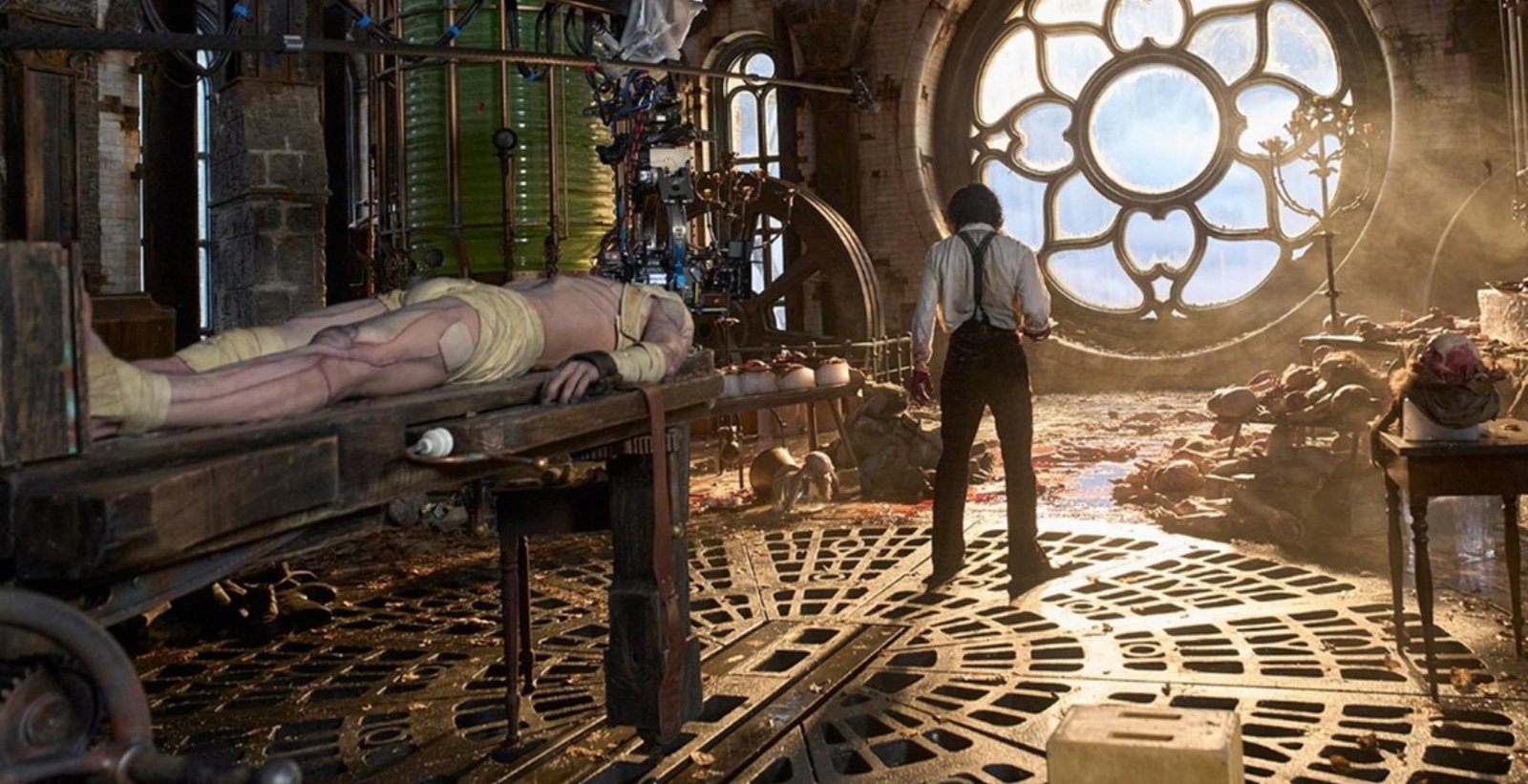
Del Toro’s Frankenstein does not drape itself in Victorian lace. Instead, the trailer paints a world that is both pre-modern and post-human—a liminal space of faded frescoes, lightning-lit laboratories, and collapsing cathedrals. Filmed largely in black and near-sepia, with moments of color bleeding through like open wounds, the palette is unmistakably Del Toro: lush decay, spiritual dread, and grotesque beauty.
From the opening shot—a crucifix shattering in reverse motion—we know this is not merely a tale of scientific hubris but one of spiritual inversion. The set design evokes the Eastern European ruins of war-torn faith, with laboratories nestled beneath stained glass windows and corridors flooded by candlelight and steam. The Creature is first glimpsed through fog, not roaring but trembling, wrapped in a monk’s robe, suggesting penitence as much as menace.
Every frame in the trailer behaves like a still-life painting: deliberate, mournful, and obsessed with texture—the granular decay of human ambition. It’s a film about bodies—sewn, desecrated, and sanctified. A tactile horror.
Voiceover as Invocation: Language and Lamentation
The trailer is narrated almost entirely in voiceover, beginning with a hushed incantation by Victor:
“What is a man, if not the sum of his acts and the shadows he casts?”
The line, original to the film, echoes Shelley’s philosophical underpinnings and reframes Victor not as a mere mad scientist but a fallen theologian, obsessed with essence and soul. We hear brief interjections from Elordi’s Creature, delivered in a tremulous, resonant whisper:
“I did not ask to be born. Yet I burn.”
The few spoken words in the trailer function as epitaphs, not dialogue. They’re elegies for the living and the damned alike. The absence of exposition is intentional—the trailer offers no explanation of origin, no chronological detail. Instead, it creates an atmosphere of accursed reverence, making the viewer feel like they’re being prayed to rather than marketed at.
The Monster as Mirror: Elordi’s Creature Reimagined
Traditionally, the Creature has been rendered as lumbering, ugly, mute. But in 2025, Elordi’s portrayal breaks with tradition in critical ways. His beauty is not incidental—it is dangerous. In a society obsessed with physical perfection, this Monster is too perfect, too stitched together, a being whose appearance is a mask for spiritual ruin.
We catch flashes in the trailer: a close-up of Elordi’s jaundiced eye, rimmed with stitches. A moment where he contemplates his reflection in a broken mirror. A slow pan of his back as he kneels, covered in crude sutures, yet posed like a martyr. This is no longer a monster to fear—it is a monster to pity, one who reflects our own fear of deformity, exile, and otherness.
Del Toro invites the viewer to see the Creature not as a deviation from humanity but its culmination. He is not less than human; he is the inevitable product of a humanity that plays God but abandons responsibility. The trailer closes with a chilling line, whispered over a heartbeat soundscape:
“You loved what I could become, but not what I am.”
Themes at Play: Mortality, Creation, and Divine Desecration
Del Toro’s Frankenstein, at least by trailer suggestion, is not interested in shock but in reckoning. The monster is not merely made from corpses—it is composed of abandonment, grief, and theologies shattered by science. This is a story where alchemy and anatomy collide, where parental love curdles into rejection, and where man’s pursuit of glory births eternal ruin.
The recurring themes teased in the trailer include:
- Creation without consent – The Creature’s line “I did not ask to be born” challenges the ethics of scientific ambition.
- Religious desecration – Crosses burn, cathedrals crumble, and religious iconography is juxtaposed with surgical implements.
- Gender and vulnerability – Mia Goth’s Elizabeth is not just a damsel or moral compass; she is the unspoken witness to man’s violence against nature, standing at the intersection of life, death, and love warped beyond recognition.
This is horror elevated to philosophical tragedy, where the soul becomes the battleground and God is no longer the only Creator.
The A24 Effect: Prestige Horror Meets Gothic Romance
It’s no accident that this Frankenstein is co-produced by A24, the studio synonymous with genre-defying “elevated horror.” Films like The Witch, Hereditary, and The Green Knight have prepared audiences for stories where slow pacing, symbolic saturation, and arthouse aesthetics take precedence over conventional thrills.
The trailer reflects that DNA. There are no jump scares. Instead, tension builds through silence, prolonged stares, and uncanny imagery: a white flower blooming inside a corpse’s mouth, or a blood-stained harp being played by unseen hands. Every second feels like a dare—to watch, to feel, to contemplate.
This Frankenstein is not built for mass-market appeal but for reverence. It is less Universal Monster than existential sacrament. A24’s marketing strategy appears to embrace the sacred and profane simultaneously, courting cinephiles more than thrill-seekers.
Cultural Moment: Why Frankenstein, Why Now?
That this adaptation arrives in 2025 is not incidental. We live in an era haunted by the unintended consequences of creation: AI ethics, climate collapse, biotech advancement, digital consciousness. The idea of “playing God” is no longer a metaphor—it is the daily practice of tech empires and scientific institutions.
Frankenstein has always been prophetic, but in this moment, it becomes painfully literal. Victor’s hubris reads like Silicon Valley ambition. The Creature’s suffering echoes the displacement of identity in an algorithmic world. The questions posed are no longer about the 19th-century gothic imagination—they are contemporary:
- What are the moral obligations of creators?
- What is the cost of life made in the absence of love?
- Can we atone for what we’ve built?
In this way, the trailer resonates far beyond cinema. It’s a mirror held to modernity, and the reflection is deeply uncomfortable.
A Monster, Reawakened and Resurrected
The 2025 Frankenstein trailer is not a preview—it is a provocation. Guillermo del Toro offers not just a new monster, but a new myth, soaked in grief and stitched with guilt. Through sparse dialogue, baroque visuals, and a tone more requiem than horror, it prepares the audience not for terror, but for heartbreak.
In resurrecting Frankenstein, the film does what Victor could not: it gives its Creature a voice, a soul, and perhaps, a chance at redemption. As the trailer fades to black with only the sound of thunder and whispered breath, we are left with not anticipation, but introspection.
Frankenstein (2025) may be a monster movie—but if the trailer is any indication, it is also a confession, a dirge, and a benediction for all things beautifully broken.
Related Articles
Two Chicago Lifers, One Wave: Kaicrewsade and Luke Titus on ‘#SWAG SURF’
Kaicrewsade's new album RAINBOW_ arrived on October 14, and its second track pulls in Chicago drummer and singer Luke Titus.