DRIFT AUDIO
Listen to this story
Choose a voice, then press play.
At MoMA PS1, Pettus turned a Texas truck giveaway into an ensemble drama about competition, dependence, and the cost of staying in the game.
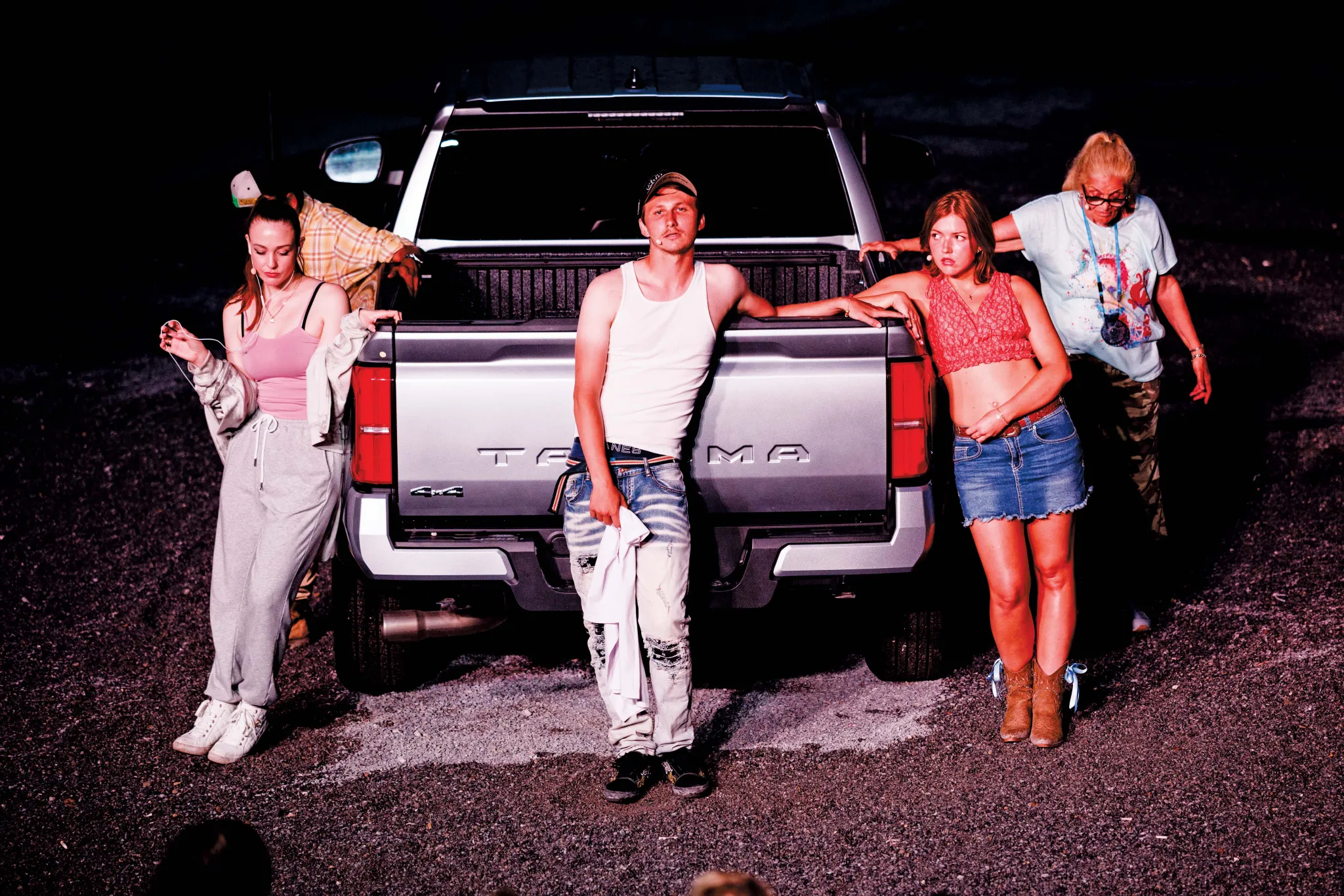
A silver pickup fills the perform photo of Georgica Pettus’s Truck. Around its tailgate, people stand in loose, uneven arrangements, dressed in denim, sweatpants, a checked shirt, and a red cropped top. Their poses could belong to an ordinary gathering until the hands become noticeable. Contact with the vehicle is the organizing principle. Everyone has somewhere to stand, but leaving that position means giving something up.
Written and directed by Pettus, Truck received its world premiere in MoMA PS1’s courtyard on June 27, 2026, within Greater New York. Its competition is straightforward: keep a hand on a pickup longer than everybody else and win it. The premise makes effort view without making its reward widely avail. There is room around the vehicle for several people, but the promise of ownership belongs to only one. That discrepancy gives the play its subject before any contestant begins explaining what the truck would mean to them.
Signal. What happened: World premiere. Exact object: Truck, a play written and directed by Georgica Pettus. When and where: June 27, 2026, MoMA PS1’s courtyard, Queens. Source: MoMA PS1, the artist’s production archive, and published interviews. Why it matters: A public endurance contest gives Pettus a way to examine how people negotiate desire within rules they did not write.
stir
The starting point was Hands on a Hardbody, S. R. Bindler’s documentary, filmed in 1995 and rel in 1997. It follows twenty-four contestants competing for a Nissan pickup in Longview, Texas. Pettus did not simply reproduce that event. Her own synopsis locates Truck in Liberty, Texas, in 2021, with five contestants, an announcer, and two salesmen sharing three days around the prize.
View this post on Instagram
The documentary had already prompted the Broadway musical Hands on a Hardbody, which opened in 2013 with a book by Doug Wright, lyrics by Amanda Green, and music by Green and Trey Anastasio. Truck is a separate work, not a revival of that musical. Keeping those productions distinct is important: an enduring premise can generate different theatrical forms without making their characters, scripts, or musical structures interchangeable.
That smaller group changes the available scale of attention. An audience can keep track of who is talking, who is listening, and who has begun treating a neighbor as an obstacle. The truck supplies a common purpose without producing a common interest. Everyone can agree that winning would be good; nobody can agree to everybody winning. Cooperation has an unusually clear stopping point.
There is also a difference between possessing an object and being allowed to use it. Here, a vehicle associated with movement becomes something that requires stillness. The competitors are near enough to touch the thing they want, yet proximity does not give them any control over it. Read this way, the play’s central image concerns conditional access as much as frustrated ambition.
Pettus told CULTURED that she and costume designer Natasha Simchowitz regarded the 2021 setting as a period piece. She also described the work as a “true ensemble.” Those details resist the temptation to turn Truck into a timeless fable populated by interchangeable losers. Its people belong to a particular recent moment, even when the bargain governing them feels familiar.
flow
The production’s eight performers were Daniel Nugent, Ruby Rodgers, Vishwam Velandy, Annie Pisapia, Austin Patrick, Ashby Bland, Jim Fletcher, and Zachary Zamsky. Pettus’s cast record assigns the five contestants the names Will, Partly, Mike, Carla, and Georgie. Bland plays the announcer; Fletcher and Zamsky play the salesmen. The distribution distinguishes those competing for the asset from those managing its presentation.
An announcer and two salesmen are not incidental additions to a story about endurance. They give the contest an administrative and promotional life. Someone has to describe what is happening, maintain its appearance of order, and make the spectacle useful to the business staging it. The participants’ desperation and the dealership’s objectives need not coincide for both to keep the event running.
Writing before the premiere, Interview’s Nolan Kelly reported exchanges about vaccine mandates and military service, alongside contestants policing rules they might themselves bend. He also described a sales deadline outlasting its usefulness while the competitors remained committed. His account suggests that the contest’s commercial purpose and its participants’ investment can separate without bringing the competition to an end.
Kelly’s report also identifies a runner-up reward: a $500 Buc-ee’s gift card. Beside the pickup, that consolation has a deliberately lopsided scale. More importantly, it is another promise of consumption, not payment for the days surrendered. The contest can recognize second place without fundamentally changing its terms. Even its consolation keeps the competitors inside somebody else’s commercial arrangement, with effort translated into a narrowly defined opportunity to spend.
They nevertheless suggest a sharper conflict than good people trapped by bad rules. A competitor can recognize unfairness and still pursue an advantage. A person can want solidarity while hoping the person beside them fails first. The drama has space for those contradictions because the prize is specific. Nobody needs a complete political philosophy to decide that they would rather drive away than watch somebody else do it.
length
MoMA PS1 listed a running time of ninety minutes. The fictional contest, by contrast, extends across days. That separation matters: Truck is a scripted play about endurance, not an invitation to mistake its actors’ working conditions for the literal ordeal being represented. Its challenge is to make an extended period of waiting legible within a much shorter shared evening.
Time becomes dramatic when its meaning differs from person to person. For a contestant, another hour might represent progress, a worsening mistake, or simply too much already invested to stop. For an organizer, the same hour might be a staffing problem. For someone watching, it can become entertainment. A single clock does not make those experiences equal.
Pettus told CULTURED that Truck took a year and a half to write, substantially longer than her earlier plays, because she needed to get to know the characters. She also discussed Marcello Palazzo’s original string quartet score. The production credits name Janet Valentina Manina as creative producer and Simchowitz as costume designer, making clear that its apparently simple setup depended on several collaborating disciplines.
This was also the first of her four plays in which Pettus did not perform. As she explained in the same interview, directing meant allowing the actors to change her relationship to the text. Her description of Fletcher requesting literal instructions rather than psychological explanations is revealing. Character can emerge through volume, pace, and timing as well as an agreed account of motivation. An ensemble is made through those different working methods, not merely assembled on a cast list.
Music offers another way of measuring duration beyond the contest’s mechanical question of who remains standing. A string quartet can organize tension through repetition, interruption, and changes of pace rather than view movement. Its presence also keeps the production from being reducible to its dialogue. The object stays put; the work around it has other ways to move.
retro
Truck follows several works in which Pettus gave private anxieties an unusually concrete setting. In $4,000 Dollars, first staged at KAJE in June 2024, Mary-Louise spends her money over a single day. The action unfolds inside a boxing ring, with a Ring Girl displaying the character’s declining balance. Financial information becomes something other people can see, almost like a score.
That device offers a useful comparison with Truck. Both premises make an intimate calculation public, but the direction changes. Mary-Louise watches a quantity disappear; the truck contestants wait for an object to become theirs. In each case, the setting makes it difficult to separate emotional exposure from an economic transaction. The embarrassment is not outside the mechanism. It is built into the encounter.
Skyscraper, presented by ACOMPI in July 2025, moved onto and around the Roosevelt Island Tram. Its plot links a land-use lawyer, a misunderstood marriage proposal, and a coworker caught between a couple. In a BOMB interview, Pettus explained that the tram’s actual schedule determined the show’s timing. Infrastructure was not merely represented. It could interrupt or govern the work.
In that BOMB conversation, Pettus connected her writing to desire and described internal monologue as a way to reveal thoughts people ordinarily withhold. That helps explain why constrained situations recur in her work. A character may appear to be doing very little while privately rehearsing an argument, anticipating rejection, or negotiating what to say next. The gap between view action and inward activity gives apparent stillness a considerable amount of dramatic room.
Seconds Minutes Hours, presented by Francis Irv at Studio 17 in December 2025, separated two characters’ bodies from their minds after a one-night stand. Four performers occupied that divided arrangement. Across these plays, Pettus repeatedly establishes a physical rule that ordinary realism would not require. Truck enlarges that approach: the restriction is shared, publicly supervised, and attached to a desirable piece of property.

exhib
The museum’s setting adds another audience to the dealership’s imagined public. MoMA PS1’s sixth Greater New York survey coincided with its fiftieth anniversary and included more than fifty multidisciplinary artists. Its stated concerns included economic precarity, surveillance, and technological change. Truck’s concentration on a monitored competition fits those concerns without requiring the fictional action to take place in New York.
The survey extended across PS1’s former school building and combined recent works with commissions, new productions, and performances. That context allows a play to be considered alongside other ways artists organize bodies and space, rather than as entertainment attached to an exhibition. A pickup does not need to become a sculpture for its placement to matter. Here it establishes distances, sightlines, and permissible movements. The production asks spectators to attend to dialogue, but its arrangement is readable before the dialogue begins. In that respect, the courtyard is not an escape from the museum’s exhibition spaces. It is another place to look.
The geographical difference can be productive. A Queens audience encounters characters pursuing a truck in Texas, rather than a conveniently local version of financial pressure. That distance creates a question of how spectators listen. Regional speech and unfamiliar beliefs can become easy markers of otherness, or they can complicate an audience’s confidence that it already knows who these people are.
Pettus’s remarks to CULTURED point toward the latter possibility. She described an interest in people’s differing belief systems without automatically treating those beliefs as proof of bad character. This is not the same as declaring every position harmless or equally persuasive. It is an artistic commitment to making a person larger than the quickest judgment available about them.
PS1 described the audience as participating characters in the farce. The sig is structural: spectators supply the public attention a promotional contest needs. Watching need not mean endorsing the bargain, but it does help constitute the event as a spectacle. The audience occupies an uncomfortable position, close enough to recognize the contestants’ predicament while remaining free from the condition that holds them there.
show
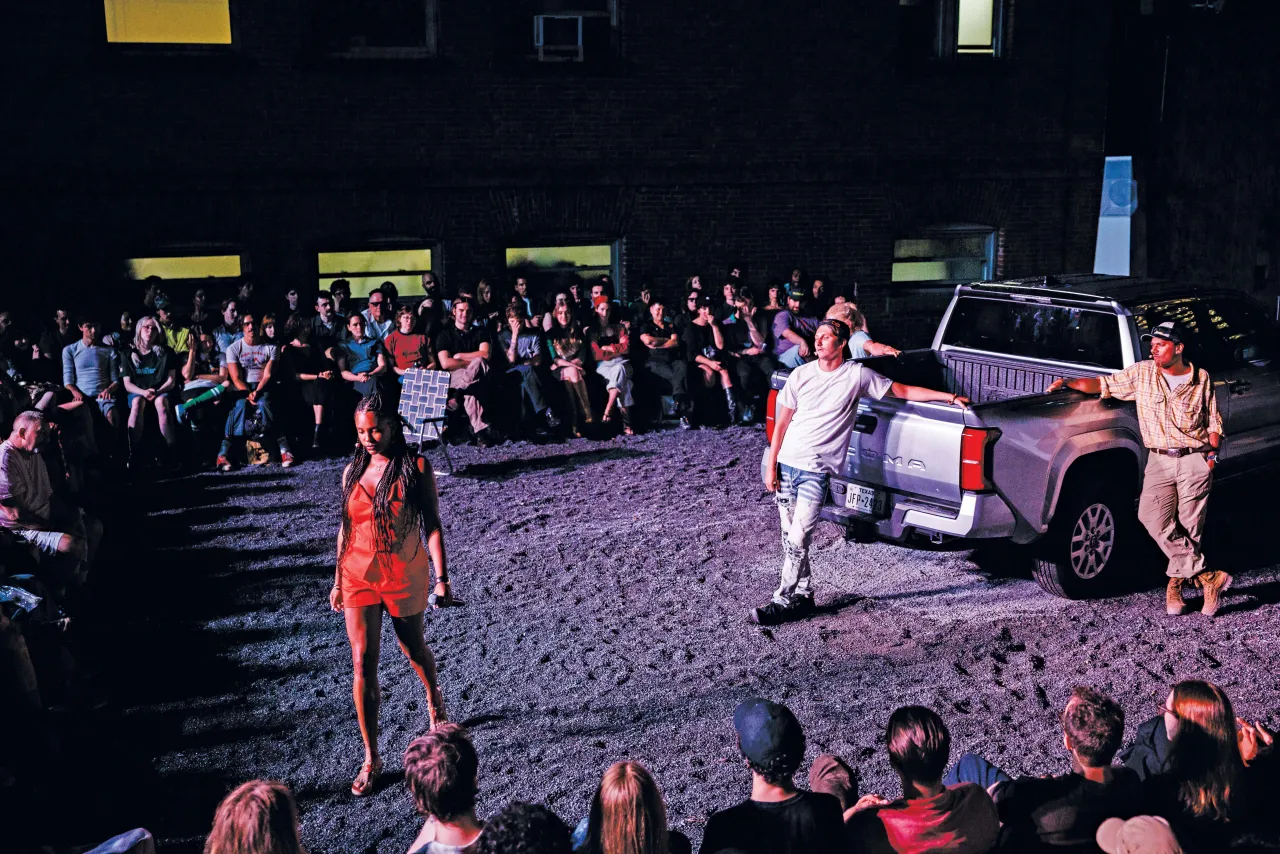
Maria Baranova’s performance documentation records that unequal arrangement particularly clearly. One image centers the pickup’s tailgate and the bodies gathered around it; another turns toward seated spectators. Together, the views make the space comprehensible without pretending to preserve the whole play. They show how the event was arranged, not everything said within it or every response it produced.
The visible clothes also keep the contestants from becoming a uniform group. A white tank top, gray sweatpants, camouflage trousers, and a denim skirt establish distinct silhouettes against the same metallic surface. Their differences remain visible even though the rule is shared. The competition does not require everyone to look alike. It only requires everyone to submit to the same condition.
A photograph necessarily removes the waiting that the play organizes. In a still image, nobody has to sustain the gesture for another hour. That limitation can sharpen one aspect of the work while concealing another: the strange arrangement becomes immediately apparent, but its cost in time disappears. The pictures are evidence of a performance, not a substitute for its duration.
They also preserve a distinction between the fictional contest and the work of staging it. In the curtain-call photograph, people stand together before the pickup, holding one another’s hands, while viewers gather in the foreground. The truck remains plainly visible behind them. What has changed is the arrangement of contact: hands that the premise attached to property now connect people to each other.
Related Articles
From Slip-Ons to the G-Class: Mattias Gollin and BRABUS Preview in Paris
Mattias Gollin built a following by hand-setting pearls on Vans. Deep into Paris Fashion Week, the Italian designer's touch surfaced on a BRABUS G-Class.