DRIFT AUDIO
Listen to this story
Choose a voice, then press play.
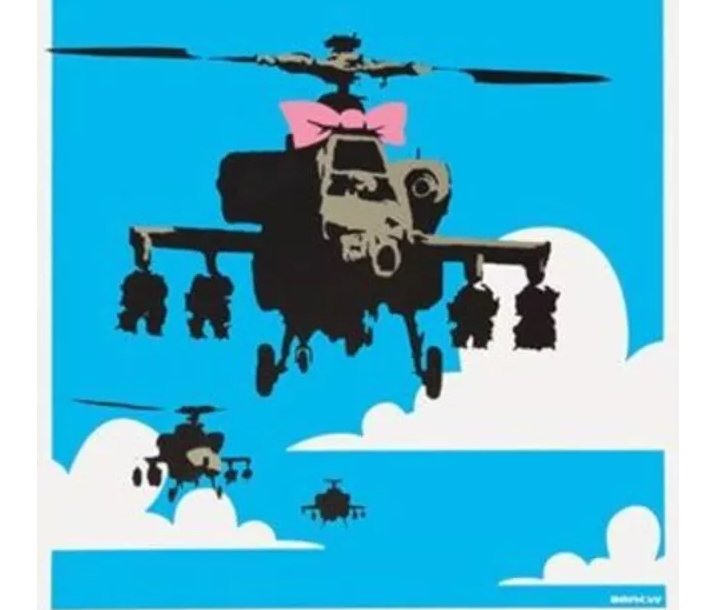
Banksy, the enigmatic street artist known for his provocative and politically charged works, created Happy Choppers in 2003. This piece exemplifies his signature blend of dark humor and social commentary. Featuring a formation of military helicopters adorned with pink bows, the artwork critiques the juxtaposition of war and innocence, highlighting the absurdity and contradiction of militarization in contemporary society.
Description of the Artwork
The Imagery
In Happy Choppers, a fleet of aggressive military helicopters appears mid-flight. The centerpiece of the composition is a single helicopter with a bright pink bow tied to its top, a stark contrast to its menacing design. The incongruity of the bow transforms the military vehicle into a symbol of irony and satire.
Medium
Originally created as a street art stencil, Happy Choppers has been reproduced as signed and unsigned screenprints. These editions remain highly sought after by collectors and fans of Banksy’s work.
Color Palette
The monochromatic design of the helicopters is punctuated by the vibrant pink bow, drawing the viewer’s attention and emphasizing the artwork’s playful yet critical message.
Themes and Interpretation
Anti-War Sentiment
The pink bow represents innocence, fragility, and naivety, contrasting sharply with the aggressive and destructive nature of the helicopters. This juxtaposition critiques the normalization of violence and questions the humanity behind warfare.
Satire and Irony
Banksy’s use of humor in Happy Choppers serves as a vehicle for deeper reflection. The absurdity of a pink bow on a war machine forces the viewer to confront the contradictions of modern military practices and propaganda.
The Dehumanization of War
The anonymous, machine-like appearance of the helicopters suggests the impersonal nature of war. By adding the bow, Banksy highlights how superficial attempts to humanize violence often fail to mask its brutal reality.
Historical Context
The Year 2003
The artwork was created during a period of global political tension, coinciding with the Iraq War. Protests against the invasion were widespread, and Happy Choppers can be interpreted as a direct response to the growing anti-war sentiment of the time.
Banksy’s Growing Influence
By 2003, Banksy was emerging as a significant voice in the art world. Works like Happy Choppers solidified his reputation as an artist who could merge street art with profound political and social commentary.
Signed Editions
•Banksy’s Happy Choppers prints are available in both signed and unsigned editions, with signed prints being more valuable due to their rarity and direct connection to the artist.
•As of recent years, signed editions have fetched prices ranging from $150,000 to $250,000 at auction, depending on condition and provenance.
Rarity and Demand
•The scarcity of these prints, coupled with Banksy’s global renown, ensures that Happy Choppers remains a coveted piece for collectors.
Legacy of Happy Choppers
Culture
Happy Choppers is one of Banksy’s most enduring works, encapsulating his ability to use humor and stark visuals to challenge societal norms and provoke thought.
Relevance Today
Two decades after its creation, the themes of militarization, propaganda, and irony in Happy Choppers remain as relevant as ever, speaking to ongoing global conflicts and the complexities of modern warfare.
Impression
Happy Choppers (Signed), 2003 is a quintessential Banksy work that combines powerful imagery, biting satire, and a poignant message. It serves as both an artwork and a call to reflect on the contradictions of modern warfare, ensuring its place as a timeless piece in the canon of contemporary art.
Related Articles

Where the Face Should Be, Rafael Silveira Paints Open Sky
A pink shirt, shoulder-length hair, then no face at all: in “Surprise,” Rafael Silveira lets flowers and a clear blue sky stand in for the person.