DRIFT AUDIO
Listen to this story
Choose a voice, then press play.
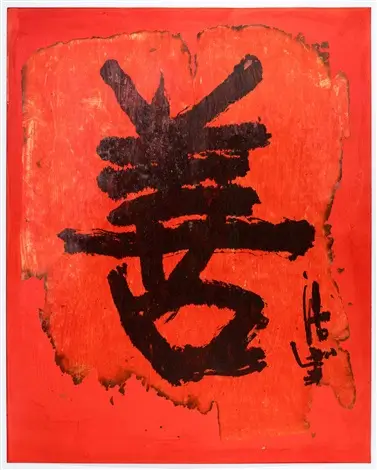
Frog King, born 1947, never arrives through narrative first. His work tends to begin with surface—paper, residue, trace—and only afterward elicits interpretation to form around it. Kindness (1978) follows this exact logic. The medium resists neutrality: ink on traditional Chinese lantern paper, edges burned, lacquer sealing the act. Each element carries its own tempo. Ink spreads. Paper absorbs. Fire interrupts. Lacquer fixes.
Lantern paper is not incidental. It belongs to a vernacular world—temporary, communal, festive, often suspended in air rather than fixed to a wall. To paint on it is already to shift expectations; to burn its edges is to complicate its role further. The work does not sit comfortably within painting, nor does it fully escape it. Instead, it hovers, like the lantern form itself—somewhere between object, ritual artifact, and image.
Burning is not destruction here; it is editing. The perimeter is rewritten through flame, leaving an irregular border that refuses containment. The work does not end cleanly. It frays, blackens, curls outward. In this sense, Kindness is structured by absence as much as presence. What is removed becomes part of what is seen.
impression
Within the central field, ink behaves less like illustration and more like an event. The gestures are not descriptive; they do not resolve into stable figures or scenes. Instead, they register motion—quick, looping, sometimes interrupted, sometimes layered. The ink sits in varying densities, pooling in certain areas, thinning into near-transparency in others.
This approach places Frog King in dialogue with, but not confined by, traditions of Chinese ink painting. The brush is still present, but its authority is loosened. Control is partial. The marks feel contingent, as if they could have gone another way. There is a sense of immediacy that resists refinement.
Kindness, as a title, does not appear in the imagery directly. It is not illustrated. Instead, it operates as a condition imposed onto the material. The viewer is asked to reconcile the softness of the word with the volatility of the process. Ink suggests continuity; fire suggests rupture. Between them, something unstable forms.
imply
The burnt edges function as both frame and anti-frame. Traditional framing contains an image, separates it from the world. Here, the boundary is active, irregular, and visibly produced. The viewer encounters the edge as a site of action rather than a limit.
Fire introduces time into the work in a direct way. The burn marks record duration—the length of exposure, the intensity of heat, the moment when paper gives way. These are not easily repeatable conditions. Each edge becomes specific, unstandardized.
The presence of lacquer complicates this further. Lacquer seals the burn, preserving the fragility it touches. It adds gloss, a slight hardness, a sense of completion. The charred edge, which might otherwise continue to degrade, is stabilized. This is not preservation in a museum sense; it is part of the composition. The burn is both arrested and displayed.
In this layering—ink, fire, lacquer—one senses a choreography of elements that do not fully agree. Each medium imposes its own logic. Their coexistence is negotiated, not resolved.
idea
Kindness, as a concept, resists direct representation. It is relational, situational, often invisible. In Kindness (1978), the term appears almost displaced, attached to a process that includes burning and interruption. This tension is central.
Frog King’s broader practice often engages with performance and social interaction. Even when working on paper, that sensibility persists. The gestures feel communicative, as if addressed outward rather than inward. The burnt edges, too, can be read as a kind of offering—paper altered, opened, made vulnerable.
Kindness here is not softness. It is not decorative. Instead, it emerges as an active condition—something that exists within friction. The work suggests that care does not eliminate damage; it coexists with it. The charred edge is not healed, but it is acknowledged, preserved, given a place within the composition.
This reframing moves kindness away from sentiment and toward action. The work becomes less about illustrating virtue and more about staging conditions in which it might be considered.
loc
The late 1970s in Hong Kong mark a period of transition—economic shifts, cultural negotiations, a growing awareness of local identity within broader global and regional frameworks. Artists working in this environment often moved between traditions, adapting and reconfiguring them.
Frog King’s practice reflects this movement. His use of traditional materials does not signal adherence to convention; rather, it becomes a site of experimentation. Lantern paper, ink, lacquer—these are recontextualized, removed from their expected roles and placed into new configurations.
Kindness does not explicitly depict Hong Kong, but it carries its conditions. The hybridity of materials, the instability of form, the negotiation between preservation and change—these resonate with a broader cultural moment.
Yet the work avoids becoming illustrative of its context. It does not close into a statement about place. Instead, it remains open, allowing multiple readings to coexist.
show
The surface of Kindness operates as a record of actions. Each mark, each burn, each layer of lacquer documents a decision or an event. Unlike traditional archival materials, however, this record is not organized or linear. It is dispersed across the plane.
The viewer reads the work not from left to right, but through movement—eye following gesture, pausing at density, tracing the edge. The burnt perimeter interrupts this reading, pulling attention outward, reminding the viewer of the work’s physical limits.
Lacquer adds another dimension. It catches light differently across the surface, creating shifts in visibility. Certain areas become more pronounced, others recede. The work changes subtly depending on viewing conditions, reinforcing its instability.
In this sense, the surface is not static. It continues to perform, even after its making is complete.
imbue
One of the defining qualities of Kindness is its refusal to resolve. The composition does not settle into balance in a conventional sense. The gestures remain open-ended, the edges uneven, the materials in tension.
This lack of closure is not accidental. It aligns with Frog King’s broader approach, where process and interaction often take precedence over finished form. The work does not aim to conclude an idea; it extends it.
Kindness, within this framework, becomes something ongoing. It is not achieved or completed. It exists within the continuation of gestures, the persistence of marks, the maintenance of fragile edges.
The viewer is not given a final interpretation. Instead, they are positioned within the work’s field, navigating its materials and tensions.
morale
There is an ethical dimension embedded in the material choices. Lantern paper is fragile, easily damaged. Burning it introduces risk. Lacquer, while stabilizing, also alters the surface permanently.
These decisions reflect a willingness to engage with vulnerability. The work does not protect its materials from harm; it incorporates that harm into its structure. This approach challenges conventional notions of preservation and value.
Kindness, in this context, does not mean avoidance of damage. It involves acknowledgment, integration, and care within transformation. The work suggests that materials, like social relations, are subject to change, stress, and intervention.
This perspective aligns with a broader shift in contemporary art during the period, where process and materiality became central concerns. Frog King’s contribution lies in how he connects these concerns to a concept as loaded and diffuse as kindness.
clue
The experience of Kindness does not conclude at the edge of the paper. The burnt perimeter lingers as an afterimage—a reminder of the work’s formation, of the moment when material met flame.
This afterimage carries the weight of the title. Kindness is not located in a single gesture or mark. It is distributed, diffused across the work and beyond it. It exists in the way the materials are handled, in the decision to preserve rather than erase, in the openness of the composition.
Frog King’s approach resists easy categorization. Kindness is not simply a painting, nor is it purely an object or a performance residue.
Related Articles
Modigliani’s Limestone ‘Tête’
Carved from a single block of limestone in Montparnasse more than a century ago, one of Modigliani's rare stone heads goes to auction for the first time…