DRIFT AUDIO
Listen to this story
Choose a voice, then press play.
The exhibition does not introduce its logic gently; it assumes you’ve already stepped inside the scene. Figures appear mid-gesture, mid-performance—caught not in moments of rest, but in states of presentation. They do not simply occupy space; they behave within it, as if aware of their own visibility.
At Lehmann Maupin London, Anna Park stages her first UK solo exhibition as a controlled environment of looking. The gallery becomes less a container and more a theater—one in which the act of viewing is inseparable from the structures that produce what is seen. The works, executed in charcoal, ink, and paint, do not stabilize into singular images. They operate as layered events, where gesture, material, and reference intersect without resolving into clarity.
This is not portraiture in the conventional sense. It is portraiture under pressure.
pin
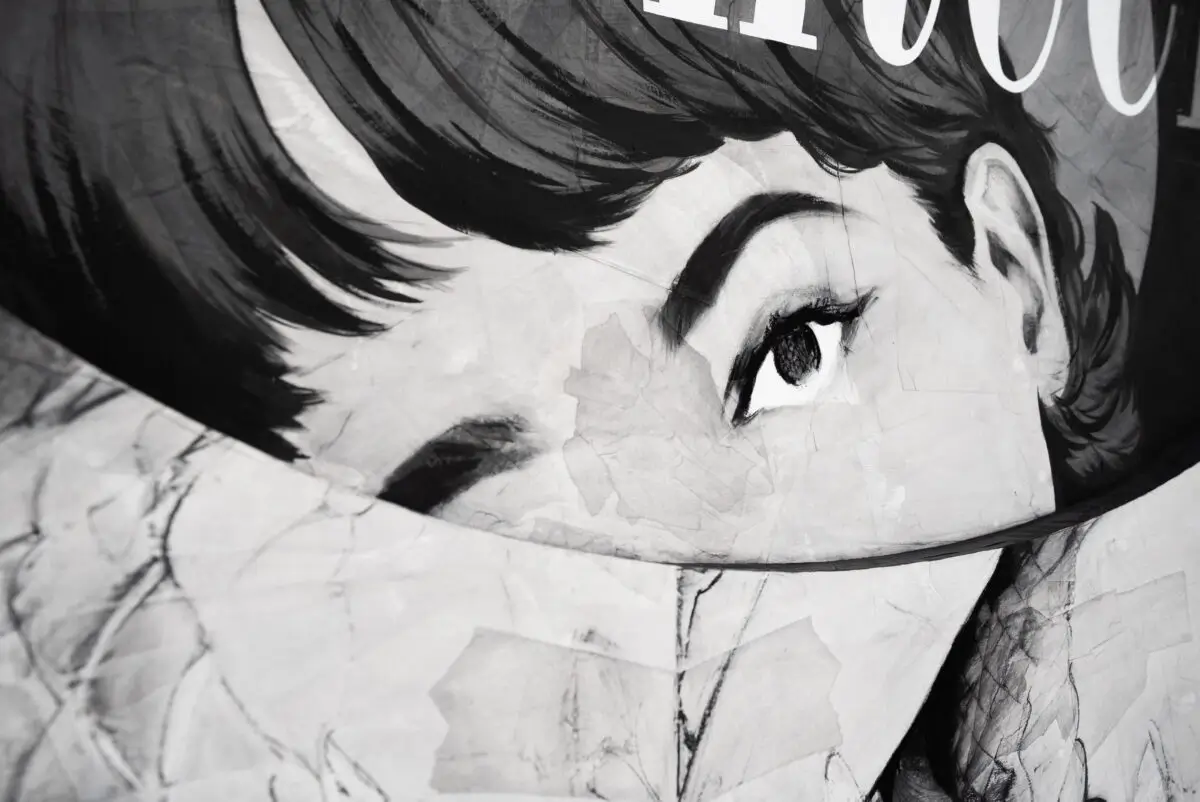
The figures in Hot Honey carry an immediate visual recognition. They echo the vocabulary of vintage pin-up imagery—arched brows, exaggerated lashes, stylized hair, and poses that suggest invitation. Bunny ears, top hats, fragments of costume: these are not incidental. They are signals, drawn from a cultural archive of femininity that has long been staged, circulated, and consumed.
But Park does not quote these archetypes cleanly. She interrupts them.
The pin-up, historically designed for clarity and desirability, is here destabilized. The bodies are present, but they are fragmented. Faces are partially withheld. Limbs dissolve into the surrounding surface. What once functioned as a coherent image of allure becomes a site of fracture.
This is where the work sharpens its critique. It does not reject the language of glamour—it inhabits it, then breaks it from within.
The theatrical elements—bunny ears, hats, accessories—remain intact enough to be recognized. But they no longer function as straightforward markers of seduction. Instead, they become props in a performance that exposes its own construction. The figures appear less as objects of desire and more as participants in a system that stages them.
show
Hot Honey is not simply about spectacle; it is structured by it. The works operate as scenes—composed, arranged, and deliberately exaggerated. There is a sense that each image could expand beyond its frame, that it belongs to a larger, unseen performance.
But spectacle here is not stable. It falters.
The compositions are crowded, often cropped in ways that deny spatial coherence. Figures overlap, interrupt each other, or dissolve into the background. The viewer is not given a clear vantage point. Instead, the eye moves across the surface, searching for orientation, only to encounter further disruption.
This instability is not accidental. It reflects the mechanics of spectacle itself—the way it constructs visibility while simultaneously obscuring the structures that sustain it.
Park makes those structures visible.
collision
Charcoal, ink, and paint are not neutral choices. Each medium carries its own behavior, its own resistance. Charcoal smudges, spreads, and stains. Ink asserts itself with precision. Paint introduces weight, density, and, in this exhibition, moments of restrained color.
These materials do not blend seamlessly. They collide.
You can see where charcoal has been dragged across the surface, leaving traces of movement. Ink lines cut through that softness with a kind of finality. Paint sits on top, sometimes reinforcing, sometimes interrupting what lies beneath.
The surface becomes a record of decisions—of marks made, altered, and left visible.
This visible matters. It refuses the illusion of a finished image. The works do not conceal their construction. They expose it, insisting that the viewer confront not just what is depicted, but how it has been made.
tincture
In a body of work largely defined by monochrome intensity, the introduction of color is deliberate and restrained. It does not overwhelm the composition. It punctuates it.
A streak of red. A muted wash. A subtle tonal shift.
These moments of color function less as decoration and more as control points. They guide the eye, but they also disrupt it. Just as the viewer begins to settle into the black-and-white logic of the image, color intervenes—quietly, but decisively.
This restraint amplifies its impact. Color is not abundant; it is strategic.
fx
At the core of Hot Honey is a sustained engagement with the act of looking. The figures do not simply present themselves; they respond to being seen.
Eyes recur throughout the exhibition as points of tension. They do not offer straightforward connection. Instead, they complicate the relationship between viewer and subject. Some gaze outward, meeting the viewer directly. Others are obscured, partially erased, or redirected.
This variability disrupts the expected dynamic. The viewer cannot assume a position of control.
In traditional representations of glamour, the gaze is often structured to invite consumption. Here, it resists. It withholds as much as it reveals. The viewer is not granted full access to the figure, even when proximity suggests otherwise.
This is where Park’s feminist critique becomes most apparent—not through overt declaration, but through the restructuring of visual relationships. The act of looking is no longer neutral. It is implicated.
participant
Fragmentation in Hot Honey is not a sign of incompleteness. It is a method of construction.
The figures are built through interruption. Lines begin and stop. Forms overlap without fully aligning. Surfaces shift, refusing to settle into coherence.
This fragmentation does not diminish the presence of the figures. If anything, it intensifies it. The viewer is forced to assemble the image mentally, to navigate its breaks and inconsistencies.
But that assembly is never final. The image continues to shift, even as it is being perceived.
This instability is central to the work’s impact. It resists the idea that an image can fully contain its subject. It suggests instead that representation is always partial, always contingent.
drama
There is a theatrical dimension to Hot Honey that extends beyond its visual references. The works feel staged, but not in a way that resolves into narrative.
There is no clear storyline, no sequence of events. Instead, there is a series of gestures—poses, expressions, interactions—that suggest performance without confirming it.
This ambiguity keeps the viewer in a state of suspension. The scene is active, but its meaning is not fixed.
The theatrical elements—costume, gesture, composition—function as cues rather than conclusions. They point toward a performance that is never fully revealed.
example
The figures in Hot Honey do not present a unified vision of femininity. They are multiple, shifting, and often contradictory.
Elements associated with traditional femininity—beauty, allure, ornamentation—are present, but they are destabilized. They do not cohere into a single identity. Instead, they appear as components, assembled and reassembled across the works.
This approach reflects a broader understanding of identity as constructed rather than inherent. The figures are not expressions of a fixed self. They are performances—negotiated, staged, and subject to change.
Park does not offer a singular critique. She creates a space in which these constructions can be examined, disrupted, and reconfigured.
imbue
In works such as Hold That Thought (2026), this dynamic becomes particularly concentrated. The title itself suggests suspension—a pause that is never fully realized.
The figure appears caught between actions, between expressions. The composition reinforces this sense of interruption. Lines break. Forms overlap without resolving. The surface carries traces of revision.
What emerges is not a completed image, but a moment held in tension.
This tension is not resolved within the work. It extends outward, shaping the viewer’s experience. The image does not conclude; it lingers.
location
As a whole, Hot Honey operates less as a collection of individual works and more as an environment. The gallery space becomes a field in which these tensions accumulate.
Moving through the exhibition, the viewer encounters variations on a set of conditions—fragmentation, theatricality, resistance, and control. Each work reconfigures these elements slightly, creating a rhythm that is both repetitive and evolving.
This repetition is not redundancy. It is emphasis.
The exhibition does not build toward a singular conclusion. It sustains a condition.
fetch
What distinguishes Hot Honey is its refusal to resolve. The works do not offer clear answers or stable meanings. They remain open, shifting, and resistant to closure.
This refusal is not evasive. It is deliberate.
In a visual culture that often prioritizes clarity and immediacy, Park’s work insists on complexity. It asks the viewer to remain within uncertainty, to engage with images that do not fully reveal themselves.
There is a discipline to this approach. The works are controlled, precise in their construction, even as they appear unstable.
clue
To engage with Hot Honey is to accept a certain kind of discomfort. The images do not settle into familiarity. They resist being easily understood.
But this resistance is what gives them their force.
They do not simply depict femininity, identity, or spectacle. They expose the mechanisms through which these ideas are constructed and perceived.
The viewer is not positioned outside of this system. They are part of it.
The act of looking becomes an act of negotiation.
Related Articles
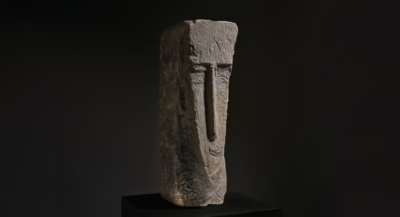
Modigliani’s Limestone ‘Tête’
Carved from a single block of limestone in Montparnasse more than a century ago, one of Modigliani's rare stone heads goes to auction for the first time…