DRIFT AUDIO
Listen to this story
Choose a voice, then press play.
Haim Steinbach, an Israeli-born American artist, is a seminal figure in the development of installation and conceptual art, particularly known for his innovative use of everyday objects in gallery settings. Born in 1944 in Rehovot, Israel, Steinbach immigrated to the United States in 1957 and later became a naturalized citizen. He studied at the Pratt Institute in Brooklyn, New York, and earned his MFA from the Whitney Museum of American Art’s Independent Study Program. Steinbach’s artistic practice emerged during a period of significant transformation in the art world, as artists began to challenge traditional notions of art and explore new forms of expression.
flow
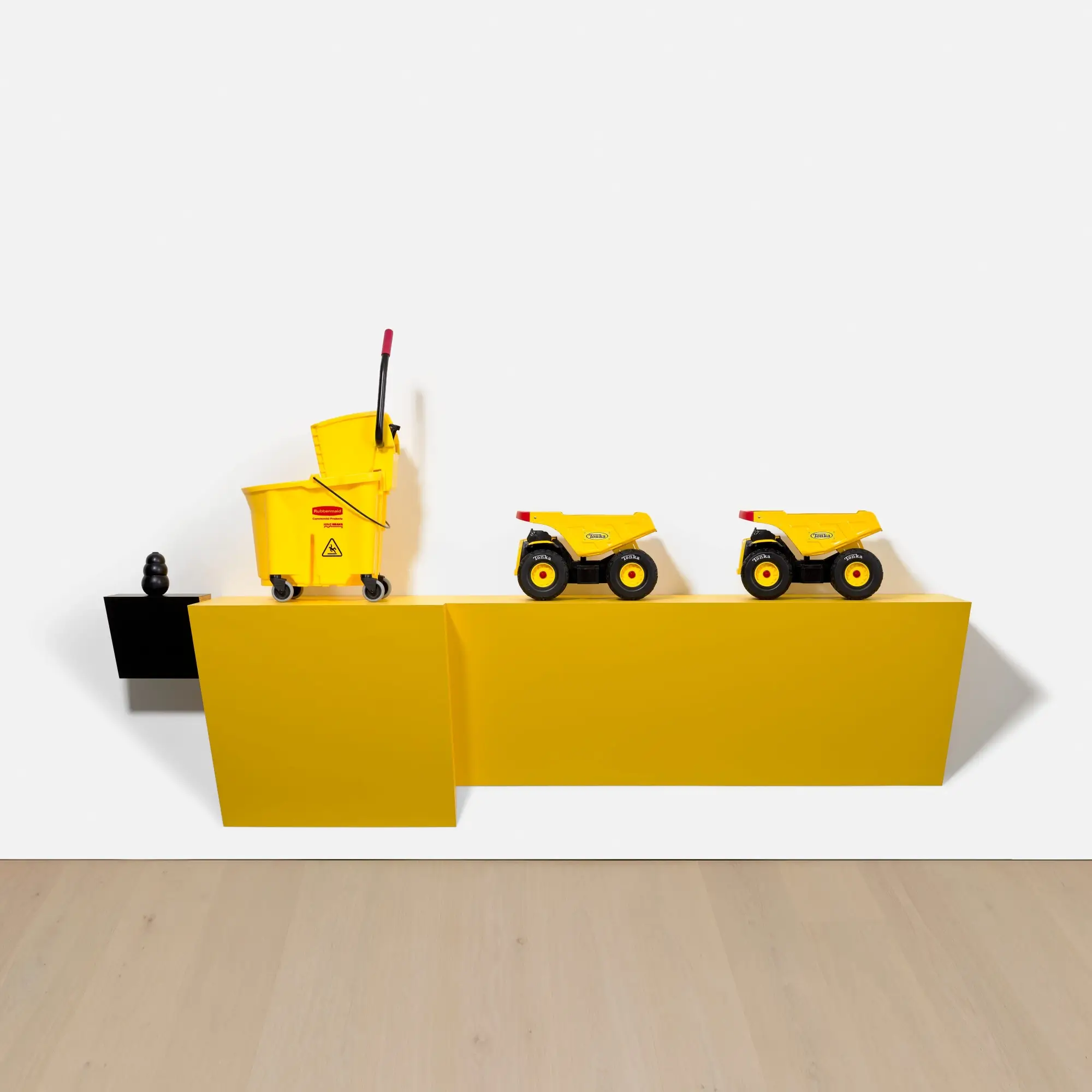
Steinbach is best known for his “shelves” or “display” works, which feature everyday objects arranged on custom-built shelves. These objects, often mundane and mass-produced, are carefully selected and arranged to create a dialogue between the objects themselves and the viewer. By placing these objects in a gallery setting, Steinbach challenges the traditional boundaries between art and everyday life, inviting viewers to reconsider the value and meaning of the objects they encounter in their daily lives. His work is deeply rooted in the traditions of conceptual art, which emphasizes the idea or concept behind the artwork over its aesthetic or material qualities.
idea
One of Steinbach’s notable works is “tongkong rubbermaid II-2,” which is part of a distinguished private European collection. This piece features a series of Rubbermaid storage containers, arranged on a custom-built shelf. The containers, typically used for organizing and storing household items, are transformed into art objects through their placement and arrangement. The work’s title, “tongkong,” is a reference to the Chinese word for “empty,” suggesting a sense of absence or void. This title adds a layer of conceptual depth to the work, inviting viewers to consider the relationship between presence and absence, fullness and emptiness.
commune
The use of Rubbermaid containers in this work is significant, as it highlights the artist’s interest in the relationship between objects and their cultural context. By selecting a brand that is widely recognized and used in American households, Steinbach draws attention to the ways in which consumer culture shapes our daily lives. The containers, typically associated with organization and order, are presented in a way that disrupts their usual function, inviting viewers to consider the objects in a new light. The arrangement of the containers on the shelf creates a visual rhythm and balance, drawing the viewer’s eye across the composition and encouraging a closer examination of the individual objects.
show
Steinbach’s work is not simply about the objects themselves, but about the relationships between them and the context in which they are presented. By placing these everyday objects in a gallery setting, he challenges the viewer to reconsider their assumptions about what constitutes art. The gallery becomes a space for contemplation and reflection, where the boundaries between art and life are blurred. Steinbach’s work invites viewers to engage with the objects on a deeper level, to consider their histories, meanings, and cultural significance.
indie
The artist’s approach to curation and display is also significant. The custom-built shelves that support the objects are an integral part of the work, providing a framework for the arrangement of the objects and creating a sense of order and structure. The shelves themselves are often painted in bold, primary colors, which contrast with the neutral tones of the objects and draw attention to the act of display. The shelves serve as a metaphor for the ways in which we organize and categorize the world around us, highlighting the role of context in shaping our perceptions.
fin
Steinbach’s work has been exhibited in numerous solo and group exhibitions around the world, including at the Museum of Modern Art in New York, the Whitney Museum of American Art, and the Centre Pompidou in Paris. His influence on the field of installation and conceptual art has been significant, and his work continues to be celebrated for its ability to challenge and expand the boundaries of what is considered art. By transforming everyday objects into art, Steinbach invites viewers to see the world in a new way, to find beauty and meaning in the mundane, and to question the assumptions that underlie our understanding of art and culture.
From the DRIFT archive: American Visionaries: Property from an Important Private Collection — Joan Mitchell, Untitled
Related Articles
Modigliani’s Limestone ‘Tête’
Carved from a single block of limestone in Montparnasse more than a century ago, one of Modigliani's rare stone heads goes to auction for the first time…