DRIFT AUDIO
Listen to this story
Choose a voice, then press play.
Jonathan Yeo spent three years painting a king who was still a prince when the sittings began, and the finished canvas turned out to be less about likeness than about heat.
In This Story
- A Ceremony Room, a Wall of Red
- Three Sittings Across Two Titles
- Reading the Canvas
- A Painter Who Keeps Getting Handed the Hardest Sitters
- The Reaction, Split Roughly in Two
- Where a Portrait Like This Actually Lives
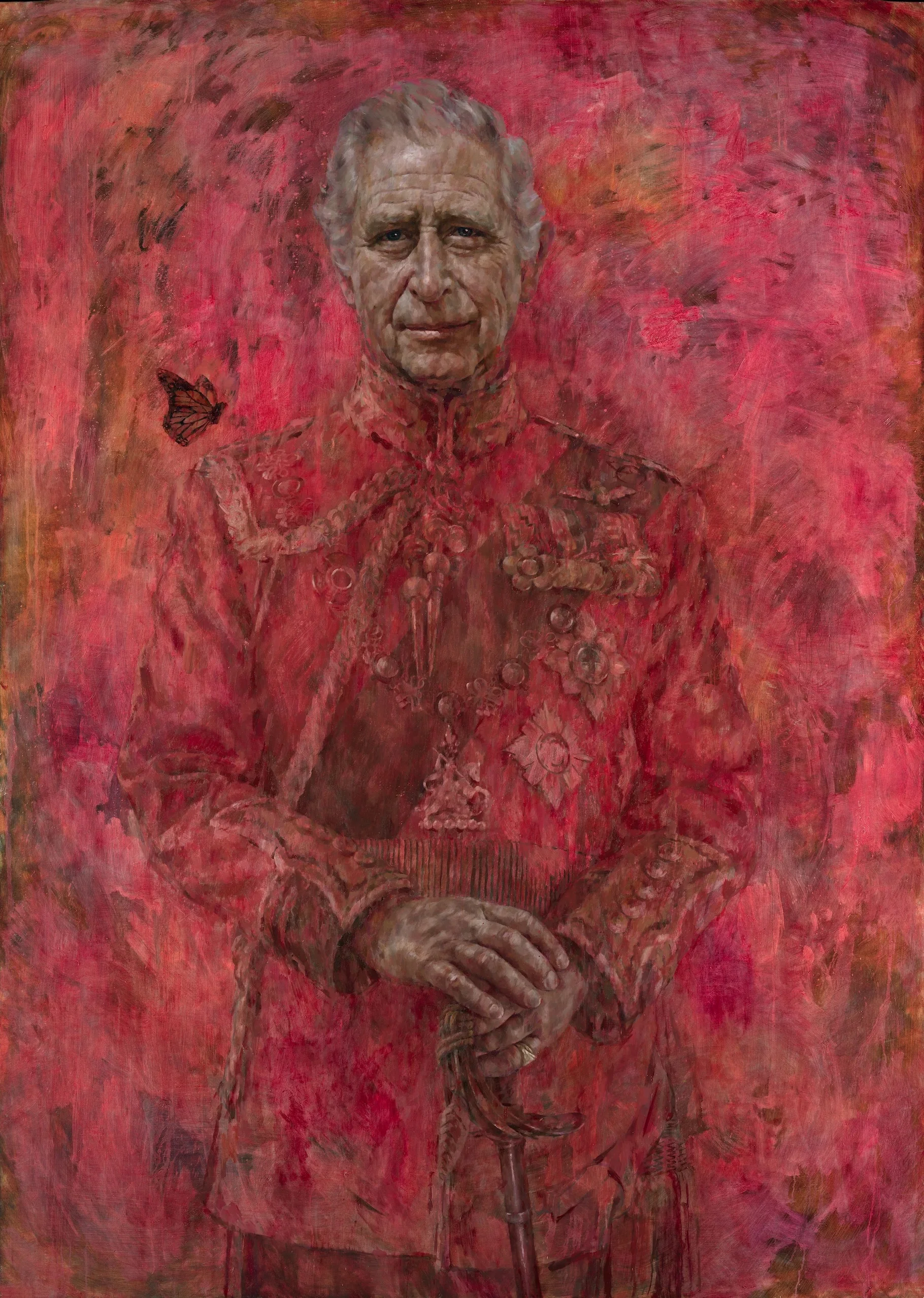
On the morning of May 14, 2024, King Charles III walked into the Blue Drawing Room at Buckingham Palace, stood beside a painter named Jonathan Yeo, and pulled back a curtain on the first official portrait of himself completed since his coronation. What came into view was not the muted, formal image people generally expect from state portraiture. It was a canvas roughly seven and a half feet tall, dominated almost entirely by a churning, fiery red, with the King’s face and hands rendered in careful, grounded detail while nearly everything else, including his own Welsh Guards uniform, dissolves into the wash around him. A monarch butterfly hovers near his right shoulder, close enough to look like it might actually land.
The painting had been years in the making by the time anyone outside the project saw it, and its unveiling turned into one of the more talked about art stories of 2024, not because of who painted it but because of how loudly the color argued with expectation. Royal portraits are supposed to be dignified in a fairly narrow, agreed upon sense. This one looked like it was on fire.
stir
The commission itself predates the reign it now represents. Yeo was approached in 2020 by The Drapers’ Company, one of the historic livery companies of the City of London, to mark fifty years since the then Prince of Wales had become a member of the organization. Charles had first joined the Drapers as a young man, and the commission was conceived as a tribute to that long, mostly shh association rather than as anything tied to a future coronation nobody could have scheduled in advance.
Yeo had four sittings with his subject, beginning in June 2021 at Highgrove while Charles was still Prince of Wales, and ending in November 2023 at Clarence House, by which point the sitter had become King. In between, Yeo worked from his own sketches and reference photography back in his London studio, piecing the final composition together across a stretch of time that quietly absorbed one of the most significant transitions the British monarchy has gone through in decades. He has said the shift in his sitter’s role changed how he thought about the picture as he built it, and that the butterfly, a detail the King himself suggested, became a way of holding that sense of transformation inside the frame rather than outside it.
The finished oil on canvas measures 230 by 165.5 centimeters, and it was designed with a specific destination in mind. After its Buckingham Palace unveiling, the portrait moved to Philip Mould & Company on Pall Mall for a month of free public viewing, then to the Buckingham Palace Ballroom for the summer, before settling into its permanent home in the fall of 2024 at Drapers’ Hall in the City of London, the building whose architecture Yeo has said he had in mind while composing the canvas.
View this post on Instagram
read
Strip away the controversy for a moment and the choices inside the painting itself are fairly deliberate. Charles is shown in the ceremonial uniform of the Welsh Guards, an regiment he was made Colonel of in 1975, sword in hand, a role and a garment loaded with the kind of formal military symbolism that has anchored royal portraiture for centuries. Yeo’s technique undercuts that formality almost immediately. Rather than rendering the uniform with the crisp precision a military portrait traditionally demands, he lets the red wash swallow most of its detail, so the medals and braid barely survive as legible shapes. The effect pulls attention away from rank and toward the two things Yeo does render with real specificity, the King’s face and his hands, the parts of a portrait that carry the most human information and the least ceremonial weight.
That imbalance seems to be the whole point. Yeo has described his aim as capturing his subject’s humanity rather than his office, and the painting’s structure supports that reading. Everything institutional in the frame, the uniform, the sword, the sheer scale of the canvas, gets treated as something closer to atmosphere. Everything personal gets treated as the actual subject.
The butterfly does a version of the same work in miniature. It is a small, fragile, temporary looking creature sitting inside a painting otherwise built on permanence, tradition, and institutional weight, and Yeo has connected it directly to the King’s decades long environmental advocacy, work Charles was doing long before it became a mainstream political concern. Critics who have written favorably about the painting tend to land on the same observation, that the butterfly is the only overt piece of symbolism in an otherwise stripped down composition, and that its placement, right at the King’s shoulder, gives the whole canvas a quieter, more melancholic undertone than the blazing red initially suggests.
portrait
Jonathan Yeo did not arrive at this commission as an outsider to difficult portraits. Born in London in 1970 and entirely self taught, having first picked up oil paint at fourteen and later abandoned formal art training to work through the discipline on his own terms, Yeo built his career on subjects that were already famous enough to carry their own cultural baggage into the frame with them. He has painted Tony Blair, David Attenborough, Malala Yousafzai, Nicole Kidman, and Damien Hirst, among many others, and earlier royal work includes portraits of Queen Camilla in 2014 and Prince Philip in 2008.
His 2013 mid career retrospective at the National Portrait Gallery in London, where he has served as a trustee since 2018, toured to venues across the UK and helped cement his reputation at a moment when traditional portrait painting was widely considered out of step with contemporary art’s interests. He picked up GQ’s Artist of the Year title in 2018, and his work has since traveled to institutions including the Smithsonian National Portrait Gallery in Washington and the Museum of National History in Denmark.
What runs through nearly all of that work, well before the King Charles commission, is a willingness to treat famous faces as psychologically complicated rather than simply iconic, sometimes to the point of real controversy. He has spoken openly about wanting to push portraiture past what audiences expect from it, and the red wash approach he used on Charles is very much in line with a career built on refusing to just paint the safe, expected version of a well known face.
rx
Public response to the painting broke almost immediately into two camps, and it has stayed that way. Social media reaction skewed sharply critical in the days after the unveiling, with a wave of commentary comparing the red background to everything from a horror film to a rendering of hell, and plenty of jokes at the expense of a monarch who appeared, to some viewers, to be dissolving into flame. Yeo, for his part, treated the response with dry humor rather than defensiveness, telling the BBC that if the painting were ever judged treasonous he could personally pay for it with his head, a fairly pointed joke for a portrait painter to make about his own work.
Reaction from people who actually stood in front of the canvas tended to run warmer. Reviewers who visited the Philip Mould Gallery showing during its month long public run generally praised the likeness itself as unusually accurate, singling out small physical details Yeo captured, like the King’s wedding band worn on his pinky finger, as evidence of real observational care beneath the more theatrical color choice. Queen Camilla, who joined the final sitting, is reported to have looked at the finished work and simply said that Yeo had gotten him. The late Queen Elizabeth II reportedly visited that same final sitting and offered a similar assessment of the likeness before her death the following year.
That split, a skeptical first reaction online against a warmer one in person, is a familiar pattern for portraits that push past what an audience is braced for, and it says as much about how images circulate now as it does about the painting itself. A canvas built to reward close, sustained looking, the kind of looking a gallery visit allows and a phone screen mostly does not, was always going to read differently in a scrolling feed than it does standing in a room with it.
There is also a generational split worth noting in how the criticism landed. Much of the harsher commentary treated the red as a departure from what a state portrait is supposed to look like, judging the painting against a fairly narrow template set by centuries of more restrained royal imagery. Supporters of the work, including several critics writing for art publications rather than general news outlets, tended to frame that same red as the whole reason the commission mattered in the first place, arguing that a portrait this visually aggressive was exactly what a modern monarchy needed if it wanted to avoid disappearing into the wallpaper of tradition. Neither camp was arguing about whether Yeo could paint. Both agreed the likeness itself was strong. The disagreement was almost entirely about what a royal portrait is allowed to feel like, which is a considerably more interesting argument than most art controversies manage to generate.
land
Royal portraiture carries a specific kind of institutional weight that most contemporary painting simply does not have to answer to. Every formal image of a British monarch becomes, almost immediately, part of a much longer visual record stretching back centuries, compared instinctively against paintings of the King’s predecessors rather than judged purely on its own terms. Against that backdrop, Yeo’s choice to prioritize a felt sense of transition over ceremonial precision is a genuinely unusual bet for a commission of this scale, and it is one that will likely take longer than a single news cycle to properly settle.
For now, the painting hangs at Drapers’ Hall, in the building it was designed to complement, available to view alongside the historic livery company’s other holdings rather than sitting inside a national collection built for mass tourism. That placement, quieter and more specific than a museum gallery built for crowds, suits a portrait that seems to have always been more interested in one person’s private transformation than in performing majesty for an audience.
It is worth remembering, too, that the sitting itself began before any of the surrounding circumstances were fixed. Yeo started work on a prince, not knowing exactly when or whether the title in the frame would change before the brush left the canvas. That kind of uncertainty rarely survives into a finished commission this formal, and it is arguably the most unusual thing about this particular portrait, more than the color, more than the reaction it produced online. A painting built around a transition that had not yet happened when the first sitting began ended up, almost by accident, becoming a portrait about transition itself.
n
From the DRIFT archive: The Art of the Can: Chaz Bojórquez’s Hand-Signed MTN Spray Paint Edition
Related Articles
Winter Ran Down A Plywood Panel In Gaeta
Cy Twombly, Untitled (Winter Picture), 2004. Acrylic on plywood in the artist’s frame. Gagosian, Madison […]