DRIFT AUDIO
Listen to this story
Choose a voice, then press play.
Oh de Laval fills her canvases with sex, violence and a small dog in the corner watching it all happen with total calm.
In This Story
- A Bedroom in Warsaw
- The Painting in Madrid
- A Sociology Degree and a Theory of Deviance
- Building a Name Nobody Had Used Before
- Venetian Pink and the Dogs Who Never Look Away
- The Kali Uchis Cover That Spotify Wouldn’t Show
- From a Debut in Mayfair to a Home in the Marais
- What She Is Painting Now
Oh de Laval was born Olga Pothipirom in Warsaw in 1990, the only child of a Polish mother and a Thai father who worked at the Thai embassy in the city. She grew up mostly alone in her room, cutting up collages, sewing and drawing, the kind of shh, self-contained childhood that later shows up in the crowded, overstuffed interiors she now paints. Her mother painted too, and cartoons were a constant background noise in the house, though nobody in the family treated art as a career path worth planning for.
Painting came late and almost by accident. She had already tried something else first.
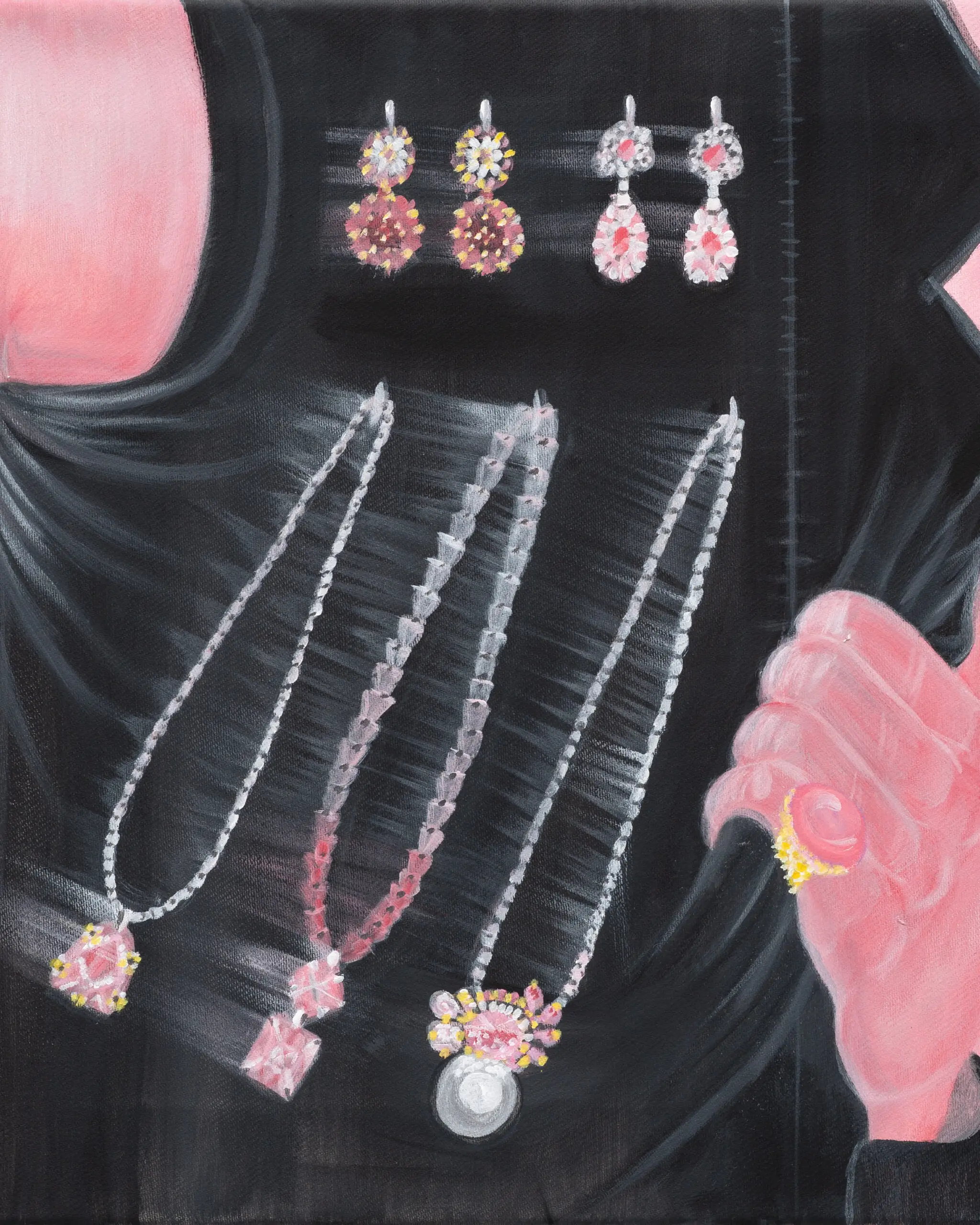
A still life of jewelry rendered in muted pinks and grayscale, transforming gemstones and luxury accessories into a painterly meditation on desire, fashion, and material culture.
There was no family expectation that any of this shh, solitary childhood work would turn into a profession. Warsaw in the 1990s was not exactly overflowing with support structures for a mixed heritage kid with an unusual last name and an even more unusual eye for detail. She has said, looking back, that the isolation of those years gave her something useful: long uninterrupted stretches of time to notice how people behave when they think nobody is paying attention, the small hypocrisies and private appetites that would eventually become the entire subject matter of her painting.
stir
At twenty one, Pothipirom enrolled in an industrial design program, a decision she now describes as a wrong turn that happened to teach her something useful about structure and interiors. Two years in, she dropped out, feeling lost, and took an ordinary job instead. It was around this time, at twenty three, that a trip to Madrid changed the direction of her life. Standing in front of Francis Bacon’s Study of the Human Body (1982), she felt something shift. She has called it the first time she experienced art in a pure, unfiltered form. She was not interested in copying Bacon’s technique. What drew her in was closer to a way of living: reckless, hedonistic, unconcerned with permission.
She went on to study at Warsaw’s Academy of Fine Arts, where she has joked that she learned how to drink heavily and paint well in the same afternoon, before relocating to London to pursue painting properly.
flow
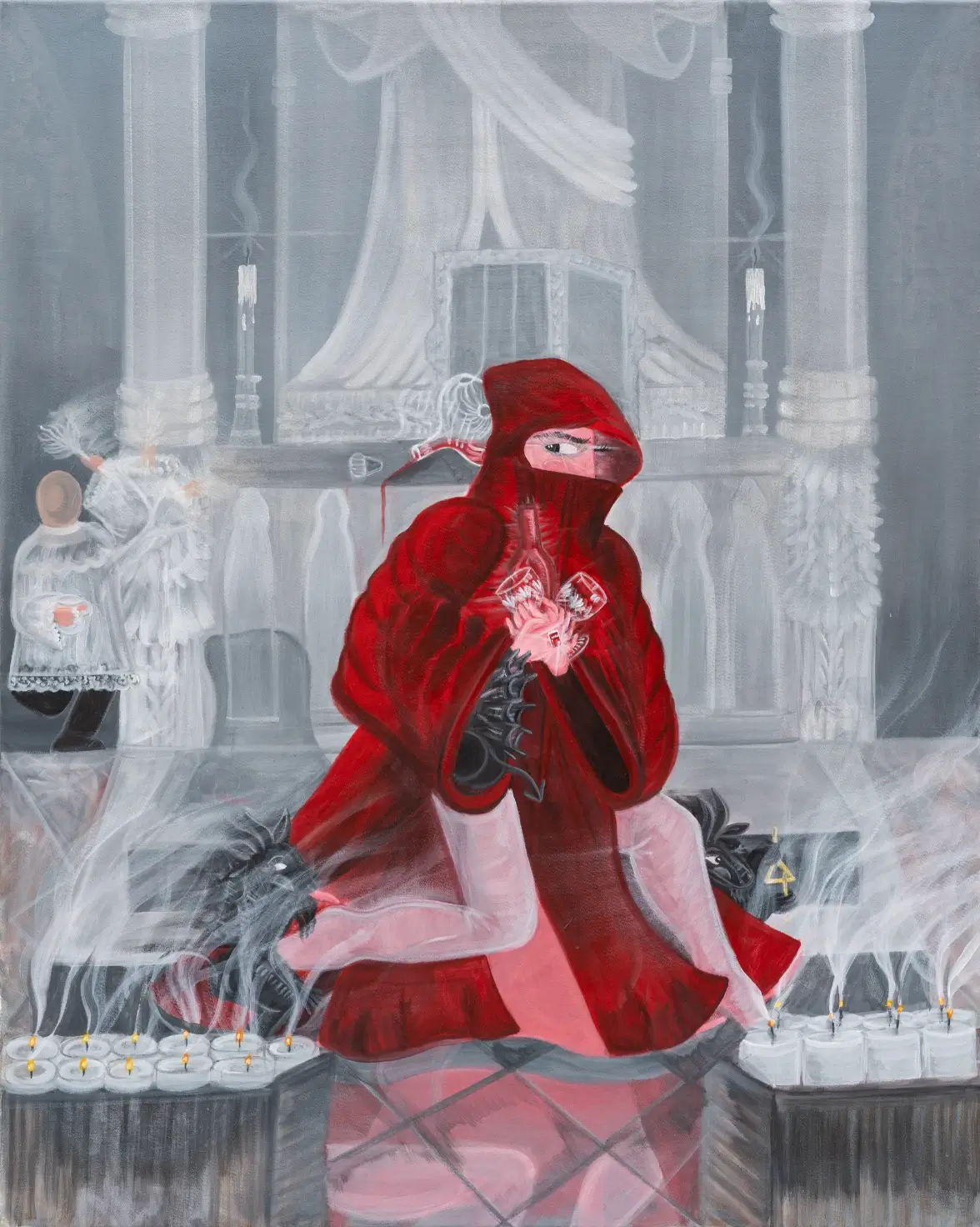
Before any of that stuck, Pothipirom completed a degree in sociology at the University of Warsaw, finishing in 2016. It was there that she encountered Émile Durkheim‘s writing on deviance, the idea that a society needs its rule breakers as much as its rule followers, that transgression is not a flaw in the system but a working part of it. That idea has never really left her paintings. Priests reach for the communion wine. A headless man in a dinner jacket carries on with an affair while a maid keeps dusting picture frames nearby. A chef presses his bare backside into the top of a wedding cake before the bride and groom arrive. None of it reads as shock for its own sake. It reads more like an artist who spent years studying why people misbehave, and decided the answer was worth painting rather than footnoting.
Her academic background also explains why her work resists easy categorization as pure fantasy. “To me, they are very real,” she has said of scenes that look, at first glance, like feverish dreams.
nominal
She did not want a name that came with a ready made story attached. “I wanted to create a name that resonates only with me,” she has said of choosing Oh de Laval, a signature built to belong to nobody but her.
The path into galleries did not run through art school connections, because she never had any. Applications were turned down. Instead she painted in her bedroom and posted the results to Instagram, a decision that now reads as an obvious move but at the time was closer to a last resort. Professors, curators and other artists eventually found her there instead of the other way around. She has framed the shift plainly: she stopped asking to be let in, and people started coming to her.
For a while she held down an ordinary job at the Thai embassy alongside her father, closing the door to her room each evening and painting through whatever hours were left over, treating the practice less like a hobby and more like a habit she could not shake regardless of how her weekends had gone. That discipline, painting on a schedule rather than waiting for a mood to strike, is the same discipline that now has her at an easel by four in the morning most days, working through the quiet hours before the rest of a household or a city wakes up. It is an unglamorous routine for an artist whose finished paintings look anything but restrained, and that contrast between the calm, early morning process and the chaotic, crowded scenes that result from it is part of what makes her studio practice hard to predict from the outside.
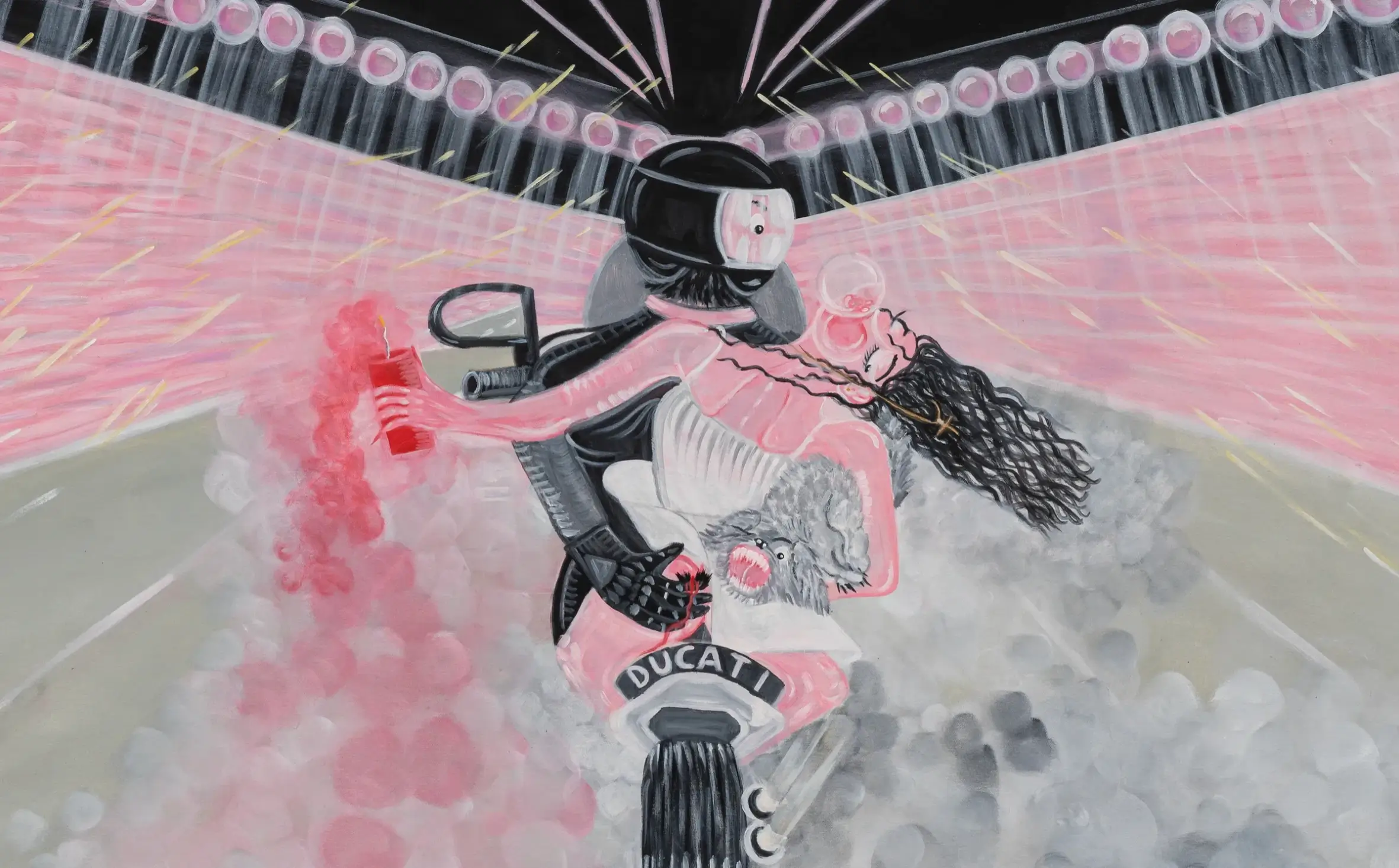
A dreamlike painting blends speed, fashion, and spectacle as a lone rider races through smoke and neon light, balancing rebellion with glamour in a palette dominated by pink, gray, and black.
show
Two things identify an Oh de Laval painting from across a gallery floor before you even get close enough to see what is happening in it. The first is color, a specific saturated rose she has made her own, often referred to in gallery texts as her signature Venetian pink, used for skies, skin and interiors alike, giving even her darkest scenes a candy coated surface. The second is a dog. Almost every canvas has one, tucked into a corner, watching whatever chaos is unfolding among the humans with an expression that reads somewhere between amusement and quiet judgment. She has described placing them in her paintings like little goblins, waiting for something to happen.
The dogs matter because they change how a viewer is allowed to feel about the scene. A painting of a headless affair or a body falling into shark infested water could simply be grotesque. With a small dog sitting calmly in the frame, unfazed, the whole thing tips into something closer to dark comedy. Writer and Frieze contributing editor Tom Morton, reviewing her debut solo show for Unit London, summed up the tone of her painted world as one built on sex, violence and often money too, playing out among gilded, good looking young people with nowhere else to be.
Her figures tend to be undressed, her interiors lush and slightly overripe, closer to a Rococo salon than anything contemporary, and the men in her paintings often carry the same sardonic, half melted grin regardless of what indignity they are currently suffering. She has cited both French New Wave cinema and film noir as reference points for the psychological undercurrent running beneath all that candy color, and has said her main source of material is simply people: their small social performances, their secret appetites, the things they would never say out loud but clearly want.
That habit of watching strangers shows up in her own description of how she gathers material, which sounds less like an artist doing research and more like an anthropologist clocking in for fieldwork: people ordering drinks, making small talk in a smoking area, chatting in restaurant bathrooms, the ordinary theater of public life that most people tune out and she apparently cannot stop cataloging. Nothing about her paintings feels invented from nowhere. Every gilded, misbehaving figure reads like a composite of someone she actually clocked once, somewhere, doing something they thought nobody noticed.
uncover
In 2020, Kali Uchis messaged her directly, with no formal brief beyond a loose idea about isolation and finding pleasure during a difficult year. The result was the cover art for Uchis’s EP To Feel Alive, painted in Oh de Laval’s now familiar palette: two versions of the singer, one dark haired and one blonde, in a luxury London apartment while a pod of the London Eye burns shh in the background. The composition, in keeping with the rest of her catalog, put female pleasure at its center rather than at its edge.
It turned out to be the one piece of her work that has ever been censored, and not by the platform most people would guess. Instagram left it alone. Spotify did not, releasing a heavily blurred version of the cover once the EP dropped, an outcome she has treated less as a controversy and more as an odd footnote to an otherwise straightforward commission.
transition
Her first solo show, Wild Things Happen in Stillness, opened at Unit London in March 2021, a compact debut that nonetheless set the terms for everything that followed: sex and violence rendered in that same warm pink, dogs stationed in every corner, and titles that read like diary entries. A second solo presentation with the gallery, For Your Eyes Only, followed, alongside group exhibitions that carried her work to Hong Kong, Taipei, Tel Aviv and Berlin, and into institutional collections including the AMMA Foundation in Mexico City, the Beth Rudin DeWoody Collection in Florida and the X Museum in Beijing.
She has since moved her primary representation to Galerie Marguo in Paris, where she mounted Take Your Pleasure Seriously in 2023 and I Miss When People Had Secrets in 2025, a show that leaned further into what she has described as private, defiant material, work concerned with what people choose to hide and what they choose to reveal. Her paintings also appeared in I Licked It, It’s Mine at New York’s Museum of Sex, a 2024 group show built around fantasy and desire, a natural enough venue for an artist whose entire practice sits at that particular intersection. At auction, her name has come up alongside painters like Lucy Bull in recent sales reporting from Sotheby’s and Phillips, a sign of steady rather than explosive market attention, which seems to suit an artist who has never shown much interest in chasing the art world’s approval in the first place.
She now lives and works primarily in Paris, having made the trip from a childhood bedroom in Warsaw to a painting practice with an international collector base without ever softening the content of the work to get there.
extent
Ask her to explain what any individual painting means and she tends to decline politely, on the grounds that doing so would ruin the trick. She has said she has no control over how a viewer reacts to her work once it leaves the studio, because people see art through the lens of who they already are. That refusal to over explain has become part of the appeal. Her paintings do not argue a thesis about desire, violence or bad behavior so much as stage them, in bright pink rooms, with a dog quietly keeping watch, and leave the viewer to decide what that says about them rather than about her.
For more on desire, see Cecily Brown: Unfurl the Flag – A Visceral Exploration of Memory and Desire.
For more on desire, see The Connor Brothers’ “I Don’t Want to Go to Heaven”: 2019’s Post-Ironic Gospel of Desire and Disillusion.
Related Articles
Winter Ran Down A Plywood Panel In Gaeta
Cy Twombly, Untitled (Winter Picture), 2004. Acrylic on plywood in the artist’s frame. Gagosian, Madison […]