DRIFT AUDIO
Listen to this story
Choose a voice, then press play.
Iris van Herpen: Sculpting the Senses, the North American debut of the Dutch designer’s acclaimed retrospective, opened on May 16, 2026, at the Brooklyn Museum. Running through December 6, 2026, the exhibition features over 140 haute couture creations, alongside contemporary artworks, scientific specimens, fossils, sound installations, and immersive video works. It marks van Herpen’s first major presentation in New York and celebrates nearly two decades of her boundary-pushing practice.
View this post on Instagram
The title of a recent Vogue feature on the show captures van Herpen’s philosophy perfectly: “When Fashion Stays in Its Own Bubble, It’s Not Responding to the World.” In a walkthrough, she explained her view of interconnectedness: connections across disciplines drive material innovation, sustainability, and deeper understanding. The exhibition embodies this ethos, transforming the galleries into a multisensory journey from microscopic life to cosmic scales.

stir
Iris van Herpen was born on June 5, 1984, in Wamel, a small village in the Netherlands. Growing up far from fashion capitals, she found creative outlets in classical ballet, painting, and playing the violin. Her first encounter with fashion came in her grandmother’s attic, where she discovered a trove of old garments and costumes that sparked her imagination about other eras and possibilities.
Ballet proved especially formative. “Those years of dance taught me so much about my body, the transformation of movement, the ‘evolution’ of shape, and how to manipulate both shape and movement,” she has said. This kinaesthetic awareness—fluidity, motion, and the body’s relationship to space—remains central to her work. Her designs often seem to ripple, levitate, or respond to invisible forces, echoing the mercurial quality of show.

In high school, she began experimenting with sewing, pattern-cutting, and embroidery. She pursued formal training at ArtEZ University of the Arts in Arnhem, graduating in 2006. Internships followed: one with Alexander McQueen in London, where she absorbed the power of theatrical, conceptual fashion, and another with Dutch artist and textile designer Claudy Jongstra, deepening her appreciation for material experimentation and craft.
show
Van Herpen launched her eponymous label in 2007 in Arnhem, debuting her first collection at Amsterdam Fashion Week. From the outset, she positioned herself outside conventional fashion cycles, treating couture as a laboratory for ideas. Her early collections already hinted at interdisciplinary interests—drawing on mythology, nature, and emerging technologies.
A pivotal moment came in 2010–2011 with the Crystallization collection. She presented her first 3D-printed dress, collaborating with architect and designer Daniel Widrig. This garment, made of polyamide via laser sintering, marked one of the earliest integrations of additive manufacturing into haute couture. It wasn’t mere novelty; it allowed for intricate, organic structures impossible with traditional methods. In 2011, she became a guest member of the Chambre Syndicale de la Haute Couture in Paris, gaining a platform on the international stage.
Her 2011 Capriole collection further showcased hybrids of technology and tradition, including a skeleton-inspired dress in collaboration with Isaïe Bloch—copper-electroplated 3D-printed polyamide evoking Gothic cathedrals and alchemical forms. These pieces established her signature: sculptural, biomorphic designs that challenge the boundaries between clothing, art, and architecture.
praxis
Van Herpen’s career is defined by relentless experimentation. She has pioneered techniques including 3D printing, laser cutting, digital fabrication, magnetic growth systems, and mycelium-based materials. Time Magazine recognized her 3D-printed dresses as one of the 50 best innovations of 2020. Yet she never abandons handcraft; her Amsterdam atelier blends artisanal sewing with high-tech tools.
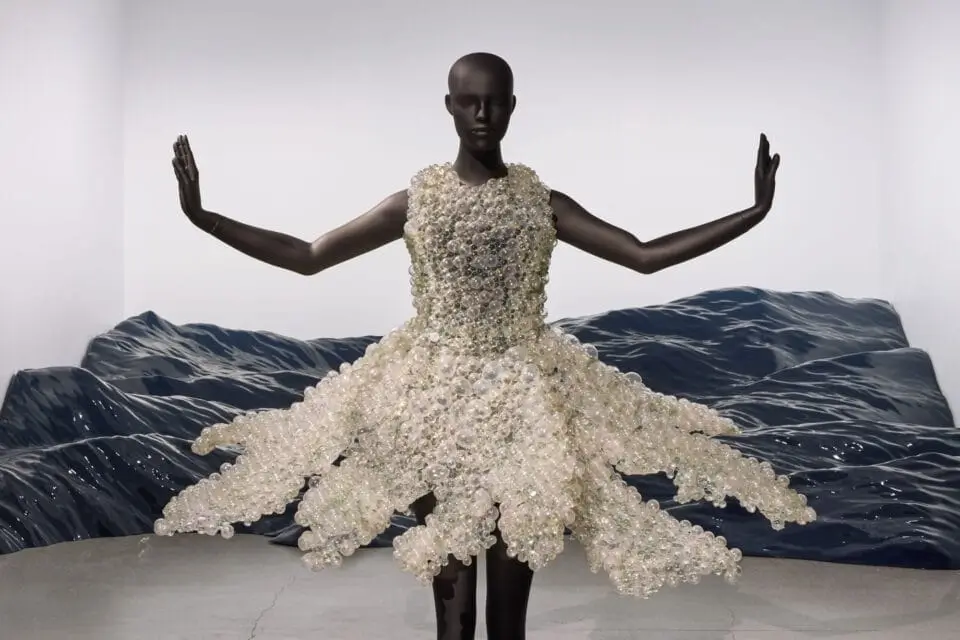
Nature is her primary muse—biomimicry, fractal geometry, neuroscience, and the intelligence of ecosystems. Collections like Sensory Seas (2020) drew on ocean currents and marine life, featuring dresses resembling jellyfish or coral. Roots of Rebirth explored regeneration and underground fungal networks, inspired by Merlin Sheldrake’s Entangled Life. Earthrise evoked planetary perspectives, while Sympoiesis (a more recent collection) highlights symbiotic relationships.
Collaboration is non-negotiable. She works with scientists, architects, artists, musicians, and engineers. Examples include sound artist Salvador Breed for immersive audio, photographer Nick Knight, and various material innovators. “The process is even more important than the results,” she notes. These partnerships yield functional advancements and sustainability-focused innovations, such as living dresses made with bioluminescent algae (125 million of them in one piece, maintained with mist in the exhibition).
Her celebrity clients—Beyoncé, Lady Gaga, Björk, Cate Blanchett, Ariana Grande, Grimes, Anne Hathaway, and Eileen Gu—have amplified her visibility. Beyoncé wore a Heliosphere dress on her Renaissance tour; Hathaway a dramatic pleated “Mother Mary” gown; Gu a bubble-emitting dress at the 2026 Met Gala. These pieces demonstrate how her work translates from runway to red carpet while retaining artistic integrity.
retro
Originally presented at the Musée des Arts Décoratifs in Paris in 2023, the exhibition has evolved for Brooklyn. Organized there by Cloé Pitiot and Louise Curtis, the Brooklyn iteration is adapted by Senior Curator Matthew Yokobosky and Imani Williford. It is structured in 11 thematic sections tracing van Herpen’s creative evolution over 19 years: Water and Dreams, Sensory Sea Life, Forces Behind the Forms, Atelier, Synesthesia, Skeletal Embodiment, Mythology of Fear, Growth Systems, Cabinet of Curiosities, Cosmic Bloom, and New Nature.
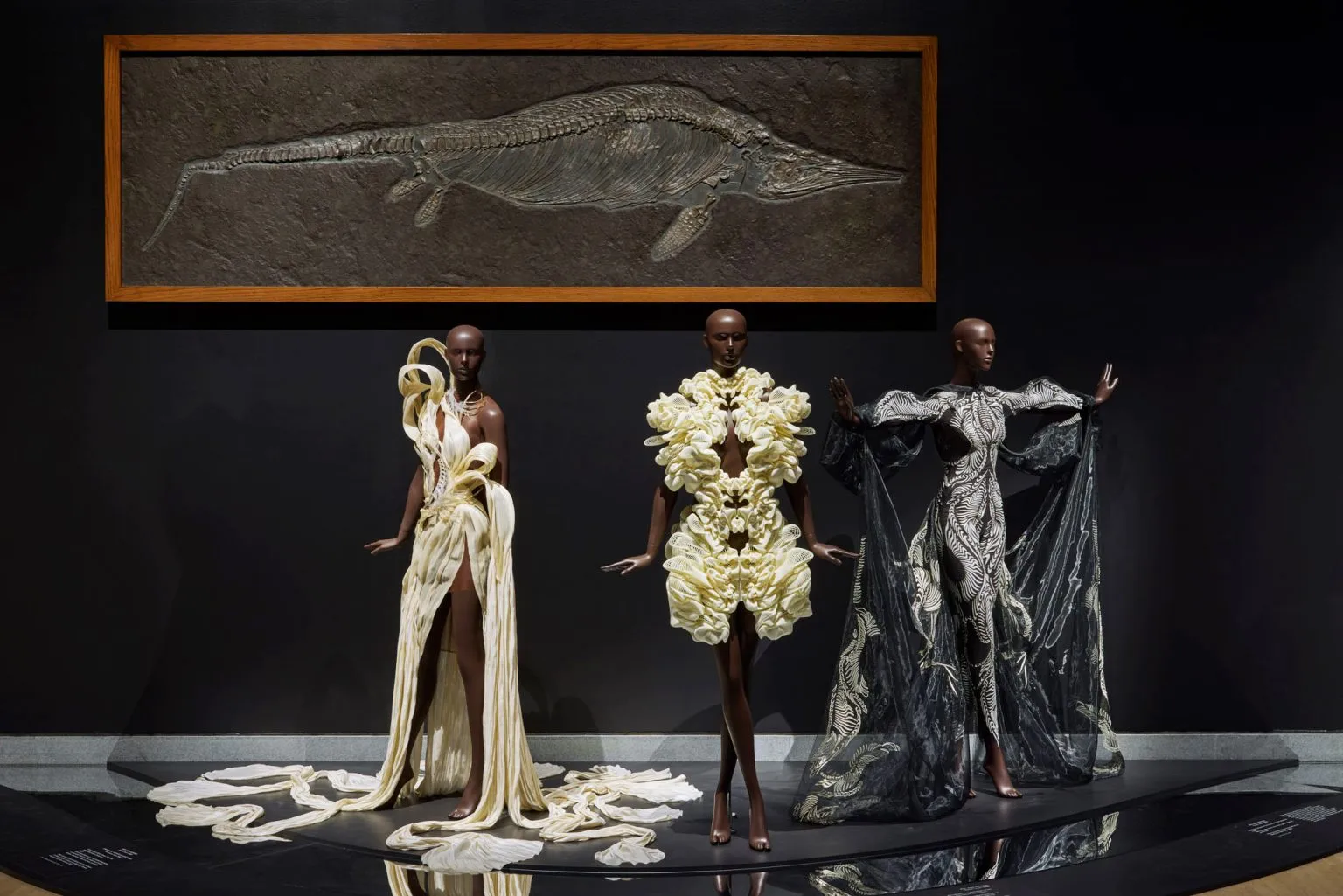
Visitors encounter a recreated atelier with live demonstrations (van Herpen plans to create a dress publicly during the run). Scientific artifacts—fossils, corals, skeletons from institutions like the American Museum of Natural History—dialogue with garments. Artworks by Naum Gabo, Rogan Brown, and others highlight shared forms. A multisensory soundscape by Salvador Breed and video installations, including the new Craftolution, enhance immersion.
Standout elements include the living algae dress, bubble pieces (including the 2016 precursor to Gu’s Met Gala look), mechanized garments, suspended mannequins evoking weightlessness, and projections on fabric. The show flows from oceanic blues to cosmic expanses, emphasizing interconnectedness across scales.
sig
In an era of fast fashion and digital overload, van Herpen offers a counterpoint: slow, thoughtful making informed by deep research. Her work addresses sustainability not as marketing but as material reality—exploring biodegradable options, reducing waste through precision tech, and learning from nature’s circular systems.
The Brooklyn Museum, with its history of landmark fashion exhibitions and commitment to arts and sciences, is an ideal host. The show aligns with concurrent exhibitions like The Met’s Costume Art, highlighting fashion’s dialogue with broader culture. Amid AI anxieties, van Herpen reaffirms the human hand, bodily experience, and natural intelligence.
Her practice also reflects a distinctly Dutch sensibility—pragmatic innovation rooted in a small country’s history of water management, trade, and artistic experimentation (she grew up near areas associated with Hieronymus Bosch). Yet it achieves universal resonance.
fin
As the exhibition runs, van Herpen continues evolving. Recent explorations include more living materials and speculative futures for nature and humanity. Her message remains optimistic: collaboration and symbiosis are nature’s strongest forces.
For those in New York, Sculpting the Senses is more than a fashion retrospective—it’s an invitation to reconsider our place in the world. Van Herpen doesn’t design clothes; she sculpts senses, perceptions, and possibilities. In refusing the bubble, she reminds us that true creativity responds to—and reshapes—the world around it.
Related Articles
Where the Face Should Be, Rafael Silveira Paints Open Sky
A pink shirt, shoulder-length hair, then no face at all: in “Surprise,” Rafael Silveira lets flowers and a clear blue sky stand in for the person.