DRIFT AUDIO
Listen to this story
Choose a voice, then press play.
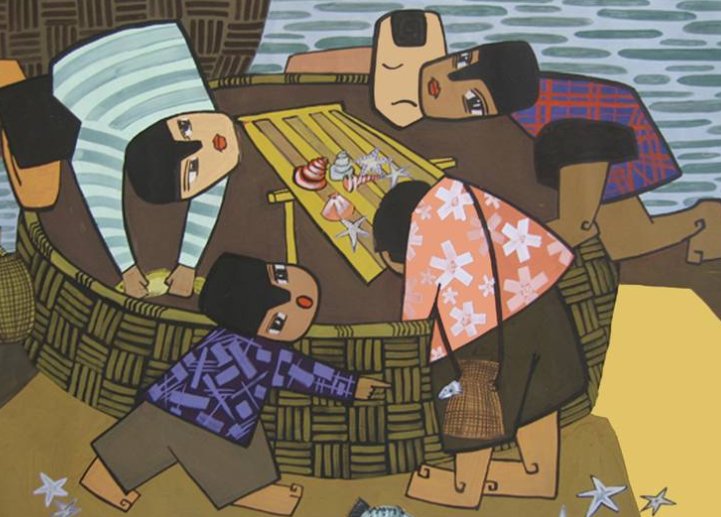
The vibrant fishing villages of Southeast Asia have long captured the imaginations of artists and photographers for their unique blend of serenity and bustling livelihood. Among the most iconic depictions is Phung Wang’s evocative masterpiece, “Children of the Fishing Village.” This work has earned its place as a cultural treasure, celebrated for its intricate storytelling and ability to portray the spirit of community through the lens of childhood innocence.
Through Wang’s keen eye and masterful technique, “Children of the Fishing Village” does more than just depict life in a small coastal community—it breathes it. The painting resonates with themes of resilience, simplicity, and joy, offering a poignant snapshot of life as seen through the eyes of children growing up by the sea.
Phung Wang: The Artist Behind the Vision
Born in 1960 in a small fishing village along the Mekong Delta, Phung Wang grew up immersed in the rhythms of coastal life. His early years were shaped by the ebb and flow of tides, the cacophony of fishing boats returning at dawn, and the laughter of children playing on the shore. These experiences became the bedrock of his artistic vision, which often centered on themes of everyday life in fishing communities.
Wang was trained in both traditional Asian ink painting and Western oil techniques, giving him a unique ability to blend styles and create deeply textured works. His art is often lauded for its use of light, vibrant color palettes, and a keen focus on the human spirit.
“Children of the Fishing Village” is one of Wang’s most celebrated works, hailed for its universal appeal and intimate portrayal of a way of life that is rapidly disappearing in the face of modernization.
The Scene: A Day in the Life of a Fishing Village
At first glance, “Children of the Fishing Village” immerses the viewer in a dynamic scene. The painting captures a small group of children playing along the shoreline, their laughter almost audible through Wang’s brushstrokes. Behind them, the village comes alive with activity: colorful fishing boats bob in the water, nets are being mended, and smoke rises from a nearby hut, perhaps signaling the preparation of the day’s catch.
The children are the focal point of the piece, their energy and innocence drawing the viewer’s eye. Some are barefoot, chasing after tiny crabs scuttling across the sand, while others take turns pushing a makeshift raft into the gentle waves. Their clothing is simple but vibrant, a patchwork of hand-dyed fabrics that speaks to the resourcefulness of their families.
This idyllic scene is framed by a horizon where the azure sky meets the shimmering ocean, a reminder of the village’s dependence on the sea. The interplay of light and shadow gives the painting depth, capturing the golden hues of the sunlit water and the cool blues of the shaded village.
Artistic Techniques and Symbolism
Wang’s use of light and texture is central to the painting’s impact. He masterfully employs a technique akin to sfumato, softening the edges of objects to create a dreamlike quality. This lends a sense of nostalgia to the scene, as though the viewer is looking back on a cherished memory.
The children’s movements are captured with fluidity, their joy almost tangible. Wang achieves this through dynamic brushstrokes, which contrast sharply with the meticulous detailing of the fishing boats and nets in the background. This juxtaposition mirrors the balance of play and labor that defines life in the village.
Color symbolism plays a significant role in the painting. The bright reds and yellows of the children’s clothing evoke warmth and vitality, while the cooler tones of the sea and sky suggest tranquility and constancy. Together, these elements create a harmonious composition that reflects the interconnectedness of the people and their environment.
Cultural Significance
Fishing villages like the one depicted in Wang’s painting are more than just picturesque settings; they are microcosms of a way of life deeply connected to nature. In these communities, the sea is not merely a resource but a living entity, providing sustenance, shaping traditions, and nurturing generations.
The children in the painting symbolize the future of this way of life, their carefree play a poignant contrast to the hard work of the adults around them. Yet, even in their games, there are hints of responsibility—building rafts, mimicking the movements of fishermen—that suggest they are learning the skills they will one day need to carry on their families’ legacies.
Wang’s painting serves as both a celebration of this culture and a subtle commentary on its fragility. As modernization encroaches on traditional fishing communities, the simple joys and tight-knit bonds portrayed in the painting are increasingly at risk of fading away.
The Universal Appeal of Childhood Innocence
One of the reasons “Children of the Fishing Village” resonates with so many viewers is its depiction of universal themes. Regardless of cultural background, the sight of children at play is instantly relatable. Wang’s painting reminds us of the universality of childhood, where the simplest moments—running barefoot, splashing in water, chasing dreams—carry the deepest meaning.
The piece also highlights the resilience of these children. Despite their humble surroundings, there is no trace of hardship in their faces, only unbridled joy. This resilience is a testament to the human spirit and its ability to find happiness in the most challenging of circumstances.
Modern-Day Relevance
As environmental concerns and urbanization threaten traditional fishing communities, Wang’s painting takes on a new layer of relevance. It serves as a call to action to preserve not only the physical spaces of these villages but also the cultural heritage they represent. Organizations dedicated to sustainable fishing and cultural preservation often draw on works like “Children of the Fishing Village” to inspire awareness and action.
Furthermore, in a world increasingly dominated by technology, the painting offers a reminder of the value of simplicity. The children’s connection to their environment, their creativity in making toys from natural materials, and their freedom to explore unstructured play are lessons that modern society can learn from.
Reception and Legacy
Since its unveiling in the late 1990s, “Children of the Fishing Village” has been exhibited in galleries around the world, earning accolades for its emotional depth and artistic mastery. It has become a symbol of Southeast Asian culture and a favorite among collectors of contemporary art.
Art historians have compared Wang’s work to that of Jean-François Millet, whose paintings of rural life in 19th-century France similarly combined realism with a deep respect for his subjects. Like Millet, Wang has succeeded in elevating everyday life to the level of fine art, creating a piece that is both specific to its setting and universally resonant.
Impression
“Children of the Fishing Village” is more than just a painting; it is a celebration of life, resilience, and the unbreakable bond between people and their environment. Through his masterful artistry, Phung Wang has captured a fleeting moment in time, one that speaks to the enduring spirit of fishing communities and the universal joys of childhood.
As viewers, we are invited to step into this world, to feel the sun on our faces and the sand between our toes, and to reflect on the beauty of life’s simple pleasures. In doing so, we honor not only the children of the fishing village but also the legacy of an artist who saw the extraordinary in the everyday.
Phung Wang’s masterpiece stands as a timeless reminder that even as the world changes, the values of community, resilience, and joy remain steadfast. It is a work that continues to inspire, challenge, and move us, proving that great art transcends boundaries and connects us all.
Related Articles

Modigliani’s Limestone ‘Tête’
Carved from a single block of limestone in Montparnasse more than a century ago, one of Modigliani's rare stone heads goes to auction for the first time…