Jensen Huang: Architect of NVIDIA’s $3 Trillion Tech Empire

April 8, 2025
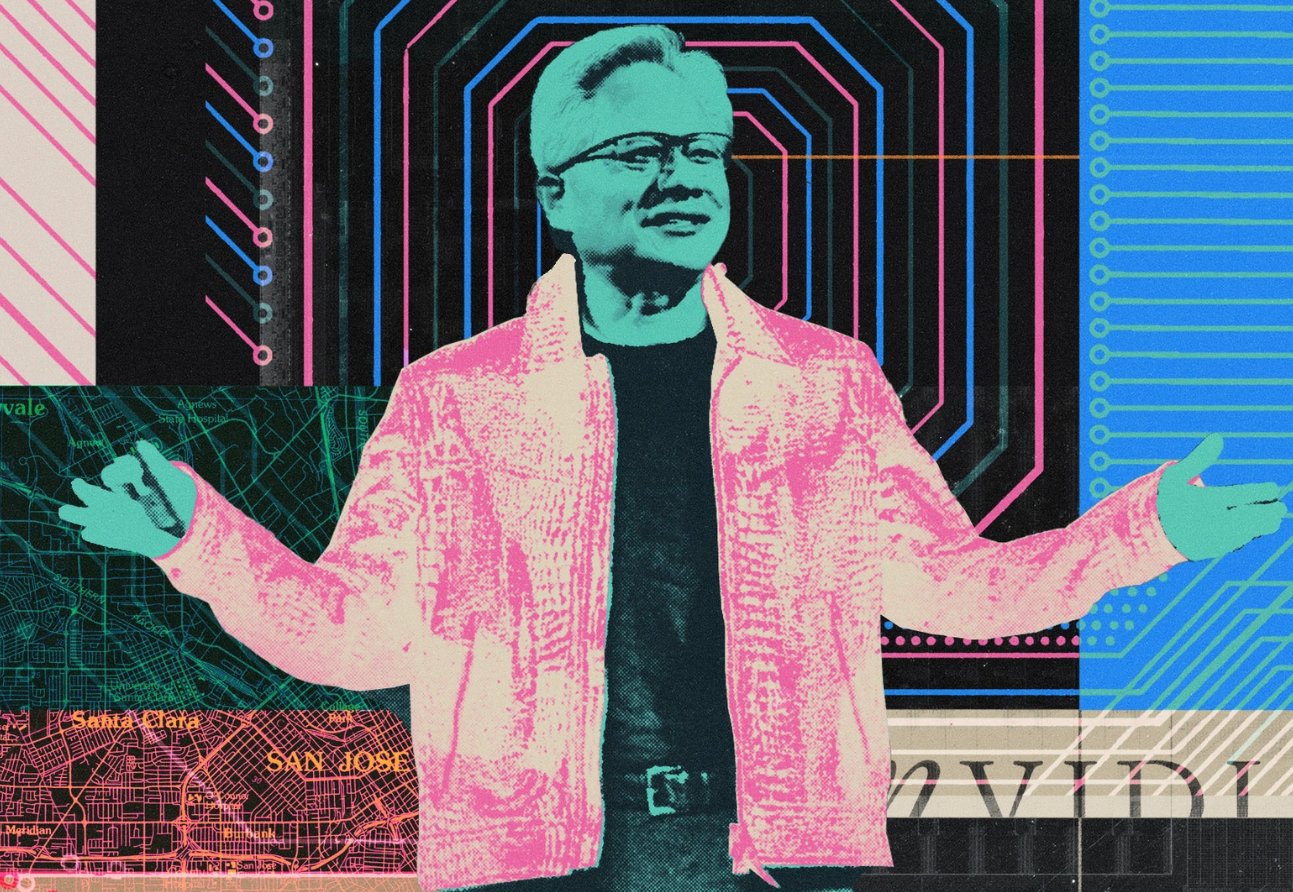
Jensen Huang, co-founder and CEO of Nvidia, has transformed the company from a niche graphics chip producer into a nearly $3 trillion tech titan at the forefront of the artificial intelligence (AI) revolution. This article explores Huang’s journey, his strategic decisions, and the innovations that propelled Nvidia to its current prominence.
Early Life and Education
Born on February 17, 1963, in Taipei, Taiwan, Huang’s early life was marked by significant transitions. His family moved to Thailand when he was six, and later, at the age of nine, Huang and his brother were sent to the United States for education. They attended the Oneida Baptist Institute, a boarding school in Kentucky, before reuniting with their family in Oregon. Huang pursued electrical engineering, earning a bachelor’s degree from Oregon State University and a master’s from Stanford University.
Founding of Nvidia
In 1993, at the age of 30, Huang co-founded Nvidia alongside Chris Malachowsky and Curtis Priem. The trio envisioned enhancing video game experiences by developing specialized chips for rendering 3D graphics. This vision materialized into the creation of the graphics processing unit (GPU), a pivotal innovation that would later find applications beyond gaming.
Pioneering GPU Technology
Nvidia’s initial focus was on the gaming industry, producing GPUs that significantly improved graphics rendering. However, Huang recognized the broader potential of GPUs. In 2006, Nvidia introduced CUDA (Compute Unified Device Architecture), enabling GPUs to perform parallel processing tasks. This development allowed GPUs to handle complex computations, making them suitable for scientific research and, eventually, AI applications.
Strategic Shift to Artificial Intelligence
The breakthrough moment came in 2012 when researchers discovered that Nvidia’s GPUs were exceptionally efficient for training deep neural networks. This realization positioned Nvidia at the heart of the AI revolution. Huang made the strategic decision to pivot the company’s focus towards AI and deep learning, investing heavily in developing hardware tailored for these applications.
Leadership Style and Corporate Culture
Huang’s leadership is characterized by an unconventional approach. He maintains a flat organizational structure, directly overseeing around 60 individuals without a traditional second-in-command. Huang eschews one-on-one meetings, preferring group discussions that foster collective learning and swift decision-making. This hands-on and demanding management style has been instrumental in driving Nvidia’s rapid innovation and adaptability.
Market Dominance and Financial Growth
Under Huang’s stewardship, Nvidia’s market capitalization soared, surpassing $3 trillion and briefly overtaking tech giants like Microsoft and Apple. This meteoric rise is largely attributed to the company’s dominance in AI hardware, with its GPUs becoming the gold standard for AI research and applications.
Challenges and Future Outlook
Despite its success, Nvidia faces challenges, including increased competition and geopolitical tensions affecting semiconductor supply chains. Huang remains optimistic about AI’s potential, viewing it as a tool for progress. He continues to steer Nvidia towards innovations that could shape the future of technology, from autonomous vehicles to advanced robotics.
Impression
Jensen Huang’s visionary leadership and strategic foresight have been instrumental in Nvidia’s evolution from a graphics chip manufacturer to a central player in the AI revolution. His ability to anticipate industry trends and pivot accordingly has not only propelled Nvidia to unprecedented heights but also significantly influenced the trajectory of modern computing.
Related Articles

CASETiFY Gears Up for a New Web Slinger with Its Spider-Man: Brand New Day Collection
CASETiFY marks Peter Parker’s next chapter with a case collection built around his reworked suit, […]