DRIFT AUDIO
Listen to this story
Choose a voice, then press play.
energy
“Jump” emerges as a high-voltage anthem designed for the global stage of football’s most watched tournament. Developed as part of a campaign by Coca-Cola, the track merges rock virtuosity, thunderous percussion, and chant-ready pop hooks into a sound built specifically for stadiums packed with tens of thousands of fans. The song captures the electric anticipation that surrounds the World Cup—those seconds before kickoff when the roar of the crowd becomes a unified rhythm.
Rather than relying solely on mainstream pop formulas, “Jump” pushes into a hybrid sonic territory. It blends arena rock, modern production, and festival-scale energy, ensuring the song resonates across streaming platforms, highlight reels, and stadium speakers alike. The result is an anthem engineered to be both global and immediate—something that can be sung, shouted, and remixed by fans around the world.
vai
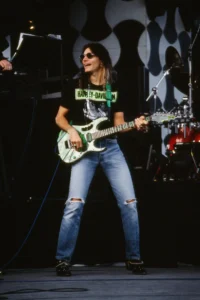
At the melodic center of the track is the unmistakable guitar work of Steve Vai. Known for decades of virtuosic playing, Vai contributes soaring lead lines and dramatic tonal textures that elevate the song beyond a typical sports anthem. His guitar riffs function almost like a rallying call—bright, expressive, and cinematic.
Instead of dominating the composition, Vai’s playing floats above the rhythm section, providing a sense of lift and movement. The guitar sections echo the emotional highs of a football match, rising during the chorus and exploding in brief bursts of melodic intensity. It is the musical equivalent of a crowd surge when a team breaks toward the goal.
barker
If Vai provides the lift, Travis Barker supplies the propulsion. The drummer’s signature style—rapid snare hits, crisp cymbal work, and explosive fills—injects relentless momentum into the track. Barker blends live drumming with modern production techniques, creating a rhythm that feels equally at home in a stadium environment or on global streaming playlists.
The percussion builds tension throughout the song, mirroring the dramatic pacing of football itself. Quiet moments swell into rhythmic eruptions, echoing the emotional waves fans experience during a match. The result is a beat that practically demands movement—something audiences can clap, stomp, and jump along with.
View this post on Instagram
stir
Coca-Cola has a long history of creating musical moments around international sporting events, particularly the World Cup. Over the years, the brand has worked with artists from across genres to produce songs that capture the celebratory spirit of the tournament. “Jump” continues that tradition but shifts toward a rock-driven sound that feels fresh within the sports anthem landscape.
The song’s structure reflects the realities of modern media consumption. Short instrumental breaks allow for highlight edits, while the chorus features chant-friendly phrasing designed for crowd participation. It is a piece of music crafted not only for listening but for shared experiences—goal celebrations, stadium chants, and viral clips.
flow
Lyrically, “Jump” centers on collective movement and shared excitement. The word “jump” itself becomes a metaphor for rising together—fans, players, and entire nations lifting their energy in unison. In football stadiums around the world, jumping is already a ritual. Supporters bounce together in rhythm as chants echo across the stands.
The anthem captures this universal gesture. Its lyrics emphasize momentum, motion, and the emotional lift that occurs when thousands of people move as one. Rather than focusing on a single team or nation, the message celebrates the global nature of the World Cup and the shared joy of the game.
end
Sports anthems exist to amplify moments. A last-minute goal, a sudden comeback, or a dramatic penalty shootout can transform an ordinary match into a memory that lives for decades. “Jump” positions itself as the soundtrack to those moments.
The track’s climactic chorus, layered instrumentation, and explosive percussion are all designed to heighten emotional peaks. When the crowd leaps from their seats and the stadium erupts, the song’s central message becomes literal. Fans jump. The music rises. The atmosphere becomes electric.
In that sense, “Jump” succeeds as more than a promotional campaign song. It becomes a sonic reflection of football’s most powerful tradition: the shared surge of energy when millions of people around the world unite around a single game.
From the DRIFT archive: Central Cee’s “Booga” Pushes His Sound into a Sharper, More Self-Assured Era · Sam Gellaitry “On & On” — A Sonic Loop of Emotion and Motion
Related Articles

Two Chicago Lifers, One Wave: Kaicrewsade and Luke Titus on ‘#SWAG SURF’
Kaicrewsade's new album RAINBOW_ arrived on October 14, and its second track pulls in Chicago drummer and singer Luke Titus.