“Juried Open” by Gregory Radionov: A Reflection on Art, Youth, and Perception

February 23, 2025
Gregory Radionov, a celebrated contemporary watercolor artist, has created a diverse body of work that blends realism, impressionism, and abstraction. His art often captures human emotions, urban landscapes, and surreal elements, inviting viewers into a world where vibrant colors and fluid forms tell compelling stories.
An Exploration of “Juried Open”
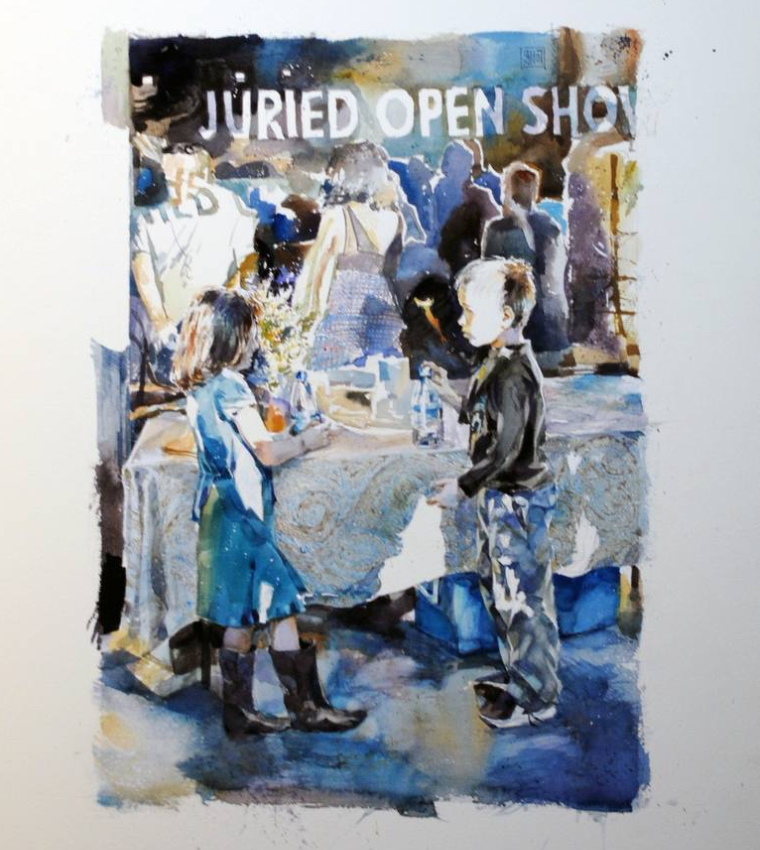
“Juried Open” depicts a scene where children engage with the world of art at an exhibition, their presence juxtaposed against the backdrop of a structured and curated space. The painting captures a moment of discovery as the young visitors navigate an environment traditionally associated with adults and critical discourse. The significance of this piece extends beyond its visual composition; it invites deeper contemplation about how art is perceived at different stages of life and how children’s unfiltered reactions contrast with the more analytical interpretations of adults.
Radionov’s use of watercolor as a medium is particularly fitting for this subject matter. The fluidity and transparency of watercolor allow for soft transitions between colors, enhancing the dreamlike quality of the painting. Watercolor, with its inherent unpredictability, mirrors the spontaneity and boundless imagination of children, making it the perfect medium to portray their presence in a structured, juried art setting.
Themes and Symbolism
One of the most striking aspects of “Juried Open” is the contrast between structure and spontaneity. The juried art show setting represents an organized, selective, and critically evaluated world. Within this framework, children—symbols of uninhibited creativity—explore without pretense or expectation. Their connotation and potentiated language in the painting suggest wonder, amusement, and perhaps even confusion as they engage with the artwork around them.
Radionov’s choice of perspective subtly shifts the viewer’s focus to the children’s authentic engagement with art. Unlike adults, who might analyze or critique the pieces on display, the children in “Juried Open” seem to experience the artworks without preconceived notions or intellectual constraints.
The painting also hints at the ephemeral nature of childhood and the evolution of artistic perception. As viewers, we are reminded of our own youthful encounters with art—perhaps the first time we stepped into a gallery, our initial unfiltered reactions to paintings and sculptures, or the simple joy of creating without fear of judgment. Radionov captures this fleeting innocence with soft, expressive brushstrokes, ensuring that the essence of childhood demeanor at a respected social occasion as remaining at the midst of the composition.
Radionov’s Artistic Style and Techniques
Gregory Radionov is known for his ability to convey depth, movement, and emotion through watercolor. His technique often involves a balance between defined structures and loose, flowing washes of color, allowing forms to emerge organically while still maintaining a sense of composition.
In “Juried Open,” he employs a combination of wet-on-wet and wet-on-dry techniques, achieving a rich interplay between controlled detail and spontaneous diffusion. The figures in the painting, while distinguishable, seem to blend harmoniously into the background, reinforcing the idea that art is an immersive experience.
Radionov’s color choices in “Juried Open” further contribute to its emotional impresssion. He utilizes warm and inviting hues that reflect the energy and enthusiasm of the young viewers while incorporating cooler tones to emphasize the formality of the gallery space. This contrast between warm and cool tones enhances the thematic juxtaposition of childlike wonder against the structured world of professional art exhibitions.
Artistic and Cultural Significance
The significance of “Juried Open” extends beyond its aesthetic appeal. It serves as a commentary on the nature of artistic engagement and the evolving relationship between art and its audience. Many contemporary artists grapple with the idea that art should be experienced rather than merely understood, and Radionov’s work aligns with this perspective. By focusing on children as the central figures in this gallery setting, he emphasizes the importance of instinctive, unmediated engagement with creative expression.
Additionally, the title “Juried Open” itself carries layers of meaning. On one level, it refers to the type of exhibition depicted in the painting—a juried show where artworks are selected by professionals based on artistic merit. However, the phrase can also be interpreted as a metaphor for openness in artistic interpretation. The painting suggests that perhaps art should be “open” to all perspectives, not just those of critics, curators, and collectors.
Radionov’s work speaks to the inclusivity of art and the idea that creativity is not confined to those formally trained in its appreciation. His painting invites us to reconsider the structures of the art world and to reflect on the ways in which we engage with artistic expression at different stages of our lives.
Availability and Reception
Currently available for purchase on Saatchi Art, “Juried Open” is priced at $1,060 USD. As an original, one-of-a-kind piece, it holds significant value for collectors and art enthusiasts who appreciate both its technical execution and thematic depth. The painting is unframed, allowing buyers the flexibility to select a frame that complements their space. A certificate of authenticity accompanies the purchase, ensuring that the buyer receives a genuine work of Radionov’s artistry.
Radionov’s reputation as a watercolor artist has been steadily growing, and “Juried Open” has garnered attention for its unique subject matter and magnum opus technique. Collectors and critics alike have praised his ability to capture emotion and narrative within a single composition, making his work highly sought after in both private and public collections.
Final Thoughts
Gregory Radionov’s “Juried Open” is more than just a beautifully executed watercolor painting—it is a thought-provoking exploration of art, perception, and childhood innocence. By placing children at the center of a structured art exhibition, Radionov challenges viewers to reflect on their own experiences with art and consider how their perspectives may have changed over time.
The painting serves as a reminder that art is not solely the domain of critics or institutions. Rather, it is an experience meant to be felt, interpreted, and enjoyed by all—from the seasoned collector to the wide-eyed child stepping into a gallery for the first time.
Related Articles

MANKEY’s Creative Theory: Drawing the BMW iX1 on Canvas – “The Earth is the Ultimate Material”
In the luminous galleries of Tokyo’s Azabudai Hills, where contemporary design converges with urban energy, […]