DRIFT AUDIO
Listen to this story
Choose a voice, then press play.
In This Story
- Picnic Bouquet (2026) by Rachel Hayden
- Checkered Flowers Inspired by Picnic Blankets
- Playful Blend of Pattern, Color, and Whimsy
- Explores Balance, Joy, and Impermanence
- Small-Scale Acrylic on Panel Composition
- Part of the Feel Free Exhibition at Joy Machine
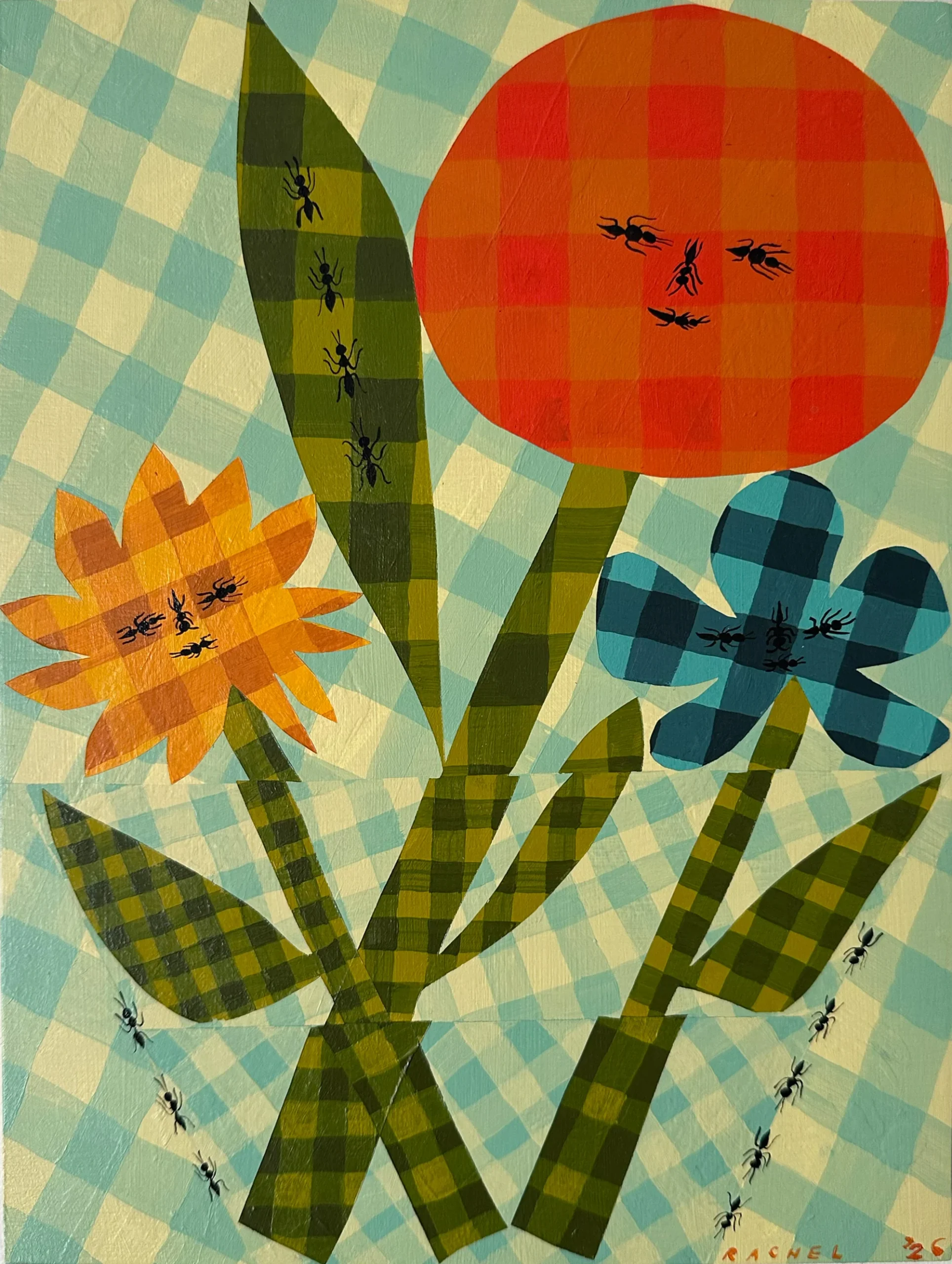
In the sun-dappled haze of a perfect afternoon, where the grass whispers secrets to the breeze and time momentarily suspends its relentless march, Rachel Hayden’s Picnic Bouquet (2026) invites us to linger. This intimate 9 x 12-inch acrylic on panel, priced at a regular $1,100 USD and accompanied by a certificate of authentication, is more than a still life—it is a tender meditation on control, impermanence, and the quiet joy of engineered delight. Currently part of the Feel Free group exhibition at Joy Machine in Chicago (on view through June 27, 2026), the work captures Hayden’s signature alchemy: blending Renaissance-inspired motifs with play, contemporary absurdity to create compositions that feel both nostalgic and utterly of-the-moment.
Born in Cincinnati, Ohio, in 1992 and now based in Brooklyn, New York, Hayden graduated with a BFA from the Maryland Institute College of Art (MICA) in 2015. Her path was shaped by early childhood education at the Walters Art Museum in Baltimore, where she led programs for infants and toddlers, fostering an appreciation for bold shapes, nameable colors, and emotional accessible in art. This foundation infuses her practice with a childlike fearlessness—puzzle-piecing elements into symmetrical order amid personal and universal chaos—while her move to New York in 2020 amid the pandemic lockdown honed her resourceful, intimate scale.
Picnic Bouquet exemplifies this evolution. At first dekko, it presents three vibrant, checkered flowers—orange, yellow, and blue—arranged with lush leaves in a bouquet-like formation. Their gingham patterns evoke classic picnic blankets, transforming the floral subjects into anthropomorphic characters with subtle facial expressions that hint at personality and emotion. The checkerboard motif creates a visual trick, blurring the line between painting and collage, fooling the eye much like the trompe-l’œil masters of the Renaissance, yet subverting expectations with modern whimsy. Ants, those ubiquitous picnic interlopers, make subtle appearances elsewhere in her related works, underscoring transience.
stir
Hayden’s oeuvre is populated by anthropomorphized fruits, flowers, bugs, and self-portraits that serve as imaginary companions. In interviews, she describes painting as a means of reclaiming control: “In the painting I can control how others (in the form of flowers, fruits, etc.) interact with me. And I can create balance. Everything can fit together just right.” This know resonates deeply in Picnic Bouquet, where disparate elements—floral forms, patterned fabrics, implied outdoor ephemerality—coalesce into uncanny harmony.
Her process often draws from personal limitations. Working in small studios, she “cram[s] things to fit into the space,” mirroring the puzzle-like compositions that define her style. Airbrushing and layered acrylic techniques allow for smooth gradients and textured depth, while color choices dictate atmosphere—vibrant daytime palettes contrasting moodier nocturnal variants. Childhood drawings of repeated motifs, like her “bun lady” character, prefigure the iterative, self-referential nature of her current output.
In the broader context of Feel Free, curated to explore “the inevitability of change” and “small instances of understanding,” Picnic Bouquet dialogues with works by Paulina Ho, Hanna Lee Joshi, and Jeremy Miranda. Hayden’s piece stands out for its playful subversion of still-life traditions, using the picnic motif to gesture toward impermanence: picnics are inherently temporary setups on grass, disrupted by ants or weather, yet they offer moments of aligned perfection.
culture
The picnic theme taps into rich cultural veins. From Édouard Manet’s Le Déjeuner sur l’herbe to modern evocations in fashion and design—think gingham dresses on runways or al fresco luxury spreads by brands like Hermès—picnics symbolize idealized leisure, nature’s bounty, and social ritual. Hayden modernizes this with a streetwise, Gen Z-inflected whimsy: checkered patterns that nod to both picnic blankets and contemporary textile design, flowers with faces that anthropomorphize emotion in a way reminiscent of Yayoi Kusama’s polka dots or the playful surrealism of artists like Chiho Aoshima.
In an era of digital overload and existential flux, Picnic Bouquet offers respite. Its small scale (9 x 12 inches) encourages intimate viewing, much like a treasured locket or a Polaroid snapshot. The $1,100 price point makes it accessible within the contemporary art market, where emerging voices like Hayden command growing attention—her works have appeared at galleries such as The Hole, 5-50 Gallery, and in publications like Hi-Fructose and Colossal.
Fashion and design parallels abound. The gingham motif echoes seasonal trends in streetwear and luxury—see collaborations blending heritage checks with bold florals, or the enduring appeal of picnic-chic in collections from Jacquemus to newer voices emphasizing sustainability and joy. Hayden’s color-driven atmospheres parallel how designers use palette to evoke mood: the sunny optimism of her bouquet could inspire a capsule collection of picnic-ready accessories or editorial spreads for summer issues.
layer
Hayden has spoken of imbuing objects with personalities—“two roses in a vase being in love; or oranges that are pissed off”—as a way to process isolation and self-reliance. Her self-portraits often feature detached figures or expressive faces exploring “happy crying,” laugh-cry combos, and the full spectrum of human vulnerability. In Picnic Bouquet, the flowers’ subtle expressions invite projection: Are they content in their arrangement, or playfully defiant against the ants of everyday disruption?
This emotional layering elevates the work beyond decoration. It aligns with broader artistic conversations around mental health, control, and whimsy as resistance—think the tender absurdity of artists like Yoshitomo Nara or the patterned domesticity of Florine Stettheimer. For collectors and enthusiasts in fashion, art, and culture, it represents a bridge: wearable joy translated to wall-bound philosophy.
min
Executed in acrylic on panel, the piece benefits from the medium’s versatility—quick-drying layers for precise detailing, airbrush softness for atmospheric depth, and durability suited to its intimate format. The panel support provides a smooth, rigid surface ideal for the crisp checkerboard patterns and fine botanical details. At 9 x 12 inches, it demands proximity, rewarding close inspection of brushwork, color transitions, and the playful interplay of positive and negative space.
Conservation-wise, acrylics are stable, and the included certificate of authentication ensures provenance. For display, it pairs beautifully in eclectic interiors: alongside mid-century modern furniture, contemporary streetwear-inspired textiles, or even horology pieces that echo its precision and balance.
impression
As part of Hayden’s ongoing exploration—seen in pieces like Self-Portrait as a Picnic Blanket from the same series—Picnic Bouquet contributes to a larger narrative of finding order in chaos. Her work has been featured in solo and group shows, puzzle collaborations (e.g., Self-Portrait as a Florist), and critical acclaim in outlets celebrating new contemporary art.
In the audience lens—where fashion meets culture, design intersects identity, and art fuels human flourishing—Hayden’s piece embodies innovation through constraint. It reminds us that in a world of constant flux, small, deliberate acts of composition can yield profound harmony. Whether displayed in a sunlit corner of a New York loft, a Chicago gallery, or a collector’s home attuned to seasonal shifts, Picnic Bouquet promises to spark conversation, evoke smiles, and perhaps inspire one’s own al fresco reveries.
Priced accessibly yet carrying the weight of thoughtful execution, this work is poised for appreciation by emerging collectors, fashion creatives seeking narrative depth in their spaces, and anyone drawn to art that balances tension with delight. As Hayden herself aims for paintings that “make [her]self laugh,” Picnic Bouquet extends that invitation outward—a bouquet not just of flowers, but of fleeting, perfect moments worth preserving.
From the DRIFT archive: ArtScience Museum Singapore – “Mirror Mirror: Journey Into the Mind” Exhibition at Marina Bay