DRIFT AUDIO
Listen to this story
Choose a voice, then press play.
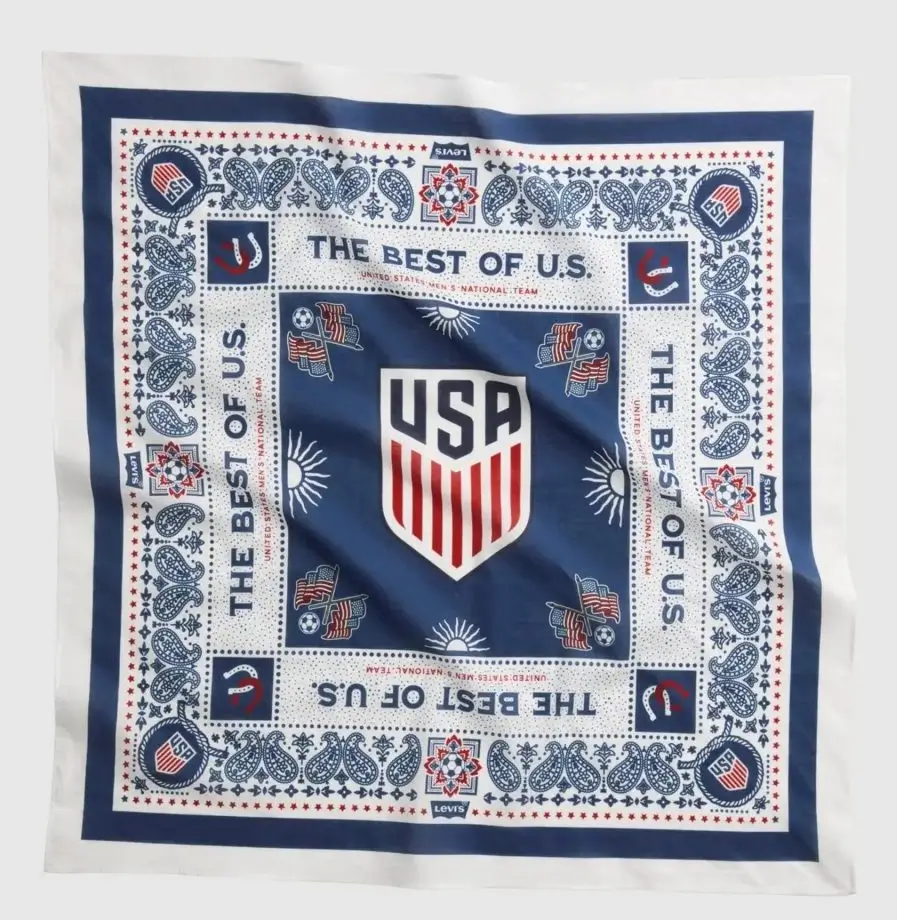
What makes this release resonate is its restraint. Rather than flooding the moment with excess, the collection distills itself into two essential forms: a reinterpreted Type I Jacket and a heritage bandana. These are not new silhouettes chasing relevance. They are existing archetypes—objects already embedded in American visual language—subtly re-coded with the U.S. Soccer crest. The result is a quiet assertion: that national pride, when filtered through design, doesn’t need to shout.
stir
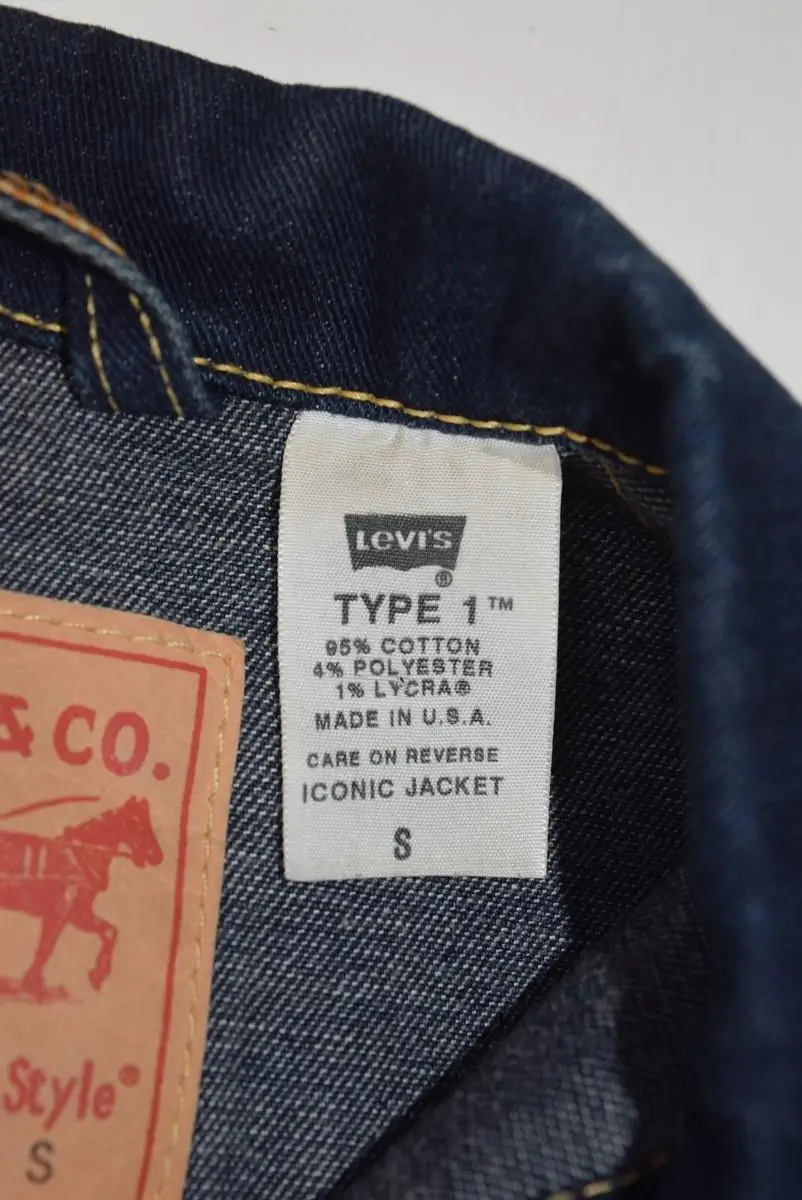
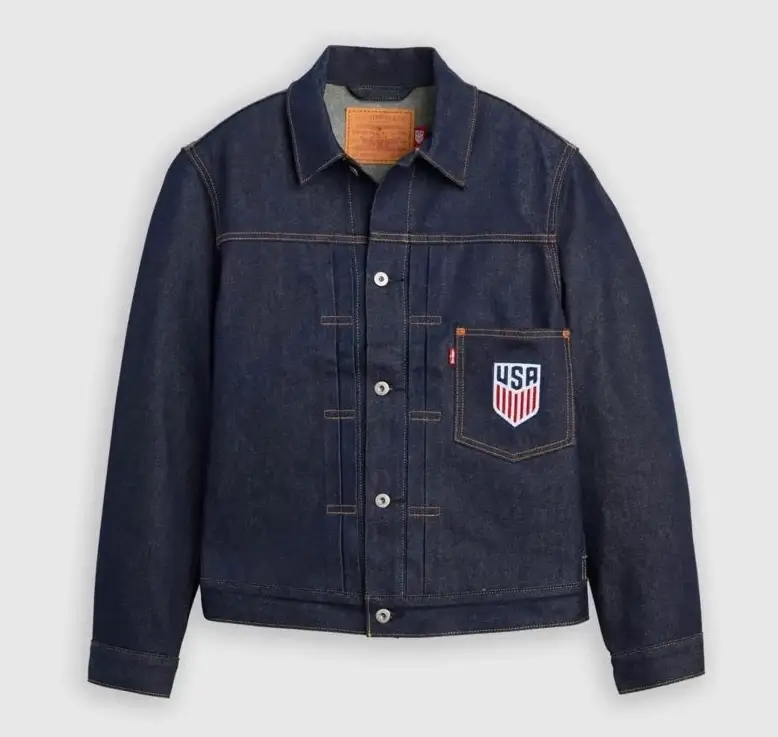
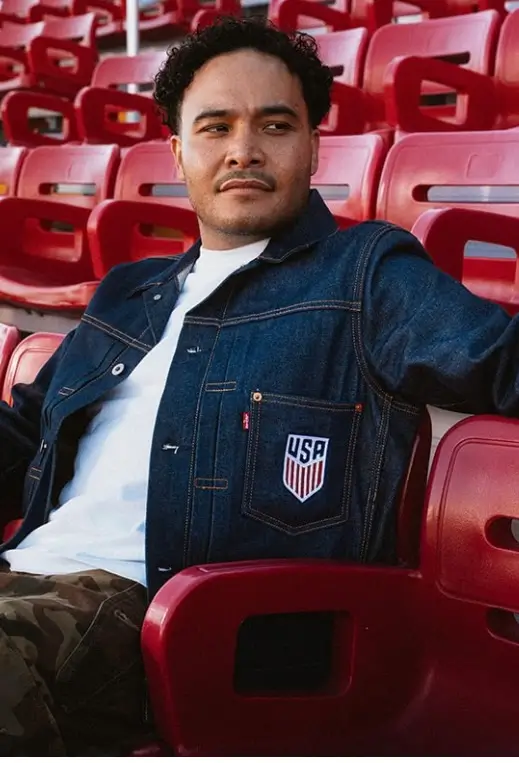
The centerpiece of the capsule is the Type I Jacket—a silhouette that predates most contemporary fashion cycles, rooted in early 20th-century American labor. Here, it returns not as reproduction, but as recalibration. The navy-washed denim anchors the piece in something familiar yet slightly elevated, the tone deeper than classic indigo, almost ceremonial in its restraint.
There’s an intentionality to how the U.S. Soccer crest is placed. On the chest, it functions as a marker—clean, direct, legible. But it’s on the back where the narrative expands. Embroidered detailing moves beyond logo placement into storytelling, referencing the layered evolution of soccer in America: from overlooked pastime to global participant. The jacket doesn’t explain this outright. It suggests it, allowing the wearer to carry that progression without overstatement.
Structurally, the piece remains loyal to its origins. The front pleats, the single pocket, the cropped proportion—these are not nostalgic gestures; they are foundational elements. Copper rivets and bar-tack reinforcements reinforce the idea that this is still, at its core, a work garment. What changes is context. Instead of mines or railroads, the terrain becomes stadiums, streets, watch parties, airports—movement across a different kind of map.
What’s compelling is how naturally the worlds align. Soccer, often framed as global and fluid, meets denim, historically grounded and American. The tension dissolves quickly. Both are languages of movement. Both accumulate meaning over time. The jacket becomes a bridge—between past and present, local and global, uniform and individuality.
flow
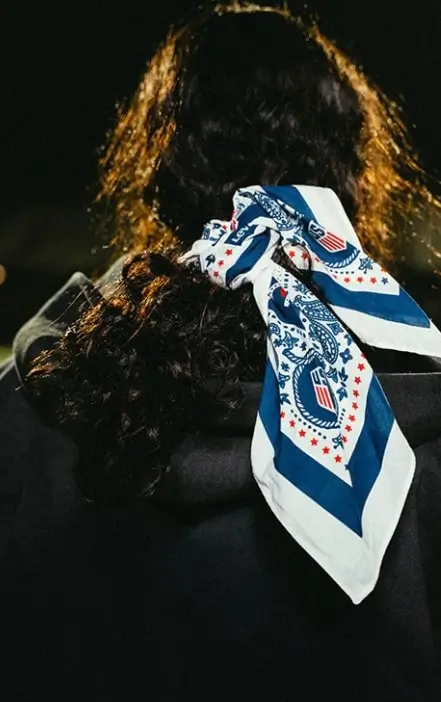
If the jacket is the statement, the bandana is the echo. Smaller in scale but not in significance, it channels a lineage of American utility—one that spans labor, rebellion, and everyday function. In this context, it becomes something else: a flexible emblem of belonging.
Printed with the U.S. Soccer crest and subtle Levi’s branding, the bandana operates across environments. It can exist at the neck, on a wrist, tied to a bag, or folded into a back pocket. It doesn’t prescribe its own use. That openness is its strength. It mirrors the way fans engage with sport—not through a single uniform, but through countless personal adaptations.
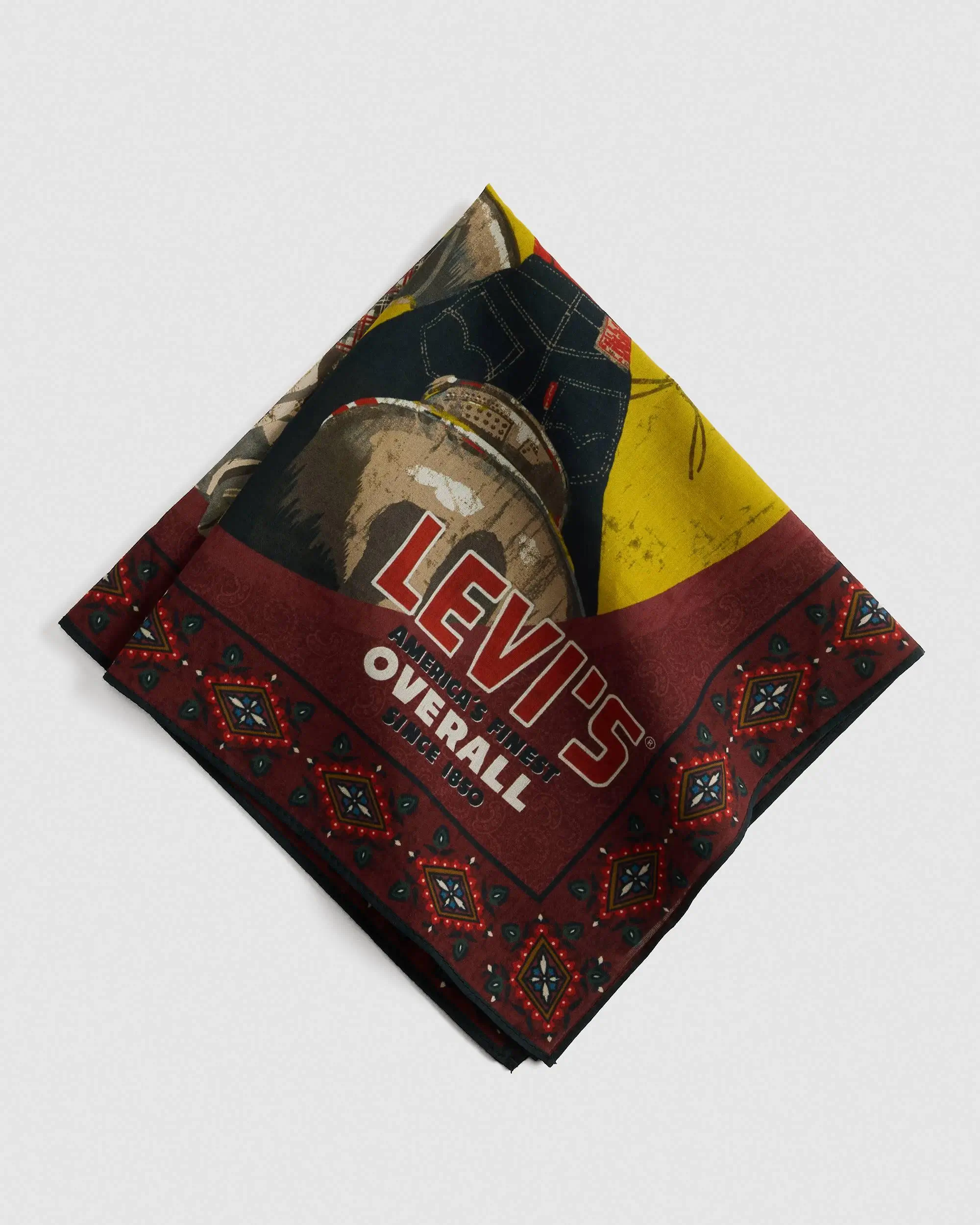
There’s also something generational in its presence. Bandanas have long carried coded meanings—regional, cultural, stylistic. Here, those layers collapse into something more universal. During the World Cup summer, it becomes less about individual identity and more about shared alignment. A quiet signal, repeated across crowds.
moment
The release does not exist in isolation. It’s synchronized with a broader cultural shift. Soccer in the United States has moved beyond its long-standing position as a secondary sport. Attendance numbers, youth participation, media coverage—each has contributed to a redefinition of its place within American life.
The 2026 World Cup, co-hosted across North America, becomes a focal point for that evolution. It is both culmination and catalyst. And within that framework, Levi’s enters not as an outsider leveraging a trend, but as a participant interpreting a moment.
There is a historical symmetry here. Levi’s has always documented American transitions—gold rush expansion, industrialization, counterculture, globalization. Soccer’s rise represents another phase. Less about industry, more about identity in a connected world. By aligning with U.S. Soccer now, Levi’s effectively archives this shift in fabric form.
auth
One of the more difficult balances in contemporary collaborations is authenticity. Too often, partnerships lean heavily into branding, overwhelming the object itself. This capsule avoids that trap by scaling back.
There are no excessive graphics, no forced reinterpretations of logos, no overdesigned elements competing for attention. Instead, the collaboration allows each component—denim, crest, construction—to remain legible. It trusts the inherent strength of those elements.
This restraint is not minimalism for its own sake. It’s strategic. It recognizes that both Levi’s and U.S. Soccer carry their own weight. The goal is not to merge identities into something unrecognizable, but to let them coexist in a shared space.
The result feels less like a product launch and more like a document—something that records where these two entities intersected at a specific cultural moment.
style
What extends the relevance of the collection is its adaptability. The Type I Jacket does not require a stadium to make sense. It functions equally in everyday environments—layered over a plain white tee, paired with denim, or contrasted with tailored trousers.
There’s a fluidity to how it can be worn. Over a jersey, it leans into fan identity. With neutral basics, it becomes more understated—less about sport, more about texture and proportion. The bandana follows a similar logic. It shifts from functional accessory to visual accent depending on context.
This versatility is essential. It ensures the collection does not expire with the tournament. Instead, it continues to evolve with the wearer. Each use adds a layer—creases, fades, associations—transforming it from object to archive.
culture
Zooming out, the collaboration sits within a larger conversation about how fashion engages with sport. Historically, the relationship has oscillated—periods of separation followed by moments of convergence. What feels different now is the permanence of that convergence.
Sport is no longer just performance. It is narrative, identity, and community. Fashion, in turn, becomes a medium through which those elements are expressed. The Levi’s x U.S. Soccer capsule exemplifies this shift. It does not treat sport as spectacle to be branded, but as culture to be interpreted.
There’s also an undercurrent of national reflection. As the United States prepares to host a global event of this scale, questions of identity surface—what it means to represent, to belong, to participate. Clothing becomes one of the ways those questions are explored. Not answered definitively, but worn, adjusted, reconsidered.
evolve
A key strength of Levi’s has always been its ability to evolve without abandoning its core. The Type I Jacket is emblematic of that philosophy. Decades old, yet continually recontextualized.
In this collision, that adaptability is foregrounded. The jacket remains structurally consistent, but its meaning shifts. It absorbs the symbolism of the World Cup, the rise of soccer, the current cultural climate. It becomes contemporary without losing its origin.
This is what prevents the collection from feeling temporary. It is not tied exclusively to 2026. It is anchored in a longer timeline—one that extends backward through Levi’s history and forward through whatever cultural moments follow.
fin
The Levi’s x U.S. Soccer capsule succeeds not because it is expansive, but because it is precise. It understands its role within a larger moment and responds accordingly—through material, through form, through restraint.
The Type I Jacket stands as the anchor. Durable, adaptable, and quietly symbolic. The bandana complements it, extending the narrative into smaller, more flexible expressions. Together, they form a cohesive statement without needing to declare one.
As the countdown to the 2026 World Cup continues, the collection offers something that goes beyond anticipation. It offers participation. Not in the sense of attending matches or following scores, but in carrying a piece of the moment—on the body, over time.
Read Drift’s related feature, Adidas Originals x Coca-Cola Collection: FIFA World Cup 2026.
Related Articles
HUF Put Unit-01 And Rei On Triple Triangle
Three tees, a pinned 6-panel, a silver keychain. ¥7,480 on the shirts and hat. ¥3,465 […]