DRIFT AUDIO
Listen to this story
Choose a voice, then press play.
In an age where shopping happens in silence—scrolling, tapping, one-clicking—Anthropologie is doing something quietly radical: it makes you stop.
Not with urgency. Not with discounts. But with atmosphere.
Its Summer 2026 window installations, unfolding across flagship locations from SoHo to Melrose, don’t behave like merchandising. They read as environments—constructed pauses in the city’s rhythm. A moment where retail sheds its function and becomes something closer to memory, or even illusion.
The concept, titled Confectionary Reverie, operates less like a campaign and more like a staged dream. Dessert becomes architecture. Fashion dissolves into setting. The real and imagined blur until distinction feels unnecessary.
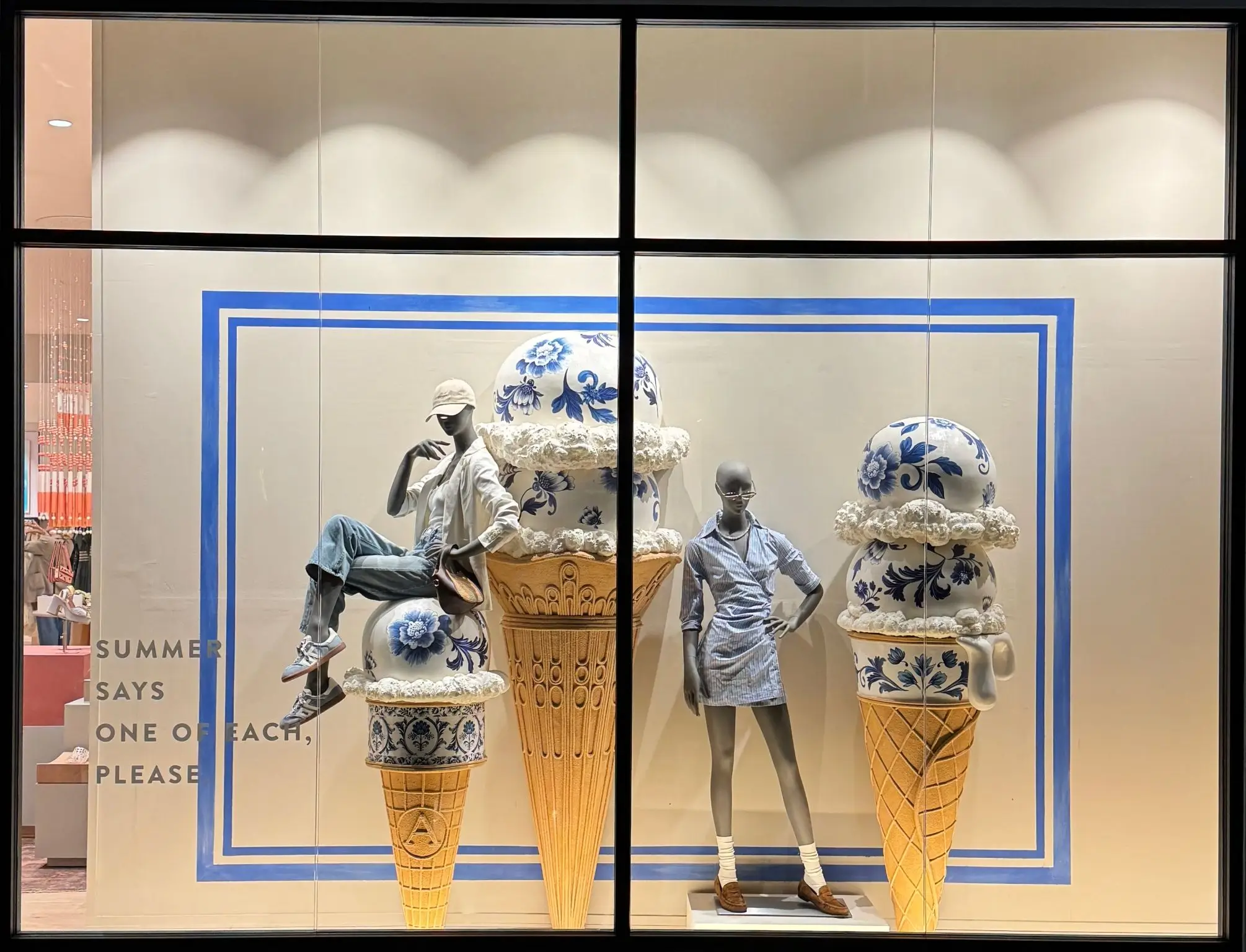
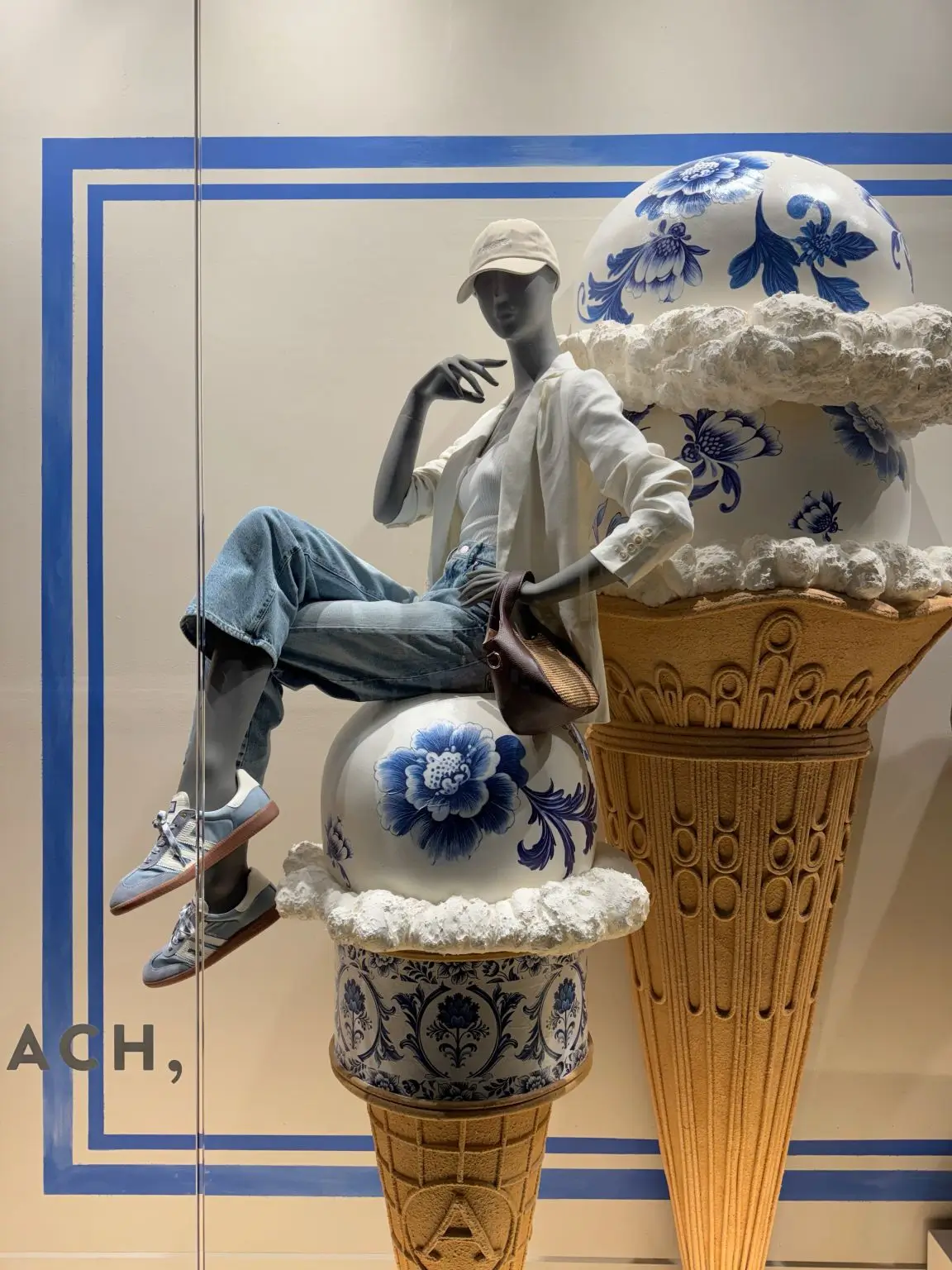
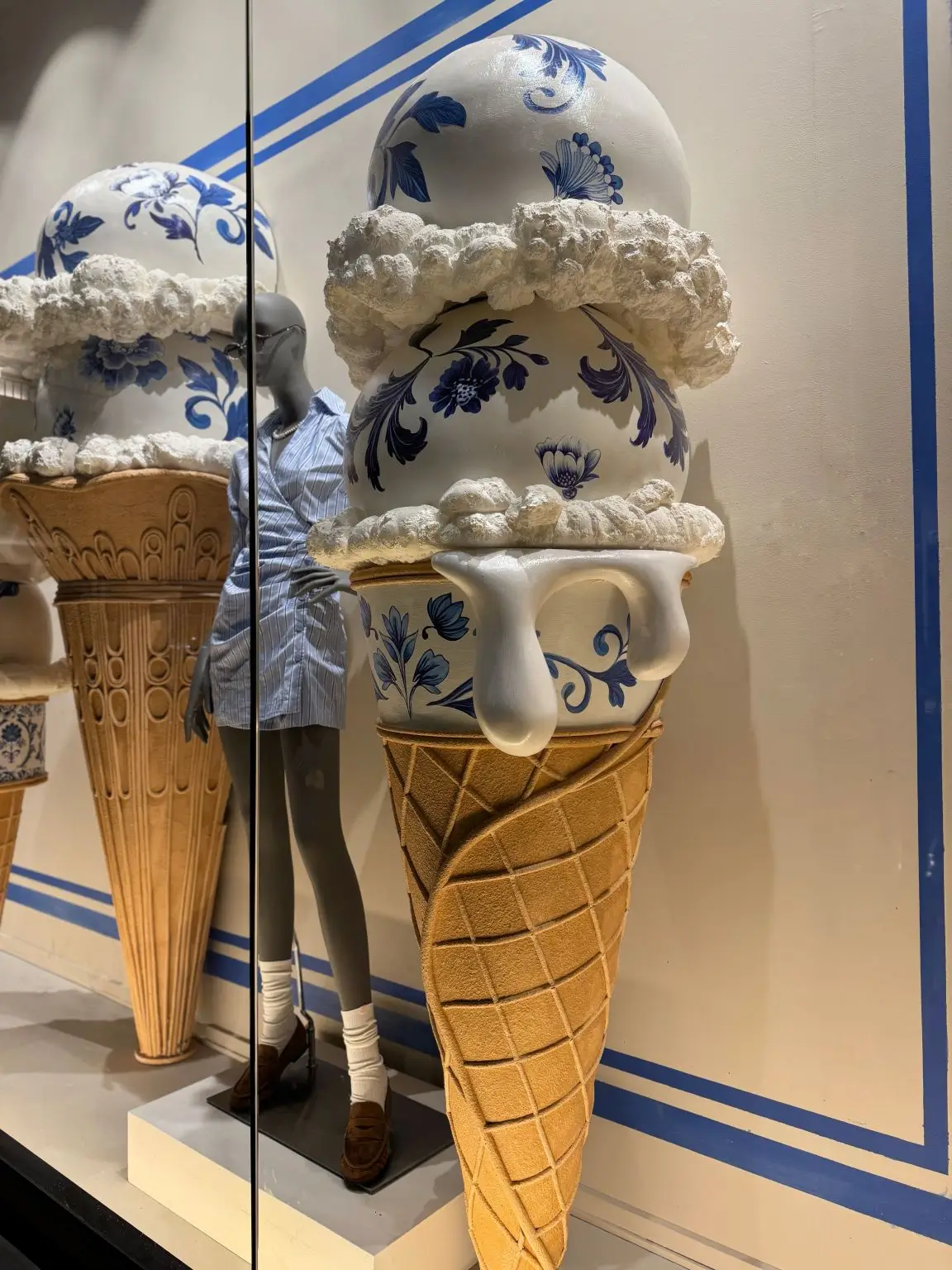
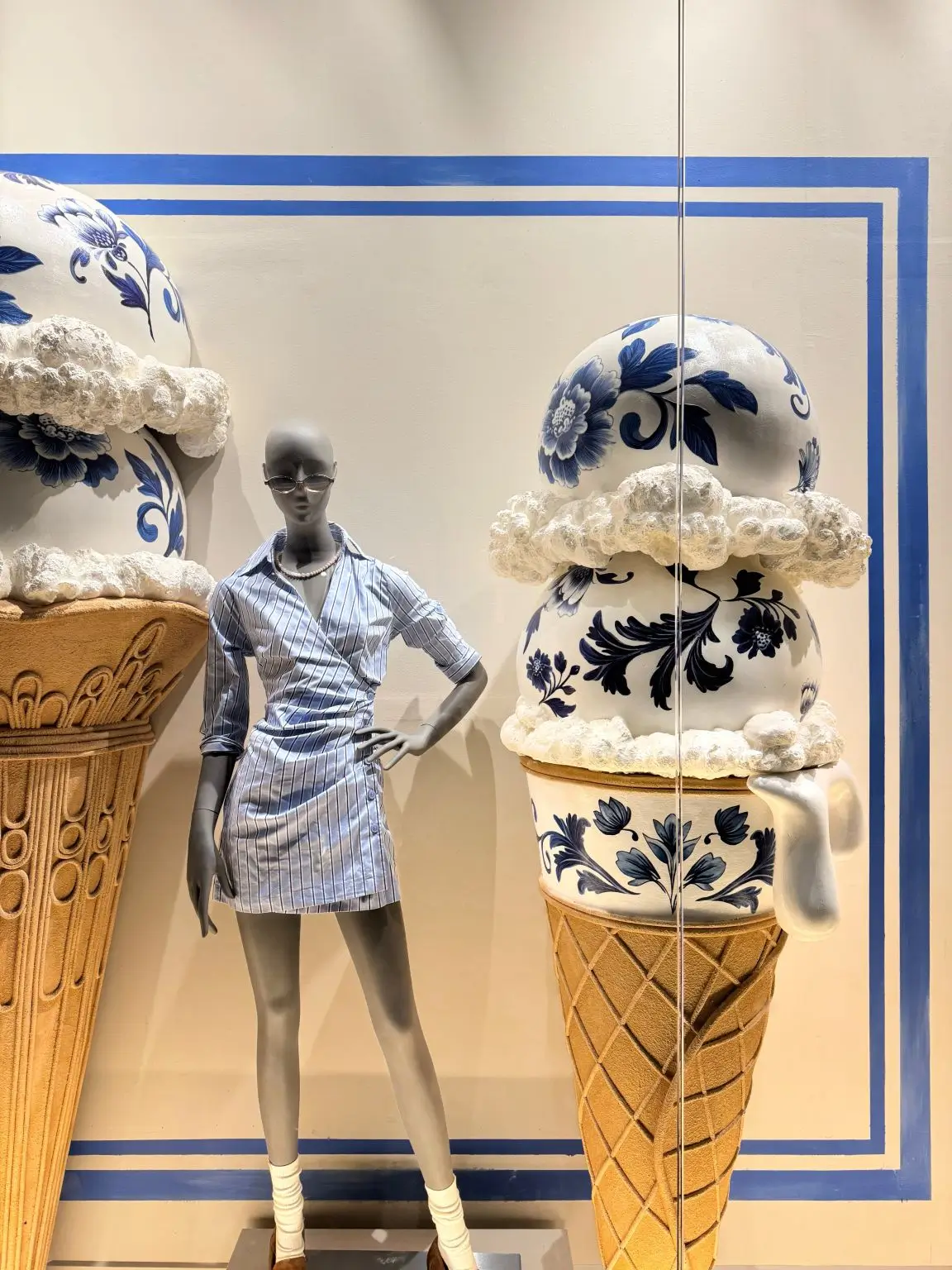
At the center: mannequins seated atop monumental ice cream cones—wrapped in intricate blue filigree, suspended somewhere between sculpture and story.
This isn’t retail. It’s theater, calibrated for a culture that rarely slows down.
stir
There’s nothing restrained about it. And that’s precisely the point.
The cones—scaled to surreal proportions—function as more than visual spectacle. They elevate the mannequins physically, yes, but also conceptually. These aren’t figures placed within a display; they’re positioned as characters within a constructed mythology.
The blue filigree, delicately layered and almost lace-like, wraps each structure with a sense of intention that borders on obsessive. It pulls from multiple visual languages at once—ornamental ironwork, domestic craft, ceremonial patterning—yet never feels derivative. Instead, it reads as something invented, something belonging only to this world.
The mannequins themselves resist performance. They aren’t posed to sell. They exist—draped in linen, soft silhouettes, and quiet summer textures—like figures caught mid-thought. Present, but not demanding attention.
This is where the installation shifts from display to emotion.
Because it doesn’t ask you to buy. It asks you to feel.
idea
Anthropologie has long understood the value of staging, but here it leans fully into surrealism.
View this post on Instagram
The composition echoes the logic of a Surrealism painting—where scale collapses, objects detach from their purpose, and familiarity becomes strange again. Ice cream isn’t food. It’s structure. Clothing isn’t product. It’s atmosphere.
The result is disorientation, but a gentle kind. The kind that invites curiosity rather than confusion.
This approach aligns with a broader cultural recalibration. After years dominated by restraint—minimalism, utility, the quiet precision of “less”—there’s a visible return to emotional expression. Not maximalism for its own sake, but feeling as design language.
“Confectionary Reverie” doesn’t sell garments. It sells a state of mind.
flow
What grounds the fantasy is craft.
The palette—pastels layered with cobalt depth and restrained gold—carries a sense of warmth without slipping into nostalgia. It feels contemporary, but not cold. Designed, but not sterile.
Lighting plays a crucial role. It diffuses rather than directs, allowing shadows to soften edges and surfaces to breathe. The filigree catches that light, creating movement where none physically exists.
Everything feels considered, yet nothing feels rigid.
The clothing follows suit. Linen, lace, and embroidery dominate—not as trend markers, but as tactile experiences. Pieces that imply wear, memory, and repetition. Clothing that lives, rather than performs.
And the setting—a garden that never existed—completes the illusion. Floral structures, domestic objects, fragments of leisure. Not literal, but suggestive.
You don’t observe it. You enter it.
monument
The choice of the cone is deceptively simple.
It’s universal. Immediate. Emotional.
It carries associations—childhood, summer, transience—but here, those associations are disrupted through scale. Enlarged beyond usability, the cone stops being something consumed and becomes something inhabited.
A pedestal. A throne. A stage.
In that transformation, it reframes the mannequin—not as a body wearing clothes, but as a figure occupying space within a narrative.
It’s not about indulgence. It’s about elevation.
delineation
If the cones provide structure, the filigree provides meaning.
Its intricacy suggests time—hours of construction, repetition, attention. It reads as something made, not manufactured. And in that distinction lies its power.
Visually, it references multiple traditions—ornamental architecture, textile craft, decorative ritual—but never settles into one. It remains fluid, interpretive.
The blue itself anchors the installation. Against the softness of the palette, it introduces depth. Calm, but not passive. Present, but not overwhelming.
It’s the element that prevents the display from drifting into sweetness.
It gives it gravity.
xp
In 2026, physical retail doesn’t compete on convenience. It competes on memory.
You don’t visit a store because you need something. You visit because you want to encounter something.
Anthropologie understands this shift intuitively.
These windows function as entry points—not just into a store, but into a constructed emotional space. They invite pause. Observation. Documentation.
People stop. They photograph. They share.
And in doing so, the installation extends beyond its physical boundaries. It becomes social, cultural, ambient.
The display isn’t just seen. It circulates.
cover
The rollout across major cities—New York, Los Angeles, San Francisco, Chicago, Boston—ensures visibility, but also variation.
Each installation adapts subtly to its environment. Light behaves differently. Architecture reframes perspective. Urban context alters interpretation.
Yet the core remains intact.
Mannequins. Cones. Blue filigree. Linen stillness.
A consistent narrative, expressed through shifting conditions.
recept
The response has been immediate, and telling.
Descriptors repeat: whimsical, surreal, unreal.
There’s a recurring question—is this real?—which feels less like confusion and more like admiration. The display occupies a space that feels slightly outside the everyday.
And that’s precisely its function.
To interrupt. To linger.
To create a moment that doesn’t resolve immediately.
show
What makes “Confectionary Reverie” resonate isn’t just its visual language—it’s its timing.
After prolonged periods of reduction—of stripping things back, refining, minimizing—there’s a renewed appetite for narrative. For texture. For emotion that isn’t hidden behind restraint.
Anthropologie taps into that without abandoning its identity.
It doesn’t pivot. It expands.
The result is something that feels both aligned with the moment and distinctly its own.
fin
“Confectionary Reverie” doesn’t attempt to redefine retail. It simply reminds us what retail can be.
A space not just of transaction, but of transformation.
A moment not just to acquire, but to experience.
In a landscape driven by speed and efficiency, Anthropologie offers something slower. Softer. More deliberate.
A pause.
And in that pause, something rare happens—you look, you feel, you remember.
Not what you came to buy.
But how it made you feel standing there, in front of something that didn’t need to exist—yet somehow, absolutely did.
From the DRIFT archive: Melbourne’s Monumental Bagpipe Moment: AC/DC Echoes Across the Plaza