DRIFT AUDIO
Listen to this story
Choose a voice, then press play.
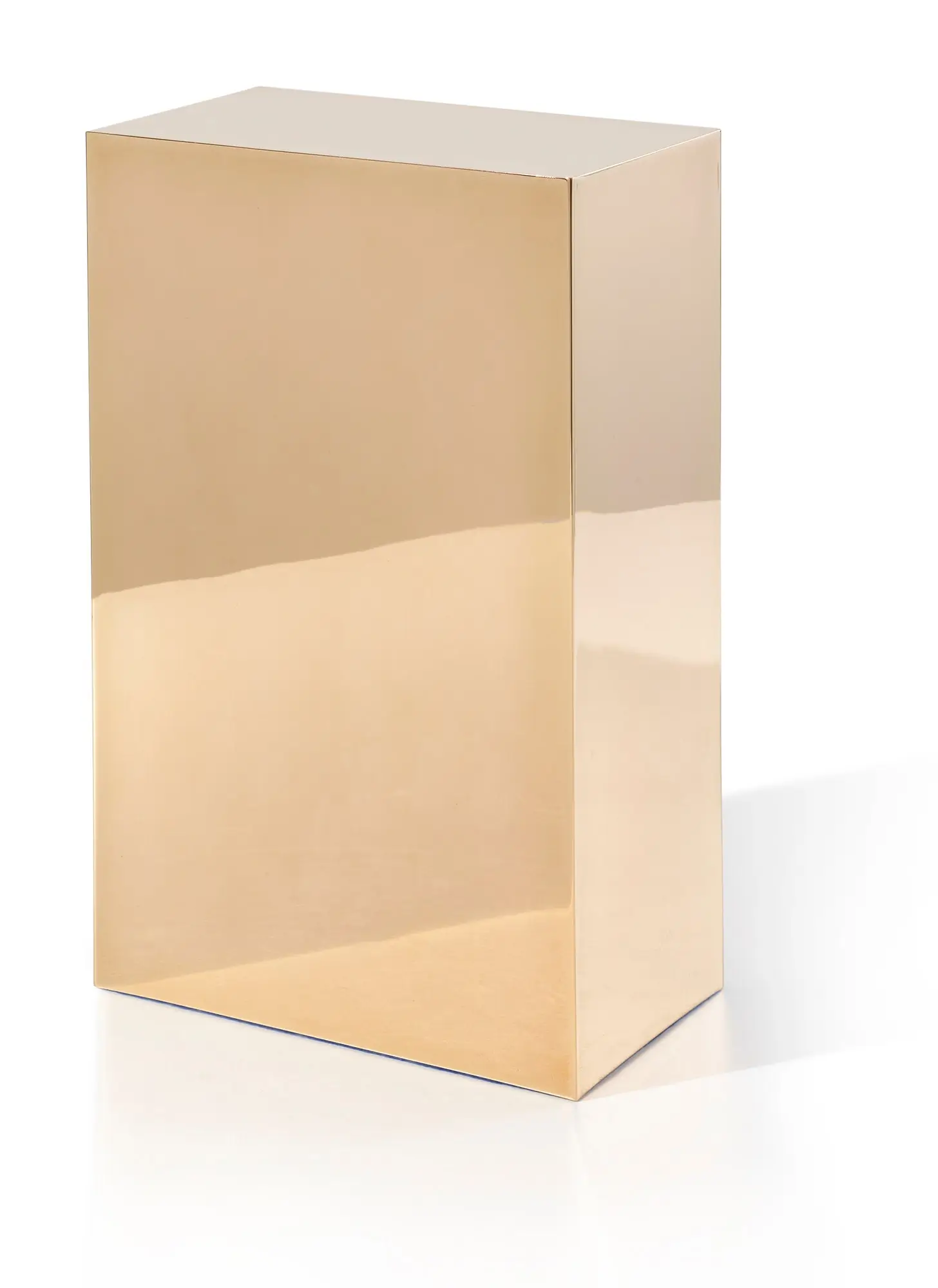
It stands. Not on a pedestal. Not behind glass. Just there—leaning, still, glowing. A tall, narrow slab of fiberglass and resin, polished to a mirror-like sheen, catching the light, the ceiling, the sky, the viewer. It doesn’t announce itself. It waits.
This is Alpha – 2 by John McCracken—not just a sculpture, but a presence. A threshold. A signal. And in its quiet, it speaks volumes.
stir
McCracken (1934–2011) was not a loud artist. He didn’t court controversy. He didn’t build his work around spectacle or statement. He made objects—simple, precise, radiant—constructed with an intensity that revealed itself only through sustained attention.
Working in Los Angeles from the late 1960s onward, he emerged alongside figures like Donald Judd and Dan Flavin, yet his position was distinct. Where East Coast Minimalism leaned toward industrial detachment, McCracken introduced something quieter, more atmospheric—a warmth embedded within reduction, a sense that even the most restrained object could hold a kind of spiritual charge.
He referred to his works not as sculptures in the conventional sense, but as objects for contemplation. “Alpha – 2” belongs to that lineage—not something to decode, but something to stand with.
idea
The plank is McCracken’s defining form: a tall, narrow rectangle, typically six to eight feet high, leaning against the wall at a slight angle. It appears simple, but its simplicity is deliberate—structured, precise, and quietly loaded with tension.
It occupies a space between categories. The wall suggests image, illusion, distance. The floor suggests object, weight, physical presence. The plank exists between them—bridging, but never resolving.
It doesn’t hang. It doesn’t sit. It stands—just off vertical, as if caught mid-transition. That slight deviation introduces a subtle instability, a sense that the object is not fully at rest.
In “Alpha – 2,” this becomes more than form. It becomes stance—a posture of quiet authority, something placed yet not fixed, present yet still in the act of becoming.
flow
“Alpha – 2” does not describe the work. It positions it.
“Alpha” signals origin—the first marker, the brightest point in a system, the beginning of something that extends beyond immediate perception. “2” complicates that origin, introducing sequence, repetition, and variation.
Together, they create tension: not beginning, but beginning again. Not origin, but return.
McCracken once imagined his planks as objects left behind by visitors from another dimension—artifacts rather than artworks. Within that framework, the title reads less like a name and more like a designation, a coded reference to something larger than the object itself.
It doesn’t explain the sculpture. It situates it within a system we can sense, but not fully access.
mat
Constructed from fiberglass and resin, each plank is hand-sanded and polished to a high-gloss surface that approaches perfection without becoming fully reflective.
It is often described as mirror-like, but that comparison only goes so far. A mirror returns a clear image. McCracken’s surface softens it, diffuses it, bending reflection into something closer to atmosphere than accuracy.
This shift changes the role of the viewer. You are not simply reflected—you are absorbed, slightly altered, folded into the object’s field.
In “Alpha – 2,” the surface gathers light and redistributes it. It draws the surrounding environment inward—ceiling, sky, body—and releases it back into the space as something quieter, more continuous.
If rendered in silver, the effect intensifies. Silver does not assert identity. It responds. It shifts with time, with position, with proximity. The object remains still, but the experience of it remains in motion.
show
McCracken’s work resists distance. It requires encounter.
You enter a room. The plank is already there—leaning, still, waiting. There is no instruction, no prescribed way of seeing. Only proximity.
The slight angle introduces tension. It feels as though it could fall, yet it doesn’t. That equilibrium—between stability and movement—creates a quiet pull.
You adjust. You shift your position. You align yourself in relation to it.
And in doing so, you become part of the work.
Reflection, spatial awareness, and bodily presence all enter the composition. The plank does not divide the room. It activates it. It turns space into something relational, something shared.
lang
McCracken is often associated with the Finish Fetish movement—a West Coast response to Minimalism that emphasized surface, polish, and material control.
But the context is broader than the label.
Los Angeles introduced light into Minimalism—not metaphorically, but physically. The city’s environment shaped how surfaces behaved, how materials responded, how objects interacted with their surroundings.
Working in Santa Monica, McCracken absorbed these conditions directly. The Pacific light, the clarity of the air, the emphasis on finish across architecture and automotive culture—all of it informed his approach.
“Alpha – 2” is not simply placed in light. It is structured for it. The surface conditions with illumination, shifting continuously as conditions change.
know
McCracken’s work extends beyond formal concerns into philosophical territory shaped by Eastern thought and speculative fiction. He studied Zen and engaged with writers like Philip K. Dick, whose work explored alternate realities and unstable perception.
Within that framework, the plank becomes something else.
Not representation. Not symbol.
Signal.
“Alpha – 2” does not communicate through narrative. It communicates through presence—through alignment, duration, and perception.
It doesn’t instruct. It invites.
It doesn’t explain. It holds.
leg
McCracken’s influence moves quietly but persistently. His work resides in institutions, yet its impact extends into design, installation, and fashion’s increasing attention to surface and finish.
What he demonstrated was not simply a formal innovation, but a shift in approach. Power does not require scale. It does not require noise. It requires control—of material, proportion, and presence.
His work operates through restraint, and in doing so, it endures.
sum
“Alpha – 2” exists between conditions—between wall and floor, object and image, stillness and motion.
It does not move, yet it shifts with light, with time, with the viewer’s position. It does not speak, yet it resonates with a clarity that builds through attention.
And in that resonance, it proposes something increasingly rare:
That stillness is not absence.
It is structure.
It is intention.
It is signal.
From the DRIFT archive: Larry Cohen: Brentwood, 1982 A Study in Suburban Tension and the Cinematic Stillness of California · Salomón Huerta’s “Unspoken Ritual”: The Subtle Weight of Intimacy
Related Articles

Where the Face Should Be, Rafael Silveira Paints Open Sky
A pink shirt, shoulder-length hair, then no face at all: in “Surprise,” Rafael Silveira lets flowers and a clear blue sky stand in for the person.