LUEDER Khaki Knight Hoodie: Casual Armor for a Restless Era

April 18, 2026
garment
There are hoodies that exist to disappear into rotation, and then there are hoodies that insist on presence. The LUEDER Khaki Knight Hoodie belongs firmly to the latter. It does not function as background clothing. It does not soften itself into neutrality. Instead, it positions itself as a form—structured, referential, and quietly confrontational.
From the first read, the name signals intent. “Knight” is not metaphor here; it is framework. It introduces a lineage that pulls from medieval armor, ritual dress, and the psychology of protection. “Khaki,” meanwhile, grounds the piece in contemporary language—military-adjacent, utilitarian, and worn-in before it’s even touched. The tension between these two ideas defines the garment: fantasy translated into function, protection reframed as everyday wear.
LUEDER has consistently worked within this space, where clothing is less about decoration and more about condition. The Khaki Knight Hoodie extends that logic. It asks a simple but loaded question: what does protection look like in 2026, when threat is less physical and more ambient?
stir
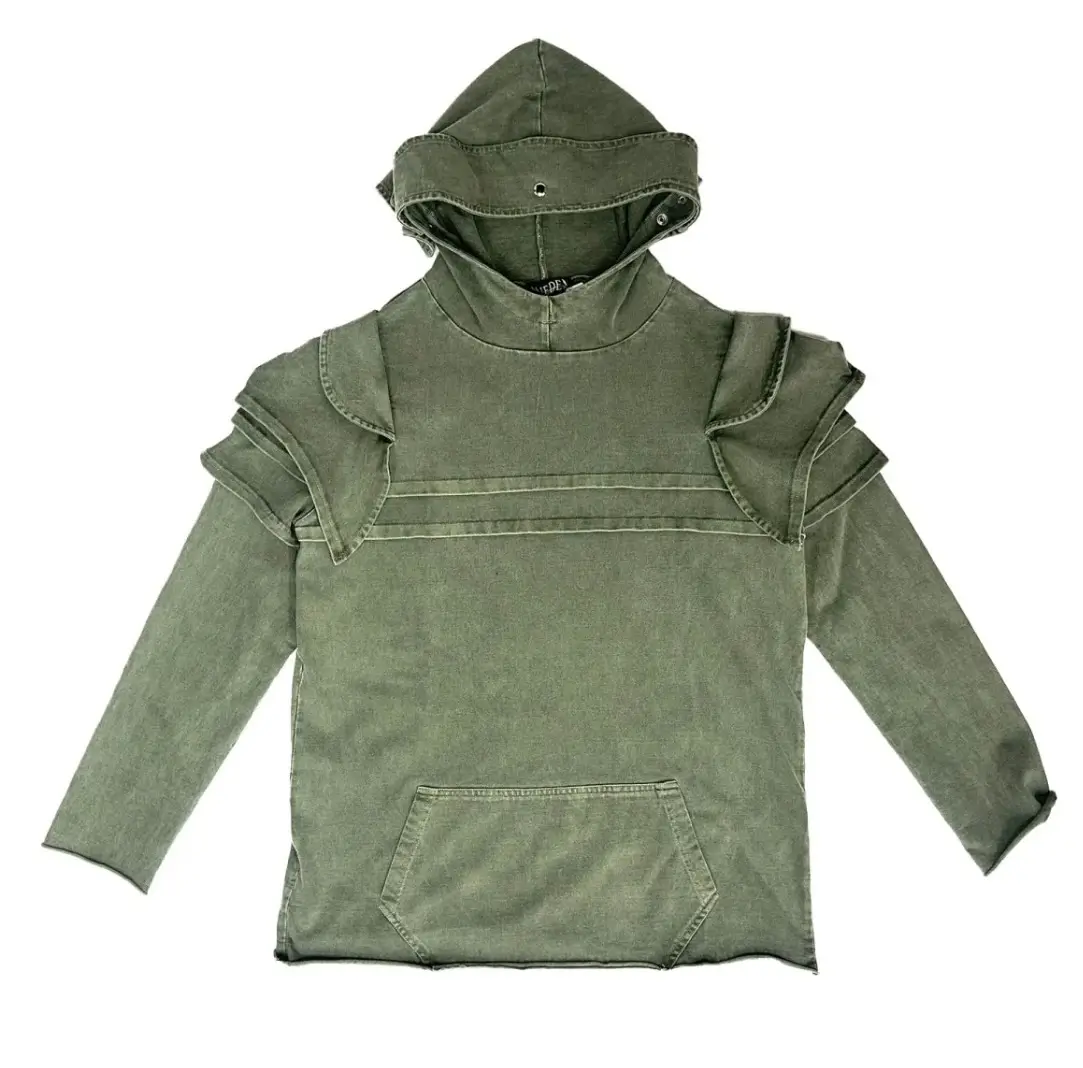
At its core, the hoodie reinterprets armor not as weight, but as suggestion. Traditional armor is rigid, metallic, and absolute. LUEDER dissolves that rigidity into softness—cotton, fleece, or blended jersey—materials that move, fold, and absorb rather than deflect. Yet the visual language remains intact.
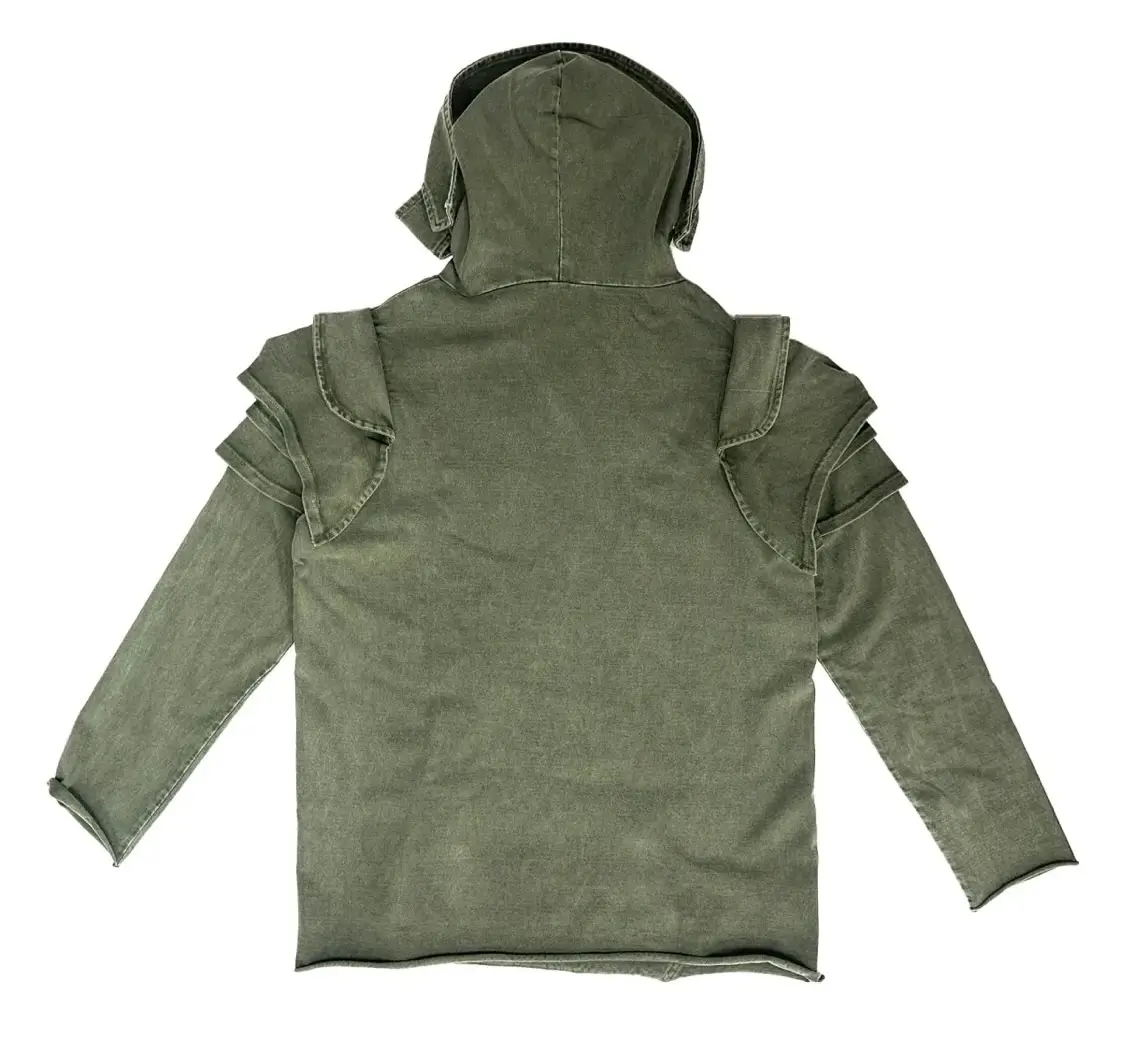
Paneling, seam placement, and structural emphasis likely echo the segmentation of plate armor: chest, shoulder, and torso broken into zones of implied reinforcement. Instead of steel plates, there are stitched divisions. Instead of rivets, there are seams. The effect is subtle but deliberate. The body is mapped, not hidden.
This is where LUEDER’s design intelligence becomes clear. The hoodie doesn’t imitate armor literally. It abstracts it. It translates the idea of defense into a garment that remains wearable, even familiar. The wearer is not encased, but outlined—given a silhouette that feels slightly more intentional, slightly more guarded.
In this way, the Khaki Knight Hoodie becomes a study in psychological protection. It doesn’t shield the body from impact; it reframes how the body is perceived.
View this post on Instagram
flow
Tincture, here, is not incidental. Khaki carries a dense set of associations—military uniforms, desert landscapes, institutional clothing, and workwear traditions. It is a color that suggests durability and neutrality at once.
Within LUEDER’s framework, khaki operates as a stabilizer. Without it, the “Knight” concept risks veering too far into costume. With it, the garment remains anchored in reality. It becomes something that can exist on the street, in transit, in everyday movement.
But khaki also carries tension. It is historically tied to systems of control—armies, colonial structures, institutional uniforms. LUEDER does not ignore this. Instead, the hoodie absorbs that history and reframes it. The color becomes less about authority and more about resilience.
Worn today, khaki reads as quiet strength. It does not demand attention, but it holds it. It suggests endurance rather than spectacle. In the context of the Khaki Knight Hoodie, it completes the transformation: armor becomes soft, and authority becomes personal.
sil
The hoodie silhouette is one of the most ubiquitous forms in contemporary fashion. It is democratic, accessible, and globally understood. LUEDER’s intervention lies in shifting that familiarity without breaking it.
The Khaki Knight Hoodie likely maintains the essential elements—hood, long sleeves, relaxed body—but introduces subtle distortions. The fit may feel slightly structured, the shoulders more defined, the body more intentional. Even minor adjustments—an elongated sleeve, a reinforced chest panel, a tightened hem—can transform the perception of the garment.
This is not about exaggeration. It is about calibration. The hoodie remains wearable, but it carries a different energy. It feels less like loungewear and more like equipment.
That shift is crucial. In a fashion landscape saturated with oversized basics and algorithm-driven silhouettes, LUEDER offers something quieter but more precise. The Khaki Knight Hoodie doesn’t chase novelty. It refines familiarity into something sharper.
story
To learn the hoodie fully, it helps to situate it within the work of Marie Lueder. Her practice consistently engages with themes of protection, identity, and subcultural codes. There is a recurring interest in uniforms—not as symbols of conformity, but as tools of self-definition.
LUEDER garments often feel like fragments of a larger system. Each piece contributes to a broader narrative about how clothing shapes perception and behavior. The Khaki Knight Hoodie fits seamlessly into this ecosystem. It is not a standalone statement, but part of an ongoing exploration.
There is also a sense of temporality in LUEDER’s work. References to medieval armor are not nostalgic; they are recontextualized. They are brought into the present, stripped of romanticism, and made functional again.
In this sense, the hoodie is less about history and more about continuity. It connects past forms of protection with contemporary needs. It suggests that while materials change, the desire for defense—physical, psychological, social—remains constant.
wear
One of the most compelling aspects of the Khaki Knight Hoodie is its potential to function as a uniform. Not in the institutional sense, but in the personal one.
A uniform simplifies decision-making. It creates consistency. It allows the wearer to move through environments with a sense of control. LUEDER taps into this logic, offering garments that feel intentional without being restrictive.
The hoodie, in this context, becomes a daily armor. It is something you reach for not because it is easy, but because it feels right. It carries a sense of readiness.
This is particularly relevant in 2026, where the boundaries between work, leisure, and public life continue to blur. Clothing needs to adapt to multiple contexts simultaneously. The Khaki Knight Hoodie does this by occupying a middle space—structured enough to feel deliberate, relaxed enough to remain comfortable.
mode
While the conceptual framework is strong, the success of the hoodie ultimately depends on its material execution. LUEDER’s approach suggests a careful balance between comfort and structure.
The fabric likely holds its shape without becoming rigid. It supports the garment’s architectural elements while remaining soft against the skin. This balance is critical. Too soft, and the armor reference collapses. Too structured, and the hoodie loses its wearability.
Details—stitching, finishing, weight—conjure a significant role here. They determine how the garment moves, how it ages, and how it interacts with the body.
Over time, the hoodie will likely develop its own character. Creases will form along seams, the khaki tone may shift slightly, and the structure will soften. This evolution is part of the design. It allows the garment to become personal, to reflect the life of the wearer.
View this post on Instagram
culture
The Khaki Knight Hoodie arrives at a moment where fashion is increasingly concerned with meaning. Consumers are no longer satisfied with surface-level aesthetics. They are looking for garments that carry narrative, intention, and depth.
LUEDER responds to this shift by embedding concept into form. The hoodie is not just something to wear; it is something to interpret. It invites engagement.
At the same time, it avoids the trap of over-explanation. The references are present, but they are not forced. The wearer can engage with them at their own level.
This flexibility is key. It allows the hoodie to function across different audiences—those who appreciate its conceptual depth, and those who simply respond to its design.
intent
What sets the LUEDER Khaki Knight Hoodie apart is not a single feature, but a cumulative effect. Every element—name, color, structure, material—contributes to a cohesive idea.
This coherence is increasingly rare. In a market driven by rapid cycles and fragmented trends, LUEDER offers something more considered. The hoodie feels complete. It knows what it is, and it does not deviate.
There is a quiet confidence in that clarity. It does not rely on branding or spectacle. It relies on design.
why
The relevance of the Khaki Knight Hoodie extends beyond fashion. It reflects a broader cultural condition.
We are living in a moment defined by uncertainty—social, technological, environmental. In response, there is a growing desire for stability, for protection, for control. Clothing becomes one of the ways this desire is expressed.
LUEDER captures this sentiment without resorting to fear or nostalgia. The hoodie does not promise safety. It offers something more subtle: a sense of readiness.
It acknowledges vulnerability while providing structure. It allows the wearer to navigate complexity with a bit more intention.
fin
The LUEDER Khaki Knight Hoodie is not designed to blend in. It is designed to hold space.
It takes one of the most familiar garments in contemporary fashion and reimagines it through a lens of protection, history, and identity. It transforms softness into strength, neutrality into statement, and everyday wear into something closer to ritual.
In doing so, it redefines what a hoodie can be. Not just a layer, but a language. Not just clothing, but context.
And in a world that often feels unstructured, that kind of clarity—quiet, deliberate, and deeply considered—feels less like fashion and more like necessity.
Related Articles
Two Bags, One Habit: JJJJound and Porter Return to the Basics That Made Them
JJJJound and Porter are back for a fourth round, and this time the entire pitch […]