DRIFT AUDIO
Listen to this story
Choose a voice, then press play.
A24 confiscated phones for the Telluride premiere of a three-year film Fielder still can’t fully explain, even to himself.
Telluride’s Sunday night mystery slot is usual a guess game. This year it was a genuine secret. Security staff collect phones from every attendee at the festival’s Herzog Theatre before the lights went down, and the pack house had no idea what they were about to see until it started. The festival has used a similar mystery-title tradition for years to build buzz around a late addition to its lineup, but rarely with the level of lockdown A24 applied here; typically the surprise is which existing awards contender turns up early, not a completely unannounced project nobody outside the production even knew existed. What unfolded was “You Can See Everything,” a documentary co-directed by comedian Nathan Fielder and filmmaker Lance Oppenheim, built entirely around Elizabeth Holmes, the disgraced Theranos founder currently serving an 11 year sentence for defrauding investors about her company’s blood testing technology.
stir
The premise, as Variety laid it out, is almost absurdly simple: 34 days before she reported to prison in 2023, Holmes invited a skeptical film crew to document her every move. What that crew ended up capturing, and what happened once Holmes was actually behind bars, is where the film gets stranger. A24 has distributed the project and re a teaser alongside the reveal, showing Fielder and Holmes locking eyes across a table. “I don’t have anything to deceive you on,” Holmes tells him in the clip, before insisting she’s simply engaging with him as a person.
For anyone who needs the recap, Holmes founded Theranos in 2003 after dropping out of Stanford at 19, built it into a startup once valued in the billions on claims that its technology could run dozens of medical tests from a single finger prick of blood, and was convicted in January 2022 on four felony counts of fraud and conspiracy after reporting showed the technology never worked as promised. A federal judge sentenced her that November to just over 11 years, and she reported to the Federal Prison Camp in Bryan, Texas that May, a min sec women’s facility roughly 95 miles from Houston. Records from the Federal Bureau of Prisons since show her release date push up to December 2032, suggest the original sentence has been reduced somewhat since she entered custody.
Before any of that, Holmes spent years cultivating a very specific image: black turtlenecks and a deep voice modeled openly on Steve Jobs, an Inc. magazine cover that dub her “The Next Steve Jobs,” and a Forbes rank as the youngest self-made female billionaire on the strength of a company valuation that report later show had almost nothing behind it. That image collapse fast once the Wall Street Journal’s John Carreyrou began publish his investigation into Theranos’s technology in October 2015. A documentary built specific around what happens when Holmes controls the camera again, years later and strip of the company that made her famous, lands square on the question her entire public career was built around in the first place: how much of what people saw was ever real.
The existence of the project had circulated as rumor for a while before Sunday. Fielder had report been in contact with Holmes for years, include visits to her at the federal prison camp in Texas where she is held, but nothing about a finish film had been confirm until A24 revealed the Telluride slot belonged to it. IndieWire describe speculation building to a fever pitch across the festival grounds in the days before the screen, with attendees trade guess about what the mystery title could be.
in
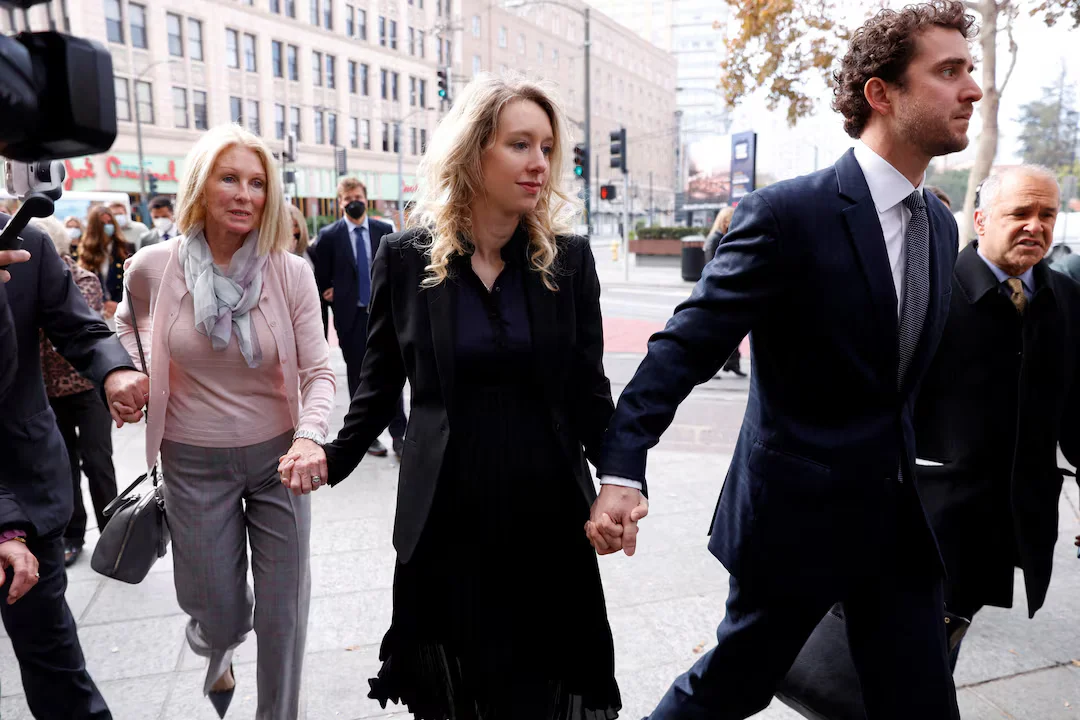
Most of the doc access happen at a rental home in San Diego, where Holmes was live with her partner, Billy Evans, and their two children in the final stretch before prison. The couple met in 2017, around the same period Holmes was already under investigation over Theranos’s collapse, and by the time she report to prison they had a son born in 2021 and a daughter born a few months into 2023. Fielder embed himself with the family there, and NBC News reported that portion of the film in which Fielder is shown communicate with Holmes off camera, include exchange tied to her time in prison, were re-created with the help of a pro actor standing in for those conversations rather than shot as they happened. It’s an unusual structure choice for something billed as doc, and one that reviewer flag immediate as part of what makes the film hard to categorize. Deadline’s cast listicle for the project include actor Christopher Abbott alongside Fielder, Holmes and Evans, though the film doesn’t spell out publicly which scenes he appears in.
Holmes’s story has already been picked over extensively elsewhere, which is part of why reviewers keep circling back to how different this version feels. John Carreyrou’s book “Bad Blood” and Hulu’s scripted series “The Dropout,” starring Amanda Seyfried as Holmes, both covered the Theranos collapse in detail, alongside HBO’s Alex Gibney documentary “The Inventor” and a run of podcasts digging into the case. Holmes’s trial itself added another layer to the public record: she testified that her former Theranos president and one-time partner, Ramesh “Sunny” Balwani, had subjected her to abuse that clouded her judgment while they ran the company together, testimony Balwani’s own defense disputed. Balwani was tried separately, also convicted on fraud charges, and is serving his own federal prison sentence. Against that backdrop, a documentary made with Holmes’s direct participation, years after the trial and headed into a second relationship and family life, is a genuinely different vantage point on a story that had otherwise mostly been told without her.
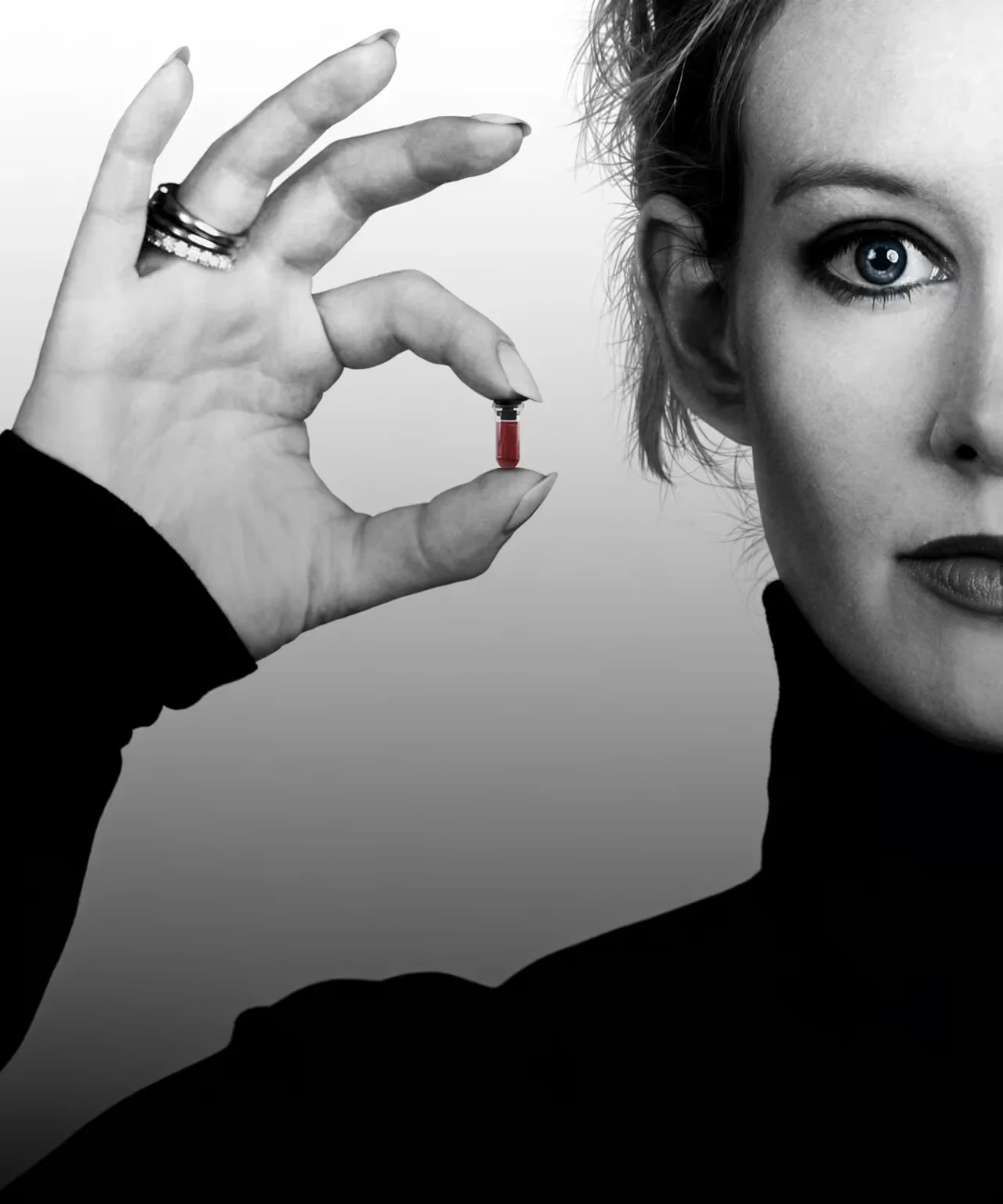
The finished film runs 174 minutes, just short of three hours, and covers roughly three years of access rather than a single tidy shoot. Deadline’s review called the level of access unlike anything the critic had seen before, crediting cinematographer David Bolen’s camera work and producers Tatiana Bears and Maggie Ambrose for holding the sprawling project together. Billy Evans emerges as a major figure in his own right rather than a background presence. Variety’s review described him as heavily involved in managing Holmes’s public image, including the continued use of the widely circulated photo of her holding a vial of blood, and reported that the film captures an actual meeting between Evans and A24 executives about a possible cut of the movie’s profits, a negotiation Holmes reportedly wasn’t told about even as it happened around her.
That negotiation scene is where the film’s structure gets genuinely strange rather than just unconventional. A24 is the studio releasing “You Can See Everything” to theaters, and according to Variety’s review, real A24 executives also appear on camera inside the finished film, sitting across from Evans as he tries to work out a deal. The company distributing the documentary is, in other words, also a subject documented inside it, a loop that several reviewers pointed to as the clearest sign the project isn’t interested in behaving like a normal fly-on-the-wall account of anyone’s life, least of all its own production. Christopher Abbott, the actor listed in Deadline’s cast rundown alongside Fielder, Holmes and Evans, has built his career on smaller, tightly controlled independent roles rather than franchise work, including turns in “First Man,” “Poor Things” and a Tony nominated run on Broadway earlier this year, the kind of actor a project like this would plausibly bring in for a reenacted sequence without wanting to advertise it in advance.
Emma Stone with Nathan Fielder and Lance Oppenheim at the “You Can See Everything” Q&A during the Telluride Film Festival yesterday. pic.twitter.com/pdjE8CUNgA
— Emma Stone Photos | Fansite (@emstonephotos) September 7, 2026
flow
Fielder and Oppenheim make an odd but pointed pairing for this kind of project. Fielder built his reputation on “Nathan For You,” the Comedy Central series that ran four seasons and 32 episodes between 2013 and 2017, in which he inserted himself into small businesses with escalating, absurdist marketing schemes, from convincing a frozen yogurt shop to introduce a feces flavored option to helping a coffee shop rebrand as “Dumb Starbucks” under a dubious parody-law loophole. The show’s series finale, “Finding Frances,” ended with Fielder renting a theater and hiring an actress to help a subject rehearse a difficult reunion conversation before he’d have to attempt it for real, a structural trick that reads, in hindsight, like a direct blueprint for the reenacted conversations “You Can See Everything” uses with Holmes. Fielder carried that same instinct into HBO’s “The Rehearsal,” which premiered in 2022 and used elaborate real-world simulations, including child actors aged up week by week to stand in for one subject’s hypothetical son, to help ordinary people practice their own lives before living them. Both shows work by collapsing the distance between performer and documentary subject until it’s unclear who’s directing whom, a tension that “You Can See Everything” appears to carry directly into a nonfiction subject as loaded as Holmes.
Oppenheim brings a different but complementary track record. He directed “Some Kind of Heaven,” a widely praised 2020 documentary about life inside the Florida retirement community The Villages, produced by Darren Aronofsky and shot by the same cinematographer, David Bolen, who worked on “You Can See Everything.” Oppenheim’s most recent film before this one, “Primetime,” is a Robert Pattinson led project about to-catch-a-predator figure Chris Hansen that had just premiered to strong reviews at the Venice Film Festival before “You Can See Everything” surfaced at Telluride. Both of Oppenheim’s recent projects share an interest in performance and self-mythology playing out inside real American institutions, which lines up closely with what Holmes spent years doing at Theranos.
Fielder didn’t offer much clarity in the post-screening Q&A. Asked to explain what audiences had just watched, he told the Telluride crowd he was still “struggling to this day” to understand exactly what he experienced making it. Critics who saw the film left similarly unsettled rather than satisfied. Forbes rounded up reactions describing it as one of a kind, and Variety’s review framed it as a reality television loop that folds back on itself rather than a conventional true crime account. IndieWire’s own writeup noted the lengths A24 went to protect the secret, including confiscating phones at the door, a level of operational security more typical of a blockbuster franchise reveal than a three-hour art house documentary.
View this post on Instagram
extend
A24, the indie studio distribute the film, has built its reputation over more than a decade on exact this kind of unconvention bet, having backed best picture winners like “Moonlight” and “Everything Everywhere All at Once” alongside stranger, harder to classify projects that a bigger studio would likely pass on. A secret doc star one of the most litigated figures in recent Silicon Valley history, made by a comedian better known for pranking small business owners, fits that pattern more than it breaks from it. The studio has set the film for a theatre rel in October, without a specific date confirm publicly yet.
Telluride has historic been a launch point for films that go on to dominate the fall festival circuit and, eventual, awards season convo, though what happens next for “You Can See Everything” is genuine assiduous to predict than usual given how unresolved even Fielder himself sounds about it. If either the film turns up next at the Toronto International Film Festival or the New York Film Festival, both of which run through September, has not been announced. What is confirmed is simpler: audiences won’t get their own chance to sit with the same questions Fielder is still asking himself until the film reaches theater next month.
Related Articles
The Many Lives of Sophie Marceau, in Seven Roles
Arte is airing a documentary on Sophie Marceau. Here are seven roles that explain why […]