Navigating “An Ocean of Books”: A Literary Odyssey Through the Web of Connections

September 4, 2024
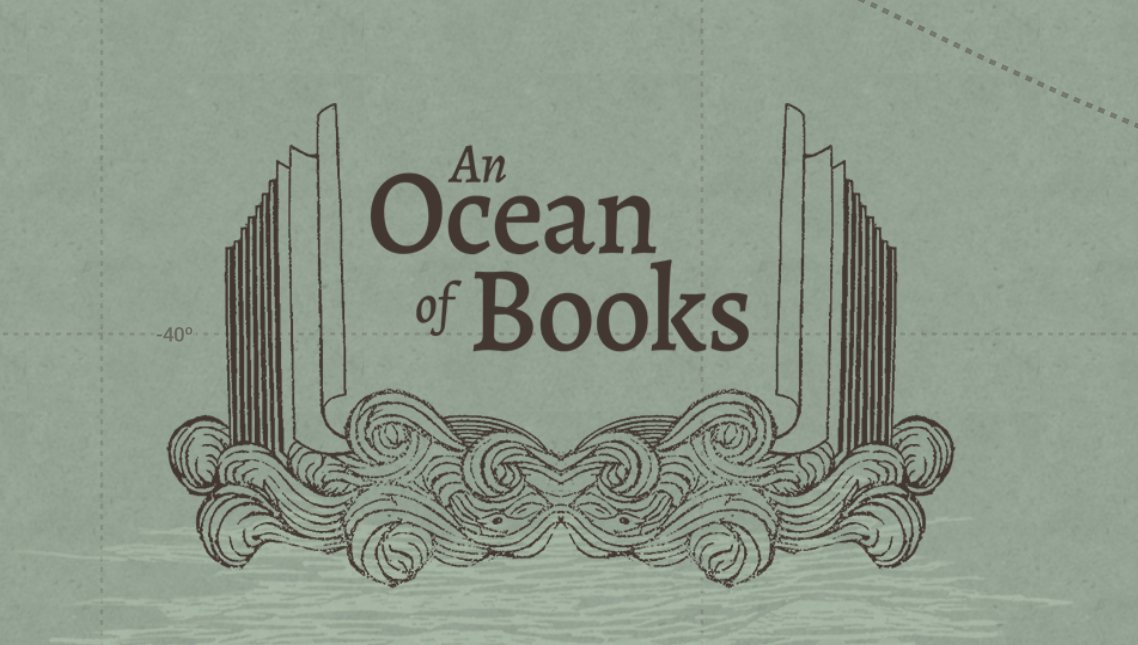
The poetic experiment of “An Ocean of Books” is an intriguing, immersive dive into a sea of literature. At first glance, it presents itself as a map—a visual representation of a boundless literary universe where islands symbolize authors and cities represent their books. But beneath this aesthetic façade lies a deeper story about how interconnected our literary world truly is. Through the use of machine learning and data analysis, this map transcends the traditional categorizations of genre and subject matter, revealing a network of authors based on their proximity to one another in the vast web of online discourse.
At its core, “An Ocean of Books” is an exploration of relationships, connections, and the hidden ties that bind authors together across time, space, and subject matter. It’s a beautiful and curious experiment, and one that invites us to get lost—not just in the literature itself, but in the connections between the minds that produced it. The result is a dynamic literary landscape that sparks new questions about how we approach authorship, relevance, and the digital fabric that connects them.
In this critical exploration, we will dive deeper into the concepts and technologies that underpin this literary map, while reflecting on its broader implications for how we understand literature, authorship, and interconnectedness in the digital age.
The Algorithmic Architecture Behind the Map: UMAP and Literary Distance
The first layer of intrigue within “An Ocean of Books” is the use of machine learning to calculate the relationships between authors. The tool used to generate the map, Uniform Manifold Approximation and Projection (UMAP), is a powerful algorithm designed to project high-dimensional data into two dimensions. This technique is widely used in data visualization and dimensionality reduction, allowing complex relationships in large datasets to be displayed in a more understandable format.
In the case of “An Ocean of Books”, the high-dimensional data comes from the vast web of literature available online. The creators of the project calculated the “distance” between authors based on how often they are mentioned together across various digital platforms, databases, and other media. Each mention, citation, or connection draws authors closer to one another, ultimately positioning them on the same island or neighboring territories.
This method of calculating literary distance is fascinating because it reflects not only academic citations or genre affiliations but also the broader, more nebulous web of cultural discussion and media coverage. For example, Jacques-Yves Cousteau and Carl Sagan might not share an obvious literary connection—one being a legendary oceanographer and filmmaker, the other a pioneering astronomer and science communicator—but the map positions them as close neighbors. Why? Because their presence on the internet is intertwined through popular discussions on science, exploration, and media that frequently reference both figures together. This surprising adjacency invites a rethinking of how we perceive intellectual kinship and literary categorization.
Questioning Traditional Categories: Genre, Subject, and Influence
What makes “An Ocean of Books” particularly compelling is its disruption of traditional literary categories. Most readers and literary scholars are accustomed to organizing literature by genre, era, or national tradition. We think of Charles Dickens as a Victorian novelist, Agatha Christie as a mystery writer, or Gabriel Garcia Márquez as a Latin American magical realist. These categories provide a comforting structure to our understanding of literature, helping us navigate vast collections of works based on familiar labels.
However, “An Ocean of Books” subverts this traditional classification by positioning authors based on the organic relationships formed through the web, rather than by strict academic or genre boundaries. This creates surprising, serendipitous pairings and groupings that challenge the way we categorize knowledge. For instance, why might Ernest Hemingway, known for his sparse prose and focus on masculinity, end up near Sylvia Plath, whose poetry delves into the complexities of mental illness and feminine identity? The answer, according to the map, may lie in how often these two authors are referenced in similar conversations online, or how frequently readers engage with their works together.
By highlighting these unexpected proximities, “An Ocean of Books” forces us to reconsider how we define an author’s place in the literary canon. Should authors be grouped based on genre alone? Or is there something more valuable in considering the cultural and intellectual networks that surround them, whether they align with conventional categories or not? This project suggests the latter—authors are more than their genre or the time period in which they wrote. They exist within an evolving matrix of ideas, influences, and associations that transcend neat categorization.
The Digital Age and Literary Networks
One of the most compelling aspects of “An Ocean of Books” is how it reflects the way we interact with literature in the digital age. In the past, literary influence and proximity might have been dictated by direct mentorship, geographic location, or shared participation in literary movements. However, the internet has radically altered the landscape of literary consumption and conversation. Today, authors are connected not just by their works, but by how their ideas are discussed, shared, and reinterpreted across digital platforms.
For example, fan communities on Reddit or Tumblr might discuss Jane Austen in the same breath as Margaret Atwood, not because they belong to the same literary tradition, but because both authors have been adapted into popular television series and films that resonate with modern audiences. Meanwhile, academic discourse and media coverage might link Toni Morrison with James Baldwin due to their shared engagement with African American history and identity, even though they wrote in different forms and styles.
This interconnectedness of authors across the internet is exactly what UMAP captures and projects onto the literary map. It reflects the way digital spaces collapse traditional boundaries and bring seemingly disparate authors into closer proximity. This highlights a new kind of literary network—one that is driven by global conversations, interdisciplinary influences, and the dynamic flow of ideas across multiple platforms.
The map’s design thus raises important questions about how digital culture is reshaping our understanding of literature. What does it mean for authors to be “connected” in an era where ideas travel across the globe in seconds, and where readers consume literature in increasingly fragmented, nonlinear ways? “An Ocean of Books” provides one possible answer, visualizing the web of influence and discussion that ties authors together in the digital age.
Getting Lost in Literature: The Value of Serendipity
One of the most poetic elements of “An Ocean of Books” is its invitation to “get lost.” The creators encourage users to explore the map without a clear destination, letting serendipity guide their journey through the literary landscape. This aligns beautifully with the experience of reading itself—particularly in the age of the internet, where readers often stumble upon new authors, ideas, or books through links, recommendations, and social media posts.
The map allows readers to approach literature in the same way they might browse through a bookstore or library, encountering unexpected authors and books along the way. For instance, a reader exploring islands dominated by contemporary fiction might suddenly find themselves drifting toward a distant land of historical nonfiction, uncovering surprising connections between modern storytellers and long-forgotten chroniclers of history.
This sense of discovery is part of what makes “An Ocean of Books” such a unique and valuable experiment. It encourages curiosity and challenges readers to think beyond their established reading habits. Rather than focusing solely on familiar authors or genres, users can traverse the map and discover new connections, allowing themselves to be surprised by the proximity of authors they might not have previously associated with one another.
In this way, “An Ocean of Books” is not just a reflection of the interconnectedness of authors, but also a tool for expanding the reader’s literary horizon. It invites us to question our own assumptions about literature, to embrace new perspectives, and to explore the often-overlooked relationships between authors across time and space.
“An Ocean of Books” is more than just a map; it’s a meditation on the nature of literature, authorship, and interconnectedness in the digital age. By using UMAP to calculate the relationships between authors based on their presence on the web, this project disrupts traditional literary categories and reveals the hidden connections that shape our understanding of literature.
Through its design, the map encourages exploration, serendipity, and curiosity. It invites readers to get lost in a sea of authors and books, discovering new relationships and expanding their literary horizons. In doing so, “An Ocean of Books” offers a glimpse into the future of how we might navigate the vast and ever-growing world of literature—one where authors are connected not just by genre or era, but by the complex web of ideas, discussions, and digital interactions that define our modern age.
Ultimately, “An Ocean of Books” is a poetic experiment that reminds us of the beauty and complexity of literature, and the endless possibilities for discovery that lie within its pages. Whether we are searching for familiar shores or drifting into uncharted waters, this map provides a new way of seeing—and engaging with—the world of books.
Related Articles

The Heart Association Just Told Millions of Coffee Drinkers to Relax a Little
New guidance from the American Heart Association says up to five cups a day is […]