DRIFT AUDIO
Listen to this story
Choose a voice, then press play.
In late May 2026, fresh off a rapturous 12-minute standing ovation at Cannes for his first directorial effort in a decade, Her Private Hell, Nicolas Winding Refn dropped a bombshell on Instagram: an ominous aerial night shot of a city with the stark overlay “Maniac Cop by NWR” and the simple promise “2027.” The internet, particularly horror and cult cinema circles, lost its collective mind.
Mubi is fully financing the project, with Goodfellas co-producing. Refn is directing and producing through his byNWR Originals banner (with Christina Erritzøe and Kimberly Willming as executive producers). Filming is slated for Los Angeles in January 2027, with casting still forthcoming. Mubi has secured wide theatrical distribution rights across North America, Latin America, the UK & Ireland, France, Italy, Spain, Benelux, Turkey, Australia, and New Zealand—signaling serious commercial ambition for what could have easily stayed a passion project.
Mubi founder and CEO Efe Cakarel put it best: “Maniac Cop in Nicolas’s hands is not a remake. It is a resurrection…and he is exactly the filmmaker to reawaken something this iconic.” Refn himself has spoken of the project’s long gestation and its resonance in the current climate: “The concept has always appealed to me… In today’s political and social climate, the iconography of Maniac Cop alone provokes an immediate, uneasy reaction. I’ve been watching it all unfold while constructing this project in the silhouettes… waiting. Now, that moment has finally arrived. The time has come to unveil a radical new view where there is no protection, no safety net, only mayhem.”
View this post on Instagram
stir
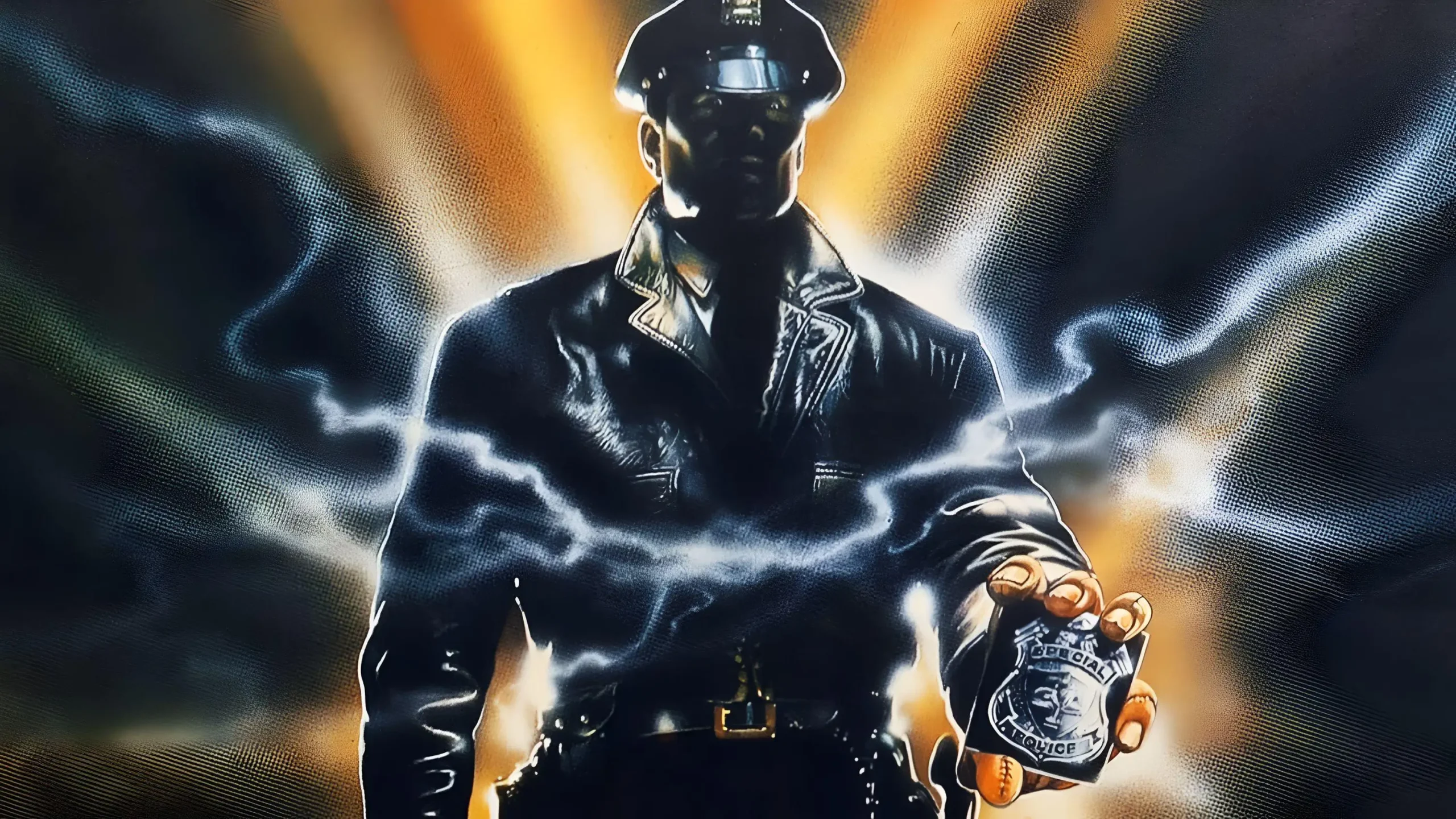
To better absorb reason why Refn’s involvement feels both inevitable and explosive, we must go back to 1988. Maniac Cop, directed by William Lustig (Maniac, Vigilante) and written/produced by the legendary exploitation maestro Larry Cohen (Q: The Winged Serpent, The Stuff, It’s Alive), is a lean, mean B-movie that punches well above its $1.1 million budget. It blends slasher tropes with gritty 1980s New York cop drama, delivering social commentary on police corruption, institutional cover-ups, and urban paranoia.
The story follows Matt Cordell (Robert Z’Dar, with his unforgettable lantern jaw and hulking presence), a decorated but brutal cop framed by corrupt colleagues, left for dead in prison, and resurrected as an undead avenger in police uniform. He stalks the streets of New York, brutally murdering innocents while the department tries to suppress the fact that the killer wears a badge. Bruce Campbell (pre-Army of Darkness fame) plays Jack Forrest, the heroic young cop framed for the killings, alongside Laurene Landon, Tom Atkins, Richard Roundtree, and William Smith.
The film was no box office smash—grossing around $671,000 theatrically—but it found a devoted audience on VHS and cable. Its success spawned two sequels: Maniac Cop 2 (1990), which doubles down on the undead revenge angle with Cordell teaming up (sort of) with a serial killer, and Maniac Cop III: Badge of Silence (1992), which introduces voodoo elements and shifts some focus to a comatose female cop. While diminishing returns set in, the trilogy remains a beloved slice of late-80s/early-90s grindhouse horror—violent, sleazy, and unafraid to critique authority.
What makes Maniac Cop endure isn’t just the kills or Z’Dar’s imposing figure. It’s the potent symbol of the killer cop: a figure who represents both protection and predation. In an era of “back the blue” versus “defund the police” rhetoric, bodycam scandals, and eroding public trust, that symbol feels sharper than ever. Refn, a director obsessed with mythic figures, hyper-stylized violence, and moral ambiguity, is perfectly positioned to amplify it.
length
Refn has been attached to Maniac Cop for over a decade. He first acquired the rights around 2012–2016. The project was announced at Cannes 2016 as a feature (initially with John Hyams attached to direct). By 2019, it had evolved into a TV series for HBO and Canal+, with Refn as executive producer and Hyams directing the pilot. Development went quiet after 2023, leaving fans wondering if it was another casualty of Hollywood’s endless IP shuffle.
Refn’s career has been full of such detours, triumphs, and near-misses. Born in Copenhagen in 1970 to a filmmaking family (his father Anders was a director-editor, his mother Vibeke a cinematographer), he burst onto the scene with the raw, semi-documentary Pusher (1996), a gritty tale of a low-level drug dealer in Copenhagen’s underworld. The film became a cult hit, spawning two sequels (Pusher II and III) that deepened the character studies of criminals on the edge.
His English-language breakthrough came with Bronson (2008), a stylized, operatic biopic of Britain’s most notorious prisoner, starring a ferocious Tom Hardy. Then came Valhalla Rising (2009), a near-wordless medieval fever dream with Mads Mikkelsen. But it was Drive (2011) that made him a household name (or at least a stylish meme). Ryan Gosling as the stoic getaway driver, neon-drenched nights, synthwave score, and ultra-violent set pieces turned it into a surprise hit and critical darling. Refn won Best Director at Cannes.
Subsequent films like Only God Forgives (2013) and The Neon Demon (2016) polarized audiences with their glacial pacing, fetishistic visuals, and provocative themes of beauty, violence, and narcissism. His 2019 Amazon series Too Old to Die Young pushed the envelope even further with its extreme length and brutality. A serious health scare—Refn has referenced flatlining for 20 minutes—added a layer of personal mythology to his return.
Refn’s style is unmistakable: slow-burn tension exploding into sudden, graphic violence; saturated colors (especially reds and neons); electronic scores; and protagonists who are more archetypes than fully rounded characters. He fetishizes surfaces—cars, knives, bodies, uniforms—while probing darker undercurrents of masculinity, revenge, and societal decay. A Maniac Cop film directed by him promises to transform the original’s straightforward exploitation into something hypnotic, nightmarish, and politically charged.
why
Refn has repeatedly emphasized this won’t be a paint-by-numbers reboot. Expect his signature aesthetic: think the rain-slicked, neon-bathed streets of a reimagined Los Angeles (shifting from the original’s gritty New York), pulsing synth scores (perhaps collaborating again with Cliff Martinez or finding a new electronic collaborator), and a Cordell reimagined as a towering, almost supernatural embodiment of institutional rot.
The move to LA makes thematic sense too. Los Angeles, with its Hollywood gloss masking deep corruption, police controversies, and cinematic history of noir and neo-noir, is fertile ground for Refn. One can imagine Cordell emerging from the shadows of a city where authority is spectacle and violence is entertainment.
This project also aligns with Refn’s recent trajectory. Her Private Hell marked his return to features after a long hiatus, and its Cannes reception suggests renewed momentum. Mubi’s involvement is savvy: the streamer-turned-distributor has backed bold, auteur-driven genre fare and is pushing for theatrical releases to capitalize on the post-The Substance horror renaissance. A stylish, R-rated horror film with Refn’s name attached could fill theaters the way Drive did for action-thrillers or The Neon Demon did for elevated horror.
(a recent arriving move release July)
View this post on Instagram
fwd
Challenges remain. Refn’s deliberate pacing and arthouse sensibilities can alienate mainstream horror audiences craving constant jump-scares and gore. The Neon Demon divided viewers, and Only God Forgives was actively hated by some. Will he deliver enough visceral thrills to satisfy fans of the original trilogy while delivering his usual view flow?
Casting will be crucial. Who plays the new Cordell? A hulking physical performer like Z’Dar is needed, but Refn often favors magnetic, unconventional leads (Gosling, Hardy, Elle Fanning). Supporting roles could attract names drawn to prestige genre work.
The culture moment is ripe. Police accountability, vigilante justice, and eroded trust in institutions dominate headlines. Refn, never one for subtlety in his symbolism, could craft something that feels dangerously relevant—less a slasher and more a dark fable about power and its abuses.
Horror fans are buzzing on Reddit, Letterboxd, and X. Some call it “genius or completely unhinged”—the perfect Refn optimal point or comfort zone. Original director William Lustig has been supportive, noting the project’s fits and starts but expressing confidence it’s moving forward.
sum
As cameras roll in January 2027, Maniac Cop represents more than just another remake in a crowded IP landscape. It’s the convergence of a cult 80s property with one of cinema’s most distinctive contemporary stylists, backed by a distributor willing to swing for the fences theatrically.
Refn has spent years in the silhouettes developing this. His health scare, the pandemic-era quiet, and the slow evolution from feature to series and back have all built anticipation. If he delivers on the promise of “resurrection,” we could be looking at not just a horror hit but a defining genre statement for the late 2020s—one that uses the uniform as a mirror for our fractured relationship with authority.
For now, the streets are quiet. But in 2027, the Maniac Cop will walk again. And under Refn’s gaze, he won’t just kill—he’ll haunt.
Related Articles

Under Rue de Castiglione, Liaigre Gives Hôtel Costes a Spa With No Hard Corners
A 20-meter lap pool, eight treatment rooms and not one sharp angle: Studio Liaigre’s spa […]