DRIFT AUDIO
Listen to this story
Choose a voice, then press play.
Comme des Garçons dresses a Paris courtyard, Burberry heads for the hills, McQueen digs up its skull and Pride season gets its own zine — the seven days in fashion worth knowing about.
In This Story
- Intro
- Comme des Garçons Turns a Paris Courtyard Into a Flag-Draped Forest
- Wales Bonner Finds the Line Between Tailoring and Ease
- Charles Jeffrey Loverboy Stages a Glitch in the System
- Nicholas Daley Sews a Jazz Record Into a Collection
- Derrick Puts Sportswear and Savile Row on the Same Rail
- Alaïa Brings French Restraint to Miami Heat
- Burberry Trades the City for the English Countryside
- McQueen Goes Back to Where the Skull Began
- Adonis Marks Pride With a Zine Pulled From the Archive
- What These Collections Reveal About Fashion Now
- Looking Ahead to the Rest of the Season
Some weeks in fashion feel like they belong to one story. This was not one of those weeks. A Paris courtyard got dressed up like a national assembly of flags, a Miami boutique turned pink from floor to ceiling, and a British house sent its cast out on a road trip while another dug through its own archive to explain a skull. Menswear week produced four distinct arguments for what tailoring should feel like in 2027, and London’s Pride calendar got a fifth. None of it adds up to a single trend, which is more or less the point — this is a rundown of what actually happened, not a thesis about what it means.
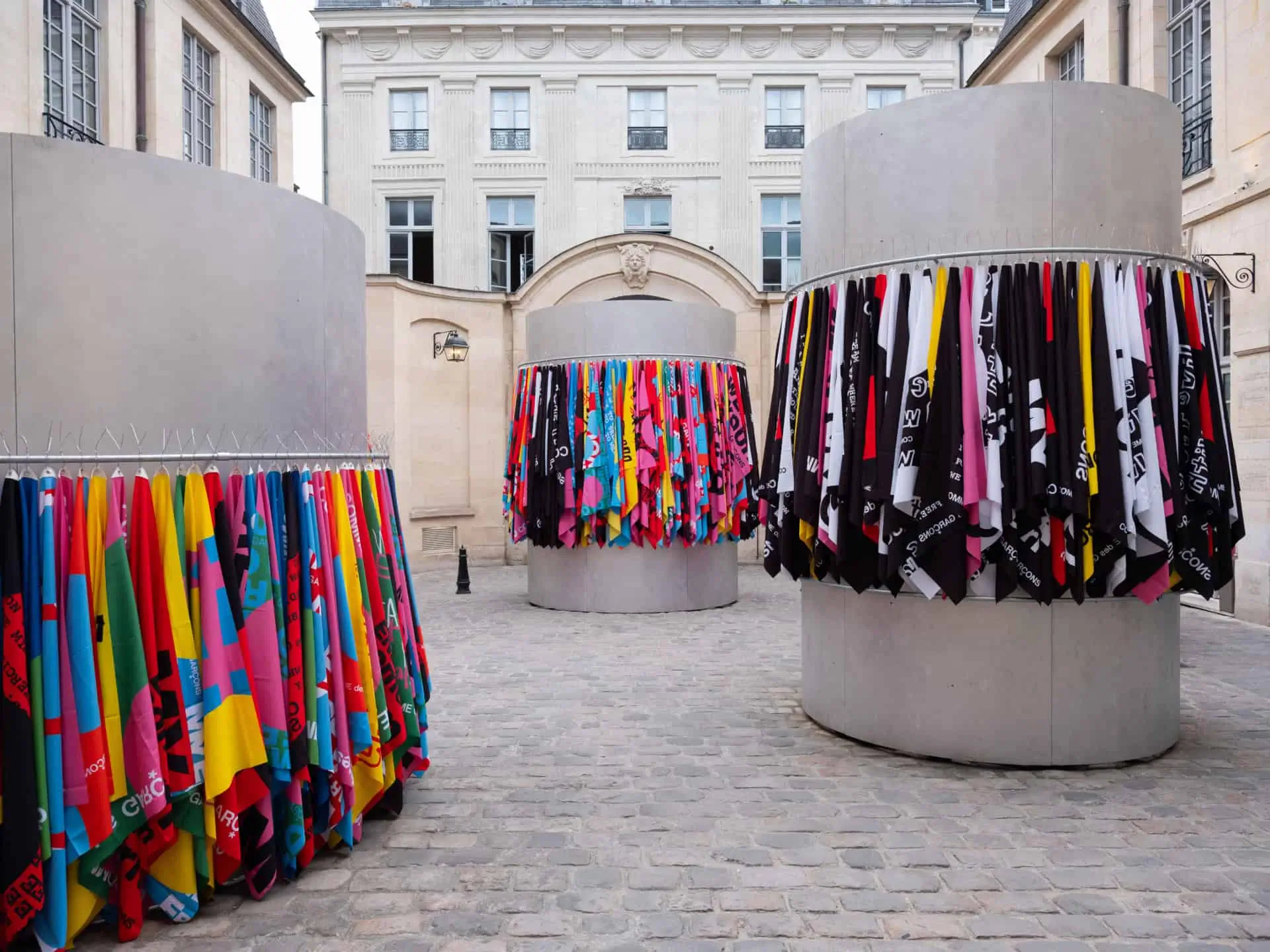
A courtyard installation showcases rows of vividly printed flags draped around monumental circular structures, bringing contemporary graphic design into a historic Parisian setting.
stir
Every few months, the courtyard at Dover Street Market gets handed over to Rei Kawakubo for a total rethink, and this time the results lean political without ever saying so out loud. Unveiled on June 26, the new installation wraps the courtyard’s industrial metal pillars in vividly coloured Comme des Garçons flags, staged to evoke the banks of national flags outside a UN building — a framing later echoed in the brand’s own Homme Plus show. Saturated reds, yellows, blues, pinks and blacks drape the cylinders in a way that turns branding into sculpture, and a walk through the space starts to feel less like browsing a store and more like wandering through an oversized, fabric-built forest. It’s a deceptively simple gesture — flags, pillars, colour — executed with the kind of scale and confidence that only a brand with total control over its own retail architecture can pull off. The space itself, inside the 17th-century Hôtel de Coulanges on rue des Francs-Bourgeois, has been a rotating canvas since it opened, and this iteration is arguably its most graphically direct yet.
View this post on Instagram
wales bonner
Where the Comme des Garçons installation goes loud, Wales Bonner‘s SS27 menswear, presented as a lookbook under the title Sun Poem, goes quiet and precise. The collection continues the house’s long-running dialogue between sharp tailoring and athleisure, but the new season pushes further into texture — embossed leathers and embroidery doing the work of adding depth without tipping the silhouettes into fussiness. Crisp shirting layered beneath athletic outerwear is the clearest expression of the idea: two dress codes that shouldn’t sit together, made to look inevitable side by side. It’s the kind of collection that photographs as effortless because the actual construction underneath is anything but, which has been Grace Wales Bonner’s signature move since the label’s earliest seasons — cultural research and craftsmanship dressed up as something you could throw on without thinking.
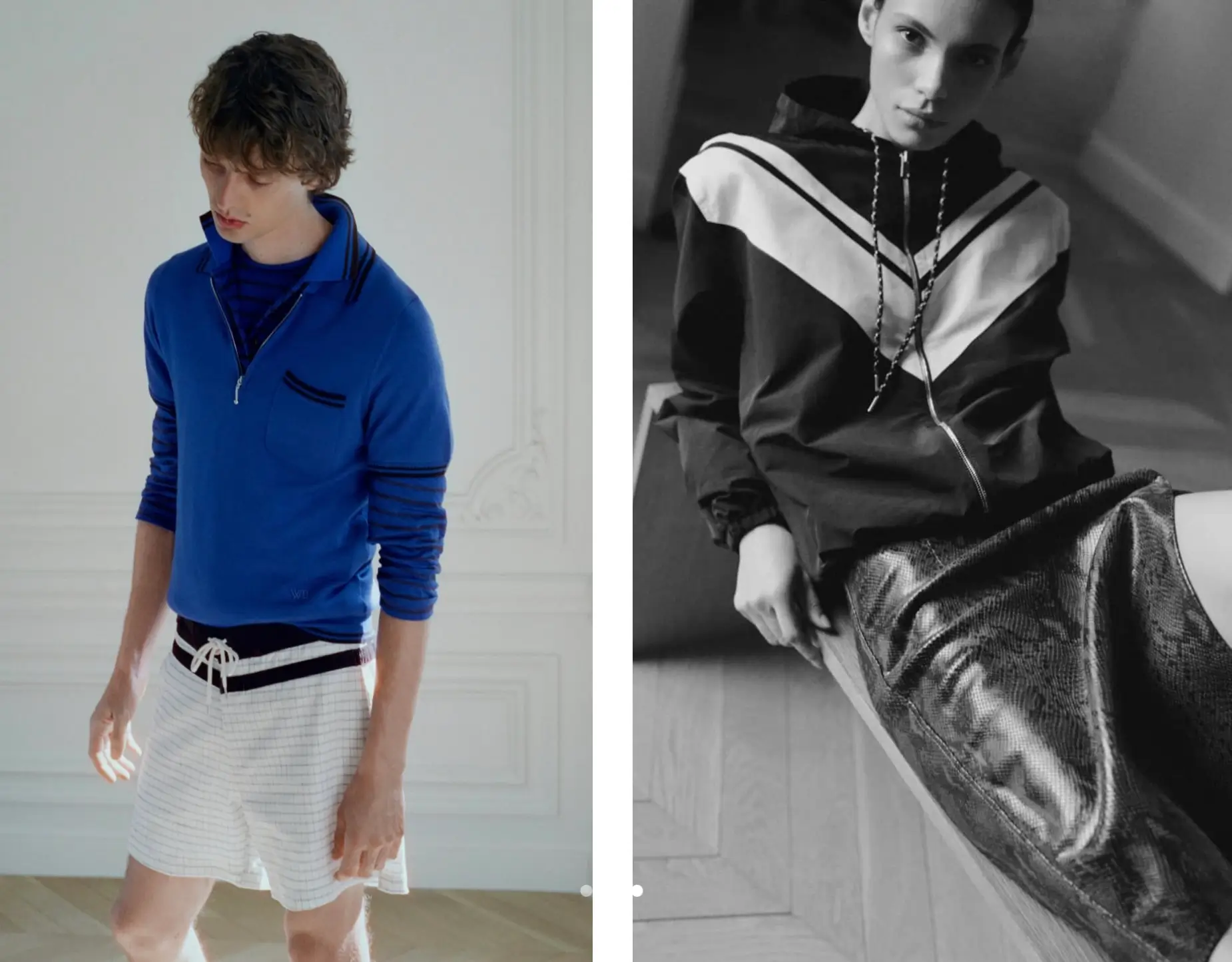
Contrasting color and monochrome editorial looks pair sporty knitwear with sculptural silhouettes, highlighting modern tailoring, graphic outerwear, and expressive textures.
charles jeffrey loverboy
If Wales Bonner is the disciplined half of London’s menswear week, Charles Jeffrey Loverboy is the chaotic other half, and this season leaned into that identity harder than most. Titled Aeolian Afternoon, the SS27 men’s collection builds a surreal, television-inflected universe where analogue craft collides with digital noise — distorted tailoring, mud-streaked denim, sculptural layering and deliberately wonky knitwear that treat imperfection as the whole point. Handcrafted embellishments and colours borrowed from Renaissance painting soften what could otherwise read as pure disorder, and the tension between those two registers is where the collection actually lives. Jeffrey, who has built Loverboy out of London’s queer club scene since 2015 and shown everywhere from Central Saint Martins to SXSW with his live band The O.R., has always treated fashion week as performance first and lookbook second — this season is no exception, framed around a DIY spirit that reads as a direct response to an era of algorithmic scrolling rather than a rejection of technology altogether.
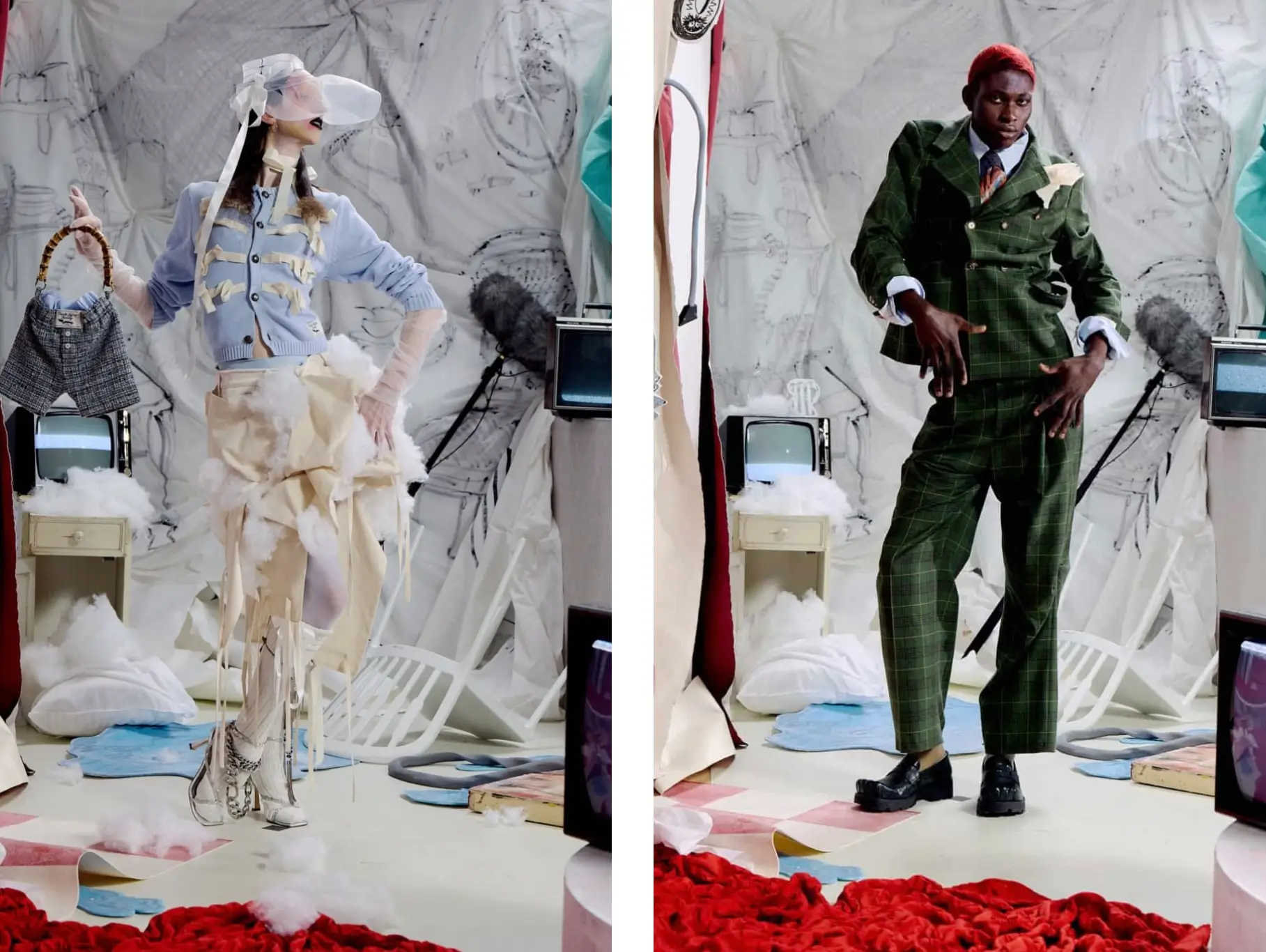
Two expressive editorial looks combine experimental styling, tailored suiting, and conceptual set design, blending theatrical fashion with contemporary art-inspired visuals.
nicholas dale nicholas
Nicholas Daley has spent a decade building his label around the idea that clothing and music are the same discipline, and SS27’s Sonic Tapestry makes that argument as literally as any collection he’s produced. Drawing on the spiritual jazz movement of the 1960s and ’70s, the lookbook centres patchwork construction throughout, closing on a jacket built from archival fabrics that nod to the label’s long-standing sustainability commitments. Handwoven knitted hats and loud tie-dye keep the mood playful against workwear and tailoring built from handmade textiles, and the overall effect is warmth rather than nostalgia — a collection that feels lived-in rather than staged. Daley, a Central Saint Martins graduate whose work has found a particularly devoted following in Japan through titles like Brutus and Popeye, continues to treat each season as an extension of his family’s own musical history rather than a seasonal reset.
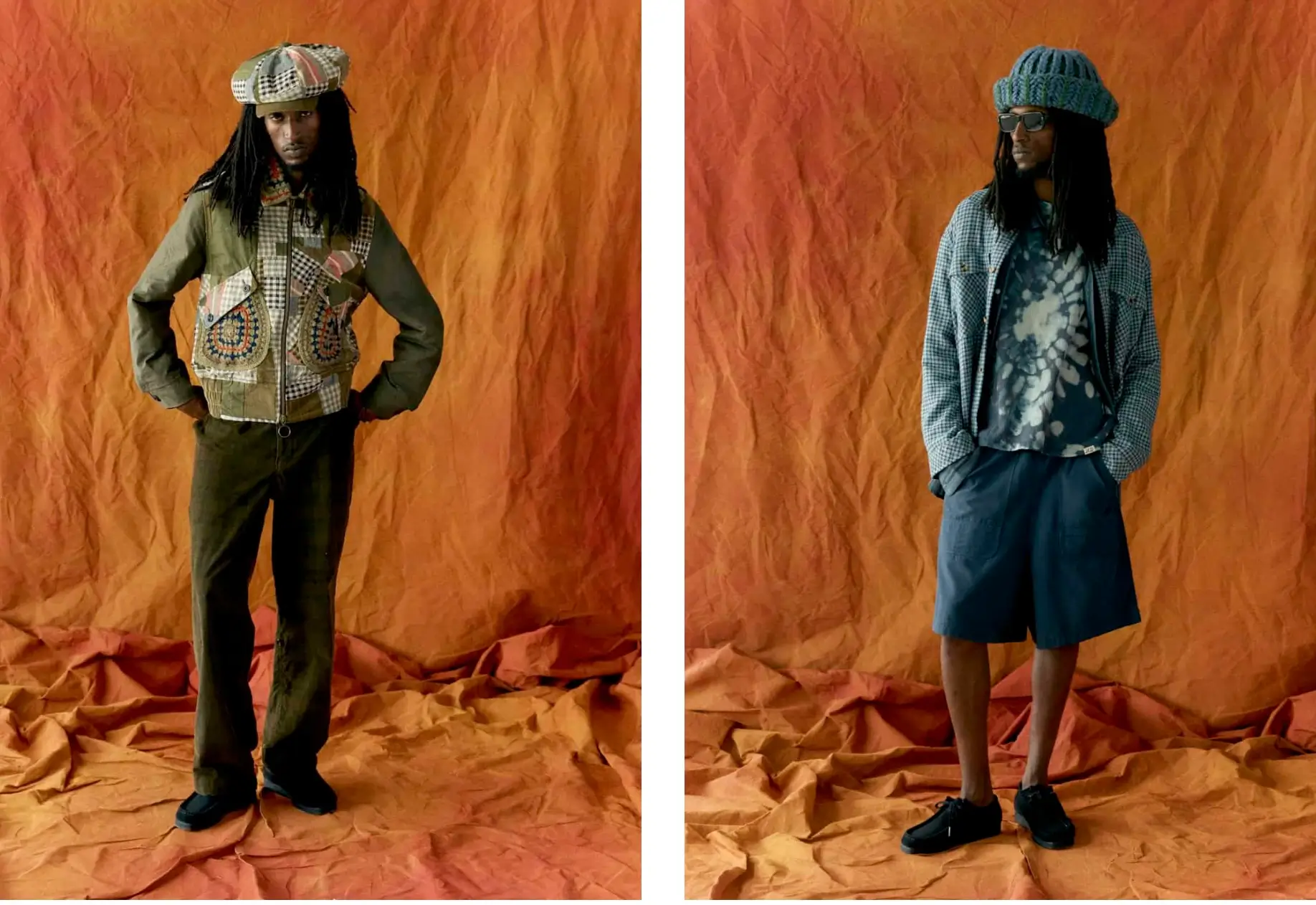
Two modern menswear looks explore layered textures, artisanal knitwear, and relaxed silhouettes, presented against a rich orange studio backdrop that highlights the collection’s earthy palette.
derrick
The fourth menswear story of the week comes from Derrick, the label built by Luke Derrick out of a Bethnal Green studio and a résumé that runs through Savile Row, Brioni and Alexander McQueen. SS27, titled Compression, is the clearest statement yet of Derrick’s core idea: that tailoring and sportswear were never as far apart as menswear convention insists. The lookbook reworks Oxford bags, boating jackets and oversized tuxedo shirting using technical fabrics and relaxed proportions, with waterproof silk-blend gabardine and silicon-dipped cotton giving classic British silhouettes a distinctly performance-driven edge. A trench layered over cycling shorts sums up the collection’s whole logic — heritage tailoring engineered to move like activewear, without losing the posture that made a suit worth wearing in the first place. Since launching in 2021, Derrick has built a following on exactly this contradiction, and Compression pushes it further than any previous collection.
View this post on Instagram
alaia miami
Alaïa opened its first Florida boutique on June 30, landing in the Miami Design District alongside Hermès, Versace and Prada with a space that reads as considerably more restrained than its neighbours. Designed by longtime collaborator Halleroed — the Stockholm studio behind several of the house’s most recent projects — the boutique wraps its facade and interior in soft pink mosaic tile, a material choice that extends from the exterior wall straight through to the furniture. A circular opening in the facade frames a living plant installation by French botanist Patrick Blanc, whose relationship with the house dates back to the green wall at Alaïa’s Paris flagship, and interior designer Martin Brûlé has filled the rooms with a curated mix of vintage and contemporary furniture, including pieces by Philippe Starck and Ron Arad. The result is a boutique that trades Miami’s usual maximalism for something closer to a private apartment — footwear housed in a circular ground-floor salon, ready-to-wear tucked upstairs behind mirrored folding screens. It’s Alaïa’s design language, under creative director Pieter Mulier, translated into architecture rather than clothing, and it’s a considerably quieter flex than most Design District openings manage.
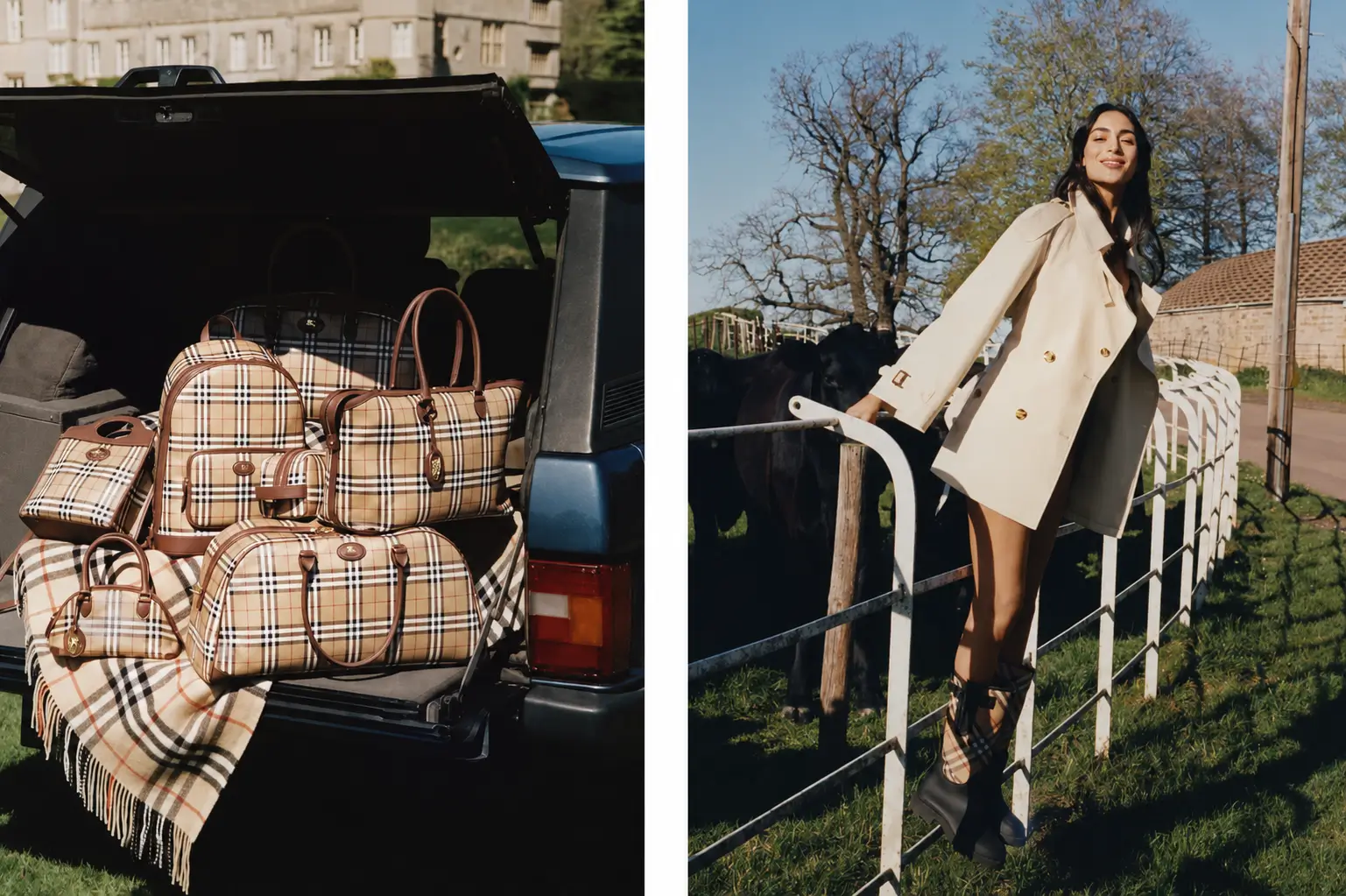
A countryside-inspired luxury campaign pairs heritage check travel bags with timeless outerwear, blending classic British style, refined craftsmanship, and pastoral elegance.
burberry
Burberry released a new campaign this week built around exactly the kind of scene its archive was made for: a group of friends on a summer road trip through the English countryside, ending up at Deene Park, a stately home in Northamptonshire. Titled Escape to the Countryside, the campaign marks the fashion campaign debut of musician Moses Martin — son of Chris Martin and Gwyneth Paltrow, and frontman of the band People I’ve Met, whose song “For Hire” scores the film — alongside regular Burberry faces Edie Campbell, Nora Attal and Sang Woo Kim. Shot by Chris Rhodes with a companion film by Martin Senyszak, the imagery leans on Burberry’s outdoor heritage rather than any obvious spectacle: open car windows, impromptu stops in villages, a Check-heavy accessories line in archive beige that includes the house’s zip tote and bucket bag. Creative director Daniel Lee frames the whole thing as a distinctly British instinct — the idea that a road trip with no fixed destination is itself a kind of luxury — and the AW26 pieces on show, from a water-resistant men’s trench to a ruched, antique-hardware coat for women, are built to move just as easily from a car boot to a country lane.
View this post on Instagram
mcqueen
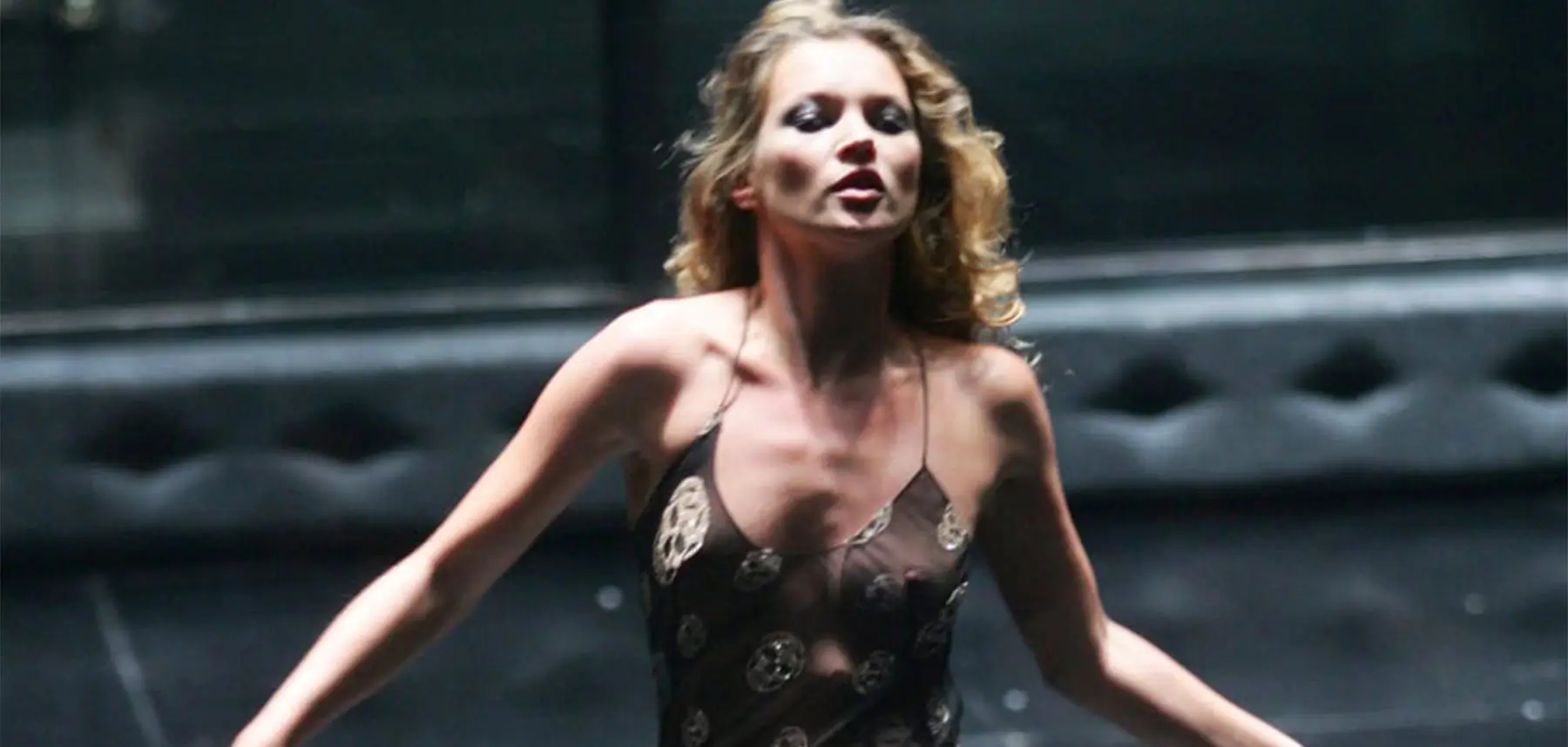
Alexander McQueen released a new instalment of Documenting McQueen this week, the house’s ongoing digital series that pairs Central Saint Martins fashion historian Alistair O’Neill with pieces pulled from the archive. This episode takes on one of the label’s most recognisable motifs — the skull — tracing its roots back to the 1996 “Dante” show, where Simon Costin’s morgue-inspired headpieces first planted the symbol’s connection to mortality and memento mori within the house’s visual language. From there, O’Neill walks through the motif’s biggest moments: the launch of the now-iconic Skull Scarf in 2003, and the custom skull-print dress made for Kate Moss at the 2004 “Black Show,” choreographed by Michael Clark. It’s a small, tightly built piece of brand storytelling, but it lands at a useful moment — a reminder, under current creative director Seán McGirr, of just how much of McQueen’s design vocabulary was established decades before he arrived, and how much of his job is translation rather than invention.
fin
Away from the runways, London’s Pride weekend brought its usual embarrassment of nightlife riches — Howl and Sextou in Hackney Wick, Club Are in Shoreditch, and Adonis, which paired its regular Saturday day party at The Cause with a joint night alongside Berlin’s Power Dance Club at Venue MOT. The standout addition this year is a zine, created by artists Max Allen and Kurtis Lincoln, built around Adonis’s extended community and the installation the pair designed for the party’s summer run — itself pulled from queer flyers, badges and ephemera held in the Bishopsgate Institute’s archive. The zine launched with a pre-Pride party at Tramp’s Bar, with resident DJ Jeffrey Hinton on the decks. It’s a smaller story than a runway show or a store opening, but it’s arguably the most direct link in this list to fashion’s actual subcultural roots — flyers and badges from decades of queer nightlife, repackaged by the people still running the parties today.
Nine stories, five cities, not one shared theme — which might be the most honest way to describe where fashion sits at the midpoint of the year. Houses with a century of history are digging through their own archives for material, while independent labels barely five years old are inventing new hybrids on the same runway calendar. Worth watching which of these threads gets picked back up next season, and which quietly disappears.
Related Articles
WACKO MARIA Brings Its Leopard Lining to the Big Leagues
Black nylon outside, leopard fur inside: WACKO MARIA’s first Major League Baseball collection reached Japan […]