DRIFT AUDIO
Listen to this story
Choose a voice, then press play.
If there was any doubt about Olivia Rodrigo’s pop-rock bonafides, she received the co-sign tonight from Debbie Harry, lead vocalist of Blondie, who appeared in a surprise cameo on Saturday Night Live to introduce the singer.
Rodrigo, pulling double duty for the first time, returned to the Studio 8H stage for her third performance, debuting her new song “drop dead.” The three-time Grammy-winning singer-songwriter released the track and its accompanying music video—dreamily directed by Petra Collins at the Louvre Museum—earlier this week, making the SNL appearance its official live baptism.
stir
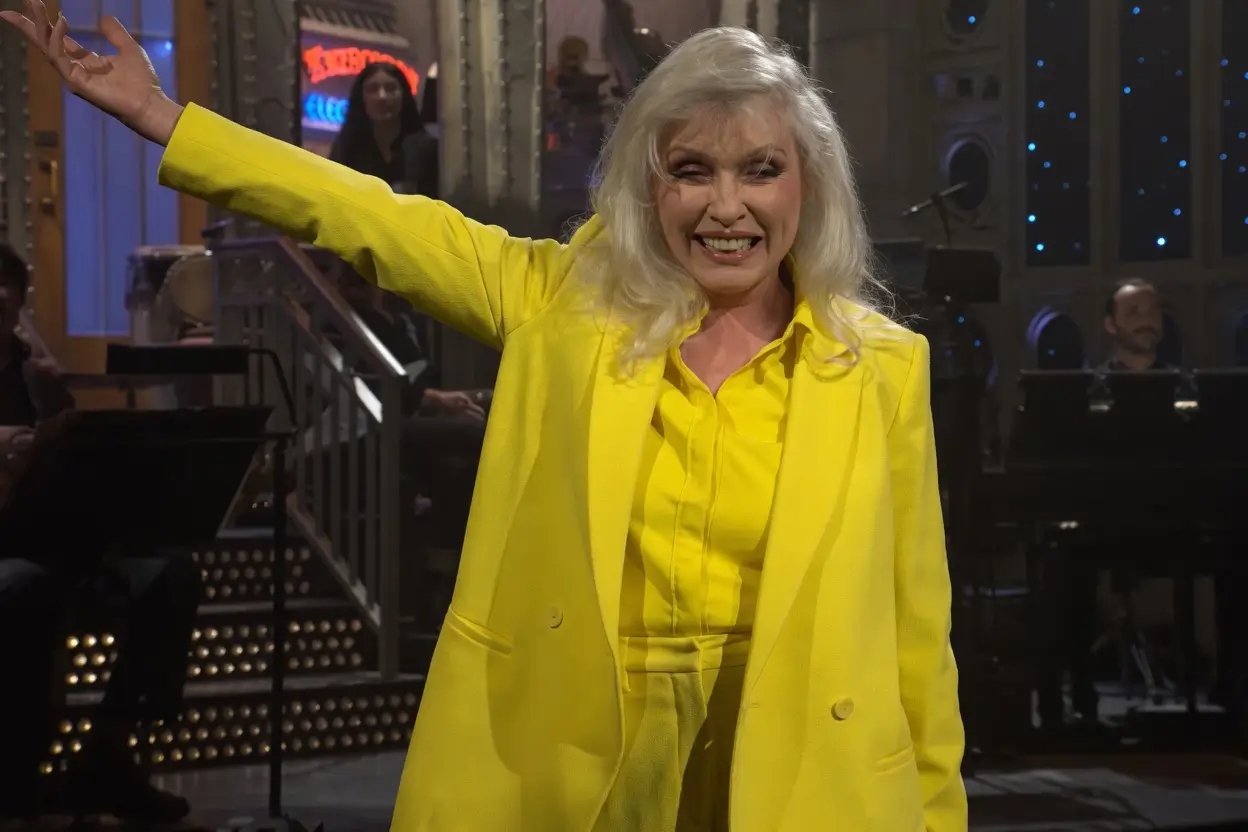
The moment was electric from the jump. As the house band struck the opening chords, the lights dimmed into a sultry crimson. Debbie Harry, every bit the punk-rock icon at 80 years young, stepped into the spotlight wearing a bright yellow blazer over a graphic tee that simply read “RIP.” The audience erupted before she even spoke. That pop of yellow felt like pure Blondie energy: bold, unexpected, and impossible to ignore.
“Tonight we have someone who reminds me why I still love this city and this stage,” Harry said, her unmistakable cool rasp cutting through the cheers. “She’s got the voice, the venom, and the vision. Please welcome the one and only… Olivia Rodrigo.”
Rodrigo walked out in a vintage leather jacket, messy eyeliner, and a tartan mini-skirt—equal parts ’90s riot grrrl and 2026 pop-punk presence. She flashed a grateful smile at Harry, the two sharing a quick hug that felt less like ceremony and more like continuity. Then the music hit.
“drop dead” is a sharp left turn, even for Rodrigo. Built on crunchy power chords, a propulsive drum beat reminiscent of early Blondie meeting Paramore, and a soaring, venomous chorus, the song finds her at her most unfiltered. The lyrics move through emotional whiplash—heartbreak, rage, dark humor—without pause.
“I hope you drop dead in the middle of your wedding / Hope the cake tastes like regret and the dress feels like a coffin,” she snarled in the second verse, the Studio 8H crowd screaming along by the second run-through. The bridge opened into a full-throated scream-sing moment that recalled the raw catharsis of her “brutal” era, now carrying more weight, more distortion, more intent.
fracture
The performance wasn’t only a debut. It clarified direction. Where GUTS leaned into theatrical pop-punk, “drop dead” feels like a full commitment to the rock side of her identity. The guitars arrive louder, the attitude sharper, and the production—handled by Dan Nigro—leans into a live-band urgency that translates cleanly on a stage like SNL.
Visually, the music video plays in contrast. Shot entirely at the Louvre at night through Petra Collins’ signature lens—dreamlike, slightly off-center—it unfolds like a gothic fairytale. Rodrigo moves through empty galleries, smashing marble statues with a guitar, dancing across artifacts, eventually setting a lavish dinner table on fire while wrapped in a tulle gown. High art and disruption collapse into each other without explanation.
Back on SNL, after the first performance, Rodrigo returned for a second song: a stripped-down, piano-led rendition of “vampire.” It felt measured, almost grounding. But the night had already tilted.
flow
The timing matters. After the scale of SOUR and GUTS, expectation could have pushed toward refinement, repetition. Instead, “drop dead” reads as a shift in posture. Less negotiation, more assertion.
In the days leading into the performance, Rodrigo kept distance. A broken heart emoji. A single image in front of the Louvre. Then the video release at midnight. No excess framing. By the time she stepped onto the SNL stage, anticipation had already compressed into something sharper.
Behind the scenes, the keep-in-touch with Debbie Harry had been in motion for months. Reports suggest Rodrigo initiated the reach-out herself. Harry accepted without hesitation. On stage, that history stayed mostly unspoken, but visible enough to register.
As the episode closed, Rodrigo stood center stage, sweat-slicked, still, the house band carrying on behind her. A quiet “thank you” mouthed toward the audience. A glance to the side. Harry, still lit in yellow, returning a nod.
fin
For a generation shaped by digital immediacy and emotional transparency, Rodrigo’s shift lands clearly. Not a departure from pop, but an expansion of its edge.
What she presented wasn’t just a new single. It was a recalibration—of tone, of scale, of intent. The “drop dead” era doesn’t arrive cautiously. It announces itself fully formed.
And if this moment holds, it is not to be just remembered as a transition.
It should be held as a beginning.
Related Articles

Master Chief Reports to Call of Duty Now: Inside Xbox’s Second Reset Wave
Twenty-five years after Halo launched the original Xbox, the next mainline game belongs to Activision. […]