
DRIFT AUDIO
Listen to this story
Choose a voice, then press play.
living memory: heritage as a new kind of modernism
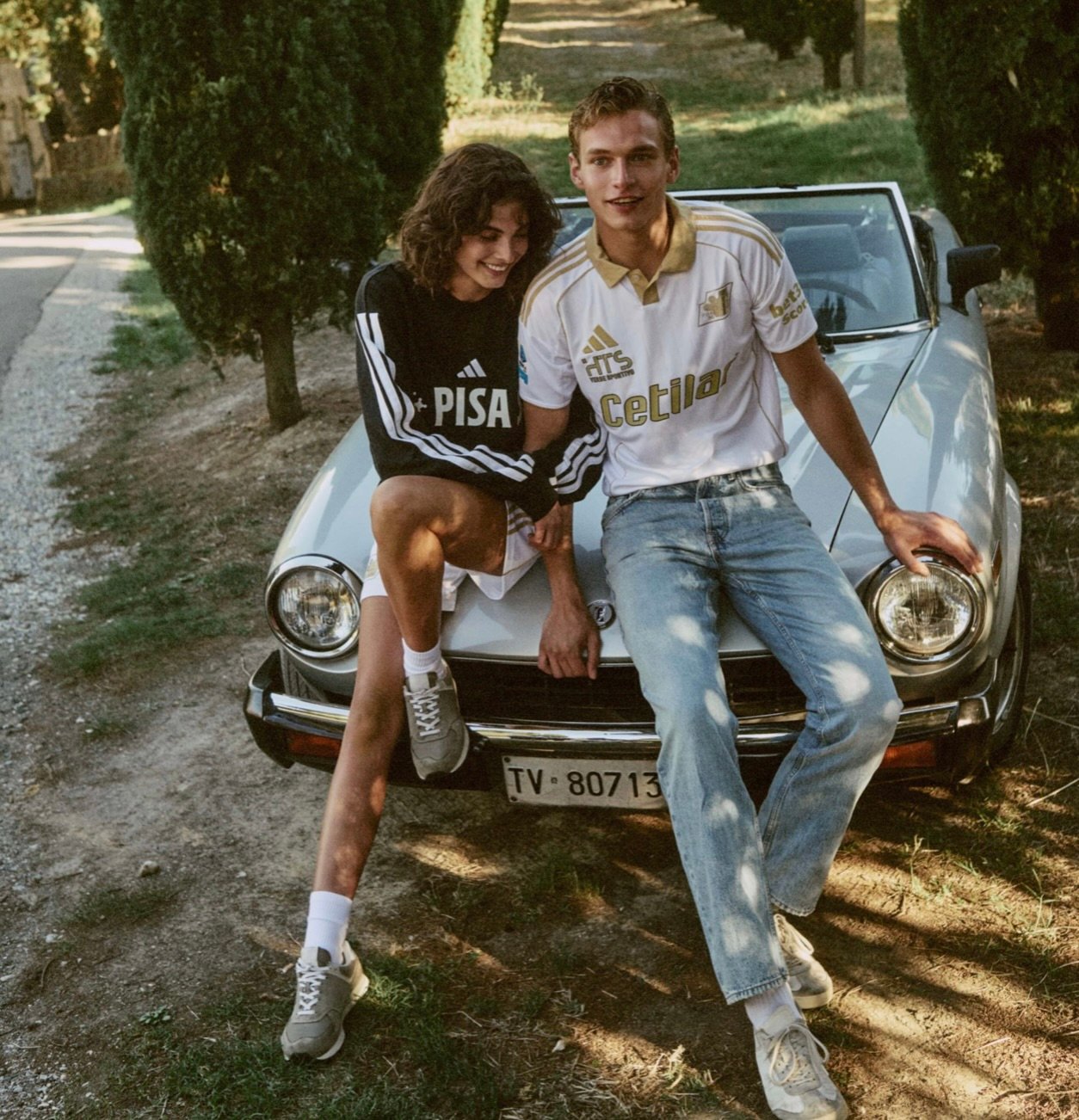
When Pisa Sporting Club and adidas revealed their 2025/26 Third Kit, it wasn’t just another jersey drop—it was an essay on continuity. The shirt fuses heritage and minimalism, connecting the Tuscan club’s golden years to a sharper, more cosmopolitan present. Football, especially in Italy, is never only about what happens on the pitch. It is theatre, memory, and identity woven into fabric.
The new Third Kit arrives wrapped in the calm authority of its colors: refined tones that evoke both the Mediterranean’s muted blues and the limestone of Piazza dei Miracoli. The elegance feels deliberate—calculated to command quiet respect rather than loud applause. In a football economy obsessed with spectacle, Pisa has chosen introspection.
The emblem at the pithy of this release—the 1980s white shield reinterpreted—functions as both a revival and a manifesto. The slightly irregular shape suggests imperfection as artistry, recalling the Leaning Tower’s very tilt. Around it, horizontal bars trace architectural echoes, while circular patterns reinterpret the Pisa cross, one of Italy’s oldest civic symbols. This isn’t nostalgia for nostalgia’s sake. It’s design as dialogue: between then and now, between civic identity and global brand narrative.
football’s new vintage: why old logos matter again
Across Europe, vintage football logos have become a quiet revolution. Clubs like Juventus, Roma, and Inter have all reconsidered their crests in recent years—some simplifying, others reintroducing classic versions for special kits. But the movement toward “retro modernism” is less about branding and more about emotion.
Pisa’s decision to restore its 1980s badge signals a broader trend: a return to authenticity amid design homogeneity. The current generation of fans—digital natives raised on a glut of content—respond to heritage. They crave tangible symbols that carry weight. The old crest carries more than identity; it carries time.
adidas has been instrumental in nurturing this revival across its European portfolio. From Arsenal’s bruised banana retros to Ajax’s eternal three-little-birds tribute, the German brand understands that football’s future depends on its ability to preserve and reinterpret the past. For Pisa, this partnership anchors the club not in the nostalgia of Serie B memories but in the ambition of design storytelling.
elegance
The Third Kit’s silhouette is sleek and modern, but its emotional charge comes from understatement. In an era of gradient overloads and geometric chaos, Pisa’s new strip is quiet luxury rendered in polyester. Its tonal balance—likely a deep navy or charcoal offset by crisp white detailing—translates the city’s monumental serenity into wearable form.
adidas employs its current HEAT.RDY technology to ensure functionality matches aesthetic refinement. Breathability, thermoregulation, and a featherweight feel give the jersey technical credibility, but it’s the cultural engineering that defines its success.
When Italian clubs experiment with subtlety, the results can be transcendent. Consider Venezia FC’s romantic kits designed by Kappa or Fiorentina’s recent retro experiments. Pisa’s offering fits within this aesthetic renaissance, positioning smaller clubs as vanguards of football’s artistic conscience.
pisa
To understand the resonance of this kit, you have to understand Pisa itself. The city, known globally for a tower that refuses to stand straight, exists in perpetual dialogue with imperfection. Its skyline embodies equilibrium through imbalance, symmetry through tilt.
Pisa Sporting Club, much like its city, has lived through its own oscillations—promotion and relegation, glory and obscurity. The return of the 1980s crest doesn’t just commemorate victories; it rehabilitates a mood, a cultural optimism that once pulsed through the Stadio Arena Garibaldi.
This jersey is, in essence, architectural fashion. Each bar on the crest feels like scaffolding around the memory of a monument. Each stripe is an echo. Together, they construct a narrative of persistence—a statement that Pisa, though modest in European stature, understands the poetry of permanence.
design
Italian clubs are once again leading the conversation around design authenticity. Yet Pisa’s Third Kit also reflects a continental aesthetic language emerging across European football—one in which heritage and modern tailoring coexist.
adidas, whose influence stretches from Munich to Madrid, has become fluent in the idioms of locality. For this project, the brand looked not to global trends but to Tuscan iconography. The irregular white shield contrasts the German penchant for precision with a distinct Italian softness—proof that collaboration between culture and corporation can yield nuance rather than compromise.
Elsewhere, clubs like Union Berlin, Marseille, and Anderlecht have adopted similar principles: kits that tell stories rather than shout slogans. Pisa’s entry into this movement situates the club within a Europe that values narrative craft as much as athletic performance.
style
What makes this jersey resonate is its ability to unite generations. For older supporters, the crest recalls the club’s iconic 1980s seasons, when Pisa’s football carried the hopes of a region often overshadowed by Florence’s glamour or Turin’s power. For younger fans, it offers authenticity in an era of digital detachment—a tactile symbol of belonging.
This intergenerational bridge is perhaps the most profound achievement of Pisa’s 2025/26 Third Kit. Football clubs are custodians of community identity, and design becomes the language through which that identity evolves. The decision to look backward is therefore not regression but strategy: a reassertion that continuity, when articulated with elegance, can feel more modern than disruption.
adidas
The German sportswear giant continues to redefine what partnership means in contemporary football. For adidas, the Pisa collaboration isn’t about volume sales; it’s about cultural cachet. This is the same logic that underpinned their connections with Y-3 and Humanrace—projects where design becomes discourse.
Here, the emphasis lies on nuance rather than novelty. The adidas Three Stripes complement the white shield crest without overpowering it, allowing the garment’s geometry to breathe. It’s a masterclass in restraint, a reminder that heritage collections can exist within mainstream performance lines.
In a football world that increasingly treats kits as seasonal fashion drops, adidas and Pisa have engineered something rarer: a product with permanence.
nostalgia
Pisa’s Third Kit embodies what might be called the new Italian minimalism—a post-haute sensibility grounded in purity of form. Where early 2000s football jerseys were maximalist expressions of sponsor logos and color clashes, the current aesthetic language favors calm surfaces and emotional precision.
In cultural terms, it mirrors Italy’s broader creative renaissance across architecture and fashion. Brands like Loro Piana, Stone Island, and Brunello Cucinelli all work from similar principles: authenticity, craftsmanship, and timeless design. Pisa’s jersey translates those values into sport.
Yet there’s also nostalgia—nostalgia not for specific matches, but for the era when football shirts were civic emblems rather than global commodities. The return of the 1980s badge makes this connection explicit. It evokes a pre-digital age when crests were stitched, not printed, and when the tactile experience of cloth carried meaning.
the aesthetic
Every football kit, at its core, asks a simple question: who are we? Pisa’s Third Kit answers by refusing to shout. It belongs to a lineage of design that understands identity as subtlety. The leaning geometry of the crest—the off-balance harmony—encapsulates the city’s self-image: proud, imperfect, enduring.
For supporters, wearing the 2025/26 Third Kit will feel less like sporting merchandise and more like cultural participation. The shirt becomes a medium through which personal memory and civic history intertwine. This emotional proximity is precisely what modern clubs seek as they compete not only in leagues but in the attention economy.
a future
If Pisa’s Third Kit looks backward, it does so to move forward. Heritage, in this context, is a renewable resource—a form of energy derived from memory. The shirt’s design language projects continuity into the digital future of European football, where streaming platforms and metaverse activations threaten to dissolve local identity.
By reclaiming its 1980s emblem, Pisa asserts the enduring relevance of locality. The club is saying: we belong to a place, a history, a tower that leans but never falls. adidas translates that declaration into textile form, ensuring that every seam carries symbolic weight.
This approach aligns perfectly with the brand’s broader sustainability agenda. Authenticity, after all, is the most sustainable aesthetic of all.
culture
No modern kit lives solely within the stadium. The Pisa x adidas Third Kit is destined for a dual life: part matchwear, part cultural artifact. Its clean palette and sculptural logo make it easily adaptable to streetwear contexts.
We can expect to see the shirt layered under technical jackets, paired with tailored trousers, or styled in the monochromatic codes dominating Milan and Berlin street style. Like Venezia’s green-and-gold shirt or AS Roma’s minimalist anniversary strip, Pisa’s jersey transcends sport to become symbol.
In the age of “footballcore,” where luxury brands borrow silhouettes from sportswear, Pisa’s new kit embodies authenticity that can’t be faked. It’s not referencing football—it is football.
impression
adidas has mastered the art of generating cross-platform resonance. Expect Pisa’s new kit campaign to populate both traditional football channels and lifestyle outlets. Social media teasers already reflect a cinematic tone: aerial views of the Leaning Tower dissolving into close-ups of the crest’s textures, intercut with shots of local youth reclaiming the city’s streets.
This visual language situates Pisa not as a provincial club but as a global story rooted in local soil. For a younger audience fluent in visual culture, such campaigns convert regional identity into shareable imagery.
The collaboration’s success, therefore, won’t be measured solely in jersey sales but in how effectively it transforms cultural perception.
Related Articles
adidas Originals Lines Up a Velour Zip-Up in Black, Navy and Burgundy
Three colors, one plush knit and no date yet. A velour zip-up sweatshirt is heading […]