DRIFT AUDIO
Listen to this story
Choose a voice, then press play.
The secondhand market is breaking records, claiming runway space, and still failing to answer the one question it was supposed to solve.
Every headline metric in secondhand fashion is pointing the same direction, and it is up. Global resale is projected to reach 393 billion USD by 2030, growing roughly twice as fast as new clothing sales, accord to ThredUp’s 2026 Resale Report. Designers who once treated archival pieces as a marketing footnote are now send them down the runway on purpose. And yet talk to the people actual running vintage shops and multi-brand resale businesses, and the mood is more complicated than the growth charts suggest. More attention has brought more competition, loyalty is harder to earn than it used to be, and a separate body of research is now arguing that all this growth has done surprisingly little to fix the waste problem resale was supposed to solve in the first place. The three stories are unfolding at once, in the same market, often to the same sellers.
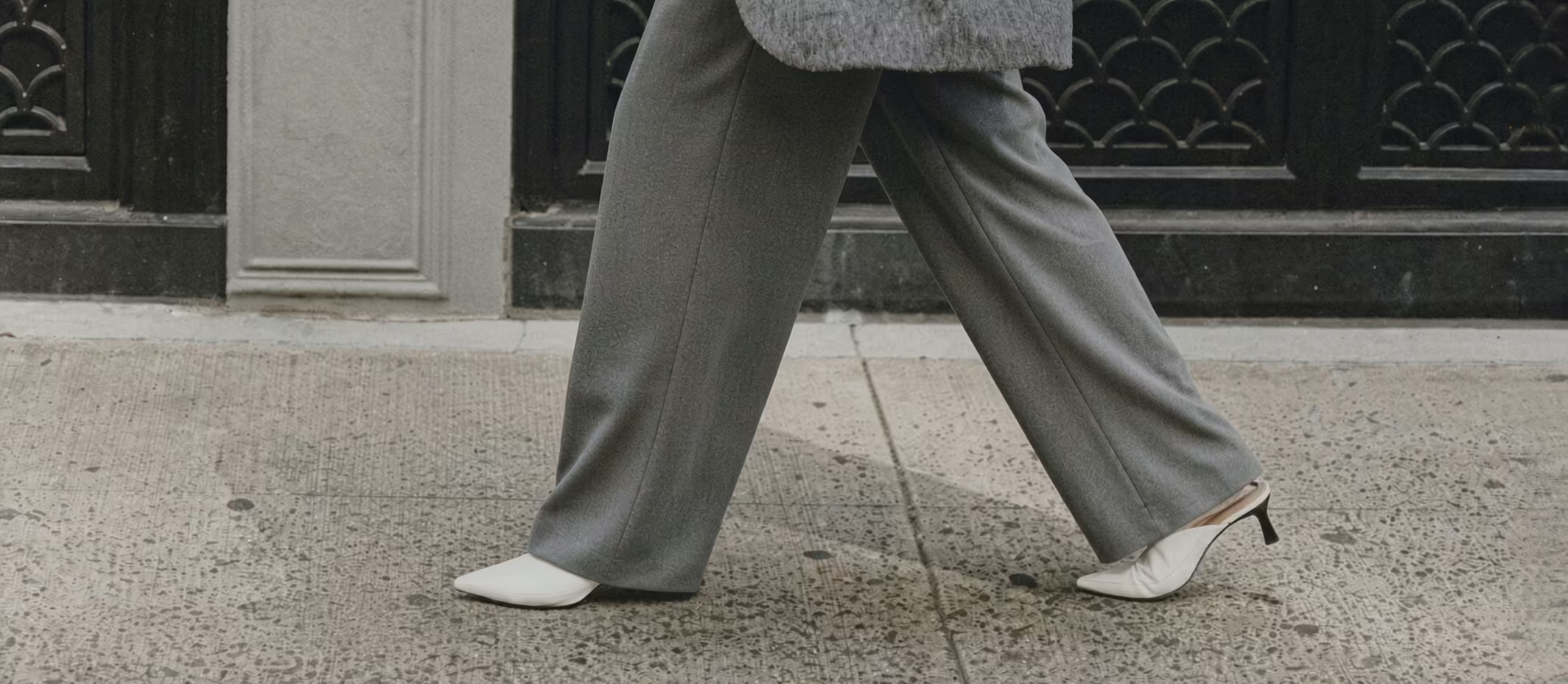
A close-up of a person walking on a city sidewalk wearing wide-leg grey trousers and white pointed-toe kitten heels, with a dark building facade in the background.
stir
By the numbers, this is close to a golden age. The global secondhand apparel market grew 13 percent in 2025 to roughly 257 billion USD, according to ThredUp’s 14th annual Resale Report, conducted with GlobalData, and is on track to hit 393 billion USD by 2030, about 10 percent of all global apparel spend. In the United States specifically, the secondhand market grew 19 percent in 2025, its strongest year since 2021 and nearly four times faster than broader retail clothing, on a path toward 78.8 billion USD by 2030. Fifty nine percent of American consumers shopped secondhand apparel last year, up seven points in three years, and ThredUp cofounder and CEO James Reinhart summed up the shift bluntly: resale, he said, is no longer just growing, it is taking direct market share. Separate research from Business of Fashion and McKinsey’s State of Fashion 2026 report puts the secondhand market on track to grow two to three times faster than firsthand fashion between 2025 and 2027. Shoppers are also finding secondhand differently than they used to: ThredUp’s report found nearly half of buyers now discover resale finds through social media, content creators and in-person browsing rather than a marketplace search bar, and nearly half say they already use AI tools somewhere in that shopping journey. Depop’s own 2026 trend forecast frames the shift as a move toward what it calls clarity over clutter, wardrobes built on curation rather than accumulation. Even condition has flipped: resale platform Fashionphile reports searches for visibly worn, patina-ed handbags up 39 percent, and The RealReal says sales of pre-worn leather goods have grown more than 15 percent year over year, as buyers increasingly treat scuffs and fading as proof a piece is real rather than a flaw to price around.
View this post on Instagram
That growth has bought resale a seat it never used to have: the runway itself. eBay’s Endless Runway initiative, now in its second year, had more than a dozen designers across New York, London, Milan and Paris folding pre loved pieces into their Spring/Summer 2026 shows, including Moschino, Eckhaus Latta, Altuzarra, Erdem and LUAR, on top of eBay’s own shoppable pre loved runway shows. Pre loved and refurbished items already make up 40 percent of eBay’s own gross merchandise volume, and global secondhand luxury sales reached roughly 50 billion USD in 2023. None of this reads like a niche anymore. It reads like infrastructure.
roll
None of that growth has made it easier to actually run a vintage business, according to reporting from inside the industry itself. Vintage journalist Emily Stochl, who covers the secondhand trade for her newsletter Pre-Loved, has been tracking a market where the easy wins are gone: the vintage Tee segment that spent several years commanding grail-level prices on hype alone is cooling fast, with resale platform Bidstitch attributing some of the churn to sneaker resellers who moved into graphic tees once that market saturated too. Curation, not inventory volume, is what Stochl argues now separates a dealer who survives from one who does not, since customers can already get algorithmically precise recommendations for free and are instead paying for a point of view they cannot get from a search bar.
That competitive pressure has pushed some of the loyalty-building underground, almost literally. Stochl’s reporting points to dealers building private customer bases on Discord, Instagram Close Friends and Substack, using early access to reward repeat buyers before a piece is ever posted publicly, a direct answer to a market where being visible everywhere no longer means being remembered by anyone. Multi vendor collectives have become a parallel strategy, not just for splitting rent: Pre-Loved’s own 2025 Secondhand Sellers Income Survey found dealers who share space with other sellers are twice as likely to talk finances with fellow business owners, and those conversations correlate with higher earnings. Underneath all of it sits an uncomfortable finding for anyone marketing vintage as a planet-saving purchase: across multiple consumer surveys, shoppers rank value, quality, uniqueness and convenience well ahead of sustainability when explaining why they actually buy secondhand.
The competition is not just online, either. In-person vintage markets such as Manhattan Vintage, A Current Affair, Pickwick and Thriftcon all significantly expanded their calendars and added new cities in 2025, and Pre-Loved’s own income survey found markets and pop-ups now factor into more than 60 percent of dealers’ revenue strategies, up from a smaller share in prior years. That density has produced its own kind of fatigue, the same vendors turning up at the same venues with similar merchandise, which is pushing organizers toward more tightly curated, single-format events instead: intimate closet sales, the kind that had lines around the block for actress Chloe Sevigny’s own clothing sale and briefly overwhelmed Depop when a sale by influencer Victoria Paris went live, have become their own competitive category, distinct from the general market stall. The same pressure has produced its own grassroots response: International Vintage Store Day, organized from scratch by reaching out to individual shop owners one by one, grew directly out of small dealers comparing notes in group chats about how hard 2024 had been and how little separated any one shop from the next in a shopper’s feed. The organizing logic was blunt: remind people that if they do not shop small, the shops themselves will not be there to shop small at.
taste
That gap between resale’s growth and its environmental promise is precisely what a Yale-led study published in December in the journal Scientific Reports set out to test, and its findings undercut one of the industry’s most repeated talking points. Economist Meital Peleg Mizrachi, a postdoctoral fellow in Yale’s Department of Economics, and Ori Sharon of Bar Ilan University surveyed 1,009 Americans across every state and found a positive correlation between how much people spend secondhand and how much they spend on new clothes, concentrated most heavily among younger and more frequent shoppers. Sixty nine percent of respondents had bought secondhand at least once, but 59 percent fell into a cluster with high spending in both markets at once, people who also churned through garments faster and returned more of what they bought. Secondhand clothing markets, Peleg Mizrachi said, contribute to a self-reinforcing cycle of overconsumption rather than an escape from it.
extend
The mechanisms the researchers point to, the rebound effect and moral licensing, describe a familiar pattern: making a purchase feel cheaper or more virtuous tends to encourage more of it, not less, the same logic that gets someone who buys a fuel-efficient car to drive further. In fashion’s case, that dynamic runs headlong into an industry already responsible for an estimated two to eight percent of global greenhouse gas emissions, more than international aviation and shipping combined, and one that produced an estimated 2.5 to 5 billion surplus garments in 2023 alone. A 2025 Harvard Business School working paper on branded recommerce adds a sharper edge to the same argument, finding that buyback programs, where a brand resells its own returned items, actually raise a shopper’s stated intent to buy that brand’s new products, since offering to buy an item back later makes it easier to justify purchasing it now. Sustainability writers covering the fast-fashion side of resale have made a related point about brands that operate resale platforms alongside their main business: a shopper who is promised a brand will buy an item back someday has one less reason to hesitate over buying it new today, which is a strange incentive to build into something marketed as a fix for overproduction. Donating what does not sell does not close the loop either, the Yale researchers noted: charitable systems are already overwhelmed by the volume of surplus clothing coming in, and much of what they cannot place gets baled and shipped abroad rather than kept in circulation locally. Exports of used textiles out of the European Union have nearly tripled over two decades, reaching 1.26 million tonnes in 2024, and a large share of that flow lands at secondhand markets such as Kantamanto in Accra, Ghana, where roughly 15 million garments arrive every week and, by the nonprofit Or Foundation’s own estimate, about 40 percent of it leaves as waste rather than as a sale. None of this is an argument against buying secondhand over buying new. It is an argument that resale, on its own, has not been asked to do the one job most of its marketing claims for it: actually shrinking how much the industry produces.
View this post on Instagram
Regulation is starting to catch up to that gap, though not around resale specifically. The European Union’s Ecodesign for Sustainable Products Regulation began barring large companies from destroying unsold clothing, footwear and accessories outright in July, with standardized disclosure of discarded volumes following in 2027, aimed squarely at the primary market rather than the secondhand one. Peleg Mizrachi argues the resale side needs its own version of that scrutiny: there are currently no policies in the United States or Europe governing how secondhand platforms operate, she said, and the secondhand chain should be treated as part of the primary fashion system rather than a separate, self-evidently virtuous category exempt from disclosing things like unsold inventory disposal rates or the emissions from shipping a garment back and forth. Until something like that exists, the industry’s environmental claims remain mostly self-reported.
fin
Put the three threads together and the picture of vintage retail in 2026 comes into focus. The market has never had more money, more culturel credible or more room on the runway. Dealers themselves are reply by compete on specialization rather than volume, chasing categories like antique and label-less pieces that cannot be replicated by an algorithm or a dupe, the same instinct that has push some sellers toward pre-1950s garments and heirloom-grade pieces with no designer name attached at all as the archives of better-known labels get picked over again and again. But specialization is a response to pressure, not a sign the pressure has eased. The market has also never had more competitors chasing the same shrink pool of loyal customers, and it is now facing peer-review research arguing that its central sustainable pitch does not hold up under a nationally representative survey. Resale is booming and getting more crowded at the same time, and whether it is actual solve fashion’s waste problem remains, for now, an open question rather than a settle one.