DRIFT AUDIO
Listen to this story
Choose a voice, then press play.
After years of oversaturation and reseller-bot fatigue nearly killed the format, Celine x Reebok, Rick Owens x adidas, sacai x Birkenstock, and a wave of other pairings suggest fashion has found a more restrained way back into shoe.
In This Story
- A Format That Was Supposed to Be Dead
- The Collaboration That Stole the Week
- A Decade-Old Partnership Comes Back Cooler Than Ever
- The Rest of the Field
- Why Restraint Is the New Strategy
- Pricing the Aspirational Customer Back In
- Whether It Actually Works
For a while, it looked like the shoe collide had run its course. The format exploded roughly a decade ago alongside the broader streetwear boom, and the appeal for brands was obvious: minimal design investment, since most collabs built on an already-existing shoe, paired with hype-driven demand and margins that bordered on absurd. But the strategy got run into the ground. Between near-weekly releases, increasingly far-fetched partnerships, and reseller bots that made gen-release shoe functionally inaccessible to actual customers, the category burned out. By the time Nike partnered with Tiffany & Co. on a version of the Air Force 1, much of the industry treated it as the moment the format had officially jumped the shark.
This season’s Paris Fashion Week suggested otherwise. Across the men’s shows, shoe collides returned in force — not with the same maximalist energy that defined the format’s first run, but with something more deliberate. Celine unveiled a Reebok partnership. Rick Owens reunited with adidas for the first time in a decade. sacai launched a Birkenstock converge. Willy Chavarria debuted footwear with both UGG and adidas. And that’s before accounting for Kenzo x Paraboot, Nahmias x Puma, Mowalola x Air Jordan, Auralee x New Balance, and a run of other pairings that filled out the rest of the calendar.
It’s worth noting the format never fully disappeared even during its supposed downturn — it simply retreated from the center of the culture conversation. Mass-market shoe collisions kept releasing at scale throughout the intervening years, alongside a parallel celebrity-convincer economy built around names like Bad Bunny, Travis Scott, Pharrell, JJJOUND, and J Balvin, all of which continued gen news within shoe-specific media without ever breaking into the wider fashion conversation the way Nike x Off-White once did during Virgil Abloh’s tenure. Luxury sneaker collaborations followed a similar pattern of quiet persistence: Miu Miu x New Balance, Vans x Valentino, Wales Bonner x adidas, and Loewe x On all released and were widely imitated in recent years, without generating the same runway-level spectacle that defined the format’s peak. What’s different about this Paris Fashion Week cycle is the sheer concentration of high-profile pairings arriving within a single week, several of them staged directly on the runway rather than announced separately from the shows.
View this post on Instagram
stir
No partnership gen more conversation than Celine x Reebok, unveiled during Michael Rider’s debut menswear show for the house. It marks Celine’s first show collision in its history — a notable departure for a brand that has historically avoided partnerships almost entirely, with its last major tie-up dating back to a 2010 eyewear licensing deal with Safilo.
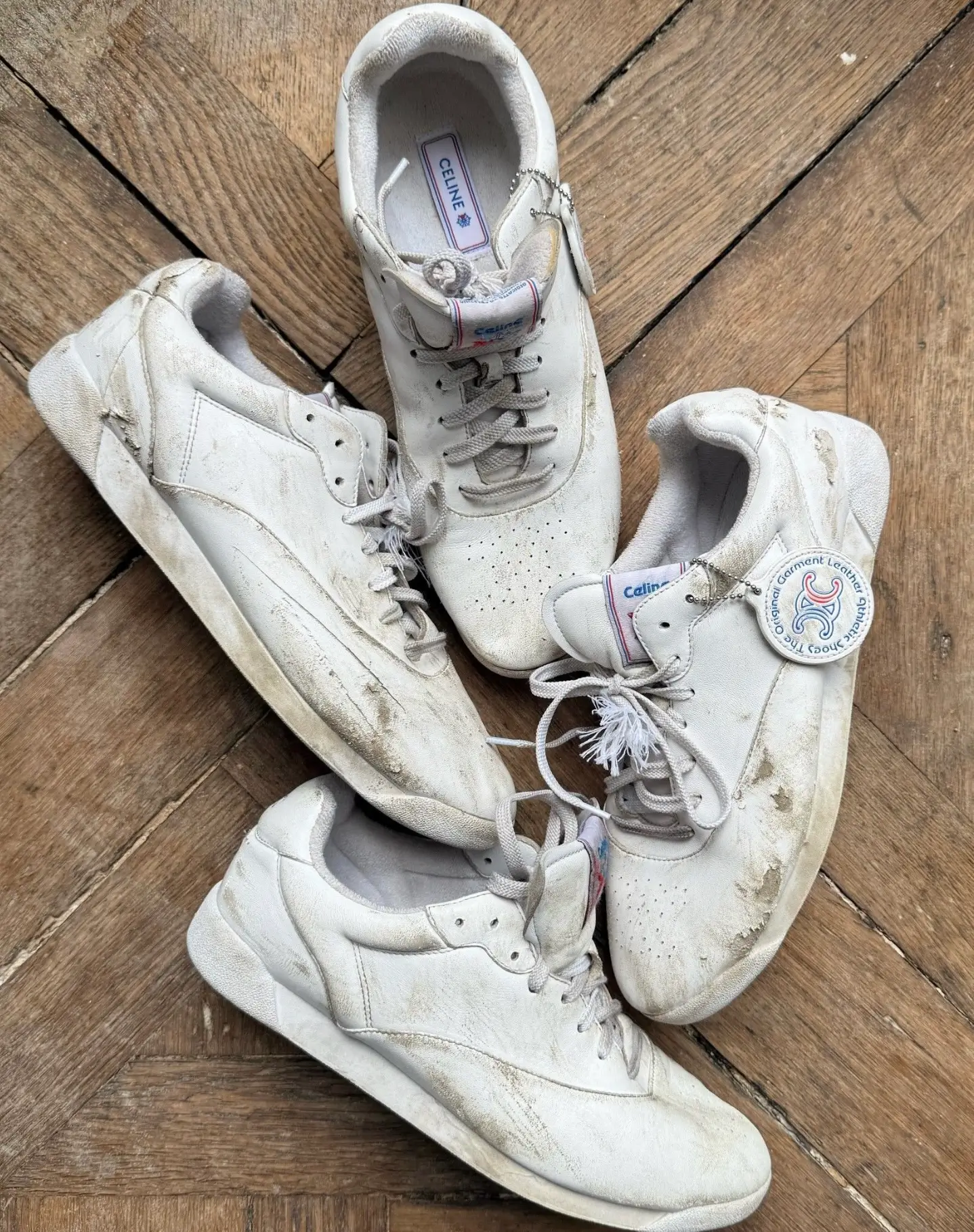
Rider built the union around Reebok’s Freestyle, a low-top silhouette introduced in 1982 and widely credited as one of the first athletic shoes designed specifically for women. Rather than leaning into archival nostalgia, the reinterpretation strips the shoe down: premium lambskin leather uppers, an intentionally scuffed and pre-distressed finish for the runway presentation, and a co-branded tongue label referencing Reebok’s archival Classic logo in place of the brand’s usual strike mark. According to coverage from Highsnobiety, the collection ultimately spans six colorways, with the first batch scheduled to arrive in September and further releases continuing into 2027.
What made the moment land wasn’t spectacle — it was the opposite. Rider introduced the shoes shh, without treating the partnership as the show’s headline, a choice several outlets described as distinctly in keeping with Celine’s historically understated posture under both Phoebe Philo and Hedi Slimane. For a house that has spent over a decade actively avoiding the kind of collaboration culture that came to define its competitors, the low-key framing did as much work as the shoe itself.
flow
If Celine x Reebok was the surprise of the week, Rick Owens x adidas was the reunion. The two brands first partnered in 2013, producing a run of experimental sneakers between 2013 and 2017 that helped define an early template for haute-meets-sportswear footwear. This season’s collection, titled Stone, marks their first collide since that run ended — though notably, it shifts focus away from the shoes that made the original partner famous and toward ready-to-wear.
The centerpiece wasn’t apparel so much as engineering: inflatable jackets and track pieces built using adidas’ Climacool technology, designed to actually cool the wearer via built-in fans, alongside an “ice vest” adapted from gear original developed for footballers and Formula 1 drivers competing in extreme heat. Owens described the concept as a personal air-conditioning system, and the timing wasn’t subtle — the collection debuted in the middle of one of Paris’s hottest fashion weeks on record. Footwear still made an appearance, including a slouched, Megaride-soled boot with white Three Stripes branding scrunched across a deflated-looking black upper, which Owens described as his first high-show running silhouette developed for the brand. Neither pricing nor a release date has been confirmed for the Rick Owens x adidas Spring/Summer 2027 collection.
rest
Beyond the two headline-grabbing partnerships, the week’s collision count kept climbing. sacai’s Chitose Abe unveiled the label’s first-ever Birkenstock collide — itself a kind of reunion, since the two brands worked together briefly in the 2010s. The new project fuses three archival Birkenstock silhouettes (the 1963 Madrid sandal, the 1973 Arizona, and the 1976 Boston clog) into two new hybrid styles: the Aoyama 107, named for sacai’s Tokyo store, and the Cassette 75, named for the brand’s Paris headquarters on Rue Cassette. Both are built on Birkenstock’s cork-latex footbed in the brand’s traditional natural and suede leathers, rendered in a restrained taupe-and-black palette, and are set for a global spring 2027 launch.
Willy Chavarria, meanwhile, used his Paris show to debut not one but two footwear partnerships. UGG made a surprise appearance on the runway with a first look at an upcoming unisex merge — the Guard Boot, Biker boot, and Hotel Chavarria Slipper — framed around a tension between biker-culture toughness and UGG’s signature comfort-first softness, with a retail launch planned for this fall at price points ranging from $190 to $800. Chavarria also teased new Stan Smith colorways as part of his ongoing, multi-season adidas partnership, describing his footwear strategy to WWD as a deliberately tiered system spanning runway-level luxury shoes, UGG’s more casual register, and Adidas shoes built for broader commercial reach.
View this post on Instagram
Elsewhere on the calendar: Kenzo linked up with French heritage shoemaker Paraboot, Nahmias partnered with Puma, Mowalola brought her design language to the Air Jordan line, and Auralee combined with New Balance. Vans stayed especially busy, following its Kei Ninomiya x Dover Street Market collision shown at Pitti with new partnerships alongside Undercover and 424. Salomon extended its own collaboration slate with both MM6 Maison Margiela and A-COLD-WALL. Versace’s Onitsuka Tiger collide and JW Anderson’s Diadora partnership round out a list that, taken together, represents one of the busiest convince seasons the men’s shoe calendar has seen in years.
restrain
What separates this wave from the mid-2010s collide boom is tone. Where earlier partnerships often leaned into loud branding and maximalist design specifically engineered to generate viral moments, this season’s pairings are notably restrained — minimal logos, an emphasis on silhouette and material over branding, and a general if-you-know-you-know sensibility. Even Rick Owens’ adidas boot, extreme as its deconstructed silhouette is by conventional standards, reads as understated within Owens’ own design vocabulary. The broader pattern extends beyond the runway collisions covered here: Louis Vuitton’s crocodile-leather reworking of a Vans silhouette drew attention for its material luxury rather than its branding, prompting Vans itself to comment on Pharrell’s social post about the shoe, while remaining relatively restrained in its overall design.
The strategic logic seems straightforward: make products easy to want and easy to buy into, rather than overwhelming with view noise the way some of the format’s more viral moments once did. That’s a meaningful shift for an industry segment that, a decade ago, treated hype-driven scarcity and maximalist design as the entire point.
mode
Accessible, more than any single design trend, appears to be the real throughline connecting this season’s links. Luxury pricing has climbed to a point where many brands’ own in-house shoes sit well outside the reach of aspirational shoppers, while the industry’s unwritten rules make walking back a price increase almost unthinkable. Partnering with a more accessible sportswear brand offers a workaround: a product that’s still a meaningful purchase, but priced closer to what a broader customer base can actually justify.
The math conjures out differently depending on the house. Jil Sander’s Puma collide, released last fall, retails for roughly half the price of Jil Sander’s own in-house sneaker — a gap wide enough to let a shopper who can’t justify an €890 shoe spend €430 without a second thought, without disrupting the brand’s overall pricing structure. Miu Miu’s New Balance collab runs the opposite direction, priced €100 to €200 above the brand’s other in-house shoe options, a structure that arguably nudges price-sensitive shoppers toward Miu Miu’s own models rather than away from them. JW Anderson, which doesn’t produce in-house shoes at all, treats its connective footwear as the most accessibly priced category in its entire store. Versace’s Onitsuka Tiger partnership, already sold out as a limited release, sits in an intermediate spot within Versace’s broader and more varied footwear price range.
View this post on Instagram
Taken together, these examples point to two distinct pricing strategies operating under the same connective umbrella. Some houses use the partner brand’s relative accessibility to genuinely widen their customer base, treating the collision as an entry point that can eventually lead a shopper toward the main line. Others use pricing in the opposite direction, positioning the collide as a premium alternative that shh protects the show of their own in-house product by making it look like the better value. Neither approach is inherently more successful than the other, but both depend on the same underlying insight: that a second, more culturally legible name on the box changes what a customer is willing to pay, independent of the shoe’s actual construction cost.
hint
None of this guarantees a lasting return to the collision boom of a decade ago. A one-off partnership generates a short, sharp sales spike rather than the sustained demand that comes from a strong in-house sneaker with staying power — the kind of “gift that keeps giving” that houses like Dries Van Noten have built with their own original footwear designs, or that Maison Margiela has cultivated over years. Both Valentino’s in-house sneaker for fall and Dior’s returning Ribbon shoe for spring were met with comparatively muted reception this season, reinforcing just how much harder it’s become for brands to generate excitement around footwear that doesn’t carry a second name on the box.
What’s harder to dismiss is the symbolic shift underway. Shoes remain one of the most consistent spending categories across price points and age groups, largely immune to the broader haute slowdown affecting other categories. A season built around low-key, minimally branded collides — rather than the maximalist, logo-heavy drops that once defined the format — suggests fashion may be extending something closer to an olive branch to the customers it spent the past several years pricing out. Stepping down off the pedestal, it turns out, is considerably easier to do in a pair of sneakers than in almost anything else a haute house makes.
From the DRIFT archive: Nike & Chipotle: How a Young Cancer Patient’s Burrito Ritual Became a Once-in-a-Lifetime Sneaker · Wizdom 2025 at Cipriani Wall Street: An Experiential Moment in Cloud Culture
Related Articles
Alpinestars RSRV at Paris Fashion Week
Inside “Style in Progress,” the Seoul studio’s SS27 presentation, and the “Altered States” capsule that […]