DRIFT AUDIO
Listen to this story
Choose a voice, then press play.
In This Story
- About the Work
- Who Is Román de Castro
- The Empty Chair as a Recurring Witness
- A Fast-Building Exhibition History
- Proyecto H / Galería Hispánica: A Bridge Between Two Cities
- ARTESANTANDER 2026: Where the Work Travels Next
- What Comes After
- Where to Follow
This week, the Palacio de Exposiciones y Congresos de Santander turns into one of Spain’s busiest contemporary art floors for four days, and among the more than forty galleries setting up booths is a Mexico City and Madrid operation called Proyecto H / Galería Hispánica, carrying with it a 2025 mixed-media canvas by a 27-year-old painter who built his name, almost by accident, on pictures of empty chairs.
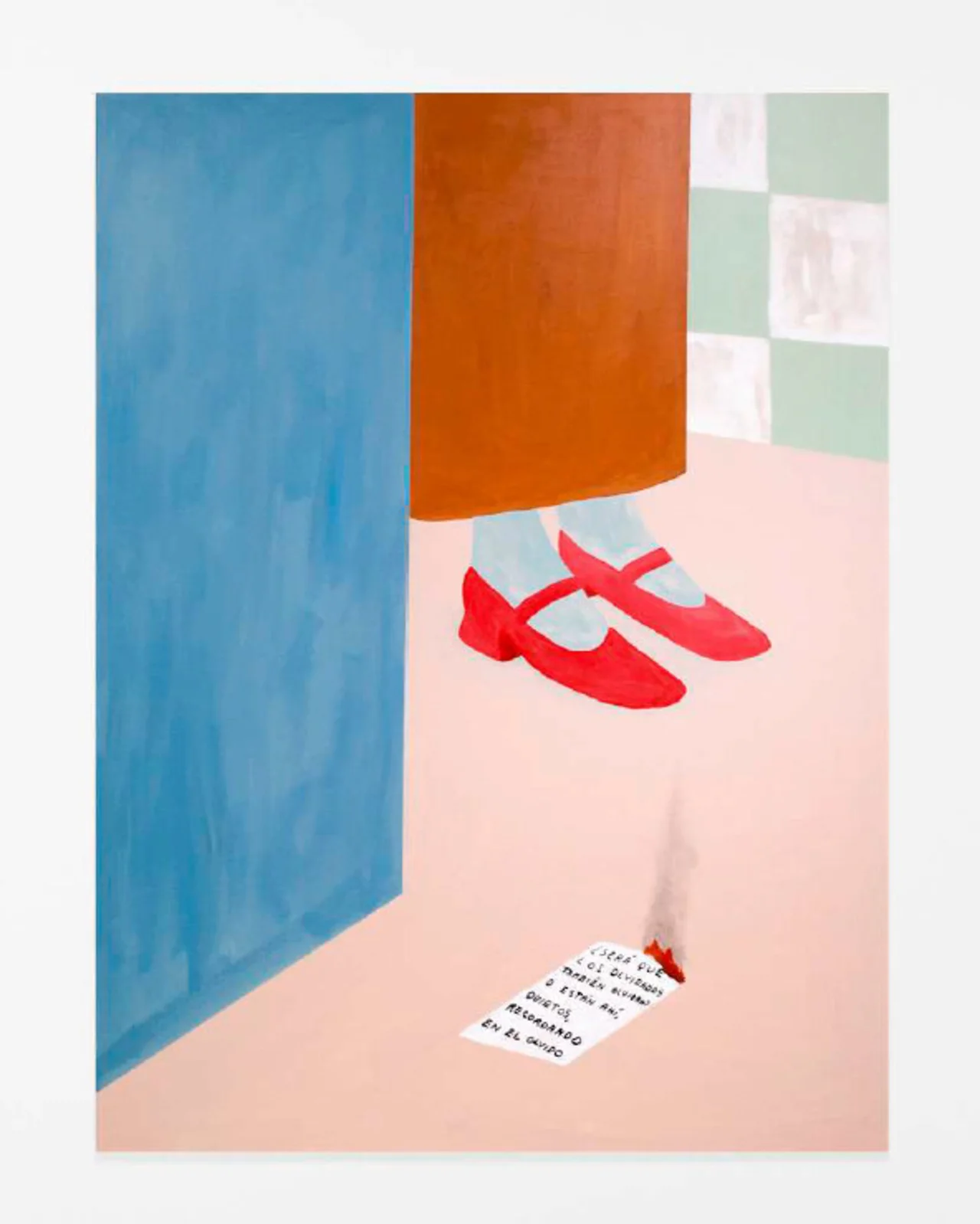
The piece is “Recordando en el olvido” — loosely, “remembering inside forgetting” — by Román de Castro, a unique, unsigned mixed-media work on canvas measuring 130 by 97 centimeters (51 1/5 by 38 1/5 inches), sold with a gallery-issued certificate of authenticity and no frame. It’s a modest-sized object to be making the trip from Mexico to Cantabria, but it’s arriving at a moment when De Castro’s career has been compounding fast: a Soho House Mexico City artist residency, a debut flow collection, a string of gallery and fair appearances across three countries, and now a slot in one of Spain’s longest-running art fairs.
stir
The listing details are sparse but specific, in the way gallery paperwork tends to be: mixed media on canvas, 130 × 97 cm, a unique piece rather than part of an edition, unsigned by the artist, with a certificate of authenticity issued by Proyecto H / Galería Hispánica included in the sale, and no frame provided. Each of those details matters more than it looks like it should to a collector. The absence of a signature isn’t unusual for De Castro’s generation of Mexico City-based painters working through galleries rather than direct studio sales — authentication runs through the gallery’s paperwork rather than a mark on the canvas itself. The unframed state is standard for a fair transaction, where framing is typically left to the buyer’s own space and taste.
What the listing doesn’t include is a description of the composition itself, and no installation photography of this specific canvas has surfaced through standard research channels as of this writing — understandable, given how recently the piece was dated (2025) and how quickly it’s moved from studio to fair circuit. What can be said with confidence is where it sits thematically: “Recordando en el olvido” lands squarely inside the territory De Castro has spent the past several years mapping out, one canvas, chair, and handwritten phrase at a time.
flow
De Castro was born in Mexico City in 1998 and split his childhood between Ciudad Satélite, on the city’s northern edge, and Rio de Janeiro, where his mother is from. He didn’t set out to be a painter. He studied film at the Universidad de la Comunicación, culture journalism at Casa Lamm, and culture management at the Universidad del Claustro de Sor Juana — a résumé built for criticism or production, not necessarily a studio practice. By his own account, art wasn’t even something that interested him as a kid; offered crayons, he says he wanted toys instead.
The shift happened during the pandemic. Bored and trying to stay off screens, he bought basic painting supplies on impulse, with no particular plan. Within a year, what had started as a way to pass the time had attracted enough attention on social media that galleries came looking for him, and after his first pieces sold, he left his job to paint full-time. It’s a familiar-sounding origin story for a certain gen of internet-native artists, but De Castro’s resulting work has aged into something more considered than the pandemic-hobby framing suggests — he now works across painting, photography, object art (furniture, specifically), install, video, and writing, with text as the connective thread running through nearly everything he makes.
scope
Ask De Castro why chairs show up so often in his work and he’ll usually give two answers. The practical one: when his technical skills were still limited, a chair was easy to draw — two rectangles and a few lines, manageable for someone learning as he went. The more romantic one traces back to an essay by the late Cherokee artist Jimmie Durham, who described chairs as spies, embedded everywhere precisely because no one questions their presence. De Castro has said that idea stuck with him — the notion that chairs are quietly watching everything, present in nearly every room a person occupies.
Once people started recognizing him as “the artist who draws chairs,” he says he couldn’t really abandon the motif even if he’d wanted to. So he leaned into it. A chair without anyone sitting in it, in De Castro’s formulation, does something an empty table doesn’t: a table left empty just reads as empty, but an empty chair implies someone — a “no one” becomes a “no one in particular,” a specific absence rather than a general one. It’s a small but precise distinction, and it’s the engine behind most of his gallery statements: the work isn’t really about chairs, it’s about who isn’t sitting in them anymore, and why that’s easier to live with than people assume.
That throughline — memory, forgetting, nostalgia, the passage of time, absence treated as almost a comfort rather than a wound — runs from his earliest gallery shows through to a painting literally titled “remembering inside forgetting.” In interviews, De Castro has pushed back on the idea that forgetting is purely negative, framing it instead as something he’s grateful for: certain things, he’s said, are better let go of, and the Spanish phrase “en memoria de” — “in memory of” — carries real tenderness rather than just grief. That reframing is arguably the actual subject of his practice, more than any single chair or object ever is.
show
De Castro’s gallery record has moved quickly for someone only a few years into a full-time practice. A 2024 solo show, “Instrucciones para quedarse” (“Instructions for Staying”), ran at Galería Duque Arango — a Medellín, Colombia gallery operating since the 1980s and known for representing major Latin American modern and contemporary artists — from late September through October. The accompanying gallery text leaned into the same vocabulary De Castro uses himself: staying as an act of depth rather than stillness, vulnerability as the through-line of his marks, objects, and interventions.
In 2025, his work appeared in a group exhibition titled “Poética de lo útil: La estética de la función” (“The Poetics of the Useful: The Aesthetics of Function”) at CONSIGNA, a Mexico City gallery and secondary-market platform based in the Anzures neighborhood that’s known for circulating work by both established names and emerging artists to a broader, less traditionally gallery-going collector base. That same year, Proyecto H staged “Sentarse en la Ausencia” (“Sitting in Absence”), pairing De Castro for the first time with Rosario Guerrero, a veteran Mexican artist born in 1944 whose decades-long practice also returns to the personified, empty chair as a motif — an unusual generational pairing built entirely around a shared symbol, on view at the gallery’s Roma Norte space through late July 2025.
Alongside the gallery circuit, De Castro became the first artist selected for Soho House Mexico City’s artist residency program in January 2025, transforming part of the members’ club into a working studio for several days, capped by a public Art Talk and an exhibition of the resulting pieces in early February. He also published his first book that year, a poetry collection titled “Mientras pasan otras cosas” (“While Other Things Happen”), illustrated with his own work — extending the text-driven side of his practice into a standalone literary object rather than something painted onto a chair or wall.
between
The gallery now representing “Recordando en el olvido” at ARTESANTANDER is itself a binational project. Proyecto H operates as a curatorial extension of Galería Hispánica, with a Madrid presence dating back to 2012 and a dedicated Mexico City space, on Guadalajara street in Roma Norte, open since 2013. Founded by the de las Heras family, the gallery’s stated mission is explicitly two-directional: promoting Spanish artists across Latin America while bringing Mexican and broader Latin American artists into European contemporary art circuits. It programs roughly eight exhibitions a year across its two locations and maintains a busy fair calendar that’s included ARTESANTANDER, Zona Maco, Art Madrid, ESTAMPA, Pinta Miami, and Feriarte in recent seasons — De Castro’s work has appeared in Proyecto H’s programming as recently as Zona Maco 2026 this past February.
huh
ARTESANTANDER itself is no minor stop. Founded in 1990, it’s Spain’s second-longest-running art fair behind ARCO Madrid, and this year’s edition — its 34th — runs July 2 through 5 at the Palacio de Exposiciones y Congresos in Santander, steps from the Sardinero beaches. Under director Mónica Álvarez Careaga, now in her third year leading the fair, the 2026 program has shifted to a tighter four-day format with extended hours and, new this year, a Sunday morning opening designed to widen access for visitors who can’t typically make a weekday gallery visit.
This edition brings together more than forty galleries and roughly 120 artists, with women representing close to half of the artist roster — a notably balanced lineup for a fair of this scale. Proyecto H returns as one of the fair’s recurring international participants alongside galleries from Italy, Portugal, Germany, and North Macedonia, continuing a presence that’s made it one of the more consistent non-Spanish names on ARTESANTANDER’s roster in recent editions. The fair’s broader programming this year also includes a new ARS International mentorship prize for a Spanish artist, a residency prize tied to Barcelona’s Piramidón art center, and acquisition awards connected to institutions including the Museo Nacional y Centro de Investigación de Altamira — giving the fair’s footprint a reach well beyond the booths themselves.
there
De Castro shows no sign of narrowing his practice. He’s spoken about pushing into ceramics for the first time for an exhibition tied to Zona Maco’s 2026 edition — a deliberate step outside the comfort zone of painting and drawing that made his name. He’s also continued to describe a wary relationship with AI-generated art, comparing it to “cooking with a microwave” — a position shared by fellow Mexican artist Pedro Reyes — even as he allows that the rise of digital art reflects something real about a culture increasingly unable to distinguish the authentic from the synthetic. For an artist whose entire visual language is built around what gets remembered, misremembered, and let go of, it’s a fitting tension to be sitting with.
It’s also worth noting how unusual De Castro’s trajectory looks against the backdrop of Mexico City’s contemporary art scene, which has historically rewarded years of slow studio practice and academic credentialing before gallery representation follows. De Castro inverted that order almost entirely: the audience came first, built largely through social platforms rather than degree shows or juried exhibitions, and the gallery system caught up to a following that already existed. Whether that path holds up as a durable model for younger Latin American artists, or proves to be a product of a particular cultural moment, is something the next few years of his career — ceramics, poetry, and whatever comes after both — will likely answer one way or another.
sum
For updates on “Recordando en el olvido” and where it lands after ARTESANTANDER, the most direct sources are Proyecto H / Galería Hispánica’s Artsy partner page and its official Instagram, which regularly posts fair booth views and sale updates. Román de Castro’s own Artsy artist page and Instagram are the best sources for new work and exhibition announcements directly from the artist. For fair details, hours, and the full gallery list, ARTESANTANDER’s official Instagram and website are running daily updates through the July 2–5 run.
From the DRIFT archive: The Art of the Can: Chaz Bojórquez’s Hand-Signed MTN Spray Paint Edition
Related Articles
Robin Rhode, Edition of Five: Inside the 2017 C-Print Called David
A 2017 C-print by Robin Rhode, titled David, measures 185.8 x 227.8 cm in an […]