DRIFT AUDIO
Listen to this story
Choose a voice, then press play.
Foxborough witnessed something that simply was not supposed to happen. A nation of seven million rewrote the World Cup record books in ninety seconds of spot-kicks.
In This Story
- The Match Nobody Had Scripted
- How Paraguay Got Here
- The First Half: Silence, Then Enciso
- Germany Equalise — and Then Lose the Match They Were Winning
- The VAR That Changed Everything
- The Shootout: Gill’s Night, Canale’s Moment
- Where This Ranks: The Upset in Historical Context
- Germany’s Reckoning
- Paraguay’s Road Ahead
Before a ball was kicked at Gillette Stadium on June 29, the question being debated was not whether Germany would win — it was whether they would win convincingly enough to put their shaky group stage performances behind them. Ranked tenth in the world. Four-time World Cup champions. A nation whose penalty shootout record in major tournaments was among the most formidable in the sport. Against a side ranked 41st that had been thrashed 4-1 by the United States in its opening match and only scraped through to the knockout stage as the seventh of eight third-place qualifiers.
This was not a match with narratives on both sides. It was a warm-up. Germany entered as -700 betting favorites to advance. According to BetMGM, 99% of wagered money was on Die Mannschaft to go through.
By the time José Canale drove his penalty into the bottom corner in sudden death and set off a sprint of disbelief from the Paraguay half, the story had been written anyway — in full, in permanent ink, in what may be the greatest knockout upset in the history of the FIFA World Cup.
Paraguay declared June 30 a national holiday after the national team defeated Germany in the round of 32 at the World Cup. The match ended 1-1 after regular time, with Paraguay winning 4-3 in the penalty shootout, the first time Germany had ever lost a World Cup penalty shootout.… pic.twitter.com/yme0phjIqe
— TRT World (@trtworld) June 30, 2026
stir
The road to Foxborough was not a promising one. Paraguay opened the 2026 World Cup with that 4-1 demolition at the hands of the United States, a result that seemed to confirm every pre-tournament scepticism about whether the South Americans belonged in the expanded 48-team field at all. What followed was a study in tactical reinvention under coach Gustavo Alfaro.
In their second group match against Turkey, Paraguay won 1-0 despite playing the entire second half with ten men — the kind of defensive resolve that looks like desperation in the moment and like prophecy in hindsight. A goalless draw against Australia, who had nothing left to play for, was enough to see them through as a third-place qualifier, and they made it by the narrowest possible margin. They arrived in the knockout rounds not as a side that had shown anything convincing in attack, but as one that had demonstrated an almost pathological willingness to defend and to hold.
Alfaro had also been dealt a blow before kickoff: defender Omar Alderete, injured in the Australia game, was unavailable. In his place started José Canale, a centre-back who would later become the author of the most important moment in Paraguayan football history. The understudies, as it turned out, had been studying.
flow
For most of the first half, Germany did exactly what anyone watching expected. They held 78% of possession. Their press was organised, their movement through midfield was fluid, and the Paraguay half looked like a place the ball visited only briefly. Florian Wirtz was everywhere. Kai Havertz lurked. The only question was when the opener would come.
It was not the right question. The right question was what Paraguay would do with the one or two moments their 4-5-1 defensive setup might carve out. Alfaro’s team had not come to Foxborough to entertain. They came to absorb, to frustrate, and to capitalise on the single opportunity their discipline might produce. Neuer had to produce a save from Júnior Alonso inside the first 30 seconds — a signal of what was coming that most people ignored.
That opportunity arrived in the 42nd minute. Miguel Almiron split the German backline with a left-footed pass to Matías Galarza. Galarza’s cross was whipped and precise. And Julio Enciso — 21 years old, playing in his first World Cup knockout match — arrived unmarked at the far post and headed the ball past Neuer with a composure that was almost offensive in its calm. Paraguay led.
No team since detailed World Cup data began in 1966 had completed 253 more successful passes than its opponent in the first half and still led at half-time. Paraguay had done exactly that. The statistics described a team being dominated. The scoreboard told a different story.
so
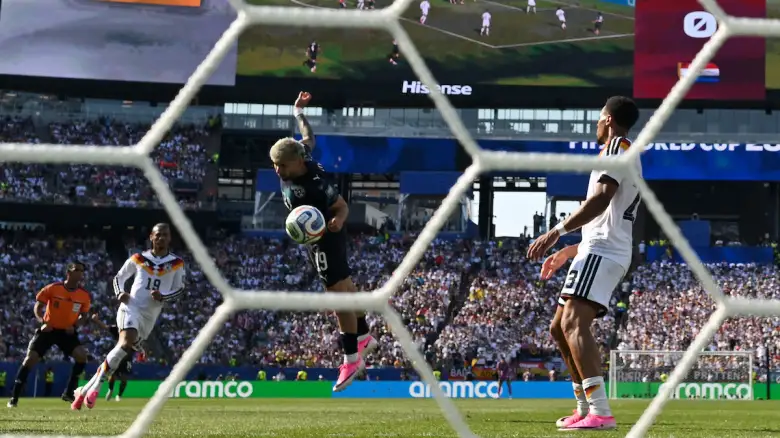
The second half began with Germany doing what Germany do. Within nine minutes of the restart, Florian Wirtz delivered a cross from the left flank that Havertz met with a glancing header, redirecting the ball past Orlando Gill at the near post. The equaliser was composed, almost inevitable — the kind of goal that confirms the natural order has been restored. The scoreboard said 1-1. Germany went back to doing what Germany do, which is control.
For the remainder of the second half they controlled. Sixteen corner kicks across the ninety minutes. Relentless territorial pressure. Nick Woltemade went close. Jamal Musiala probed. And then there was Gill.
Orlando Gill, 26 years old, had never played at a major international tournament before this World Cup. He arrived in the United States as Paraguay’s first-choice keeper largely by default, and in the group stage he had been solid without being spectacular. Against Germany he produced the performance of his life. Six saves across the 120 minutes. Every time it seemed that Germany’s dominance would finally translate into a second goal, Gill was in the way — diving, stretching, repositioning, willing his body into angles that shouldn’t have been reachable. Paraguay completed 161 passes in total. Germany completed 719. The xG figures told the whole story: Germany generated 1.49 expected goals to Paraguay’s 0.42. And the score remained 1-1.
change
In the 102nd minute of extra time, Nathaniel Brown’s corner found Jonathan Tah at the back post. Tah’s header was powerful and accurate. Germany’s players sprinted toward the corner flag. Gillette Stadium erupted. It was over.
The VAR review that followed took several minutes that felt longer. The conclusion: Waldemar Anton had impeded Gill before the ball was delivered, preventing the keeper from making a save. The goal was disallowed.
Nagelsmann afterwards called it “a joke.” Whether the foul was soft or clear is a question that will be argued in Germany for months. What cannot be argued is that the disallowed goal gave Paraguay a second chance they had done almost nothing to earn, and they used it perfectly.
Germany had two more late chances in the dying minutes of extra time. Neither went in. After 120 minutes of football in which one side had dominated almost everything except the thing that matters — the scoreline — the match was going to penalties.
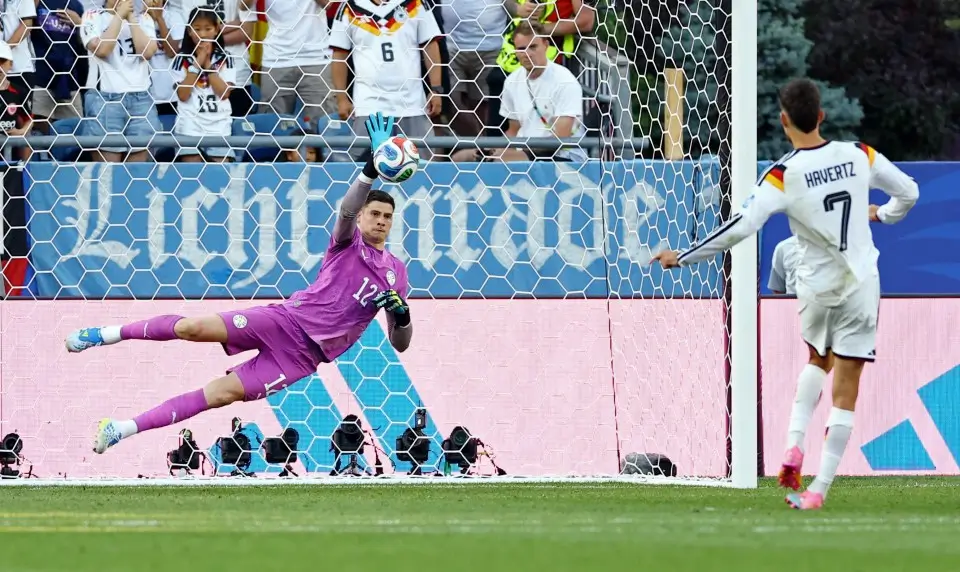
Germany goalkeeper makes a full-stretch save during a penalty kick, with Kai Havertz watching as fans look on from behind the goal.
shootout
Gill walked the length of the field before Germany’s first penalty taker, Kai Havertz, placed the ball on the spot. It was a psychological move, and it worked with devastating efficiency. Havertz — a Champions League winner, an Arsenal regular, a player who had scored the equaliser barely an hour earlier — watched Gill dive the correct way and save his shot. Paraguay 0-1 up in the shootout before they had kicked a ball.
What followed was a sequence of events that swung back and forth with brutal unpredictability. Germany’s Joshua Kimmich scored. Paraguay’s Mauricio equalised. Jamal Musiala scored. Matías Galarza scored. Then Woltemade stepped up and Gill saved again — Paraguay’s goalkeeper had now stopped two of Germany’s four attempts. Antonio Sanabria, with the chance to win it for Paraguay, dragged his kick wide left. Germany were still alive. Nadiem Amiri scored to make it 3-3. Fabián Balbuena’s shot was parried away by the 40-year-old Neuer, who reminded the world in that moment why he was still standing between the German posts despite a decade of questions about his age.
Three penalties each scored, one apiece saved, one miss per side. Sudden death. Tah stepped up. He skied it into the Boston evening sky. Canale, the centre-back who had started only because of Alderete’s injury, who had been outstanding throughout 120 minutes, walked forward and drove the ball into the corner past a diving Neuer. Paraguay’s players ran from the halfway line. Gill fell to his knees. Canale disappeared under a pile of white shirts.
“We had to analyze every player, every detail,” Gill said afterward. “Thanks to that I was able to only miss two penalties. This is for all the people of Paraguay.”
where
The 31-place gap between Paraguay (41st) and Germany (10th) in the FIFA World Rankings makes this the fourth-biggest knockout-stage upset by ranking differential since the rankings were introduced. But raw numbers only tell part of the story.
The comparison most frequently cited is Germany’s 1994 defeat to Bulgaria, long considered the benchmark for German knockout-stage failures. That Bulgaria side had Hristo Stoichkov — that year’s Ballon d’Or winner — leading the line, and were ranked 29th before the tournament. They were, for all the shock of the result, a genuine threat. The Paraguay side that just knocked Germany out had been beaten 4-1 by the United States in its opener, ranked 41st, and managed just 161 pass completions in a game where Germany completed 719. The statistical gap between the two sides was unprecedented for a World Cup knockout result.
Russia’s shootout victory over Spain in 2018, South Korea’s elimination of Italy and Spain in 2002, Senegal’s group-stage defeat of defending champion France — each was stunning in its own context. The difference with Paraguay is that none of those teams had been so comprehensively outplayed across 120 minutes while still advancing. Paraguay’s win was not a performance-based upset. It was a defensive masterclass, a goalkeeper’s night, and a shootout in which the supposed penalty kings fell apart while the team nobody gave a chance held its nerve.
Al Jazeera called it “the greatest upset in World Cup football.” The evidence does not make that easy to dispute.
challenge
For German football, the loss to Paraguay is the conclusion of a decade-long unravelling that began with the 2018 group-stage exit in Russia and continued with another group-stage failure in Qatar in 2022. The 2026 campaign had appeared to offer a reset: ten goals in the group stage, a first-place finish in Group E, and genuine depth throughout the squad. The performance in Foxborough confirmed what critics had been saying for months: this Germany side lacks a cutting edge in matches where the opponent refuses to engage openly, and its penalty composure was never as invulnerable as its reputation suggested.
Nagelsmann, who refused to resign immediately, acknowledged the depth of the problem. He described Germany as needing “some solutions for the future” and admitted the DFB would need time to assess whether he remained part of the project. Havertz, who missed the first penalty, put it plainly: “We had very big plans for this World Cup. It’s very difficult to disappoint again.”
Germany’s elimination is only the second time they have been knocked out in the first knockout round since 1938. The parallels with 2002 are uncomfortable, and they extend beyond the result into questions about structure, player development, and a tactical flexibility that the Bundesliga has been criticised for failing to nurture for a generation.
extent
Paraguay faces the winner of Tuesday’s France-Sweden match in the Round of 16 in Philadelphia on Saturday, July 5. If France come through — and they are the heavy favourites — Alfaro’s side will next face Kylian Mbappé and what is expected to be one of the tournament’s strongest remaining sides.
That might, on paper, seem like the end of the road. Two weeks ago, an opening game that suggested Paraguay would be exiting the group stage also seemed like the end of the road. Canale, who has already found his place in World Cup history, knows better than to write this story’s ending in advance.
“What I want to highlight from our team is how united we are,” he said in the post-match interviews. “Today was a game we really needed to show our true colors.”
They did. Seven million people in a landlocked South American nation surrounded by football giants will not forget what happened in Foxborough on June 29, 2026. Neither will the rest of the world.