DRIFT

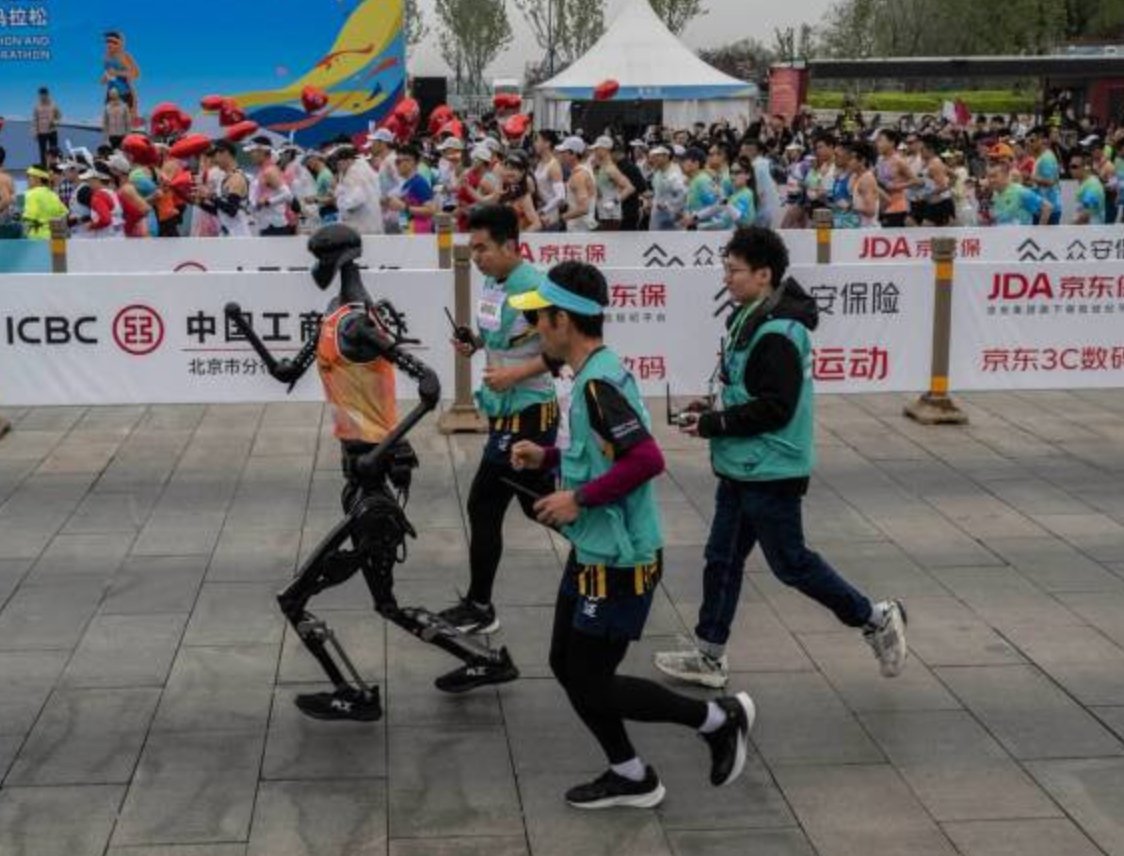
What do you get when you mix James Cameron-esque androids with a 13.1-mile urban obstacle course? In Beijing this weekend, the answer was part science experiment, part public spectacle, and part techno-circus. On Saturday, 21 humanoid robots were unleashed on the city streets—not to warn of the singularity, but to lace up, charge up, and compete in a half-marathon.

While the event bore little resemblance to the polished, lethal vision of The Terminator, it was nonetheless a sign of things to come. These machines didn’t arrive to end humanity—they came to test their gait. And in doing so, they offered a real-time glimpse at the current state of humanoid robotics: wildly uneven, oddly mesmerizing, and increasingly relevant.

This mechanical marathon wasn’t a one-off stunt. It was a high-profile demonstration by China’s most advanced robot-makers, designed to showcase their progress in humanoid form, balance, energy efficiency, and autonomous mobility. The results were equal parts fascinating and chaotic.

The Race Breakdown: From Stride to Stumble

Of the 21 humanoids that lined up for the event, only a few managed anything resembling a full run. The winning robot completed the 13.1-mile course in 2 hours and 40 minutes—double the time of elite human competitors but, considering the complexity of the task, an extraordinary achievement in engineering.

Several other androids managed to complete significant portions of the course, gliding along in jerky but determined steps. But the field quickly narrowed. Some bots powered down mid-stride. Others took two awkward steps, lost their balance, and faceplanted like toddlers in ski boots. One careened into a barrier and disassembled dramatically, metal limbs scattered like the remains of a toy in the jaws of a golden retriever.

Still, for many in the tech world, the race was a win—not because of how far the bots went, but because they went at all.

Metaphor in Motion: The Symbolism of Humanoids Running

The robot half-marathon was more than a spectacle; it was a metaphor. Humanoid robots represent the current vanguard of the artificial intelligence and robotics industries. While AI has seen mass adoption in software, language processing, and data analysis, its translation into embodied physical intelligence has been the next frontier.

What better way to measure that progress than with an endurance test designed for humans?

Balance. Adaptability. Decision-making. Real-time processing. All of these traits are necessary not just to complete a half-marathon, but to function in everyday environments—factories, hospitals, homes, and disaster zones. For robot-makers, this was not about speed but grace under stress.

“There’s no blueprint for this,” said Dr. Min Yao, head of Shanghai-based robotics firm XiXen, which entered three competitors into the race. “Every step the robot takes is an equation. Every obstacle is a lesson.”

China’s Robot Ambitions: Domestic Development on the World Stage

The half-marathon was orchestrated as part of a broader Chinese state initiative to promote national excellence in robotics and artificial intelligence. With a highly coordinated industrial strategy, China aims to become the world’s leading robotics hub by 2030—and it’s pouring resources into education, infrastructure, and export pipelines to get there.

The humanoid robots in this event were all Chinese-made, representing both established tech companies and nimble startups. Firms like Fourier Intelligence, Unitree Robotics, and UBTech have been scaling their humanoid projects at record pace, shifting from research prototypes to commercial viability.

“We’re moving beyond arms and legs,” said Dr. Yao. “It’s about adaptability, interactivity, and autonomy. And yes—eventually, marketability.”

The Global Stakes: Tech Titans and the Humanoid Gold Rush

The event in Beijing is only a microcosm of the global humanoid arms race. In the West, every major tech titan is developing or investing in humanoid platforms.

  • Tesla is perhaps the most vocal, with Elon Musk claiming its Optimus robot will “revolutionize the labor economy.” Although the prototype shown in 2024 was still partially human-operated via suit, Musk now estimates a $10 trillion potential market once scalable production is achieved.
  • Apple has quietly invested in robotics through its advanced hardware team, focusing on human-machine interaction and the next generation of ambient computing.
  • Nvidia, the current nerve center of AI development, is powering the training models for most humanoid systems, offering chips and AI frameworks for synthetic cognition and motor planning.
  • Meta is developing embodied avatars that blur the lines between virtual and physical agents.
  • Alphabet (Google’s parent company) continues work through DeepMind and Everyday Robots, seeking to apply reinforcement learning to real-world tasks like folding laundry or navigating offices.

According to PitchBook, over $7.2 billion has been invested in humanoid robotics startups globally since 2015—with a sharp spike in funding post-2020 as automation gained new urgency during the COVID-19 pandemic and subsequent labor shortages.

But Can They Really Walk Among Us?

Despite the capital, the charisma, and the clever marketing videos, humanoid robots still face profound technical challenges. Motion is only the beginning.

Current bottlenecks include:

  • Power Efficiency: Many bots require bulky battery packs and can’t operate autonomously for long stretches.
  • Sensing and Feedback: Interpreting the world in real-time—terrain, humans, unexpected events—remains limited.
  • Cognition: While ChatGPT can generate human-like responses, physical AI needs to interpret context visually and spatially.
  • Manufacturing Scale: Building thousands of humanoids that work reliably outside of lab conditions is a gargantuan task.

The half-marathon made these limitations stark. While one robot ran smoothly, another looked like it was mid-exorcism—limbs flailing, camera eyes rolling, commands misfiring. Spectators clapped with sympathy.

But that’s the paradox of humanoid robotics: even their failures are compelling. They’re trying to be us—and in doing so, they show us how complex, graceful, and resilient human movement truly is.

The Business of Bots: Humanoids as Labor and Lifestyle Solutions

Still, the promise remains. Humanoids aren’t just tech demos—they’re business propositions. Their applications span:

  • Warehousing and logistics (replacing repetitive human labor)
  • Elder care and companionship (Japan and South Korea lead here)
  • Disaster response (navigating dangerous terrain or collapsed structures)
  • Hospitality and retail (customer-facing bots for interaction and navigation)

Startups like Figure AI and Agility Robotics have developed humanoid workers that can stock shelves or load pallets. Others like Sanctuary AI focus on cognitive labor—robots that can learn complex workflows in retail or manufacturing.

And then there’s the lifestyle angle. Imagine an “intelligent roommate” who can make breakfast, fold your laundry, or help you carry groceries upstairs. It’s Jetsons logic applied through real-world engineering.

But making a humanoid that moves as fluently as we do is only half the challenge. The next is acceptance: Do we want them? Will we trust them?

Cultural Reflections: Humor, Humanity, and the Uncanny

The half-marathon revealed something else: people like watching robots struggle. They’re rooting for them—not unlike toddlers taking their first steps. The crowd in Beijing cheered when robots stumbled, gasped when they broke apart, and gave standing ovations for any that finished upright.

There’s a psychological phenomenon called the “uncanny valley”—the discomfort we feel when something looks almost human. But events like this narrow that valley. By humanizing the learning process—by letting bots wobble and fall—we build familiarity.

“It’s weirdly emotional,” said one spectator. “You know it’s metal. But when it gets back up, you feel proud.”

In this way, humanoids may win the world over not through perfection, but through persistence.

Impression

The Beijing humanoid half-marathon didn’t deliver dystopian precision or robotic supremacy. What it delivered was far more important: a snapshot of progress, a public invitation to witness innovation, and a reminder of how far we’ve come—and how far we still have to go.

These robots aren’t replacing us. They’re learning from us. They’re running toward something bigger: a future where machines might not only walk among us—but walk with us.

Related Articles
In a highly anticipated reunion after 24 years, Adidas Originals and Coca-Cola have joined forces once again to celebrate the FIFA World Cup 2026™. The collaboration revives their iconic 2002 partnership from the Japan-South Korea tournament, now reimagined for the biggest global sporting event of 2026, co-hosted by the United States, Canada, and Mexico. Set to launch on June 6, 2026, this collection masterfully blends Adidas' streetwear heritage with Coca-Cola's timeless branding, creating a vibrant fusion of football culture, nostalgia, and modern style. The drop arrives at a perfect moment. With the World Cup kicking off on June 11, 2026, fans worldwide are gearing up for a summer of football excitement. This collaboration isn't just merch—it's a cultural statement that merges two legendary brands under the banner of "Originals are the Real Thing," a clever twist on Coca-Cola's famous slogan. Historical Context: A Reunion 24 Years in the Making Adidas and Coca-Cola first collaborated during the 2002 FIFA World Cup, producing limited-edition pieces that captured the era's energy. That partnership helped define early 2000s football-streetwear crossover culture. Fast-forward to 2026, and the brands are back with fresh energy, leveraging Adidas' deep FIFA ties (as an official partner) and Coca-Cola's long-standing sponsorship of the tournament. The 2026 edition promises to be historic as the first 48-team World Cup, spanning three countries and generating unprecedented global hype. This collab taps into that momentum, offering fans wearable pieces that celebrate both brands' legacies while looking forward to the future of football fashion. Collection Overview and Design Philosophy The Adidas Originals x Coca-Cola collection fuses 2000s street style with classic sporting aesthetics. Expect bold reds, creams, whites, and silver accents inspired by Coca-Cola's iconic packaging—think classic script logos, droplet detailing, and can-inspired motifs. The lineup spans footwear, apparel, and accessories, divided into two visual directions: one logo-heavy and graphic-forward, the other drawing from vintage advertising aesthetics. Designs pay homage to Coca-Cola's visual language while staying true to Adidas Originals' archival roots. High-quality materials, attention to detail, and versatile silhouettes make these pieces suitable for both match-day wear and everyday street style. The campaign, featuring young football star Lamine Yamal and a diverse cast in everyday scenes building anticipation for the tournament, reinforces themes of originality and shared cultural moments. Footwear Highlights Footwear takes center stage in this collaboration, with reimagined takes on iconic 2000s Adidas silhouettes: Samba and Superstar Models: These classics get Coca-Cola treatment with white/cream/red colorways and prominent script branding. The Samba blends street heritage with football roots, while the Superstar II features weathered bases and bold side panels. Expected pricing around $110–$130. Adistar Control 5: A standout with droplet detailing mimicking condensation on a cold Coke can. This model brings performance-inspired design into lifestyle territory. Predator Sala: Indoor/hybrid style with silver-and-red accents, nodding to predatory precision on the pitch and Coca-Cola's bold energy. Climacool 1: Revived with breathable tech and Coke-inspired graphics, perfect for warm summer days. Megaride F50: A highlight paying tribute to the iconic Coca-Cola glass bottle, with unique contours and refreshing design cues. Each pair incorporates thoughtful details like embroidered logos, custom insoles, and packaging that mimics vintage Coke crates or cans. These shoes are built for durability and comfort, appealing to sneakerheads, football fans, and casual wearers alike. Apparel and Accessories Beyond kicks, the collection offers a full lifestyle range: Track Tops and Jerseys: Standout jerseys fuse retro Coca-Cola advertising from different eras into cohesive football designs. Track jackets feature signature three stripes alongside Coke branding, in vibrant reds and classic whites. Shorts and T-Shirts: Relaxed fits with graphic prints, ideal for casual wear or layering. Expect motivational football motifs blended with refreshing beverage references. Accessories: A bright red airliner bag stands out as a functional statement piece. Additional items may include caps, socks, and tote bags carrying the collaborative spirit. The apparel emphasizes comfort with premium cotton blends, mesh panels for breathability, and oversized silhouettes popular in contemporary streetwear. Unisex sizing and inclusive fits make the collection accessible to a broad audience. Cultural Impact and Fan Appeal This collaboration resonates on multiple levels. For football fans, it represents national pride and global unity ahead of the 2026 tournament. Sneaker enthusiasts will appreciate the nostalgic 2000s revival mixed with modern execution. Streetwear collectors see it as a prime example of how heritage brands can innovate through partnerships. In an era where sports and fashion increasingly intersect, Adidas and Coca-Cola deliver pieces that transcend the pitch. Wear them to watch matches at home, attend watch parties, or hit the streets in any host city—New York, Los Angeles, Toronto, or beyond. The designs are versatile enough for gym sessions, festivals, or daily commutes. The timing aligns perfectly with rising interest in football in North America, boosted by the co-hosting nations. Young talents like Lamine Yamal in the campaign help bridge generational gaps, attracting newer fans while satisfying longtime supporters. Where to Buy and Release Details The collection launches globally on June 6, 2026, via: Adidas CONFIRMED app (for early access and raffles) Adidas.com Select retailers and flagship stores worldwide Some regions may see staggered drops, with Japan and other markets getting early access. Prices are expected to range from $50–$150 depending on the item, making it relatively accessible compared to ultra-limited drops. Pro Tips for Copping: Enable notifications on the CONFIRMED app. Check local stock at Adidas stores in major cities. Monitor resale platforms post-drop for exclusive colorways, but be wary of markups. Size up slightly for oversized apparel fits. Given the World Cup hype, popular items like the Sambas and jerseys are likely to sell out quickly. International shipping is available, but factor in potential customs delays. Styling Suggestions Match Day Look: Pair a collaborative jersey with classic black shorts and Samba sneakers for effortless fan style. Streetwear Rotation: Layer a track top over a graphic tee with wide-leg pants and the Megaride F50 for a bold urban ensemble. Casual Summer: White Superstar with denim shorts and the airliner bag for a refreshing, vacation-ready vibe. These pieces mix seamlessly with existing Adidas or neutral wardrobes, maximizing versatility. Broader Context in 2026 Fashion and Sports The Adidas x Coca-Cola drop is part of a larger wave of high-profile collaborations tied to the World Cup. Adidas continues its dominance in football kit design, while Coca-Cola leverages its sponsorship with collectibles, bottles, and experiential activations like the Trophy Tour. In the sneaker industry, this collab exemplifies the ongoing trend of lifestyle reinterpretations of performance silhouettes. It also highlights how global brands use major events to drive cultural conversations around unity, originality, and joy—core values for both companies. Sustainability notes (based on Adidas' broader initiatives) suggest some pieces may incorporate recycled materials, aligning with modern consumer expectations. Looking Forward: Legacy and Excitement As the countdown to kickoff continues, this collection serves as the perfect prelude to an unforgettable summer of football. Whether you're a die-hard supporter, a fashion-forward collector, or someone seeking motivation through style, the Adidas Originals x Coca-Cola FIFA World Cup 2026 lineup delivers. Expect potential restocks, special event exclusives in host cities, and continued campaign content featuring more athletes. This isn't just clothing—it's a ticket to participate in the global celebration of the beautiful game. Mark your calendars for June 6, 2026. Refresh your wardrobe, lace up those Sambas, and get ready to cheer on your team in style. The "Real Thing" meets the Originals in what promises to be one of the most talked-about releases of the year. This collaboration captures the essence of football's universal appeal: bringing people together through shared passion, iconic brands, and unforgettable moments. As the world prepares for 2026's expanded tournament, Adidas and Coca-Cola remind us that some partnerships are truly timeless.

Adidas Originals x Coca-Cola Collection: FIFA World Cup 2026

In a highly anticipated reunion after 24 years, Adidas Originals and Coca-Cola have joined forces […]

Loewe shoulder bag crafted in brown and black leather with minimalist lion face detailing and a matching fur tail charm

180 Years Unfolded: The Full Story Behind Loewe’s New Campaign

The year was 1846. Queen Victoria was on the British throne and the telephone, the […]

Interior view of H.Lorenzo’s new West Hollywood flagship illuminated in vivid green lighting, featuring sculptural metal display structures, minimalist furnishings, and an immersive futuristic retail environment

H.Lorenzo Opens a New Flagship in West Hollywood, Uniting Four Decades of Avant-Garde Fashion Under One Roof

For more than four decades, H.Lorenzo has occupied a singular and irreplaceable position within the […]