Salzburg Just Turned Mozart’s Birthday Into a Real Life Game of Hide and Seek, and the Thieves Already Have a Head Start

July 16, 2026
Three hundred gold statues went on display this week. Two disappeared within hours. The math on classical music’s honor system is not looking good.
- A City Built on One Man’s Name
- The Artist Who Turns Public Space Into a Punchline
- Why the Dog Matters As Much As the Composer
- The Math Problem Nobody Wants to Talk About
- A Pattern That Already Played Out in Bayreuth
- What 100 Euros Actually Buys
- The Bigger Bet Underneath the Gimmick
Salzburg does not have a subtle relationship with Wolfgang Amadeus Mozart. His face is on the chocolate. His name is on the airport. His childhood apartment is a museum with a gift shop attached, and his birthday, January 27, functions as an unofficial civic holiday decades after his death. So when the Mozarteum Foundation, the nonprofit that has run the composer’s birthplace and residence since the nineteenth century, wanted to mark 270 years since his birth, restraint was never really on the table.
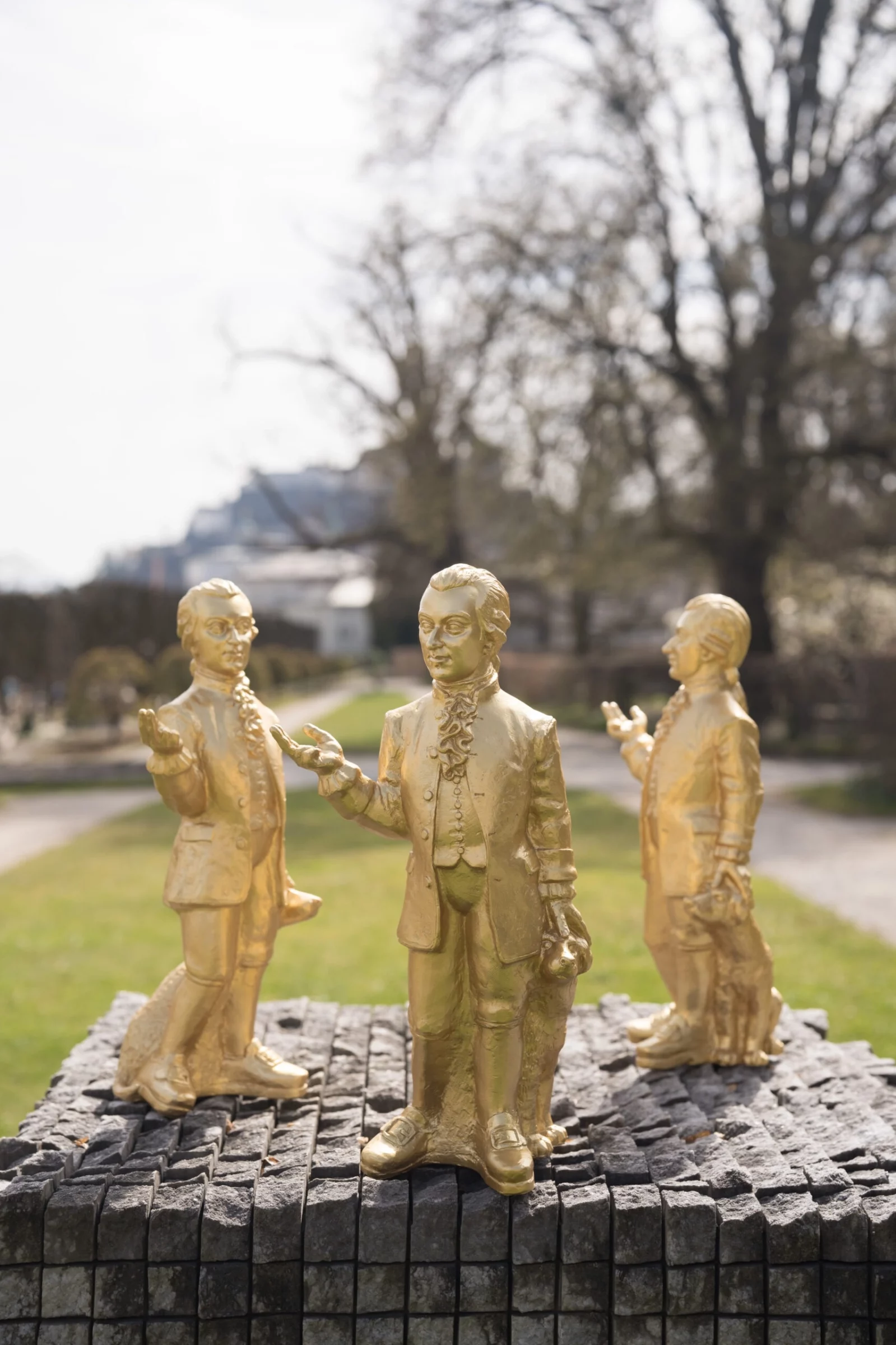
What they landed on instead was stranger and more playful than another bronze bust in a piazza. On Wednesday, the foundation unveiled 300 gold tincture statuettes of Mozart, each barely 50 centimeters tall, scattered through the Mirabell Gardens, tucked into Mozart’s former living quarters, and arranged across several pavilions around the city. They are small enough to tuck under an arm. They are shiny enough to catch the eye from across a courtyard. And within the first few hours of the display going up, at least two of them were already gone.
View this post on Instagram
Linus Klumpner, speaking for the Mozarteum Foundation, confirmed the disappearances to the Associated Press with the weary matter of factness of someone who saw this coming from a mile away. Which, as it turns out, he did. The foundation had 400 statues made. Only 300 went on public display. The other hundred are sitting in reserve, ready to backfill whatever the sticky fingered portion of Salzburg’s tourist population manages to walk off with.
stir
The statues themselves are the work of Ottmar Hörl, a German conceptual sculptor who has spent decades building a career on the idea that public art works best when it is mass produced, a little absurd, and impossible to take entirely seriously. Hörl is the sculptor behind fields of grinning garden gnomes flipping off passersby in Straelen and Christmas markets, and armies of identical figures arranged in grids so dense they start to feel less like individual artworks and more like a crowd. His interest has never really been in the single, reverent monument. It is in repetition, in the way an image changes meaning when there are 300 of it instead of one.
That instinct shaped the pitch he brought to Salzburg. “I didn’t want to do a monument of Mozart. There are already enough of these,” Hörl told the Associated Press. “But I wanted to show his human side, that he was a normal human being despite his genius.” It is a fairly pointed statement for a city whose entire tourism economy runs on Mozart’s genius being treated as a kind of civic religion. Hörl’s version of the composer is not standing on a plinth looking contemplative. He is rendered at a fraction of scale, painted the tincture of a cheap trophy, and multiplied until the effect stops being solemn and starts being funny.
flow
The detail doing the most work in this installation is not the composer at all. It is Pimperl, Mozart’s own dog, standing beside him in every single casting. Hörl’s decision to include the animal was deliberate, a way of grounding the piece in domestic life rather than musical legend. A man walking his dog reads as an ordinary Tuesday. A genius composer standing alone on a pedestal reads as a lecture. By putting Pimperl in the frame, Hörl nudges the whole installation toward warmth instead of ceremony, which tracks with what he told the AP about wanting to humanize a figure who has been mythologized for two and a half centuries.
It also happens to make the statues more collectible looking, whether or not that was the intent. A tiny gold man and his dog has the view logic of a keepsake in a way that a solo bust does not. Anyone who has walked past a Mirabell Gardens display and felt the pull to pick one up and take it home is responding, at least in part, to a piece of sculpture that was built to feel personal rather than monumental.
scope
Here is where the story gets interesting as more than an art review. The Mozarteum Foundation built in a 25 percent buffer before a single visitor set foot in the gardens. Four hundred statues made, only 300 shown, a hundred held back specifically to replace whatever gets stolen. That is not the behavior of an institution that is naively hoping for the best. It is a foundation that ran the numbers on how previous outdoor installations of this kind have gone and planned its production run accordingly.
And the early results suggest the buffer was not overly cautious. Two statues vanished within the first few hours of the unveiling, according to Klumpner’s account to the AP, out of an opening batch of 300. If that rate holds even loosely across the run of the installation, the hundred statues in reserve could get eaten into fast. Salzburg in the summer draws enormous numbers of visitors specifically because of the Mozart connection, and a 50 centimeter gold statue sitting in a public garden with no fencing and no obvious deterrent is, functionally, an invitation.
What makes the theft rate notable is who is presumably doing the taking. This is not a random public plaza in an unrelated city. This is Mozart’s own hometown, populated in no small part by people who came specifically because they care about classical music and cultural heritage. The Mozarteum Foundation’s own pitch is that the statues exist to draw new audiences toward Mozart’s work, to get people curious enough to wander into a concert hall who might not otherwise have thought about it. Klumpner described the intended effect directly: seeing “small golden heads shimmering in the sun on the horizon” as a hook, a way of getting people curious enough to look closer, and eventually closer still to the music itself. It is an earnest, almost civic minded goal. The theft numbers suggest that at least some portion of the audience is skipping the “getting closer to the music” step and going straight to “getting closer to owning a piece of it,” literally.
pattern
Hörl has been here before, and the precedent is not encouraging for anyone hoping the Salzburg statues survive the season intact. At an earlier installation in Bayreuth, Germany, featuring a full array of statues depicting composer Richard Wagner, the entire set was stolen within ten days. Not a couple of stray pieces picked off by opportunists. The complete installation, gone, inside a week and a half.
That history gives real weight to why the Mozarteum Foundation built such a large reserve into its production numbers from the start. Hörl himself does not seem particularly rattled by the pattern, treating the theft of his work almost as a predictable side effect of the format he has chosen, mass produced figures in unsecured public space, rather than as a failure of the project. There is an argument, unspoken but implied in how casually the foundation and the artist discuss the losses, that a certain amount of theft is simply priced into this kind of public art. It gens conversation. It gens headlines. Two gold Mozarts disappearing on opening day is, in its own strange way, a more viral opening than a smooth, uneventful unveiling would have been.
The Bayreuth Wagner install is worth dwelling on for a moment, because it shows how quickly this format can collapse when the audience decides the artwork is more valuable as property than as public sculpture. Ten days is not a slow leak. It is closer to a run on a bank, one figure disappearing after another until an entire field of identical sculptures simply stops existing in public. Hörl’s response to that outcome was not to abandon the format, it was to keep making the work and, evidently, to build the loss into his planning going forward. Whatever his personal feelings about watching his own art vanish from public squares, the pattern has become part of the pitch rather than a deterrent from repeating it.
There is also a distinction worth drawing between Bayreuth’s Wagner and Salzburg’s Mozart that may end up mattering for how this plays out. Wagner carries a complicated culture weight in Germany that Mozart, for all his fame, simply does not share in Austria. Whether that changes the calculus of who is inclined to walk off with a statue, tourists looking for a keepsake versus locals making a statement, is not something either the foundation or Hörl has addressed publicly. What is clear from the AP’s reporting is that the theft in Salzburg started fast, within hours rather than days, which suggests the appeal of a free gold trinket needs no ideological motive at all to move quickly.
View this post on Instagram
euro
For visitors who would rather not test the foundation’s patience or Austria’s theft statutes, there is a legitimate path to ownership. The Mozarteum Foundation is selling the statues directly for 100 euros apiece, a price point that positions them somewhere between a serious collectible and a very memorable souvenir. It is not an impulse purchase in the way a magnet or a postcard is, but it is well short of what a Hörl piece would typically command through a gallery given his standing as one of Germany’s more commercially successful living sculptors, known for a body of work that spans garden gnomes, ravens, and historical figures like Martin Luther, installed at scale in public squares across Europe.
The pricing also functions as a kind of test of the audience the foundation is trying to reach. A hundred euros is accessible enough that a curious tourist could justify the purchase on a whim, which fits neatly with the foundation’s stated goal of using the statues as a low barrier entry point into deeper engagement with Mozart’s legacy. Buy the statue in the gift shop today, maybe end up at a Mozart Week concert next January, is the implicit hope. If whether that pipeline actually converts casual buyers into concertgoers is unmeasurable from the outside, but it is clearly the bet the foundation is making with its pricing.
It is also worth noting what the legitimate purchase option does to the theft numbers, at least in theory. A hundred euros is not an unreasonable ask for a limited edition, artist designed collectible tied to one of the most recognizable names in music history, and the existence of a straightforward, above board way to take one home should, in principle, reduce the incentive to simply pick one up and walk. That it apparently has not, at least not in the first few hours of the display being open, says something about the specific appeal of taking a free one over paying for a legitimate one. There is a difference between owning a Hörl multiple and having a story about the one you took off a garden path in Salzburg, and for a certain kind of visitor, the story may be worth more than the object.
fin
Strip away the novelty of a scavenger hunt for miniature composers, and what is left is a fairly candid admission from one of classical music’s most storied institutions: reverence alone does not move the needle anymore. The Mozarteum Foundation has spent well over a century maintaining museums, funding research, and staging some of the most prestigious concerts in the classical calendar. None of that, on its own, was deemed sufficient to mark a 270th birthday. It needed something shareable, something a little absurd, something built explicitly to catch a stranger’s eye from across a garden and make them want to walk closer.
That the strategy is already working, at least by the metric of getting people to notice, is hard to dispute. A pair of stolen statues on day one gen wire coverage that reached audiences who have likely never read a word about Mozart Week or the Bibliotheca Mozartiana’s collection of original scores.
Related Articles
Inside The GRAMMY Museum’s New Wing Where Pop’s Biggest Nights Live Forever
A ruby minidress. An upcycled belt buckle skirt. A tube top that once belonged to […]