Olivier Rousteing Just Inherited Fashion’s Strangest, Most Fascinating House
 Paul Jean
July 15, 2026
0
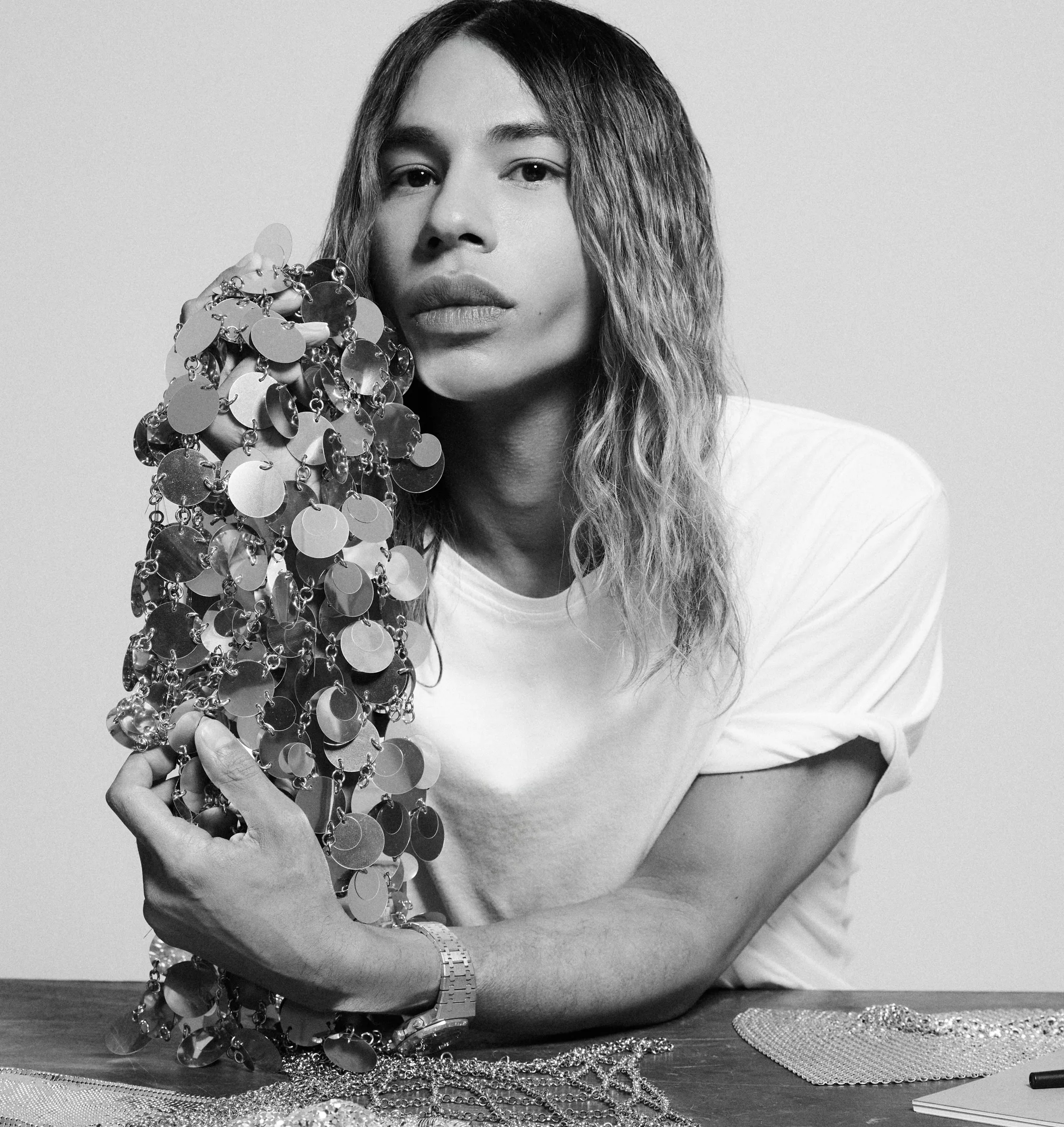
Rabanne has named the former Balmain designer its creative director, closing one era of maximalist glamour and opening a very different one.
recall
- The Announcement
- Fourteen Years, One Exit
- What Dossena Leaves Behind
- Why Rabanne, Why Now
- The Puig Calculation
- What Rousteing Actually Said
- March 2027 and the Long Runway to a First Show
On Tuesday, Rabanne confirmed what fashion insiders had been trading whispers about for months: Olivier Rousteing is the house’s new creative director. The Puig owned label called it, in its own statement, a significant new step in the Maison’s evolution, and for once that kind of corporate framing actually undersells the moment. This is one of the year’s bigger reshuffles in French fashion, and it lands at a house that has spent the last decade shh rebuilding its identity around metal mesh, disco physics, and a kind of futurism that never fully went out of style because it was never really in one.
Rousteing will present his debut for Rabanne in March 2027 as part of the Fall/Winter 2027 shows during Paris Fashion Week, according to the brand. Ahead of that, a pre fall collection is expected to arrive in November, giving him a smaller, lower pressure runway to start reintroducing himself to an audience that has watched him work almost exclusively through a Balmain lens since 2011.
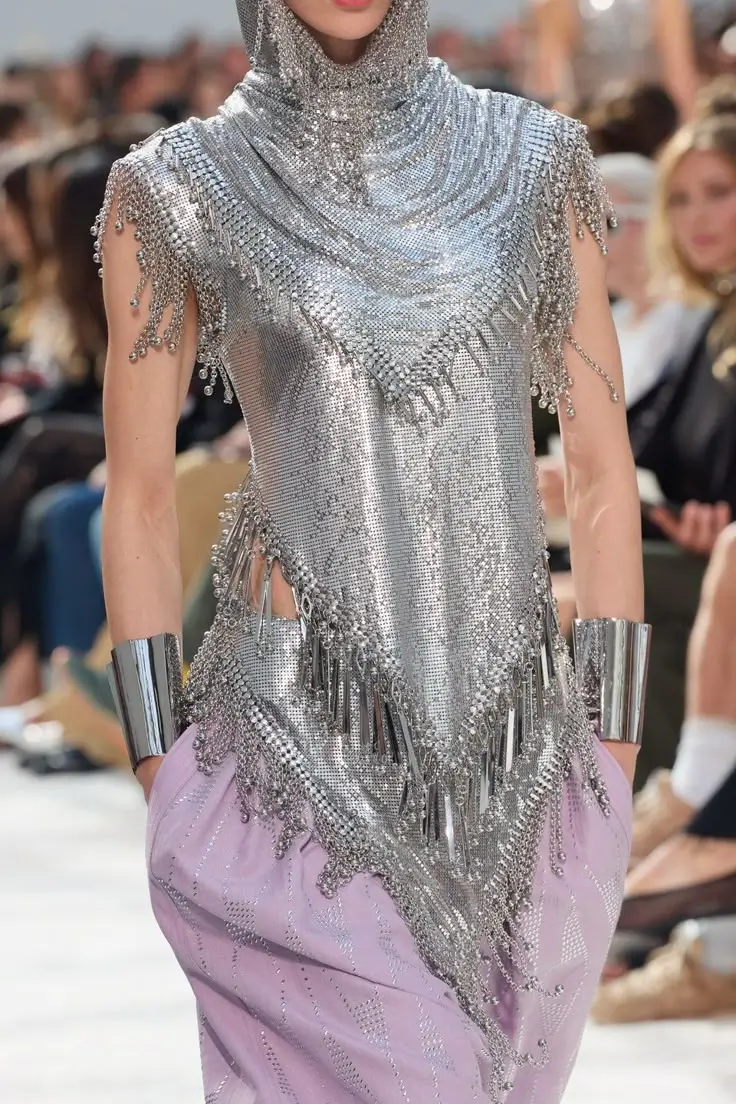
A metallic chainmail-inspired runway ensemble combines shimmering silver draping, crystal fringe, and soft lavender tailoring for a modern interpretation of Rabanne’s signature materials.
stir
The role Rousteing is stepping into belonged, until recently, to Julien Dossena, who left the house after 13 years at the helm. Dossena’s exit was one of those departures that seemed to catch even seasoned fashion editors off guard, not because it happened, careers end, but because of how long and how steadily he’d built something at Rabanne that felt genuinely his. Rousteing appears to know this. In comments shared through the brand and echoed across his own channels, he made a point of crediting Dossena directly, calling his creative legacy remarkable and noting that it redefined the house for a new generation while staying respectful of its founding spirit. That’s not a throwaway line in an appointment announcement. Incoming designers don’t always bother to name their predecessors, let alone praise them specifically.
flow
He took over in 2011 at 25 years old, replacing Christophe Decarnin, and became the youngest designer to lead a major Paris house since Yves Saint Laurent’s own early ascent at Dior. He was also the first Black designer to lead a French fashion house, a fact that shaped both how he was covered and how he approached the job, by his own account, from day one.
What followed was fourteen years of a very specific kind of transformation. Rousteing turned Balmain into a house defined almost as much by its front row as by its runway, assembling what got nicknamed the Balmain Army: a rotating cast of famous faces and models who became inseparable from the brand’s image. He dressed people for red carpets and album eras rather than just for the collection. He opened stores outside Paris, launched a beauty and fragrance line with Estée Lauder in 2023, expanded accessories, and at various points collaborated directly with some of the biggest names in music and entertainment. He also, by most industry accounts, helped drag a single storied house through the entire arc of the social media era, from the earliest days of fashion brands experimenting with Instagram to a moment where a single Rousteing post could move culture on its own.
He stepped away from Balmain in November 2025, closing out that run. Less than a year later, he’s back with a new address.
move
It’s worth sitting with what Rabanne actually was before Dossena, and what it became under him, because it explains why Rousteing is walking into a very different kind of assignment than the one he left. Rabanne started as Paco Rabanne’s own vision: chainmail dresses, unconventional materials, a willingness to treat clothing as something closer to engineering than tailoring. For a long stretch after the founder’s most active years, the label existed more as a fragrance business than a fashion one.
Dossena is widely credited with reversing that. Over thirteen years he built Rabanne back into one of the more consistently well reviewed presences on the Paris ready to wear calendar, expanding into accessories along the way, including the shoulder bags that became a recognizable signature. He did this while staying close to the house’s original DNA rather than discarding it, leaning into metallics, disco adjacent silhouettes, and a kind of restrained futurism that never tipped into costume.
That’s the version of Rabanne Rousteing inherits: smaller than Balmain in cultural footprint, but arguably more coherent as a design language, and sitting on genuine momentum rather than needing a rescue.
different
One thing several fashion writers have pointed out this week is how strange, in a good way, this pairing actually is. Rousteing’s reputation was built on body conscious glamour, embroidery, and star power. Rabanne’s archive is about unconventional materials and a kind of cool detachment. Neither designer has been shy about ambition, but they’ve expressed it in almost opposite registers. Whether that tension produces something genuinely new, or just gets smoothed over into something safer, is the actual open question hanging over March.
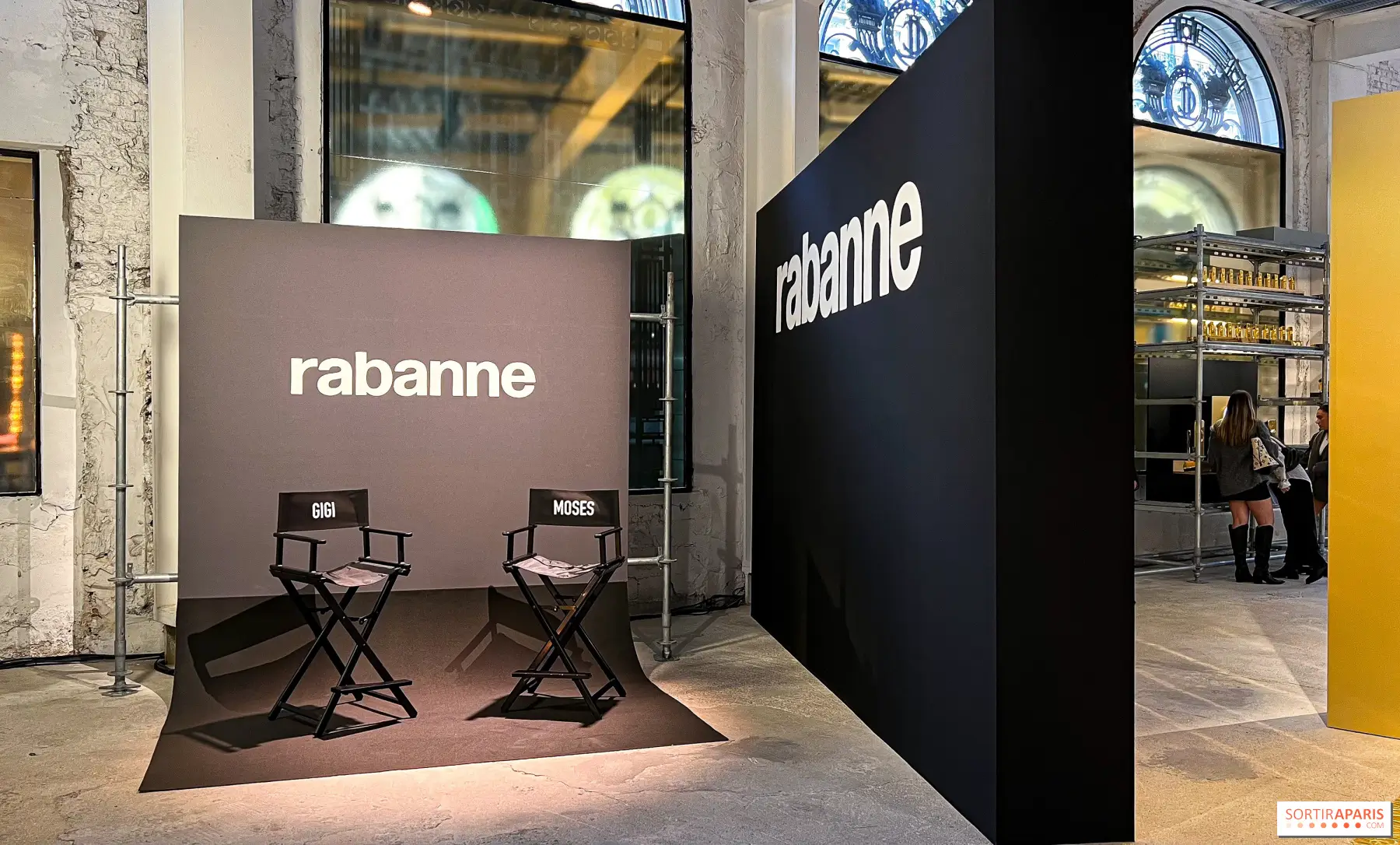
A Rabanne pop-up installation combines minimalist branding, industrial architecture, and personalized seating within an immersive event space designed for fashion presentations and guest experiences.
why
Fashion appointments rarely happen in a vacuum, and this one lines up with a broader pattern across French luxury this year: established creative directors moving between houses within the same handful of conglomerates, each one betting that a fresh pairing of designer and archive can generate the kind of coverage and cultural conversation that a quieter, more incremental handover wouldn’t.
For Rabanne specifically, the calculation seems to be about scale. The brand has real product depth already, beauty, fragrance, ready to wear, accessories, and Puig appears to want a name attached to it that can pull attention across all of those categories at once rather than one at a time. Rousteing has fourteen years of experience doing exactly that kind of cross category brand building, arguably more of it than almost anyone else currently available on the market.
There’s also a timing element that shouldn’t be overlooked. Rousteing left Balmain in November 2025, and by the time his Rabanne appointment was confirmed this week, reporting had already surfaced suggesting he’d quietly begun working on the house’s future collections months earlier. That kind of overlap, a designer developing ideas for a new employer before the ink is officially dry, isn’t unheard of in an industry where searches for creative directors tend to happen behind closed doors long before any public announcement. It does suggest, though, that both sides moved with more urgency than the calm, formal language of the press statement lets on.
calc
Puig, the Spanish conglomerate that owns Rabanne alongside Carolina Herrera, Jean Paul Gaultier, Nina Ricci, and Charlotte Tilbury, framed the hire through Ana Trias, its president of prestige and fashion brands. Her comments centered on the idea that Rousteing’s creative instincts are closely tied to the current cultural moment, and that his ability to make fashion feel personal and expressive made him, in her words, a natural fit for the house.
That kind of language is standard for an announcement like this, but it’s also consistent with how Puig has operated across its portfolio: pairing designers known for a strong, recognizable point of view with houses that have real commercial infrastructure already in place, then letting the designer’s profile do a lot of the marketing work.
mention
Rousteing’s own statement leaned less on strategy and more on emotion, which tracks with how he’s talked about his career throughout his time at Balmain. He described joining Rabanne as a tremendous honor and called it a house that has always challenged convention, one whose spirit of innovation and craftsmanship has inspired generations and now inspires him directly. He also framed his approach to fashion in fairly personal terms, describing it as being about emotion, identity, and the confidence to express who people truly are, and connected that idea back to Paco Rabanne’s own belief in freedom and individuality.
It’s worth noting that none of this language is particularly unusual for a creative director’s opening remarks. What stands out more is the specific acknowledgment of Dossena, and the fact that Rousteing chose to frame his arrival as building on an existing legacy rather than starting fresh, a subtly different posture than the one he took stepping into Balmain in 2011, when he was the new, largely unknown designer trying to prove himself against an established aesthetic.
again
There’s also a shh throughline in how this appointment is being discussed that’s worth naming plainly. Rousteing’s rise at Balmain was shaped in part by being the first Black designer to lead a major French house, a distinction he’s spoken about candidly over the years, including the skepticism he faced early on simply because of who he was stepping into the role as. His move to Rabanne doesn’t erase that history. If anything, several outlets covering the appointment this week have framed it as another marker in an industry that has been slow, house by house, to diversify who actually gets handed the keys to its most storied names.
extend
For now, the actual clothes remain the biggest unknown. Rousteing’s debut is scheduled for March 2027 as part of Fall/Winter 2027 Paris Fashion Week, with a pre fall collection reportedly arriving in November as a kind of soft opening. That’s a longer runway than some designers get between announcement and first show, which suggests both sides are treating this as a considered transition rather than a rushed rebrand.
Until then, the appointment itself is the story: a fourteen year Balmain veteran taking the reins at a house built on entirely different material, literally and stylistically, with an audience of editors, buyers, and longtime Rabanne loyalists waiting to see which version of Rousteing shows up when the lights actually go down on his first collection.
There’s a version of this story where Rousteing simply imports what worked at Balmain: the embroidery, the body conscious tailoring, the celebrity front row. There’s another version where he genuinely absorbs Rabanne’s own material language, the chainmail, the sense of clothing as engineering, and produces something that looks less like a Balmain sequel and more like an actual synthesis of two very different design philosophies. Industry chatter this week has largely assumed the former, given how closely his name has become attached to a specific aesthetic over fourteen years. But designers have surprised their audiences before, and Rousteing’s own comments about stepping into this role with respect for the Maison’s heritage suggest he’s at least aware of the difference between the two paths. Which one he actually takes won’t be clear until March, when the clothes, not the statements, do the chatting.
Previous article
← Justin Bieber's SKYLRK Turns a Meatpacking District Storefront Into a Five-Day Waiting RoomNext article
No next articleRelated Articles
Justin Bieber’s SKYLRK Turns a Meatpacking District Storefront Into a Five-Day Waiting Room
A limited pop-up, a speaker rel at Target, and a World Cup halftime slot line […]