Inside The GRAMMY Museum’s New Wing Where Pop’s Biggest Nights Live Forever

July 17, 2026
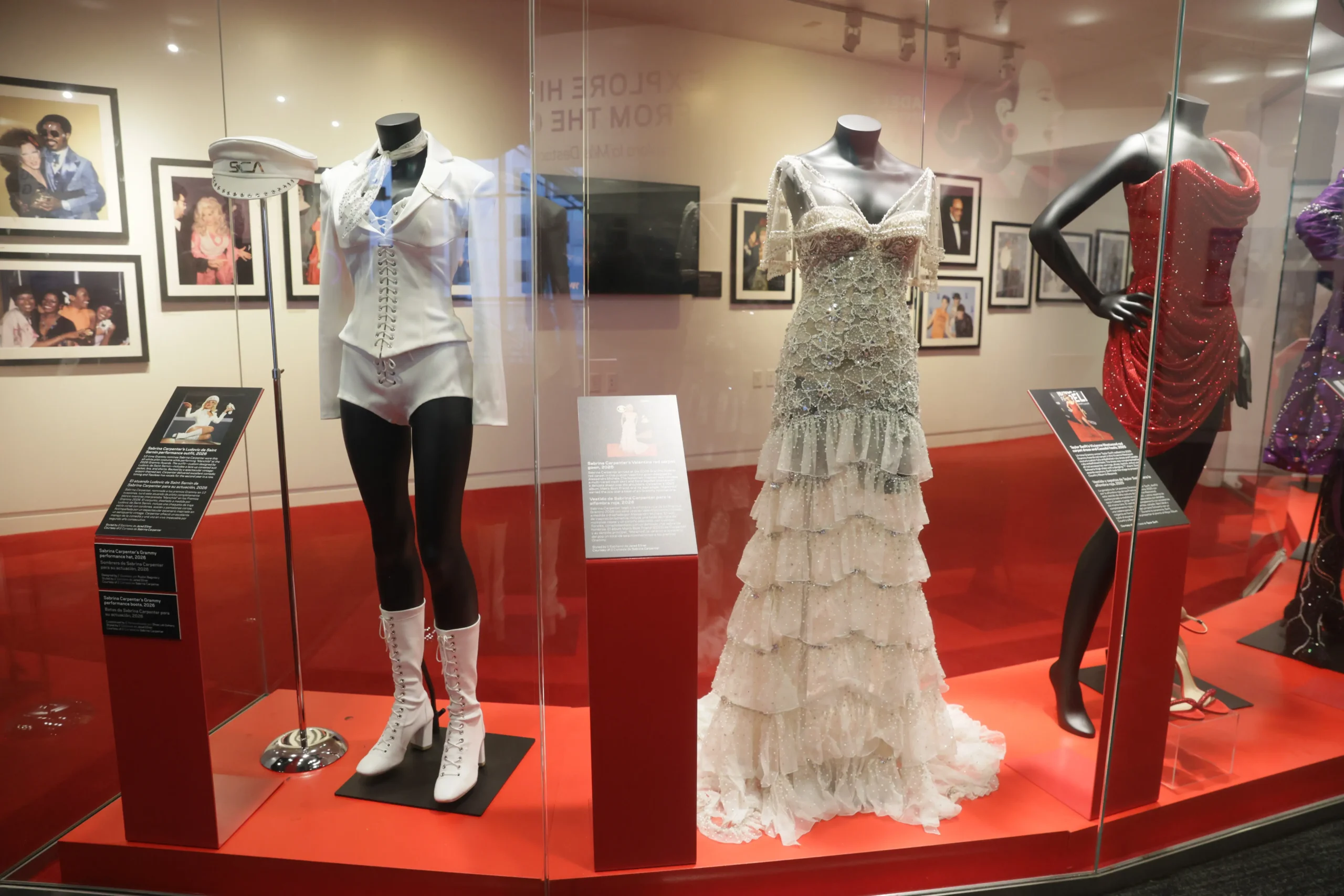
A ruby minidress. An upcycled belt buckle skirt. A tube top that once belonged to a woman who sang like nobody since. The GRAMMY Museum just built them a room.
recall
- A Third Floor Gallery Built for Wardrobe Archaeology
- Taylor Swift’s Westwood Moment, Preserved
- Sabrina Carpenter Gets Two Looks and a Full Arc
- Billie Eilish and the Upcycled Instinct
- Amy Winehouse, Nearly Two Decades Later
- The Ron Galella Photographs Sitting Quietly Nearby
- Why a Costume Case Matters More Than a Photo Ever Could
Los Angeles is not short on places to look at other people’s clothes. But the GRAMMY Museum, tucked into the L.A. Live complex a few blocks from Crypto Arena, has spent the last several years quietly building the closest thing the music industry has to a permanent fashion archive. Its third floor gallery now houses “On The Red Carpet,” an ongoing exhibit that treats award show wardrobe the way a natural history museum treats fossils: pinned, lit, labeled, and left there for anyone willing to walk up three flights and look closely.
The premise is almost embarrassingly simple. Every year, GRAMMY nominees get asked some version of the same question walking into the ceremony: who are you wearing. The answer used to evaporate the second the broadcast ended, surviving only in paparazzi contact sheets and, eventually, in an endless scroll of best and worst dressed roundups. The museum’s pitch is that the answer deserves to last longer than that. So it collects the actual garments, the actual heels, the actual belts, and puts them under glass a floor above where visitors can also find the Recording Academy’s own trophy case.
What makes the current rotation notable is the range it manages to cover in one room. There are pieces from the 2025 and 2026 ceremonies still smelling faintly of hairspray, hanging a few feet from a top and skirt that last moved under stage lights in 2008, worn by a singer who has been gone for more than a decade. That juxtaposition, deliberate or not, is the whole argument for the gallery’s existence.
View this post on Instagram
reserve
Start with the dress most people already have seared into memory. Taylor Swift walked the 67th Annual GRAMMYs red carpet in February 2025 in a short, ruby red gown by Vivienne Westwood, its bodice cinched into the label’s signature corseted silhouette, its skirt catching light the way couture is supposed to. She paired it with a set of heels from Italian shoemaker Casadei, the kind of styling decision that reads effortless on a red carpet and takes a stylist several fittings to actually land.
The dress arrived on the heels, so to speak, of a very different Grammy night for Swift. The year before, she had shown up in a stark white corseted Schiaparelli gown and black opera gloves, the same evening she made history winning her fourth Album of the Year trophy. Red, by comparison, read almost play: a sharper, shorter, more sparkling companion piece to a year that had been dominated by her Eras Tour and the rollout of “The Tortured Poets Department.” Fans and stylists alike noted the small details worked into the look, chandelier earrings, a scattering of rings, a charm dangling against her thigh, the kind of touches that turn a dress into a night rather than just an outfit.
Now that dress sits in a case in downtown Los Angeles, alongside the Casadei heels that carried her across the same carpet. It is, per the museum’s own description, one of the anchor pieces of the current rotation, credited as a custom red carpet look from the 67th Annual GRAMMYs.
View this post on Instagram
arc
If Swift’s inclusion tells a single night’s story, Sabrina Carpenter‘s section of the gallery tells something closer to a career arc, which makes sense given how thoroughly she has dominated the last two Grammy cycles. The exhibit includes a custom performance set from designer Ludovic de Saint Sernin, built for her 68th Annual GRAMMYs stage appearance in 2026: a lace up, corseted jacket worn over a matching bra and shorts, all rendered in stark white, the kind of architectural minimalism the Paris based designer has built his label around since launching it in 2017. It is a performance costume in the strictest sense, engineered for movement, not for standing still on a carpet, and it shows in the construction.
Set against it is Carpenter’s red carpet gown from the same 68th ceremony, a sheer white Valentino piece embellished with delicate detailing and finished with a ruffled skirt, worn with natural, understated makeup for an arrival that photographers described at the time as flirtier and softer than her performance look from the same night. Together the two pieces, custom stagewear and custom red carpet gown, sitting a few feet apart in the same case, do something a single outfit could not: they show how differently one artist can dress for two very different jobs on the exact same evening.
Carpenter’s inclusion is not incidental to the museum’s calendar either. Her outfits went on public display not long after the museum hosted a dedicated fan activation tied to her Los Angeles concert run, complete with themed drinks and photo opportunities on the venue’s Ray Charles Terrace, a sign of how closely the institution has started tracking pop’s most online fanbases as a programming strategy in its own right.
View this post on Instagram
upcyle
Billie Eilish‘s contribution to the gallery pulls the exhibit in a more conceptual direction. Her red carpet outfit from the 68th Annual GRAMMYs in 2026 comes from HODAKOVA, the Stockholm based label founded in 2021 by designer Ellen Hodakova Larsson, who won the LVMH Prize for Young Designers in 2024 on the strength of a design philosophy built almost entirely around upcycling. Larsson’s atelier works from second hand garments, deadstock fabric, and salvaged hardware, reconstructing them into pieces that read as couture while carrying the literal material history of something else entirely. Reports at the time described Eilish’s look as jacket and skirt reworked from existing materials rather than cut from new fabric, consistent with the brand’s signature method.
It is a fitting choice for an artist who has spent years publicly wrestling with fashion’s environmental footprint and the industry’s appetite for disposability. Eilish’s Grammy look the year prior, a nautical inspired outfit from Prada accessorized with a black hat, sunglasses, and a silver chain, leaned into a completely different register, more playful vintage sailor than sustainability statement. Seeing both eras of her red carpet choices catalogued in the same institution underlines how much range a single artist can move through year over year, and how a museum collection, unlike a single magazine spread, has the patience to hold all of it at once.
View this post on Instagram
two
The oldest piece in the current rotation belongs to Amy Winehouse, and it is also the one that hits differently walking through the gallery. Her look from the 50th Annual GRAMMYs in February 2008, a black tube top, a belt, and a skirt designed by Tina Kalivas, the Greek Australian designer who spent years working under Alexander McQueen before launching her own label, has been folded into the exhibit as a kind of anchor point for everything else in the room.
Kalivas has built a career designing for performers who need clothing that can survive a stage and still photograph like couture, a client list that has also included Rihanna and Dita Von Teese over the years. Her work for Winehouse came during the singer’s “Back to Black” era, the same year she won five Grammys while appearing via satellite from London due to a U.S. visa issue, a detail that makes the surviving wardrobe from that ceremony feel even more like a historical artifact than a fashion one. Seeing the skirt now, framed a few feet from garments that debuted less than six months ago, does the thing museums are supposed to do: it collapses time, and it makes clear that a great red carpet look does not have an expiration date.
shh
The gallery does not stop at garments. Woven through the same third floor space is a collection of photography from Ron Galella, one of the GRAMMYs’ official photographers across the 1970s, ’80s, ’90s, and early 2000s, whose archive the museum credits as coming through a continuing partnership with the Ron Galella Foundation. His images capture an earlier, less curated version of red carpet culture, artists arriving, mingling, and posing with freshly won trophies decades before step and repeat backdrops became an industry unto themselves.
Pairing the photographs with the physical garments turns the gallery into something closer to a time capsule with two entry points. One case shows you the fabric. The photographs a few steps away show you what red carpet fashion looked like before it had its own dedicated museum wing to begin with, back when a single photographer with a long lens was often the only record that survived the night.
fin
There is an obvious question underneath all of this: why does a dress in a glass case matter more than the thousands of photographs already circulating of the same outfit online. The answer has to do with what a photograph cannot capture. A photo flattens a garment into two dimensions and one angle. It cannot show the actual weight of a Westwood corset, the specific give of upcycled fabric reworked by hand, or the exact stitching a McQueen trained designer used to construct a skirt for a five foot two performer standing under stage lights. Those are details that only survive in the object itself, and the GRAMMY Museum has effectively bet that enough people care about those details to justify building, and continuing to expand, a dedicated gallery for them.
It is also, whether the museum frames it this way or not, an acknowledgment that the red carpet has become its own creative discipline within the music industry, distinct from the shows and the awards themselves. Designers now build custom pieces specifically for a single night’s arrival, knowing full well the garment may end up preserved rather than resold or archived privately. That shift, from disposable spectacle to collectible artifact, is arguably the real story the gallery is telling, one case at a time.
There is also a practical side to what the museum is doing that tends to get lost in the conversation about who wore what. Garments like these are not easy to preserve. Fabric degrades, embellishments loosen, custom pieces built for a single wear were rarely engineered with decades of display in mind. Keeping a corseted Westwood bodice or an upcycled HODAKOVA jacket in wearable, photographable condition takes conservation work that has nothing to do with fashion and everything to do with textile science: humidity control, careful mounting, the same kind of case work a museum might use for a centuries old tapestry. That the GRAMMY Museum is applying it to a dress from last year’s ceremony says something about how quickly the institution has decided contemporary pop fashion deserves the same treatment as anything else in its collection.
The location helps make the case too. Housed inside L.A. Live, a short walk from Crypto.com Arena where several of these exact garments were first photographed, the museum sits close enough to the source that visitors can, in theory, stand where a given red carpet moment actually happened and then walk a few blocks to see the outfit itself preserved under glass. Few museum experiences offer that kind of geographic continuity between an event and its artifact, and it is one of the more understated advantages of building a fashion archive around an awards show rather than around a single designer’s career.
None of this requires a visitor to know who Ellen Hodakova Larsson is, or to recognize Tina Kalivas’s name from her years constructing show pieces for Alexander McQueen. The gallery works on a simpler level too, as a room full of genuinely striking clothing, arranged so that a 2008 tube top and a 2026 lace up performance set can sit close enough together to be compared directly, which is more than most red carpet coverage, however thorough, has ever been able to offer.
The exhibit remains on view in the museum’s third floor gallery as part of its ongoing programming, with the Recording Academy and the museum both continuing to add pieces from each new ceremony as the years go on. Visitors can currently view it as part of general admission, alongside the museum’s other permanent and rotating collections.
Related Articles
Inside Nike’s Three City Relay for Getting World Cup Stars the Exact Boot They Need, Overnight
A three hub system spanning Beaverton, New York, and Mexico City kept Nike’s biggest football […]