DRIFT AUDIO
Listen to this story
Choose a voice, then press play.
On May 18, 2026, a whisper from the past steps forward. Not abruptly. Not theatrically. But with the quiet authority of something that has never needed urgency to endure.
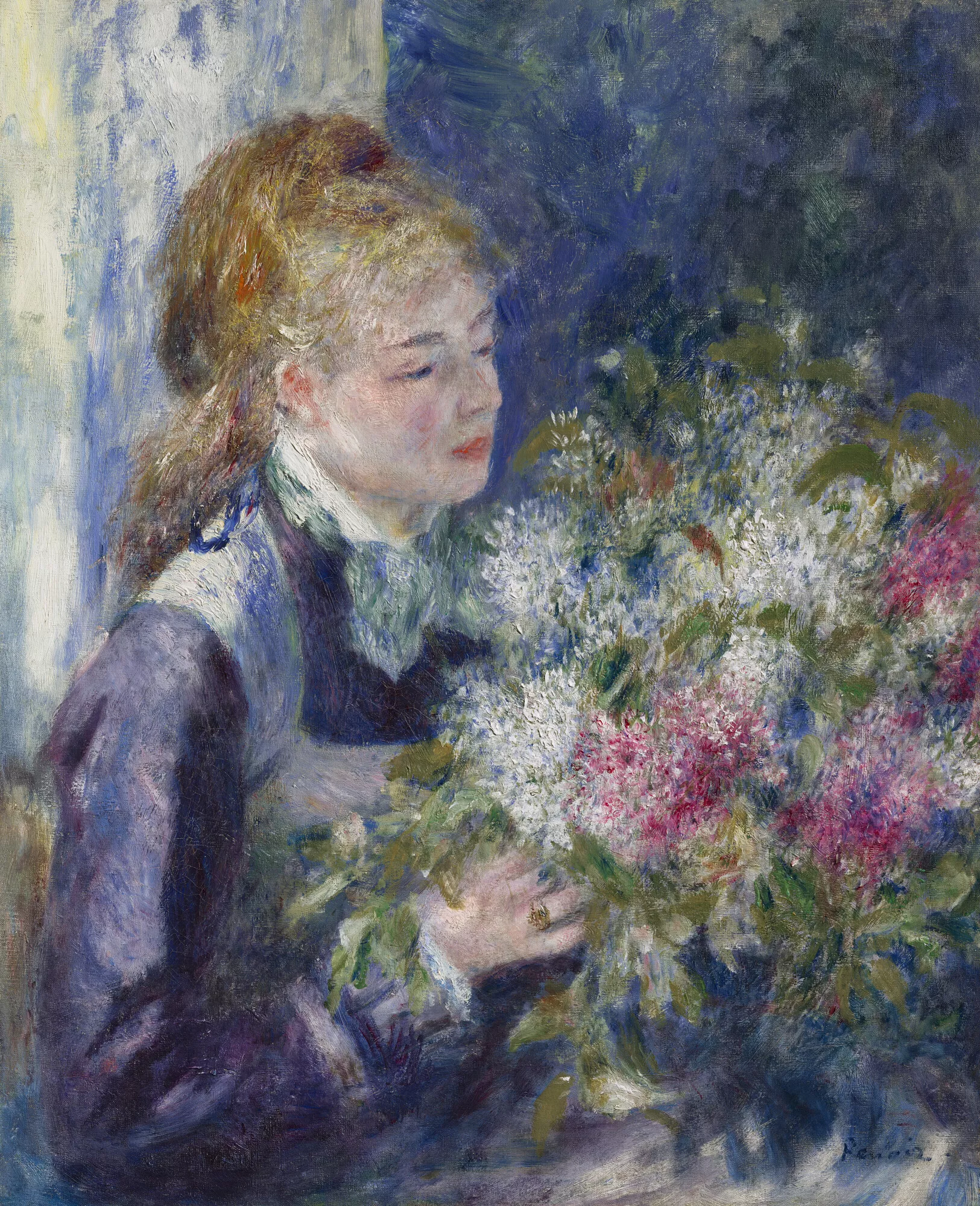
La femme aux lilas (Portrait de Nini Lopez)—an 1876–77 oil-on-canvas by Pierre-Auguste Renoir—will be offered at Christie’s 20th Century Evening Sale in New York. Its first public appearance in ninety-seven years.
Long held within the private orbit of the Whitney Payson family, most recently under the stewardship of Lorinda Payson de Roulet, the painting does not re-enter the world as an object alone. It arrives as a reintroduction. A recalibration.
Estimated at $25 to $35 million, the work exceeds the category of “lot.” It operates instead as a missing interval in Renoir’s portraiture—a moment of stillness resurfacing within a market defined by velocity.
This is not rediscovery.
It is re-presence.
The Painting As Suspension, Not Statement
At 28 by 23 inches, the composition resists scale as spectacle. It draws inward.
Nini Lopez—actress, model, presence—sits against a field of deep blue. Her gaze avoids the viewer. It settles somewhere beyond, or within. In her hands: lilacs. Rendered in tones that dissolve at their edges—lavender, white, faint green.
The painting does not assert narrative. It suspends it.
Renoir’s brushwork moves between control and release. Hair catches light without stiffness. Skin carries warmth without excess. The lace at the collar exists not as detail, but as atmosphere.
This is not the outward energy of Bal du moulin de la Galette. Nor the communal intimacy of Luncheon of the Boating Party.
Here, the gesture is quieter. More contained.
Lopez is not positioned. She is present.
And that presence—unperformed, unresolved—becomes the work’s central force.
Nini Lopez: The Figure Without Fixity
Historical traces of Nini Lopez remain minimal. A name, a profession, a recurrence across Renoir’s canvases in the 1870s.
Yet within those repetitions, something accumulates. Not identity in the formal sense—but familiarity.
She is neither patron nor partner. Neither mythologized nor monumentalized. She exists within Renoir’s work as a momentary constant—a figure who appears, dissolves, reappears.
In La femme aux lilas, that ambiguity deepens.
Her gaze does not return ours. It withdraws from it. Not in refusal, but in indifference. The lilacs—symbols often tied to renewal, youth, seasonal transition—do not clarify her state. They complicate it.
Is this a portrait of anticipation? Reflection? Absence?
The painting resists resolution.
And in doing so, it extends beyond portraiture into something closer to condition.
From Atelier To Seclusion: A Provenance Of Quiet Continuity
The painting’s trajectory from Renoir’s studio to its re-emergence in 2026 unfolds without spectacle.
Its early presence within the collection of Alexandre Berthier, 4th Prince of Wagram, situates it within a lineage of early Impressionist patronage. Between 1905 and 1908, Berthier assembled works that would later define institutional collections.
In December 1929, Joan Whitney Payson and Charles Payson acquired the painting for $100,000—an acquisition that reflects not only wealth, but discernment.
Joan Whitney Payson, later founder of the New York Mets, collected with precision. Her holdings—Degas, Monet, Van Gogh—were not assembled for visibility. They were assembled for proximity.
La femme aux lilas entered that environment not as centerpiece alone, but as anchor.
For nearly a century, it remained within the family. Not exhibited. Not circulated. Not absorbed into the mechanisms of public validation.
It existed in continuity.
A different kind of visibility.
One defined not by audience, but by duration.
Christie’s And The Reintroduction Of Value
The placement of the work within Christie’s 20th Century Evening Sale reframes its trajectory without destabilizing it.
The estimate—$25 to $35 million—reflects both rarity and restraint. Major Renoir portraits of this scale, condition, and provenance seldom reach the market.
But valuation here extends beyond financial metrics.
Christie’s positions the painting as a defining Impressionist work—not through exaggeration, but through absence. Ninety-seven years outside public circulation generates a different kind of demand. Not familiarity, but curiosity.
The comparison to recent Renoir sales underscores the distinction. Smaller works circulate. This one returns.
The difference is structural.
Market Conditions And The Return Of Meaning
The contemporary art market, still recalibrating after periods of volatility, has begun to shift toward works that offer more than liquidity.
Collectors—both institutional and private—are increasingly oriented toward continuity, narrative, and material presence.
In a landscape saturated by digital production and speculative cycles, a 150-year-old oil painting carries a different weight.
It is not optimized.
It is not accelerated.
It exists.
And in that existence, it reintroduces a slower form of value—one tied to looking, to time, to sustained engagement.
La femme aux lilas enters this moment not as counterpoint, but as correction.
Condition As Evidence Of Stewardship
One of the work’s most striking attributes is its preservation.
After nearly a century in private care, the painting retains structural and visual integrity at a level rarely encountered. The canvas remains stable. Pigments retain vibrancy. The surface shows no evidence of intrusive restoration.
This condition is not incidental. It is the result of controlled environments, consistent attention, and a refusal to subject the work to unnecessary exposure.
The Payson family’s stewardship becomes visible not through documentation, but through the painting itself.
Care, here, is not abstract.
It is material.
consider
The reappearance of La femme aux lilas reopens an enduring question: what is the role of private ownership within cultural continuity?
Criticism often frames private collections as removal—art withdrawn from public access.
Yet this narrative simplifies a more complex reality.
Private collecting can function as preservation. As insulation against overexposure, environmental fluctuation, and institutional demand.
The Payson family did not circulate the painting. They sustained it.
Now, as it returns to the public sphere, the tension shifts.
Will it enter a museum collection, reestablishing public access?
Or will it transition into another private environment, extending its cycle of quiet continuity?
The answer remains open.
As it should.
frame
What distinguishes La femme aux lilas is not solely its composition, or its provenance, or its market positioning.
It is its relationship to time.
Ninety-seven years without public visibility does not diminish its relevance. It intensifies it.
The painting does not feel historical. It feels suspended—untouched by the cycles that have passed around it.
When it is seen—whether within Christie’s galleries or beyond—it will not register as rediscovered.
It will register as immediate.
Alive within its stillness.
sum
On May 18, the gavel will fall. Ownership will transfer. The painting will enter its next phase.
But the essential question remains unchanged.
What does it mean to be seen?
Renoir’s answer, in 1877, was not explicit. It was suggested—through posture, through gaze, through the delicate instability of lilacs held between presence and disappearance.
Nearly a century later, that suggestion persists.
La femme aux lilas does not demand attention.
It holds it.
And in that holding, it reminds us that visibility is not always immediate. Not always constant.
Sometimes, it is deferred.
And in that delay, it deepens.
From the DRIFT archive: Chris P. Bacon: Francis DiFronzo’s Quiet Rebellion Against the Everyday · The Rise of a Masterwork: Klimt’s Portrait and Its Historic $236.4M Sale
Related Articles
Modigliani’s Limestone ‘Tête’
Carved from a single block of limestone in Montparnasse more than a century ago, one of Modigliani's rare stone heads goes to auction for the first time…