Stephen Rhodes “Emotionally Empty” Short-Sleeve: Satirical Nihilism for the Disenchanted Generation

May 26, 2025
In an era saturated with ironic detachment and the slow-burn collapse of late-stage capitalism, Stephen Rhodes’ work channels an unsettling sense of generational malaise with razor-edged satire and pixel-perfect nostalgia. The “Emotionally Empty” T-shirt, a part of his now-iconic mock-retro catalogue of parody educational posters, functions not merely as fashion but as a cultural indictment dressed in polyester and ink. It is a wearable cry of cognitive dissonance — and it’s laughing through the pain.
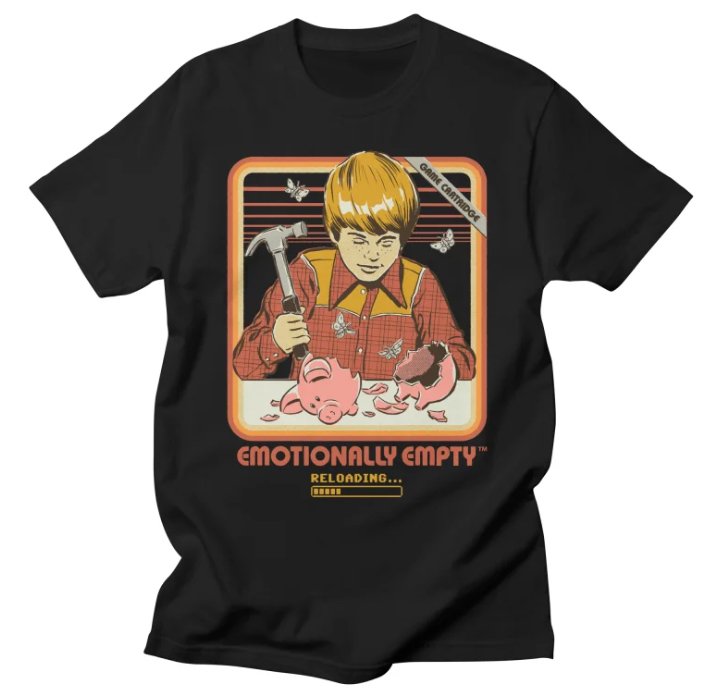
At first glance, the T-shirt seems lifted straight from a 1970s classroom visual aid or a Reader’s Digest booklet about emotional development. The image is framed with thick, warm-toned borders — soft oranges, muted yellows, and browns that evoke memories of wood-paneled dens and rotary telephones. A cherub-faced boy, rendered in graphic halftone style, is shown gleefully destroying a piggy bank with a hammer. Inside the broken ceramic shell, instead of coins or savings, flies buzz out — symbols of decay, emptiness, and perhaps the death of childhood ideals. Beneath the scene, in blocky arcade-era type, the shirt reads: “EMOTIONALLY EMPTY™,” followed by a reloading bar as though depletion were something temporary, fixable, or game-like.
Rhodes’ design works on multiple levels. On the surface, it’s hilarious in its grotesque parody — the boy’s innocent glee contrasts with the disturbing act of destruction. But underneath the comedy lies biting commentary. The shirt interrogates the fragility of our emotional economy. The piggy bank, traditionally a symbol of saved value, becomes a hollow vessel; its interior contains no nourishment, only rot. The idea of “reloading” alludes to video game mechanics, suggesting that emotional resilience has become a performative loop — we crash, reboot, repeat.
This irony is amplified by the phrase “Game Cartridge Slot” appearing at the top corner of the design, as if to imply that even emotions have become modular, artificial, commodified. Rhodes masterfully subverts visual tropes from children’s literature and instructional graphics to critique adult disillusionment. His use of nostalgia doesn’t comfort; it indicts. The warm tones are a trap, bait for anyone yearning for simpler times, only to find that the message they carry is unrelentingly modern in its existential despair.
The T-shirt’s power is its accessibility. It offers a shared laugh between strangers on the street — a flash of recognition, an unspoken “same.” For many wearers, it functions as both armor and admission. It says: “Yes, I’m running on fumes. But I see the joke. And I’ll wear it.” This garment does not offer solutions. It wears apathy like a badge, but in doing so, invites conversation — a shrug that, ironically, asks to be understood.
Rhodes’ work, like this tee, does not aim for comfort. It doesn’t fix what’s broken. Instead, it frames the wreckage and sells it back to us with design so clever, we laugh even as we sink. That’s not failure — that’s postmodern genius.
Related Articles
CLESSTE Turns a Work Short Into a Weatherproof City Piece With +phenix
The Tokyo label’s latest WINDSTOPPER release lands July 22, folding a ski brand’s wind science […]