DRIFT AUDIO
Listen to this story
Choose a voice, then press play.
A four piece Tabby capsule made with independent American makers pushes Coach’s accessible workhorse into four figure territory for the first time.
Walk into almost any American city and you will spot a Coach Tabby within a few blocks. The bag has become the house’s default answer to nearly every question a customer might ask: something structured enough for the office, small enough for a night out, priced low enough that a first designer bag purchase does not feel like a financial event. That ubiquity is precisely what makes Coach’s newest release strange to look at. Called American Craft, the capsule takes the Tabby Shoulder Bag 26 and hands it to four independent makers scattered across the country, each of whom applies a technique that has nothing to do with a factory line: hand tufting, hand worked leather inlay, patchwork quilting, and hand tooled metal hardware.
The results do not look like variations on a theme so much as four separate objects that happen to share a sil. One arrives covered in a tufted, yarn built landscape. Another carries an inlaid leather motif drawn from the natural world. A third is built from a patchwork of textiles pieced together over months. The fourth trades the usual turn lock for a rodeo grade, hand engraved buckle in silver and brass. None of them will be mistaken for the version sitting in a Coach outlet.
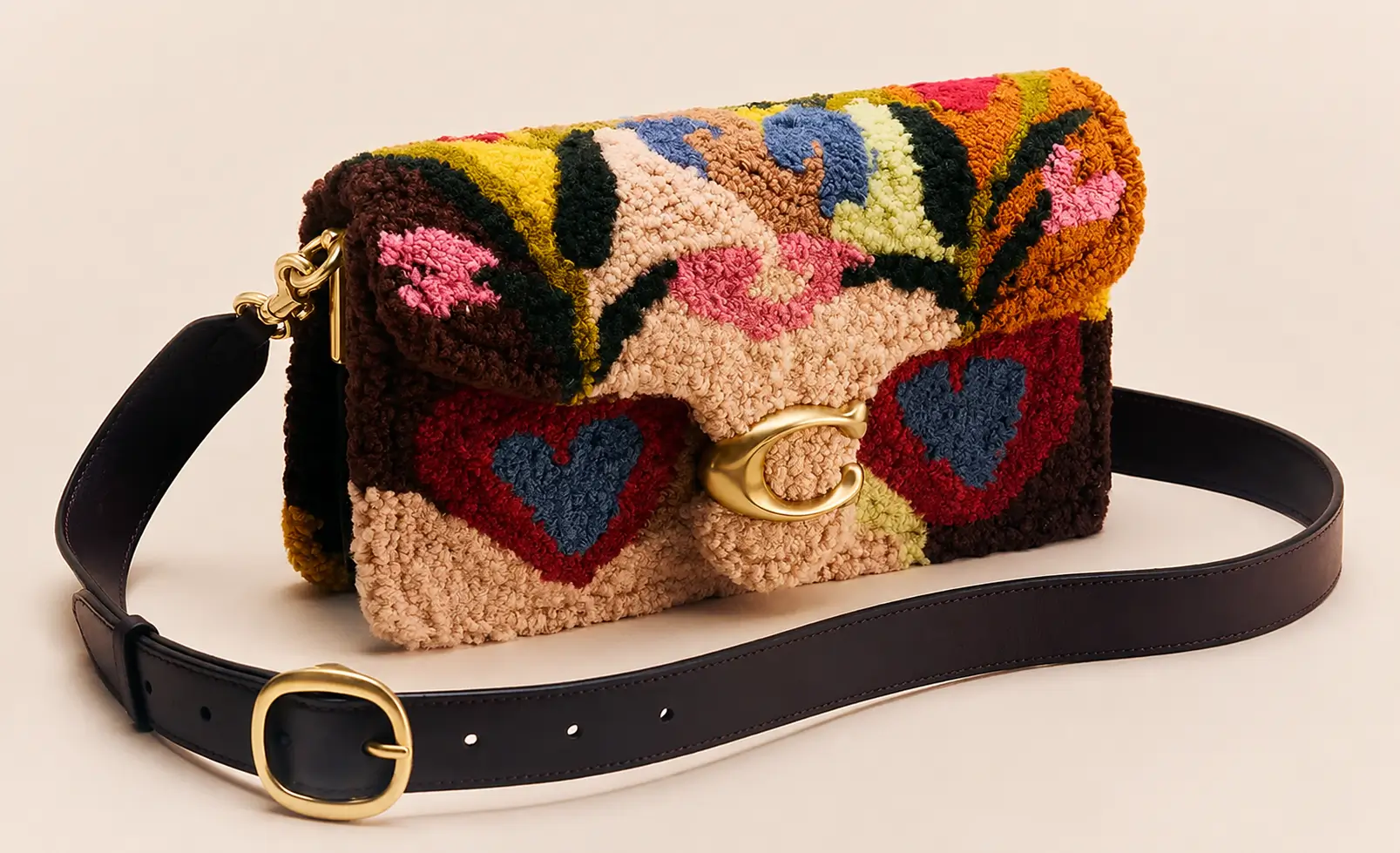
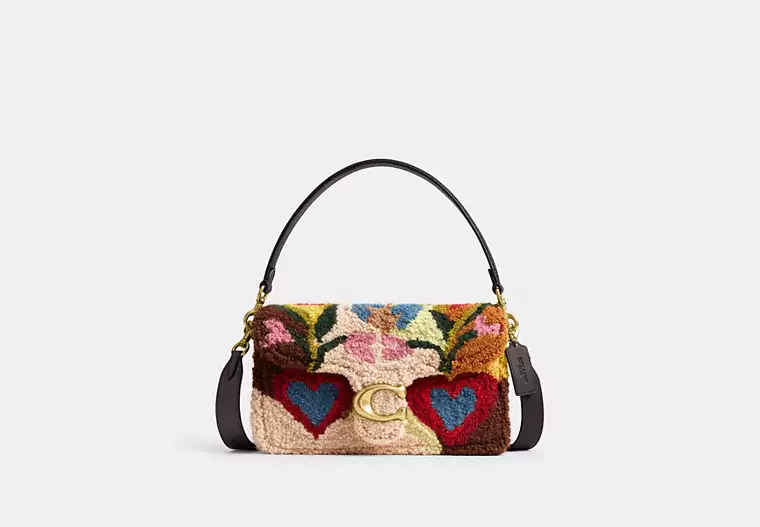
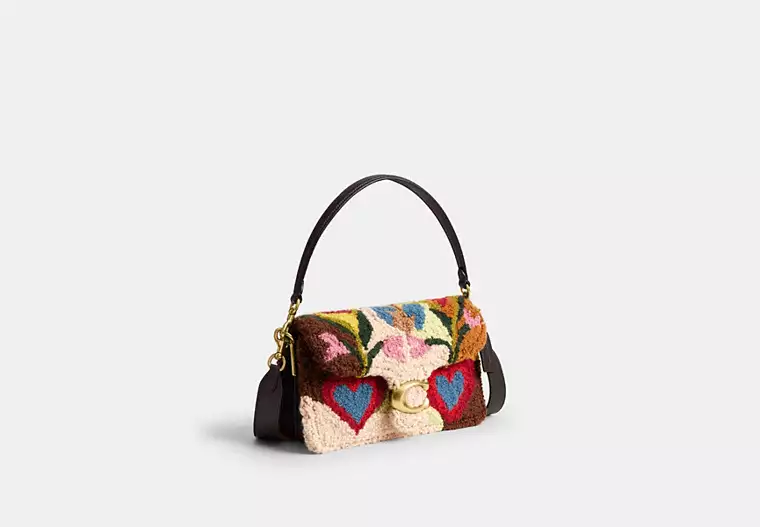
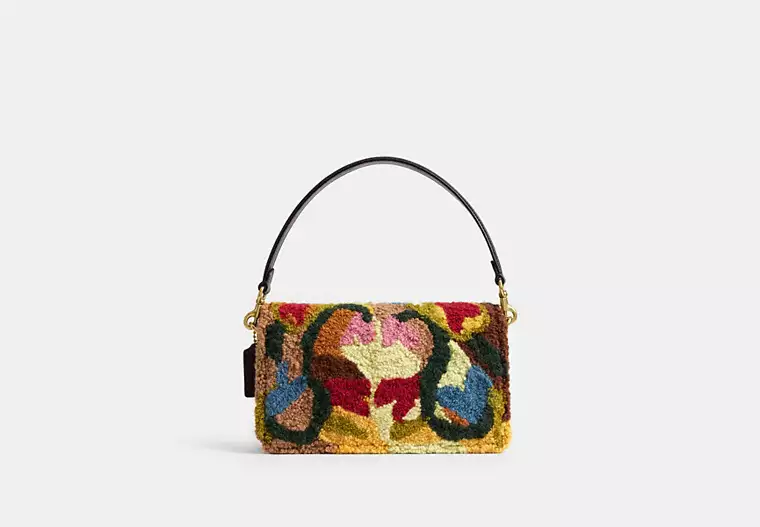
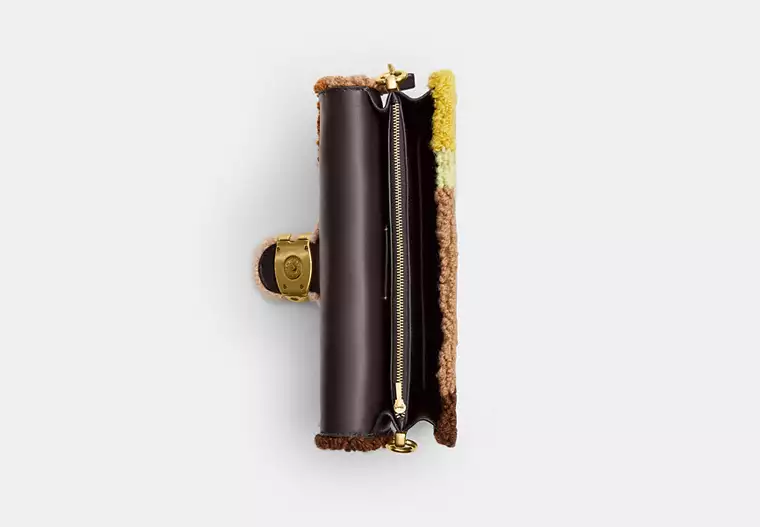
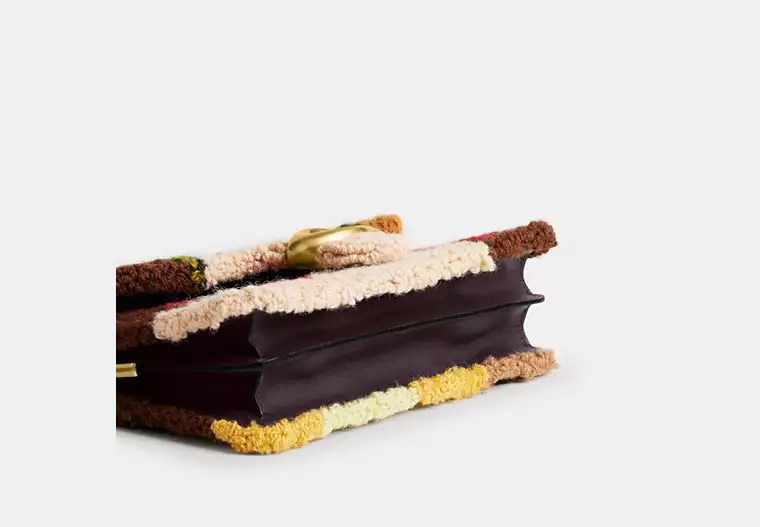
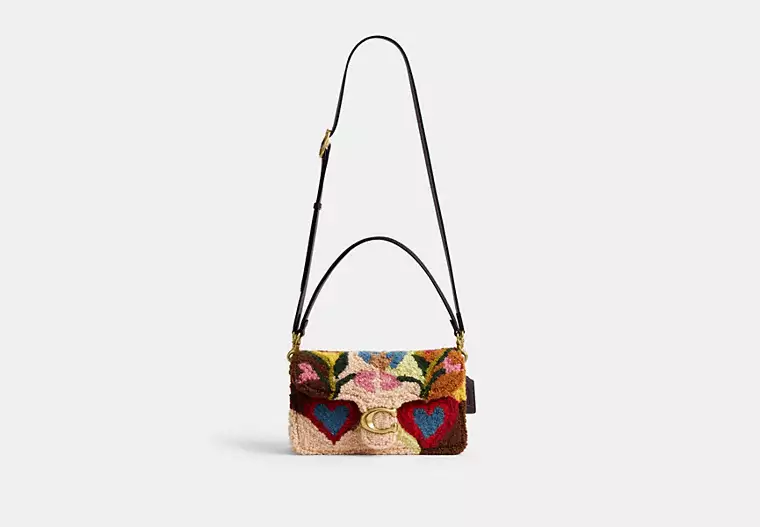
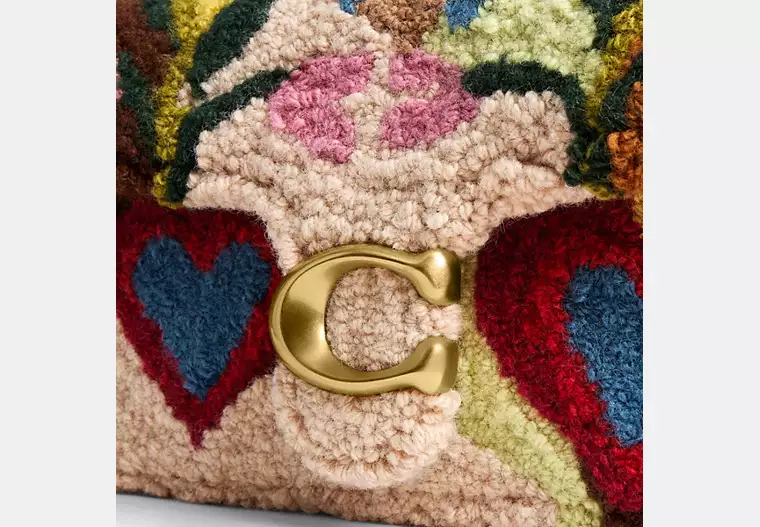
The handcrafted Coach Tabby capsule reimagines the house’s signature silhouette with richly tufted textiles, floral motifs, heart detailing, and polished gold hardware.
The Tabby itself has never really stood still since its 2019 debut. It has been through a slouchier, chain equipped iteration, a miniaturized version that circulated widely on social feeds a couple of years back, and a rotating cast of colorways and finishes sold through Coach’s dedicated Tabby shop. It has also become something of a celebrity uniform piece, turning up on shoulders from Bella Hadid to Jennifer Lopez without much need for a formal campaign to keep it visible. Creative director Stuart Vevers has treated the bag less like a fixed product and more like a recurring design prompt, one that keeps returning in slightly different proportions and hardware without ever losing the underlying shape that made it recognizable in the first place. American Craft is the furthest that prompt has been pushed. Rather than adjusting the strap length or swapping a finish, it hands the entire surface of the bag over to someone outside the company and lets their process, not Coach’s product calendar, dictate how long the piece takes to finish.
View this post on Instagram
four
The maker roster reads less like a typical fashion collaboration list and more like a cross section of American craft trades that rarely intersect with a handbag brand at all.
Bo Hubbard, a Brooklyn based fiber artist, brought machine and hand tufting techniques more commonly associated with rugs and wall hangings to a floral and heart motif panel. Rocketbuster, the El Paso bootmaker run by Nevena Christi, translated its inlay technique, more often seen on the shafts of custom cowboy boots, onto the Tabby’s front panel. Luke Haynes, a quilter who has shown work in the Brooklyn Museum’s collection among others, pieced together a patchwork surface built from the kind of composition and material choices that define his gallery quilts. And A Cut Above Buckles, a family run Utah shop that has spent more than two decades making championship rodeo buckles, supplied a hand tooled silver and brass hardware set, engraved with the kind of flourish typically reserved for a trophy buckle rather than a shoulder bag.
Each of the four had built a career entirely outside fashion before this project. That distance from the industry is arguably the point. Coach is not borrowing credibility from another luxury house or a celebrity designer here. It is borrowing from trades that carry their own, separate claim to American craftsmanship, betting that the pairing reads as authentic rather than as a marketing exercise stitched onto a familiar shape.
The trades themselves come with their own histories that predate any handbag entirely. A Cut Above Buckles has spent more than two decades supplying trophy buckles to rodeo associations across Utah and Texas, the kind of hardware traditionally awarded rather than purchased, engraved with the flourishes of a specific event or champion rather than a fashion season. Rocketbuster has built its reputation over roughly three decades as a custom bootmaker in El Paso, where inlay work is judged by the same standards that apply to a one of a kind pair of boots built to a rider’s exact foot rather than a standard size run. Quilting carries a different but equally specific lineage, one built around piecing, hand labor, and material reuse long before it found a place in contemporary art galleries. Tufting, meanwhile, has spent most of its recent history associated with rugs and wall hangings rather than anything load bearing or wearable. None of these four crafts were developed with a handbag’s stress points, strap tension, or daily handling in mind, which is part of why each maker has described a real adjustment period translating a technique built for one object onto the frame of another.
say
The timelines involved undercut any assumption that this was a quick licensing arrangement. Haynes has described the piece taking roughly eighteen months from initial concept through final construction, most of it spent in an iterative back and forth between his composition and the physical material itself. Hubbard has said his tufted panel took close to a year from concept to completion, including months of prototyping to work out how a tufted surface would actually behave once mounted onto a functional bag rather than hung on a wall.
View this post on Instagram
Christi, who left New York decades ago to take over Rocketbuster, has framed the collaboration as a kind of homecoming, describing her design life as coming full circle now that a New York based accessories house sought her out. Andrews, of A Cut Above Buckles, has been more matter of fact about the process, noting that fitting hand forged, hand engraved hardware to a mass manufacturable silhouette took several rounds of revision with Coach’s design team before the parts actually lined up.
What comes through across all four accounts is less a story about fashion and more one about production mismatch: craftspeople accustomed to building one object at a time, adapting techniques developed for boots, quilts, wall art, and rodeo trophies to a category with entirely different tolerances and expectations.
math
Pricing is where the real experiment sits. A core Tabby generally lists under $600, positioning it squarely in the accessible luxury tier that Coach has spent years cultivating deliberately. American Craft prices land between $2,995 and $4,995, roughly five to ten times that figure. That is not an incremental premium for nicer materials. It is an attempt to see whether the same silhouette, shifted into small batch production with named collaborators and one of a kind construction, can support a price point that belongs to a different competitive set entirely.
The structural logic borrows directly from how established luxury houses justify their own upper tiers: scarcity, named makers, heritage storytelling, and construction that cannot be easily replicated at volume. What makes the test unusual is that Coach is running it on top of, rather than instead of, its existing pricing architecture. The sub $600 Tabby remains on shelves untouched. American Craft sits above it as a separate tier rather than a replacement, which means Coach gets to observe demand at the new price point without disturbing the volume business that still does the bulk of its selling.
View this post on Instagram
That separation matters because Coach’s core strength has always been volume rather than scarcity. The brand’s recent turnaround, credited in large part to the Tabby itself, was built on making a recognizable, well made bag available at a price a much wider customer base could justify without much deliberation. American Craft flips that formula entirely. Four bags, four makers, months of hand labor each, means the entire capsule can only ever exist in the smallest of quantities. There is no restock, no additional colorway, no version that arrives cheaper once the initial excitement fades. Whether that scarcity reads as genuine exclusivity or simply as a small, one time experiment likely depends less on the bags themselves than on whether Coach chooses to build on the format again.
why
The timing is not incidental. The four bags arrive as part of Coach’s broader lean into Americana themes tied to the 250th anniversary of the country’s founding, a framing that gives the maker driven story a built in occasion rather than requiring Coach to invent one from scratch. Anniversary tie ins of this kind tend to be short lived by design, which raises an obvious question about whether American Craft is a one time moment or the opening of a repeatable premium tier.
There is also a broader business context worth reading against. Coach has spent recent seasons building cultural equity with younger shoppers through high visibility moves: placements tied to major streaming advertising slots, a partnership around the film adaptation of Summer I Turned Pretty, and recurring ties to musicians and other public figures who carry outsized reach with that audience. That strategy has been about reach and relevance more than margin. American Craft reads as an attempt to convert some of that accumulated goodwill into higher value spend, testing whether a customer base won over through visibility and cultural relevance will also follow the brand upward in price when the story changes from ubiquity to scarcity.
Parent company Tapestry has been vocal about wanting Coach to carry more of its growth, and creative director Stuart Vevers has treated the Tabby as an open canvas for several seasons running, from compact and padded versions to chain strap variants to collaborations tied to pop culture moments. American Craft extends that pattern into new territory: rather than changing the bag’s proportions or hardware finish, it changes who is allowed to touch the object at all.
fin
Whether American Craft becomes a recurring tier or stays a one off tied to a single anniversary is not something Coach has stated publicly. The four bags are, by design, extremely limited: one of a kind constructions built by hand over months, not a line that can be restocked on demand. That scarcity is part of what makes the premium plausible in the first place, and it is also what makes the format hard to repeat on a predictable schedule without diluting the very thing that justifies the price.
What is clear already is that Coach chose its highest volume, most recognizable bag as the test subject rather than introducing an entirely new silhouette for the exercise. If the premium tier holds, or if it shh disappears once the anniversary framing expires, either outcome will say something concrete about how much upward room a genuinely mass market accessory can find once craft and scarcity, rather than price alone, become the argument.
Related Articles
Eric Haze Stitches a Nineties Friend Into TOKYO Capsule
Five pieces carry Eric Haze's embroidered tagging for TOKYO No.1 SOUL SET, sold online and in Osaka around the band's Oct 25 BAYCREW'S FESTIVAL set.