DRIFT AUDIO
Listen to this story
Choose a voice, then press play.
Crocs is no longer negotiating its reputation—it’s rewriting it. What was once framed as purely functional foam footwear has, over the past decade, evolved into a cultural object: worn, debated, remixed, and ultimately reframed. Collabs with figures like Salehe Bembury, Post Malone, and Balmain didn’t just elevate view—they repositioned Crocs as a platform. But platforms require architects. In late 2024, Crocs made a decisive move by appointing Steven Smith as Head of Creative Innovation and EVP.
The shift since then isn’t cosmetic. It’s structural.

a transition
Steven Smith’s résumé reads less like a career trajectory and more like a blueprint of modern footwear. His work includes foundational silhouettes such as the New Balance 574 and New Balance 997, alongside disruptive designs like the Reebok Instapump Fury. His later contributions to Nike Air Max 2017 and Nike VaporMax further cemented his reputation for merging performance engineering with visual identity. His involvement with the YEEZY ecosystem only amplified that influence.
What Smith brings to Crocs is not trend awareness—it’s systems thinking. Operating between Portland and Crocs’ Colorado headquarters, he leads a focused innovation team tasked with redefining what a Croc can be. The objective isn’t to iterate—it’s to rethink from first principles.
View this post on Instagram
idea
Under Smith, Crocs begins to shift from utility-first design toward something more considered—object-oriented, even architectural. Croslite, the proprietary foam that once defined comfort, becomes a medium rather than a limitation. The emphasis moves from ergonomics alone to composition: how foam can be segmented, layered, tensioned, and sculpted.
Early signals point to silhouettes like the rumored “Ripple,” expected to emerge in 2026. While still largely under wraps, its design language—layered geometries, modular construction, and pronounced structural lines—suggests a departure from the classic perforated clog. Instead, Crocs appears to be developing a new view vocabulary, one that situates the brand within broader design conversations rather than isolating it in casual wear.
This is not about making Crocs “fashion.” It’s about making them legible as design.
stir
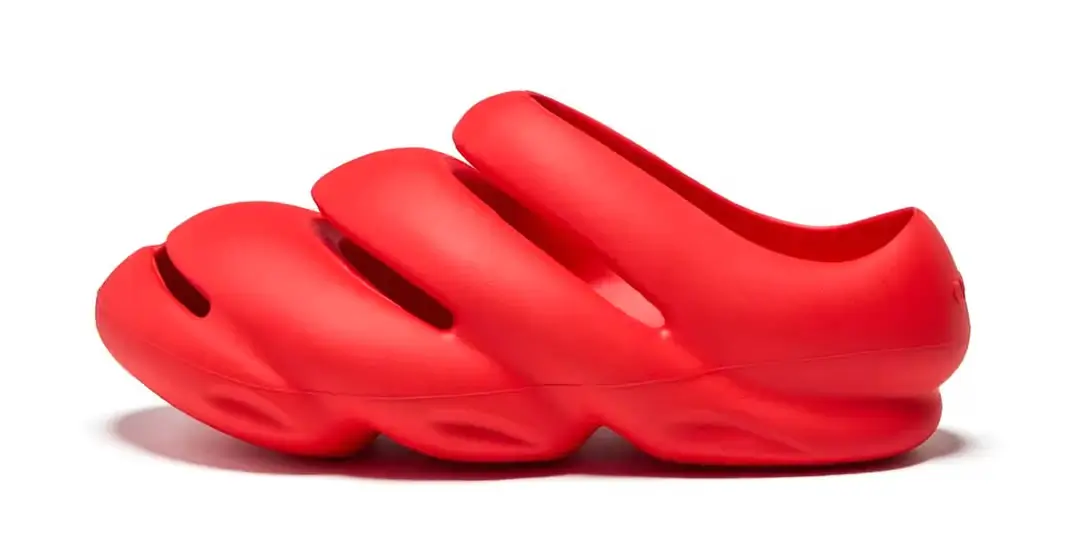
The clearest articulation of this evolving philosophy arrives in the form of “The Roy,” a sculptural red clog associated with TEDxPortland. Not released through traditional retail channels, the shoe functions as a concept artifact—distributed within a specific context rather than the open market.
Its design resists familiarity. Three elongated apertures stretch across the upper, replacing conventional perforations with something more deliberate and directional. The sole undulates, forming wave-like contours that blur the line between cushioning and sculpture. The entire form appears molded as a single piece—continuous, uninterrupted, and intentionally ambiguous.
More importantly, “The Roy” doesn’t present itself as a Croc in the traditional sense. It reframes the identity entirely, suggesting that the brand’s future may lie in abstraction rather than iteration.
rare
Crocs has grown increasingly fluent in the language of scarcity. Event-specific releases, limited collaborations, and geographically bound drops have all contributed to a new perception: that access is part of the product. “The Roy,” tied to the TEDxPortland ecosystem, extends that logic.
This approach aligns with broader movements across fashion and shoe culture, where narrative often defines value. A product gains significance not only through design, but through context—where it appears, who encounters it, and how it circulates afterward.
In this sense, Crocs is not simply participating in hype cycles. It is constructing its own framework for relevance.

consider
Even Crocs’ most recognizable accessory—the Jibbitz charm—takes on new meaning within this evolving system. Once seen as coltish add-ons, these small elements now read as points of interaction, capable of signaling identity, geography, or affiliation.
Under a more design-forward approach, their role could expand further. They might become modular components, integrated into the structure of the shoe itself rather than applied after the fact. The shift is subtle but significant: from decoration to system logic.
as
The broader trajectory suggests a repositioning that extends beyond footwear. With Smith at the helm, Crocs edges closer to the territory occupied by design-driven fashion houses like Maison Margiela and Jil Sander—not in aesthetic imitation, but in conceptual intent.
This opens the door to new possibilities. Footwear as collectible object. Foam as a site of material innovation. Even sustainability—through recyclable compounds, modular construction, or closed-loop systems—becomes part of the design conversation rather than an afterthought.
fin
The clog isn’t disappearing. It’s evolving—dissolving into something less literal, more exploratory. Under Steven Smith, Crocs is not abandoning comfort; it’s embedding it within a broader design language that includes form, narrative, and cultural positioning.
What emerges is not reinvention for its own sake, but recalibration. A recognition that even the most familiar objects can be imagined—if approached not just as products, but as possibilities.
n
From the DRIFT archive: The Nike LeBron 23 “From This Point Forward”
Related Articles

JOURNAL STANDARD Trades Its Signature Grey for Earth Strata Brown on the adidas Tobacco
Reservations open September 23 for JOURNAL STANDARD’s adidas Originals Tobacco, in deep brown suede with […]