Streep’s Cerulean Sweater: How The Devil Wears Prada Wrote Fashion Memory in 2026 – J.Crew

April 19, 2026
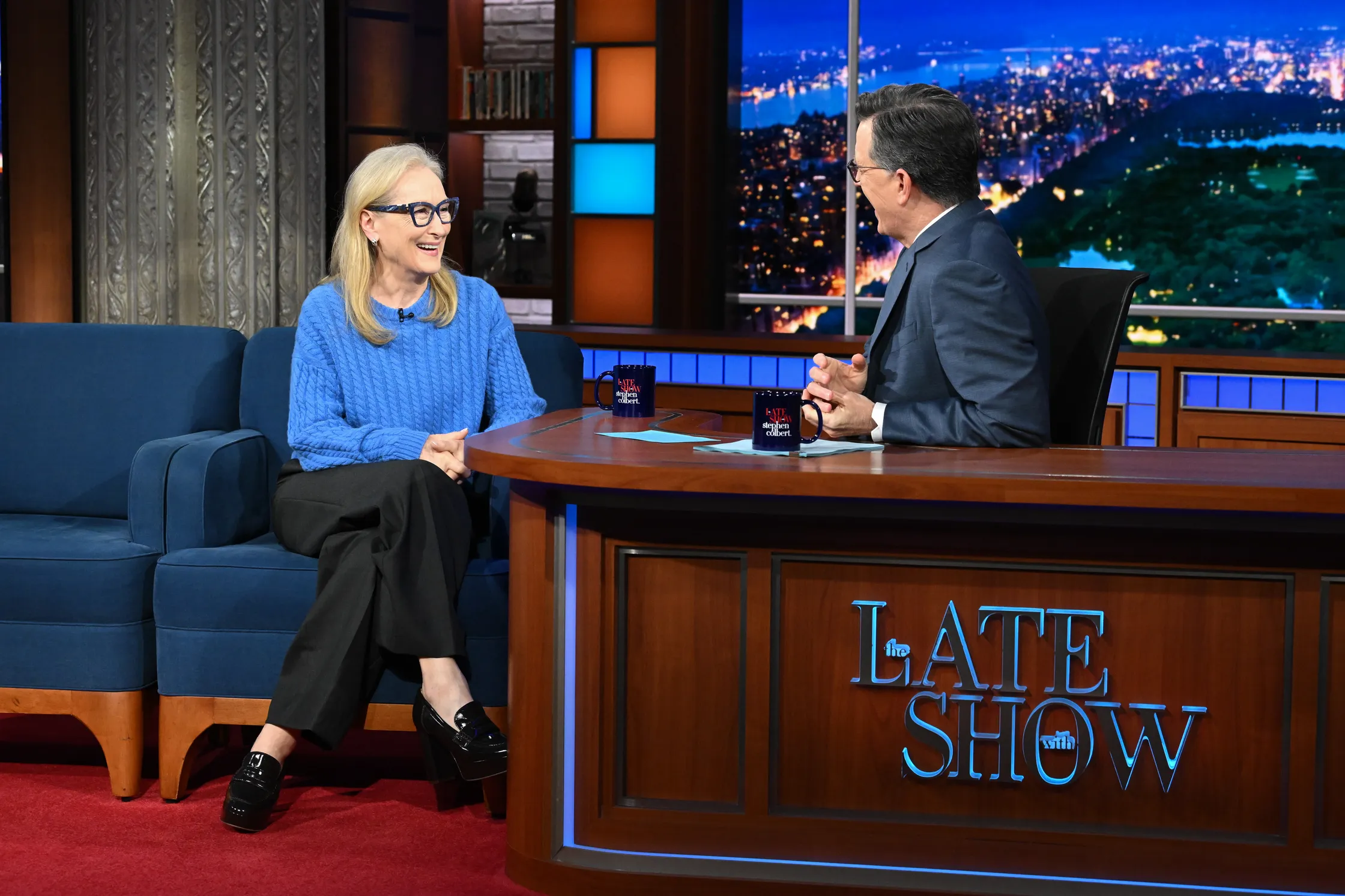
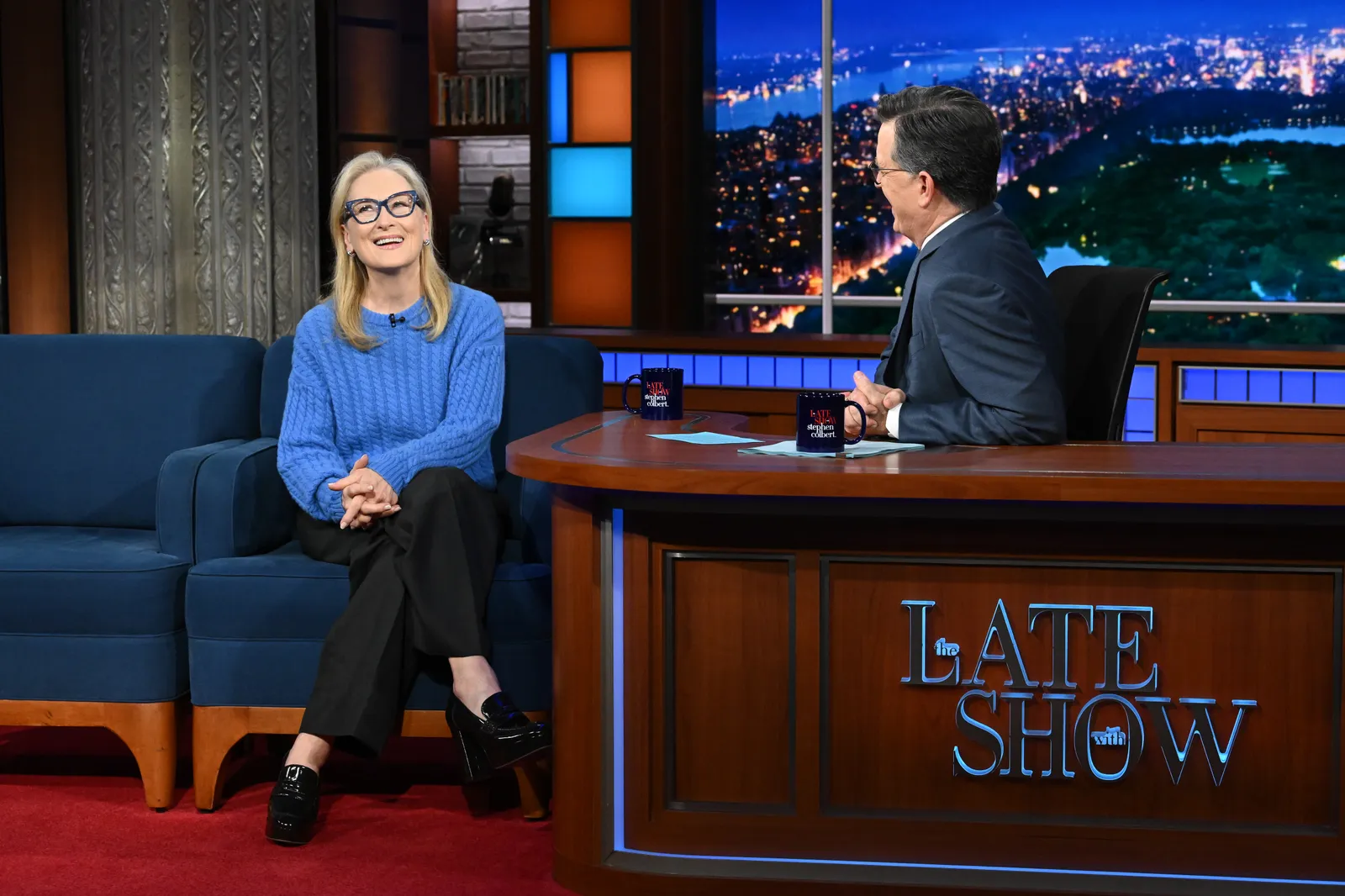
When Meryl Streep stepped onto The Late Show with Stephen Colbert, the camera didn’t linger on her face first. It went straight to the sweater. A soft, rich cerulean cable-knit in cashmere—custom-made by J.Crew, styled by Micaela Erlanger, and worn with the quiet confidence only Streep can summon. In that moment, the internet didn’t just do a double-take. It exhaled. Because this wasn’t just fashion. It was memory. It was myth. It was The Devil Wears Prada walking back into our lives—not through a sequel trailer, but through a single, deliberate stitch.
stir
And yet, this wasn’t nostalgia for nostalgia’s sake. It was a reawakening. A reminder that fashion, far from being superficial, is a language—one that speaks in color, cut, and context. And no one speaks it more fluently than Meryl.
The sweater, a bespoke take on J.Crew’s $198 cable-knit crewneck, was crafted in connect between Olympia Gayotand Erlanger. It wasn’t a costume. It was a continuation. The choice of cashmere—elevated, tactile, self-aware—was no accident. It honored the original’s irony while transcending it. This wasn’t Andy Sachs’ “lumpy blue sweater.” This was its evolution.

tincture
And the color? Cerulean. Not sky blue. Not turquoise. Not lapis. Cerulean. The very shade Miranda Priestly once used to school Andy on the invisible machinery of fashion. That monologue—still quoted, still dissected—did more than define a character. It defined an era’s understanding of influence.
Two decades later, Streep wore that lesson like a medal.
flow
J.Crew, a brand built on bold color since 1983, understood the weight of the moment. Gayot called the connection “equal parts honor and wink”—a nod to the film’s satire while embracing its truth. “Meryl made cerulean a cultural thesis,” she said. And now, they weren’t just selling a sweater. They were curating a conversation.
The timing was perfect. Streep was promoting a sequel—an idea once improbable, now inevitable. And in that single garment, she bridged two eras—2006 and 2026—proving that some icons don’t age. They mature.
power
But beyond the brand strategy and media buzz, there was something deeper at play: the power of the object. That sweater—real or fictional—had become a vessel. For memory. For meaning. For identity.
Fashion scholars have long argued that clothing is never neutral. It carries ideology, economics, and emotion. The cerulean sweater, in both its iterations, embodies that truth. It’s not just fabric. It’s a symbol of awareness—or the lack of it. Andy wore it unaware. Miranda wore it knowing. And Meryl? She wore it teaching.
streep
And let’s not overlook the woman inside the knit. Streep has always had a quiet mastery of style—not for vanity, but for character. Whether as Miranda, Margaret Thatcher, or herself, she uses clothing to communicate power, vulnerability, and transformation. This moment was no different. By wearing the sweater as Meryl, not as Miranda, she blurred the line between actor and role, fiction and reality. It was a meta-commentary on legacy, authorship, and the way art outlives its creators.
Meryl Streep brings back the iconic cerulean blue sweater for ‘Devil Wears Prada 2’ https://t.co/vbE9Aem5C4 pic.twitter.com/vbX6BL1E2f
— New York Post (@nypost) April 2, 2026
show
The public response was immediate and layered. Fans flooded social media with side-by-side comparisons. Designers quoted the monologue in interviews. Vogue called it “a full-circle moment in fashion history.” But beyond the praise, there was reflection. Why does this still matter? Why do we care about a fictional sweater from a 20-year-old film?
Because it’s not about the sweater. It’s about what it represents.
pin
It’s about the unseen systems that shape our choices. The way a decision in a Paris atelier ripples through factories, stores, and closets. The way we think we’re making independent choices—until someone points out the invisible thread.
And in 2026, that message feels even more urgent. In an age of fast fashion, algorithmic styling, and AI-generated trends, the cerulean sweater reminds us: nothing is accidental. Every color, every cut, every cost—it’s all part of a story.
beyond
What follows is where the moment stretches—where the image of cerulean becomes less about reference and more about recursion. Because what Streep activated wasn’t simply a callback. It was a loop. A system re-triggered.
In contemporary fashion discourse, we often speak about cycles—how trends return, how silhouettes echo past decades. But this operates differently. This is reflexive fashion. The sweater does not just return; it reflects on its own return.
That distinction matters. Because reflexivity introduces awareness. It asks the viewer not only to recognize the object, but to recognize their recognition of it.
special
Audiences today are not passive consumers. They are archivists—cataloging, comparing, contextualizing in real time. The side-by-side images, the instant discourse, the micro-analysis of knit structure and hue variation—this is participatory fashion criticism at scale.
The cerulean sweater became a prompt. A trigger for collective interpretation.
idea
There is also an economic layer worth tracing. The original monologue dissected trickle-down fashion. Today, trends cascade—fragmented, accelerated, simultaneous.
So when J.Crew positions itself within this moment, it inserts itself into a broader question: who owns cerulean now?
The runway? The screenplay? The performance? The consumer?
Or culture itself?
scope
J.Crew’s answer is strategic. By grounding the sweater in craftsmanship—cashmere, connection, considered design—they resist disposability. They align with continuity rather than speed.
Continuity, here, becomes resistance. A refusal to let meaning dissolve under acceleration.
icon
For many, the cerulean sweater is personal. A first viewing. A formative lesson. A shift in perception.
Seeing Streep now—older, more assured—reframes aging as accumulation, not decline. The sweater does not belong to the past. It belongs to a continuum.
And Streep, in wearing it now, does not revisit Miranda Priestly. She transcends her.
embrace
Miranda was iconography—constructed, deliberate, imposing. Meryl, here, is embodiment—effortless, lived-in, precise.
And that shift repositions the entire narrative. The sweater is no longer about hierarchy. It is about literacy.
To read fashion. To understand its systems. To recognize its weight.
clue
So yes, cerulean is just a color. But it is also a system. A signal. A story. Meryl Streep didn’t just wear a sweater. She reopened a conversation—about influence, identity, and awareness.
And in doing so, she reminded us that fashion isn’t something we put on.
It’s something we live in.
Related Articles

Rose Byrne and Mary Bronstein Are Doing It Again, and This Time They Brought Jenna Ortega
A coach and her prodigy are about to become the most dangerous relationship in a […]