DRIFT AUDIO
Listen to this story
Choose a voice, then press play.
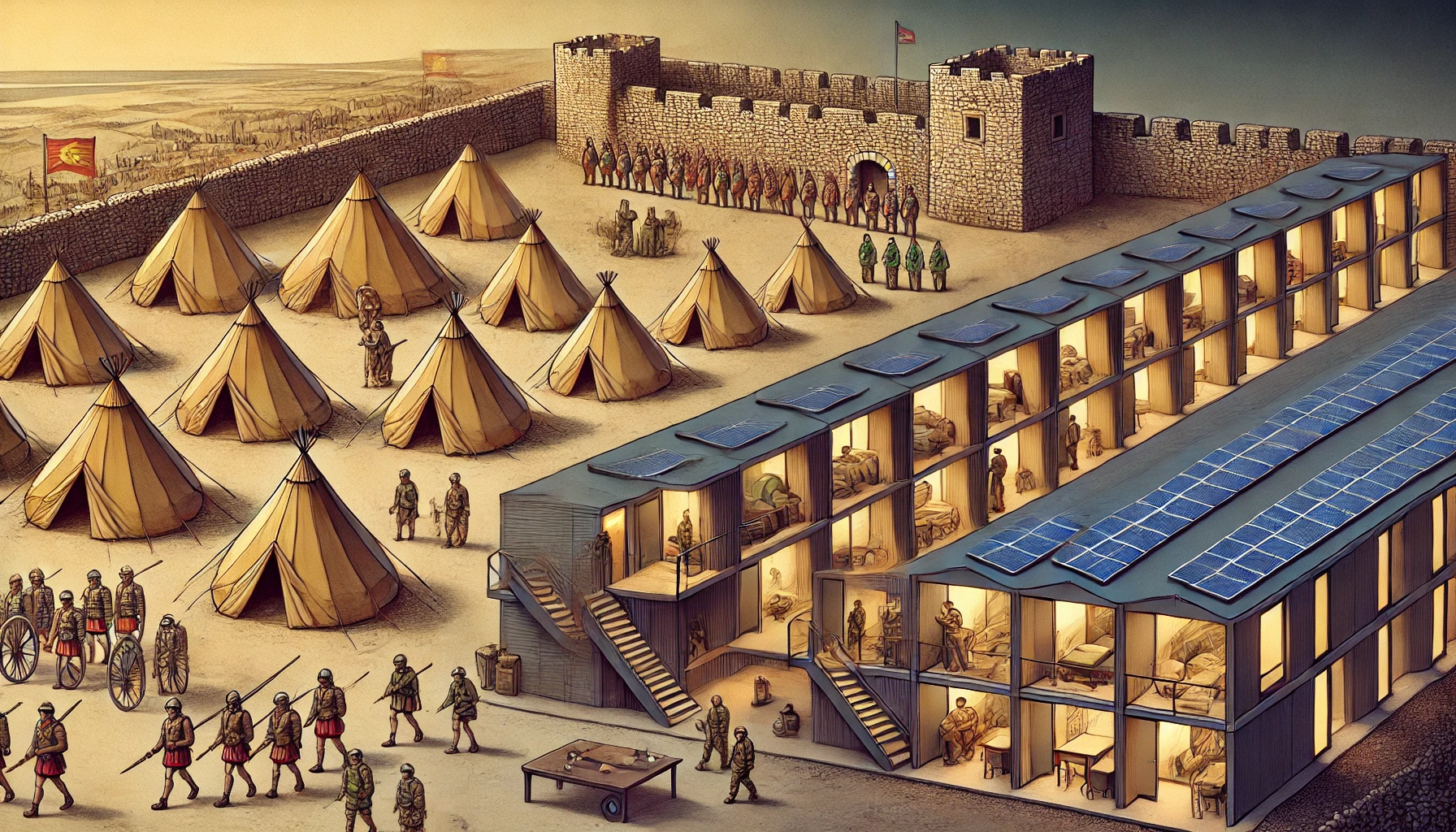
The history of military quarters is a dramatic reflection of societal priorities, architectural advancements, and the evolving demands of warfare. From makeshift shelters to modern, inclusive housing, the journey of military barracks mirrors the tumultuous path of history itself. Let’s delve into a histrionic timeline that captures the essence of this transformation.
Ancient Beginnings: Discipline Under the Stars
Circa 100 BCE – 400 CE
In the Roman Empire, the military encampments of the legendary legions were marvels of organization. These temporary quarters featured uniform layouts, with tents for soldiers, command centers for generals, and fortified walls to deter attacks. The precision of these camps underscored the Romans’ obsession with discipline and order. Yet, for the common soldier, life remained harsh—exposed to the elements, with only a thin fabric separating them from the chaos of war.
Medieval Era: The Grit of Survival
500 CE – 1500 CE
As castles and fortresses dotted the landscapes of medieval Europe, they became the primary military quarters. Soldiers, often crammed into damp, dimly lit halls, lived in conditions befitting their expendable status. The barracks were utilitarian at best, prioritizing defense over comfort. Hygiene? An afterthought. Yet, in these grim quarters, the camaraderie among soldiers flourished—a rare bright spot in an otherwise bleak existence.
The Industrial Age: Order and Standardization
1700s – 1800s
The Enlightenment brought not just scientific discovery but also the realization that healthier soldiers performed better. Permanent barracks began to rise, their designs reflecting the structured ethos of the era. The British Army’s quarters became paragons of efficiency, featuring dormitories, mess halls, and parade grounds. Hygiene facilities improved marginally, and centralized heating began to alleviate the harshness of winters. This era marked the first glimmers of a shift: soldiers were starting to be seen as valuable assets, not just fodder for war.
World Wars: The Strain of Mass Mobilization
1914 – 1945
The global conflicts of the 20th century tested military housing like never before. Temporary barracks—prefabricated huts, tent cities, and even commandeered civilian buildings—sprang up to accommodate the unprecedented scale of conscription. Conditions were often Spartan, with overcrowding and minimal amenities. Despite this, the barracks became crucibles of resilience and ingenuity, as soldiers made do with what little they had. The communal spirit fostered in these quarters laid the groundwork for lifelong bonds among comrades.
Cold War Era: The Rise of Modern Comfort
1947 – 1990
As the Cold War escalated, so did the sophistication of military installations. Permanent barracks expanded into full-fledged housing complexes, complete with family quarters, recreation areas, and medical facilities. The U.S. military led the charge, introducing private rooms for officers and improved living standards for enlisted personnel. The stark, utilitarian designs of earlier eras gave way to more comfortable, human-centric spaces, reflecting a growing recognition of the link between morale and operational readiness.
The New Millennium: A Paradigm Shift
2000 – Present
The 21st century brought dramatic changes to military quarters, driven by technological innovation and cultural awareness:
•Inclusivity: Barracks began to reflect the diversity of modern armed forces, with gender-neutral facilities and accommodations for service members with disabilities.
•Technological Integration: Smart technologies revolutionized military housing. Quarters now feature energy-efficient systems, advanced security measures, and connectivity for training and communication.
•Sustainability: Green initiatives, such as solar panels and eco-friendly materials, have become standard in many installations. Bases like Yokosuka Naval Base in Japan are leading examples of sustainable military design.
The Future: Beyond the Horizon
2025 and Beyond
As we peer into the future, military quarters are poised for further evolution:
•Modular Construction: Lightweight, rapidly deployable barracks will enable military forces to adapt to dynamic operational needs.
•AI and Automation: Predictive maintenance, energy optimization, and robotic facility management are set to redefine efficiency.
•Hybrid Communities: Military housing will increasingly integrate with civilian spaces, fostering to buttress community.
Cultural Reflection: More Than Just Quarters
The history of military barracks is more than an architectural tale—it is a narrative of shifting values. From ancient camps to smart quarters, these spaces have evolved to meet the needs of soldiers while reflecting the priorities of their societies. As military forces continue to adapt to global challenges, the story of their quarters will remain a testament to resilience, innovation, and the enduring human spirit.
Related Articles
Master Chief Reports to Call of Duty Now: Inside Xbox’s Second Reset Wave
Twenty-five years after Halo launched the original Xbox, the next mainline game belongs to Activision. […]