DRIFT AUDIO
Listen to this story
Choose a voice, then press play.
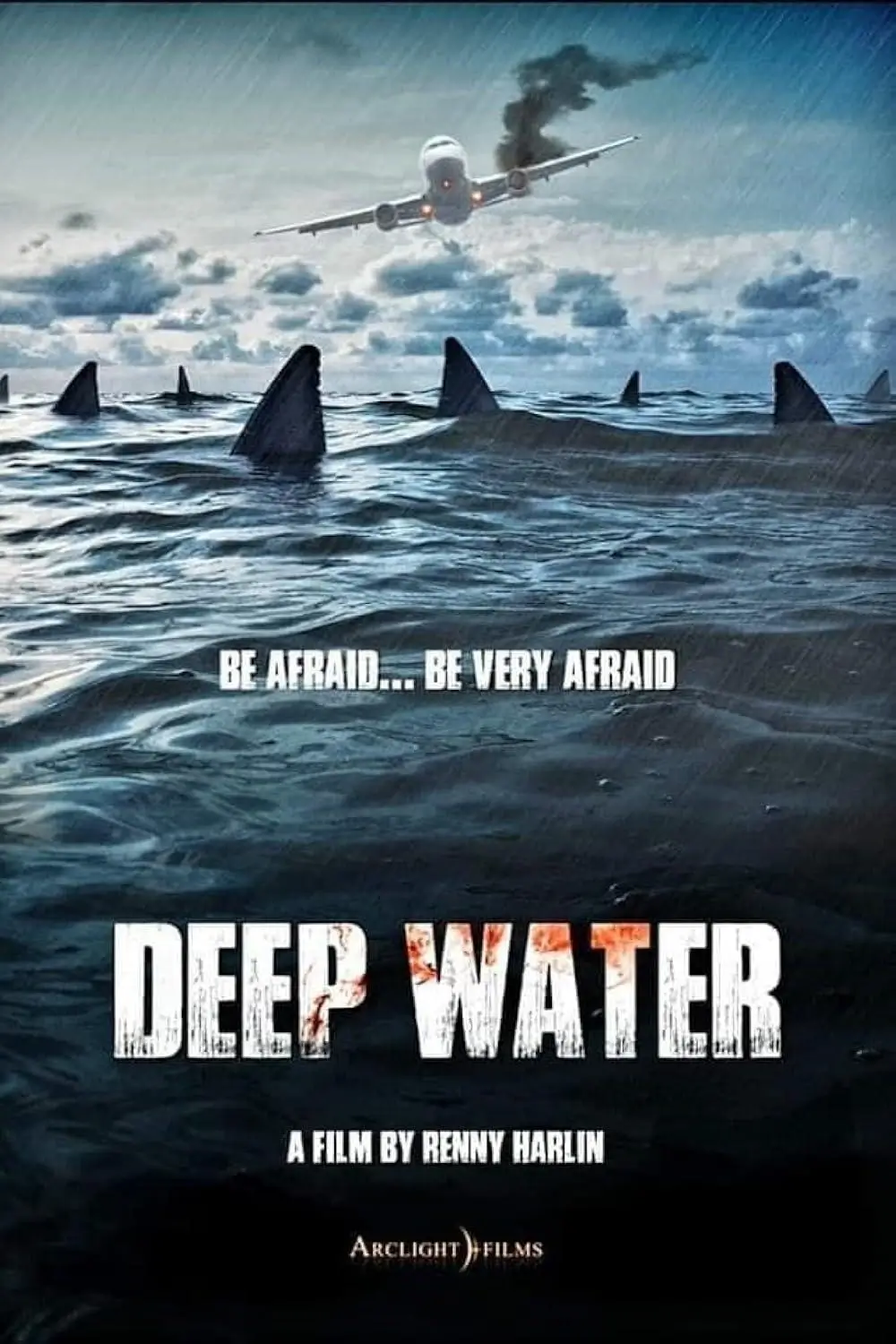
Deep Water works because it refuses to grow beyond its setup. A commercial flight goes down in open ocean. Survivors make it to the surface. Debris becomes flotation. Sharks begin to circle. Rescue is distant, uncertain, maybe irrelevant.
That’s it. The film doesn’t add layers for the sake of scale. It doesn’t introduce a secondary plot, a hidden conspiracy, or a last-minute twist designed to reframe everything. Instead, it stays inside one condition and lets that condition tighten.
This is where it separates itself from most contemporary survival films. The instinct now is expansion—more locations, more threats, more explanations. Here, the instinct is reduction. Everything is stripped to what matters in that exact moment: breath, distance, movement, proximity.
The result is a film that feels less like a story unfolding and more like a situation being endured.
stir
For Renny Harlin, this is a recalibration. His earlier work, especially Deep Blue Sea, relied on escalation—more chaos, more movement, more engineered spectacle. The environment in that film was dynamic, almost aggressive.
In Deep Water, the aggression is removed. The ocean does not chase the characters. It simply holds them. That shift changes everything.
Harlin leans into stillness as a form of pressure. The camera often sits at water level, refusing to give the audience a stable vantage point. Horizon lines stretch wide, uninterrupted. Characters are small within the frame, often isolated even when they are physically close.
There is very little visual relief. No interior spaces, no structured environments, no clear boundaries. Just surface and sky.
This restraint forces the viewer to experience time differently. Without constant movement or visual change, minutes begin to feel longer. Waiting becomes tangible. The film doesn’t need to tell you that time is passing slowly—you feel it.
flow
What defines Deep Water is its treatment of the ocean as a system rather than a setting. It isn’t there to be navigated; it is there to impose limits.
Visibility is inconsistent. Light shifts. Debris moves with currents rather than intention. Sound travels strangely—voices are carried, broken, lost. Nothing stays where it was placed.
This instability forces the characters to constantly adjust. There is no fixed strategy, no reliable pattern. Every decision is temporary, valid only until the environment changes again.
The film makes this clear without over-explaining it. A piece of wreckage that seemed stable drifts away. A group that was intact separates by a few meters, which quickly becomes a meaningful distance. A signal flare is fired, but the horizon absorbs it without response.
These moments accumulate. They reinforce a single idea: control is minimal, and it does not last.
show
Performance in Deep Water is physical first, emotional second. Dialogue exists, but it’s not the primary language. What matters is how bodies behave under strain.
Aaron Eckhart plays this directly. His character moves with intention. Every action is measured—how far to swim, when to conserve energy, when to intervene. There is no excess in his performance. He doesn’t try to dominate the situation; he tries to manage it.
Opposite him, Ben Kingsley introduces a different rhythm. His performance is less about action and more about interpretation. He questions decisions, reframes priorities, occasionally disrupts the fragile order that forms among the survivors.
The tension between these two approaches is subtle but constant. One is focused on immediate survival. The other is engaged with meaning, with understanding the situation beyond its practical demands.
Around them, the rest of the group functions as a shifting unit. Some panic early. Some withdraw. Some attempt to follow, others resist. The film doesn’t overdevelop these individuals, but it doesn’t need to. Their roles are clear through behavior.
A character who wastes energy becomes a liability. A character who hesitates at the wrong moment creates risk. These dynamics are visible, not explained.
compare
It would be easy to reduce Deep Water to a shark movie, but that framing misses what the film is doing. The sharks are not the main event—they are part of the condition.
They are not constantly visible. Often, they are suggested rather than shown: a silhouette below the surface, a shift in movement, a sudden silence. Their presence changes how the characters behave even when they are not actively attacking.
This is a quieter, more controlled use of the predator dynamic than in films like The Meg or even Jaws. There are no extended chase sequences, no elaborate set pieces designed to showcase the creature.
When attacks happen, they are fast and unresolved. There is no buildup, no spectacle. A character is there, then they are not. The group absorbs the loss and continues.
This approach keeps the focus where the film wants it: on the ongoing state of vulnerability, not on isolated moments of shock.
emotive
More than sharks, more than injury, the real threat in Deep Water is time. Not in a countdown sense—there is no ticking clock—but as a gradual depletion.
Energy fades. Focus slips. Small mistakes become more likely. The body begins to fail in subtle ways before it fails completely.
The film communicates this through repetition. Actions that were manageable early on—holding onto debris, coordinating movement, maintaining position—become harder. Not dramatically, but noticeably.
This is where the film’s pacing becomes its most effective tool. It does not rush through these changes. It allows them to register, to settle. The audience is not just told that the characters are weakening; it is shown through incremental shifts.
archetype
One of the more precise elements of Deep Water is its depiction of group behavior under stress. The survivors do not immediately unify. Cooperation has to be negotiated, and it is fragile.
Decisions are made quickly, often without full agreement. Who stays with whom, who moves toward which piece of wreckage, who takes the lead—these are not resolved cleanly.
Conflict exists, but it is not theatrical. It emerges from necessity. A disagreement over direction is not ideological; it is about survival. There is no space for prolonged argument, but that does not mean tension disappears. It lingers, affecting subsequent decisions.
The film understands that in a situation like this, cohesion is temporary. It forms, breaks, reforms. No configuration lasts long.
restrain
Visually, Deep Water avoids excess. The palette is controlled—blues, whites, occasional muted tones from debris or clothing. There is no attempt to stylize the environment beyond what is necessary.
The camera rarely indulges in dramatic movement. It stays close to the surface, maintaining a consistent perspective. This creates a kind of visual monotony, but it is intentional. The lack of variation reinforces the sense of being trapped.
When the film does shift perspective—brief underwater shots, wider aerial views—it is used sparingly. These moments provide contrast without breaking the overall structure.
The effect is cumulative. The viewer becomes accustomed to the visual field, which makes any deviation more noticeable.
volume
Sound design conjures a critical role. Water is constant—not just as a background element, but as an active presence. It muffles, distorts, interrupts.
Dialogue is sometimes partially obscured, not to create confusion, but to reflect the reality of the environment. Communication is imperfect. Messages are missed or misheard.
Silence is rare, but when it occurs, it carries weight. A sudden drop in ambient noise often signals a shift—attention focusing, danger approaching, something about to change.
The film uses these shifts carefully. It does not rely on loud cues or abrupt changes. Instead, it builds a consistent auditory field and makes small adjustments within it.
why
Despite these limitations, Deep Water succeeds because it commits fully to its premise. It does not dilute its focus or compromise its structure to accommodate broader expectations.
It understands that the strength of its concept lies in its simplicity. By staying within that simplicity, it creates a consistent, controlled experience.
The film trusts the viewer to engage with that experience without constant reinforcement. It does not over-explain, over-dramatize, or over-expand.
fin
Deep Water is not a film about conquering the ocean or defeating a threat. It is about remaining present within a situation that offers very little in return.
It is about managing energy, maintaining awareness, and making decisions with incomplete information. It is about the limits of the body and the instability of the environment.
The sharks are there, but they are not the point. The point is the condition itself—the pressure of being exposed, the uncertainty of duration, the absence of control.
Related Articles

Le Labo Writes Memory Into Wax With PAPYRUS 20
Cypriol, the root oil kin to the reed that carried ancient writing, anchors Le Labo's first new classic candle in two years.