The Great Migration: How Haute’s Star Designers Found a New Address on the High Street

July 19, 2026

Francesco Risso is trading Marni’s atelier for GU’s shop floor, and he is far from alone in making that trip.
On January 8, Fast Retailing confirmed what industry insiders had been circling for weeks: Francesco Risso, who spent nearly a decade steering Marni, would become creative director of GU, the company’s second largest brand behind Uniqlo itself. His debut collection, arriving for Autumn and Winter 2026, would not be his first brush with the group. Risso had already designed the widely liked Uniqlo and Marni collection back in 2022, a partnership that put his signature clashing prints and irregular tailoring into a price bracket Marni customers never touched.
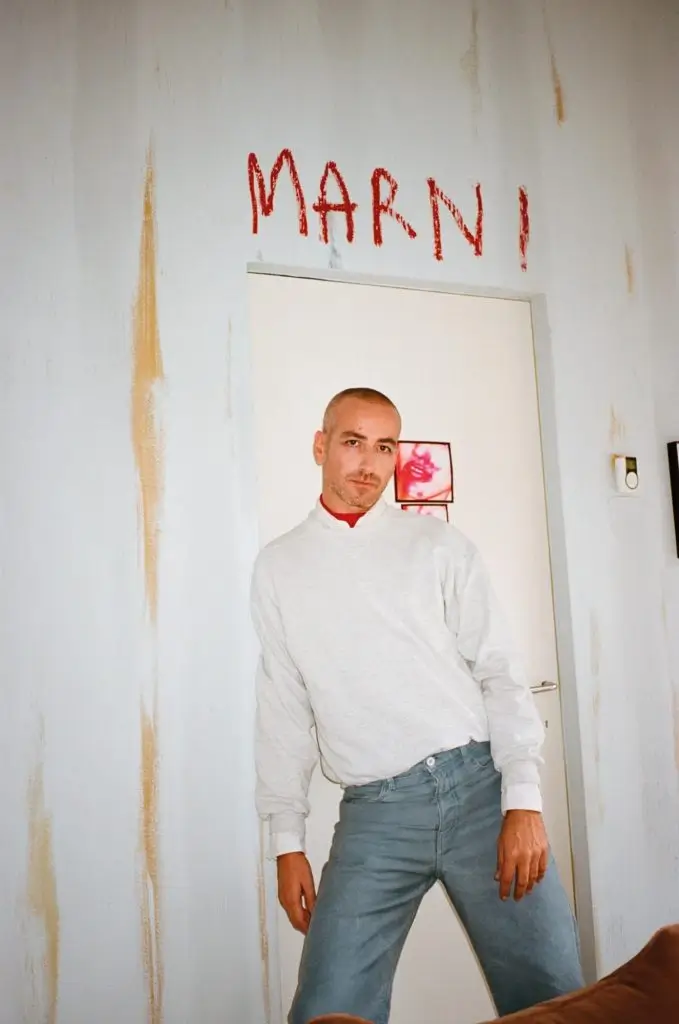
The new job comes with a second assignment attached. Alongside his GU appointment, Risso is also developing a fresh Uniqlo collab line, due later this year, with further specifics promised at a future date. It is a tidy arrangement for Fast Retailing: one designer, two brands, two separate audiences, and a single signature running underneath both.
GU itself is worth pausing on, because it is not simply Uniqlo’s little sibling. Founded in 2006, GU built its identity around trend driven pieces at even steeper discounts than Uniqlo, expanding through Shanghai in 2013, Taiwan in 2014, and South Korea in 2018 before landing in the United States last year. Tomokazu Kurose, president and chief executive of GU, framed the Risso hire as arriving squarely inside that expansion push, describing GU as a business with what he called tremendous potential and a key driver of the group’s next phase of growth, timed neatly against the brand’s twentieth anniversary. Where Uniqlo speaks to a broad, ageless customer, GU has always chased someone younger and more restless, and a designer known for treating clothing like collage fits that brief.
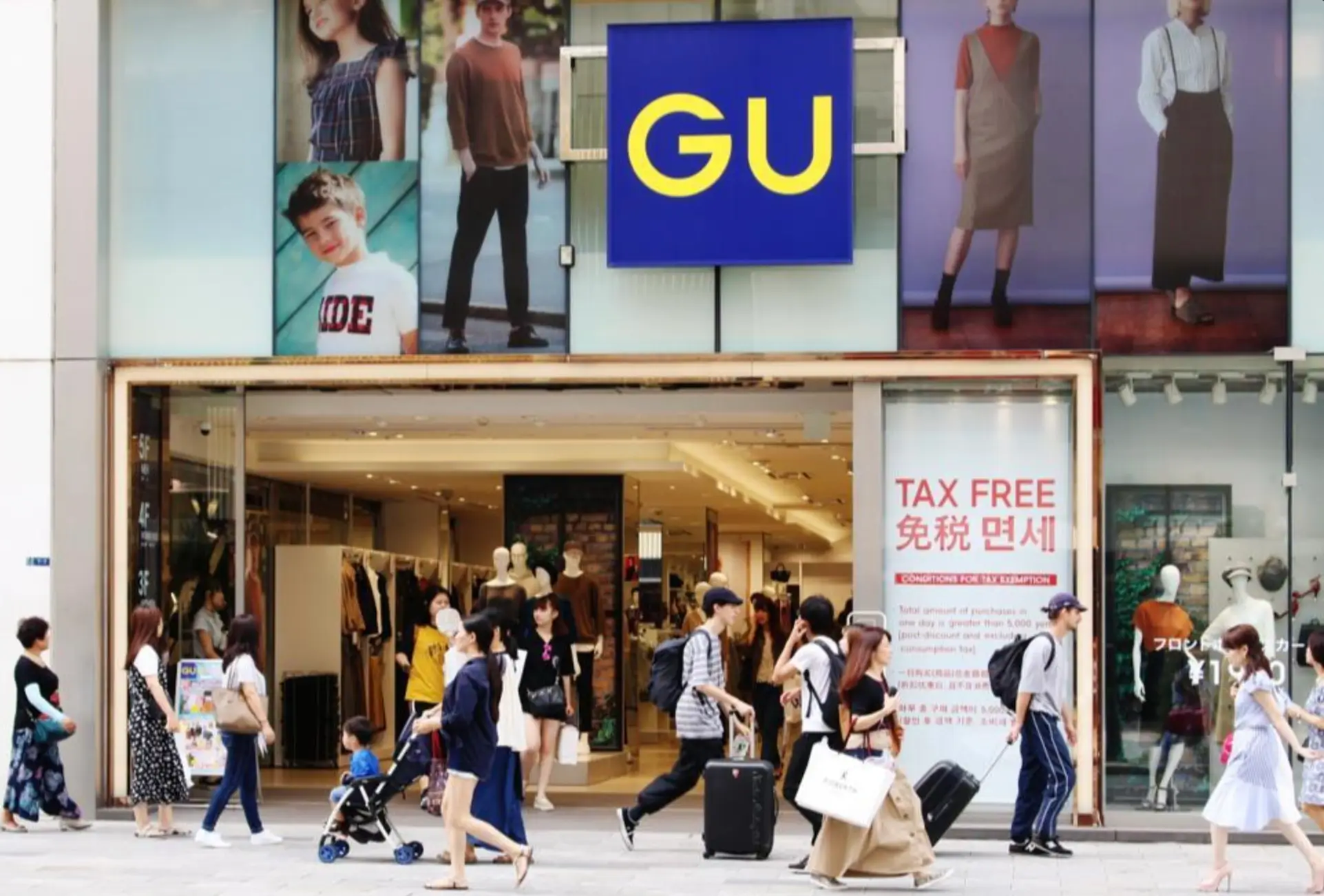
A busy GU flagship storefront highlights the Japanese retailer’s accessible fashion model, welcoming local shoppers and international visitors beneath oversized campaign visuals and prominent tax-free signage.
dec
Risso’s résumé reads like a map of how a certain kind of designer gets made. Italian born, he studied fashion across Florence, New York, and London, then spent ten years at Prada absorbing what he has called a rigorous approach to narrative and craft before Marni handed him the creative directorship in 2016. He held that post until stepping down in June 2025, and across those nine years he pushed Marni toward something more sculptural and unruly than the brand’s earlier reputation for polite, colorful eccentricity. Music, art, and a kind of deliberate imperfection ran through his collections, and it is exactly that art infused sensible that Fast Retailing is now importing into a brand built on convenience and low prices.
Risso himself has described his interest in clothing in fairly plain terms, saying what draws him in most is its ability to accompany life, a comment that reads as a deliberate contrast with the theatrical language he used at Marni. He has also kept a foot in education throughout his career, taking guest lecturer positions at several leading art and design schools, a detail that fits a designer who has always talked about clothing as narrative material rather than pure commerce. Either that plainness survives contact with GU’s production schedule and price architecture is the real story to watch once the Autumn and Winter 2026 pieces actually hit racks. Fast fashion runs on speed and repeatable margins, and a designer who built his name on irregular hems and deliberately mismatched color will have to figure out how much of that instinct can survive a supply chain built for volume rather than eccentricity.
It also helps to remember what the 2022 Uniqlo and Marni line actually looked like on the ground. That collection took Marni’s characteristic prints, an assortment of florals and geometric patterns that rarely agreed with each other on purpose, and pressed them onto Uniqlo’s basics: crewnecks, tote bags, simple shift dresses. It sold quickly and became one of the more talked about Uniqlo connections of that year precisely because it did not try to soften Risso’s aesthetic for a mass audience. That track record is presumably why Fast Retailing went back to him rather than treating the 2022 project as a one off.
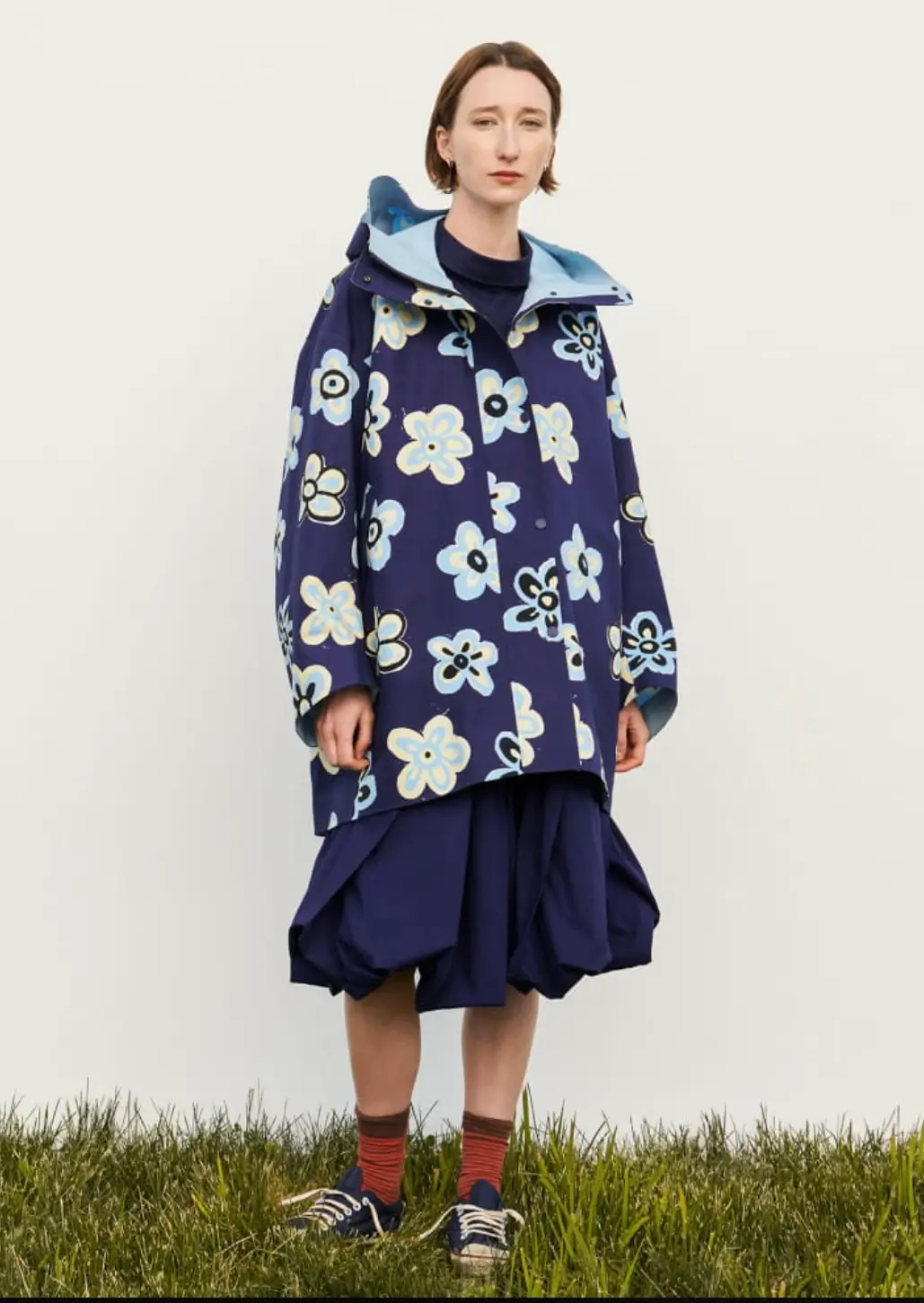
A model wears an oversized floral coat with a sculptural navy skirt and casual lace-up shoes.
kept
Risso’s move only makes sense in context, and the context is crowded. Clare Waight Keller, formerly of Givenchy and Chloé, already holds the creative director title at Uniqlo proper, a post she took in 2023 after her own collaboration line, Uniqlo:C, proved successful enough to earn her the mainline job, menswear included. In March, the British Fashion Council added her to its executive board, an appointment that put a Uniqlo executive inside the governance structure of Britain’s own fashion establishment.
Then there is John Galliano. Fresh off his departure from Maison Margiela at the end of 2024, Galliano signed a two year partnership with Zara announced in March, under which he will not design new garments from scratch so much as dismantle and rebuild pieces pulled from the retailer’s own archive, a process Zara has described as couture led. The first collection under that arrangement is due in September 2026. It marks Galliano’s first venture into mass market retail after a career built at Givenchy, Christian Dior, and Margiela, and after a 2011 dismissal from Dior that had, for years, looked like it might close the door on any major comeback.
Zoom out further and the roster gets longer still. Zac Posen took the chief creative officer role at Gap in 2024 and a parallel creative director post at Old Navy. Stefano Pilati, once head designer at Yves Saint Laurent, released a personal collection with Zara. Samuel Ross, founder of A Cold Wall, struck a longer term collaboration with the same retailer under his SR_A label. Kim Jones has taken on a role at Bosideng, and Heron Preston spent time designing for H&Mbefore that arrangement ended in mid 2025. Jun Takahashi of Undercover has quietly been doing something similar for over a decade, supplying both Uniqlo and GU with collaborative lines, including a separate GU specific line called UG.
back
Of everyone on that list, Galliano’s arrangement carries the most weight, mostly because of how far he had to travel to get here. He was fired from Dior in 2011 after remarks that were widely and rightly condemned, a fall that turned him, for a stretch, into something close to an industry outcast. His return built slowly: a shh stint at Oscar de la Renta, then a decade at Maison Margiela that included the widely discussed Artisanal show from Spring 2024, a collection still referenced two years later for its technical ambition. He left Margiela at the end of that year and, by his own account to Vogue, spent the gap that followed visiting museums and walking without his phone rather than rushing toward another creative directorship.
What he landed on instead was Zara, and the framing Inditex has put around the deal is deliberate. Galliano is described as a creative partner tasked with re authoring Zara’s own archive, not designing new collections from a blank page. Pieces from past seasons will be taken apart and rebuilt using what the company calls a couture informed process, with new collections surfacing each season across the two year term starting in September. Galliano told Vogue that the scale of Zara’s platform was itself the draw, saying the chance to deliver fashion through that kind of reach, paired with the resources a company of Inditex’s size can offer, was thrilling to him. For a designer whose entire reputation was built on volume that could sell to a small couture clientele, an archive stocked with millions of garments already in circulation is a genuinely different kind of material to work with.
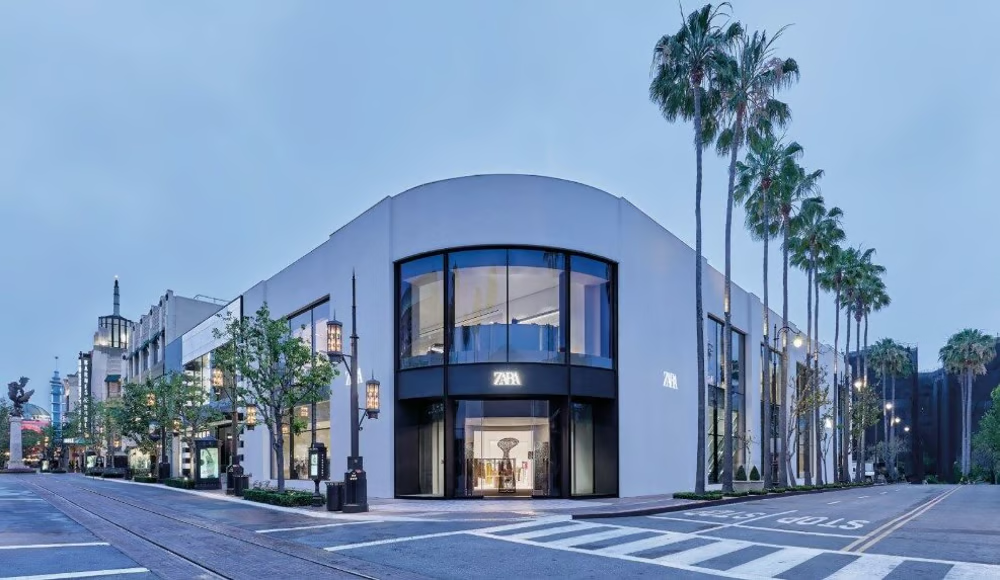
Zara’s modern flagship storefront anchors a palm-lined luxury shopping district at dusk.
why
None of this is happening because mass retailers suddenly discovered they liked good taste. The logic is closer to defense. Inditex, Zara’s parent company, posted a record annual profit in 2025 for the third consecutive year, yet still faces mounting pressure from Shein and Temu on price and from tariff exposure on margin. Attaching Galliano’s name to a limited, seasonal capsule line is a way to justify higher price points and pull in a customer who would otherwise never set foot in a Zara for anything beyond basics. Fast Retailing’s calculus looks similar. GU has never had a defined design point of view the way Uniqlo has cultivated through LifeWear and its long running collaborations with Jil Sander and others, and a designer as recognizable as Risso gives the brand a story to tell as it pushes into markets outside Asia.
There is a talent side to this too. Luxury has been retrenching, with creative directors cycling through houses faster than in previous decades and fewer of those houses expanding headcount or budget. A designer coming off a decade long tenure, as Risso and Galliano both were, now has an option that did not carry much prestige a few years back: taking a title at a company that can put a design in front of tens of millions of people rather than tens of thousands. Waight Keller has been fairly candid about that calculation, telling press after her own Uniqlo appointment that mass retailers offer an incredible way to get clothes onto a lot of people, at a price point that removes exclusivity from the equation entirely.
look
The Risso era at GU is no longer hypothetical. On July 14, GU unveiled its Autumn and Winter 2026 collection, its first under Risso’s direction, built around six lifestyle categories and described by the brand as a comprehensive renewal of its entire product lineup. Kurose called it a combination of customer centered product development with Risso’s creativity, adding that shoppers would likely be surprised by the pricing given the design ambition behind the pieces. It is early evidence that Fast Retailing intends this collaboration to run deeper than a single capsule drop, restructuring how the brand designs rather than simply slapping a designer’s name on an existing line.
Meanwhile, the second half of Risso’s arrangement, the new Uniqlo collaboration line, remains unannounced in detail, with Fast Retailing saying only that further information will follow. Given the pattern of the 2022 Uniqlo and Marni release, expect a limited run positioned well above Uniqlo’s usual pricing but nowhere near Marni’s own price tags.
struct
What separates this moment from the capsule collection era of the 2010s is where these designers are actually sitting. A capsule collaboration is a guest appearance, timed to a launch date and gone within a season. A creative director title is different. It implies ongoing authority over merchandising decisions, seasonal planning, and brand identity, the kind of structural role that used to be reserved for houses with runway shows and six figure price tags. Waight Keller sits on Uniqlo’s mainline. Risso now sits atop GU’s entire product renewal. Galliano’s Zara arrangement runs two years and multiple seasonal drops rather than one release.
View this post on Instagram
Fast Company’s coverage of the Galliano deal put it plainly: the announcement reads like ordinary fashion news, but it functions as a signal about where value creation in the industry is actually heading, with couture level craft now being applied directly to fast fashion’s own archives rather than treated as something separate from it. Mass retailers are no longer renting prestige for a single product cycle. They are hiring the people who used to define prestige and asking them to redefine what an affordable wardrobe can look like from the inside.