DRIFT AUDIO
Listen to this story
Choose a voice, then press play.
In the complex web of body language, the middle finger stands out as one of the most loaded symbols. It transcends linguistic and cultural boundaries, embodying a rebellious, and at times defiant, gesture that has evolved from ancient roots. While today it’s commonly recognized as a universally offensive sign, the middle finger has a rich history that reflects deeper social and cultural undercurrents, tracing back to the ancient Greeks. In this critical exploration, we will examine how the middle finger became such a controversial figure of speech and delve into its evolution, symbolism, and significance across different eras.
Origins: The Ancient Greeks and Roman Influence
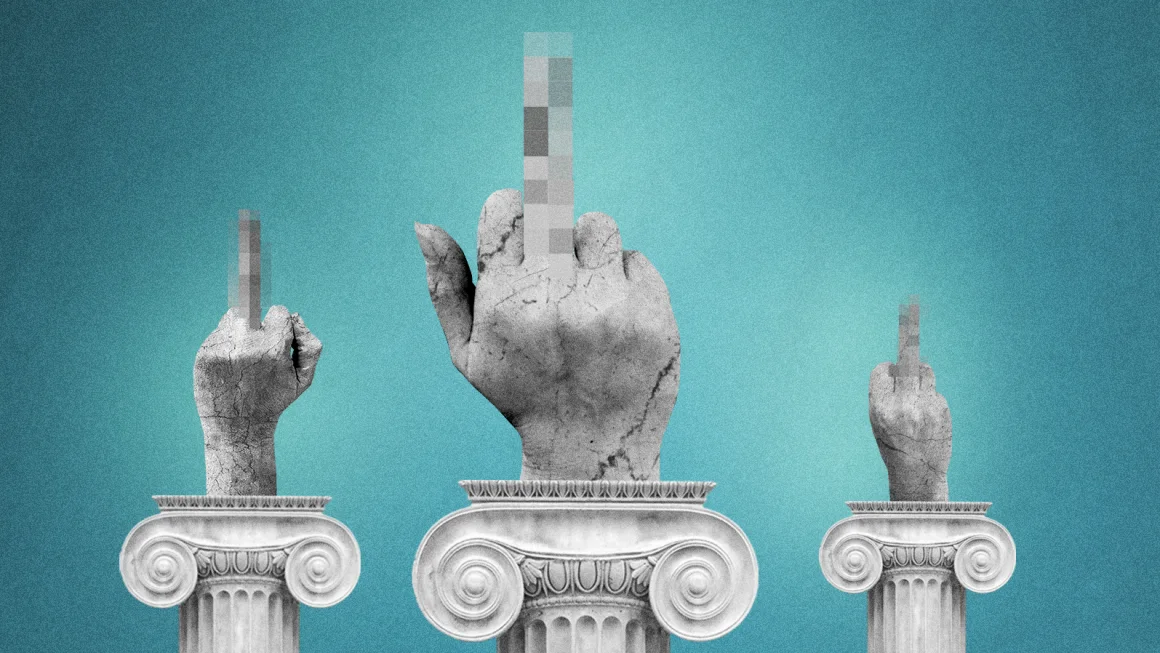
The middle finger, as we understand it today, owes much of its significance to the ancient Greeks. Historically, the gesture was known as “katapygon,” derived from the Greek term for the male genitals. It was primarily used to insult or belittle, especially in a sexual context. In ancient Greece, this gesture symbolized a phallic metaphor, with the erect middle finger representing male genitalia, and the folded fingers on either side representing the scrotum. The gesture, therefore, was a way to demean or mock, suggesting dominance, virility, or sexual power over another person.
The ancient Romans, heavily influenced by Greek culture, adopted the middle finger’s significance but applied it with broader societal meaning. Roman philosopher Diogenes is famously recorded giving the finger to an Athenian orator, which underscored how the gesture was used as an expression of defiance and resistance to authority. It was not merely about sex, but about rebellion, defiance, and a kind of social commentary wrapped in one crude motion.
From these early moments, the middle finger quickly evolved from an offensive sexual innuendo to a symbol of broader disrespect and defiance, solidifying its role in the public sphere.
A Longstanding Gesture of Defiance: Middle Ages and Beyond
Throughout history, the middle finger has often been a method of social or political rebellion, especially in contexts where authority was present. The Medieval era saw a surge in the use of body language and symbols to communicate displeasure or offense. During this period, the middle finger gesture was often paired with crude speech or even bodily harm. Its sexual connotations remained intact, as the gesture continued to symbolize male dominance and power, but its symbolic resonance had expanded.
In a world dominated by religious dogma and societal hierarchies, the middle finger became a quiet but powerful method for the lower classes to signal their resistance. In a time when speaking out against authority could lead to severe punishment, a well-placed middle finger offered an alternative means of expression. The gesture’s defiance became an act of subversion in a world constrained by rigid structures of power.
It is worth noting that the gesture’s significance fluctuated geographically. In some parts of medieval Europe, it was considered highly disrespectful, while in others, it was regarded as less potent. Despite this variation, it remained a hallmark of defiance.
From Rebellion to Pop Culture Icon: The 20th Century and Beyond
Fast forward to the 20th century, and the middle finger underwent a dramatic cultural transformation. With the rise of the media, mass entertainment, and youth subcultures, the gesture started to appear everywhere. No longer just a form of rebellion, the middle finger evolved into a tool of self-expression, iconography, and an emblem of resistance.
In the 1960s, as countercultural movements blossomed, the middle finger became an especially prominent gesture. Amidst anti-establishment protests, civil rights struggles, and anti-war movements, the gesture once again emerged as a silent but powerful protest against systems of control. Musicians like Jimi Hendrix and Bob Dylan, who were known for challenging norms, helped popularize the middle finger in the mainstream. It became less about sexual domination or direct insult and more a symbol of rebellion against societal constraints and authority.
In the realm of art and pop culture, the middle finger became an emblem of rebellion that transcended class boundaries. It started to show up in advertising, music, movies, and other cultural artifacts. In punk rock, for instance, the middle finger became synonymous with anti-authoritarianism. The Ramones, The Sex Pistols, and others in the genre embraced the middle finger as part of their broader ethos, which pushed against the grain of conformity and conservative values.
This period also marked a shift in the public’s perception of the middle finger as it started to lose some of its original potency. What was once a forbidden, deeply offensive gesture began to be seen as a casual or humorous sign of defiance, especially in Western culture.
The Globalization of the Middle Finger: A Cross-Cultural Analysis
While the middle finger is most commonly associated with Western culture, its symbolism has traveled across borders, and its meaning has fluctuated depending on cultural context. Interestingly, the middle finger’s offensive nature is not universal. In countries like Japan or South Korea, the gesture carries little significance, and other hand gestures, like the two-finger V-sign with the palm inward, hold similar offensive weight. In some parts of the world, entirely different gestures represent a similar level of disrespect.
However, globalization, primarily through the export of American media and pop culture, has disseminated the middle finger’s meaning to new cultures. Films, music videos, and even sports events have carried the gesture’s associations with rebellion, humor, and confrontation around the world. Celebrities like Johnny Cash and more recently, Billie Eilish, have famously flashed their middle fingers during high-profile moments, making it a form of self-expression that is both deeply personal and universally accessible.
For example, during sporting events, the middle finger is a common sight among disgruntled fans. It has even made appearances on grand stages, such as the Olympics or international football tournaments. These moments reflect the middle finger’s growing ubiquity as a non-verbal means of conveying frustration, dissatisfaction, or contempt.
A Tool of Empowerment or Crassness?
As the middle finger has evolved, so too has its meaning. It has shifted from a crude sexual symbol to one of rebellion, humor, or even irony. Yet, for all of its evolution, the middle finger remains an offensive and taboo gesture in many parts of the world. Its universal appeal as a form of non-verbal communication taps into something primal: the desire to express discontent, dissatisfaction, or defiance in the most basic way possible.
While some might argue that the gesture has lost much of its original power in the age of internet memes and casual cultural references, others maintain that the middle finger still holds a strong, rebellious allure. In a world where much of our speech and interaction are mediated through the screens, a simple, direct, and universally understood hand gesture offers a way to cut through the noise. This makes the middle finger a unique symbol in our modern age, where it stands at the intersection of empowerment and crassness.
For marginalized groups, the middle finger has sometimes served as a means to push back against oppressive forces. In queer communities, for example, the gesture has been used to mock and defy heteronormative structures. It symbolizes an active refusal to conform to societal expectations. In other cases, it becomes a symbol of solidarity, a way for groups to unify in their shared defiance against political or cultural adversaries.
However, the middle finger’s accessibility and ease of use have also contributed to its trivialization. Overuse of the gesture in casual settings or within humor has diluted some of its original rebellious power. In some instances, it is merely viewed as an empty gesture, devoid of real meaning.
The Middle Finger in Digital Spaces: A 21st-Century Rebirth
The internet has created a new environment for gestures like the middle finger to thrive. Emojis, GIFs, and memes featuring the middle finger have become commonplace. The digital sphere allows people to use the gesture with increased frequency, further contributing to its normalization.
The digital incarnation of the middle finger is particularly notable for how it traverses cultural boundaries. In online spaces, where communication is often brief and detached, the middle finger can take on a myriad of meanings, from lighthearted sarcasm to serious aggression. Its flexibility and symbolic power in the virtual realm mirror its complex, evolving role in physical interactions.
Yet, in these digital contexts, the middle finger still retains some of its original rebelliousness. Whether used in response to trolls or as part of a meme, the gesture continues to convey a sense of resistance and individuality that transcends text-based communication.
The Lasting Legacy of the Middle Finger
In examining the history and evolution of the middle finger, one thing becomes clear: its significance as a gesture is both timeless and constantly evolving. While its origins lie in ancient Greece as a vulgar insult, the middle finger has since grown into a complex symbol of defiance, rebellion, and even humor.
Despite its controversial nature, the middle finger has remained a persistent and effective form of non-verbal communication. Whether it’s flashed in a moment of road rage, held aloft at a protest, or used to punctuate a joke, the middle finger holds a unique place in our cultural consciousness.
As we continue to navigate a world of shifting norms and values, the middle finger is likely to remain a potent symbol of resistance. While it may lose some of its offensive edge in certain contexts, its raw and instinctual power as an expression of discontent ensures that it will never entirely fade from view.
In the end, the middle finger is more than just a crude gesture—it’s a universal language of defiance that continues to evolve alongside the societies that use it. Thank the ancient Greeks for that.
Related Articles
Modigliani’s Limestone ‘Tête’
Carved from a single block of limestone in Montparnasse more than a century ago, one of Modigliani's rare stone heads goes to auction for the first time…