DRIFT AUDIO
Listen to this story
Choose a voice, then press play.
David Ayer’s survival thriller is meticulous in every prop it gives Brad Pitt — and the Rolex 14060 sitting above his compass is the most eloquent detail in the entire film
In This Story
- What the Watch Geeks Saw That Nobody Else Did
- First, the Film
- The Rolex Submariner 14060 — Last of the True Tool Watches
- The Real Story Behind the Reference
- The Strap and Compass — A Deeper Layer of Meaning
- Why This Kind of Detail Actually Matters
- Where Things Stand Now
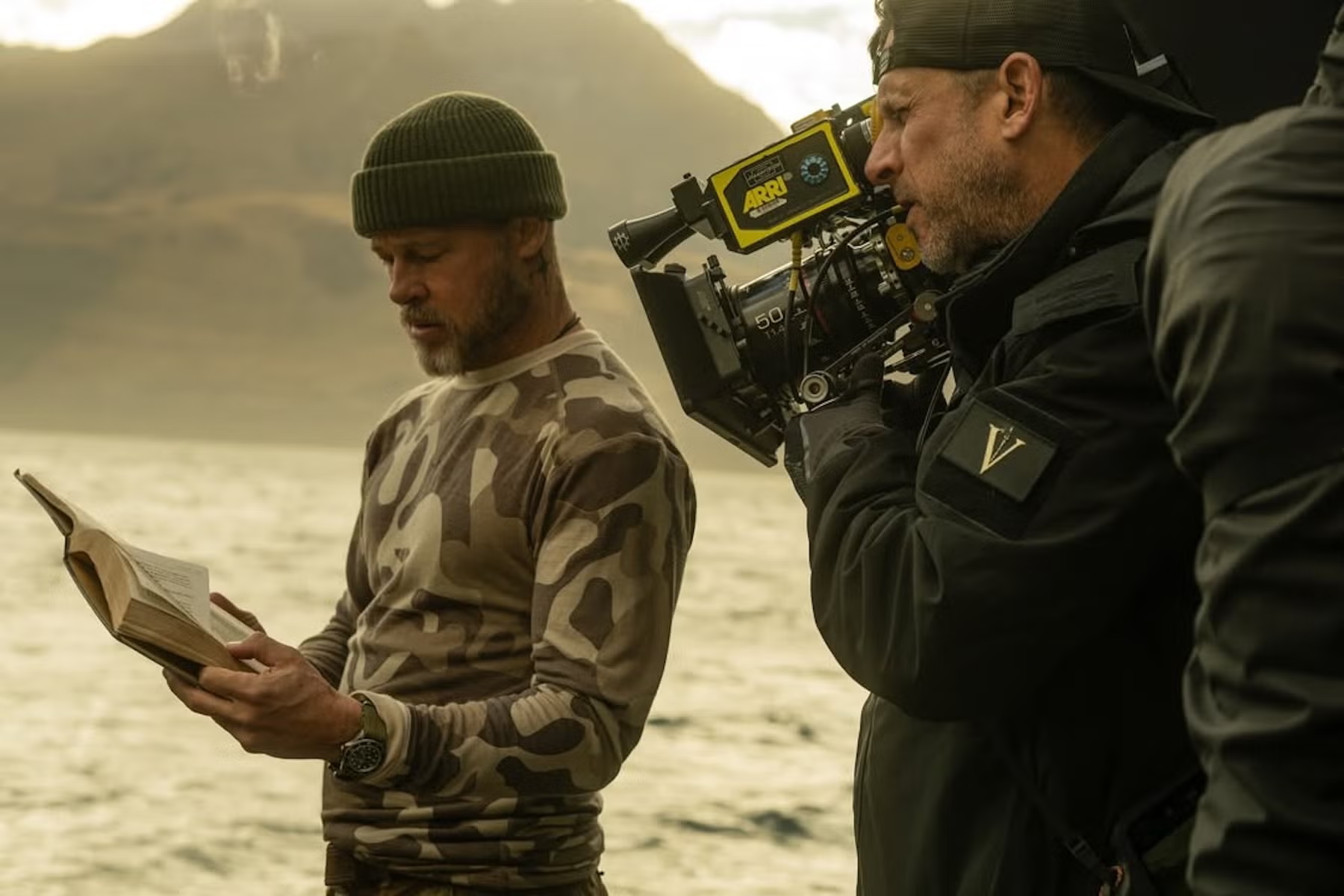
When Paramount dropped the first production stills from Heart of the Beast in June 2026, most people clocked Brad Pitt’s beard, the bleakness of the Alaskan setting, and the dog. The watch community noticed something else. On Pitt’s left wrist, just above a military-style wrist compass, sat a Rolex Submariner — not on its original steel bracelet, but threaded onto a fabric strap with a green and red stripe pattern. Specifically: a Rolex Submariner no-date reference 14060, one of the final iterations of the classic tool-watch Submariner before the brand moved to ceramic bezels, super cases, and the luxury stratosphere it now occupies.
To ninety-nine percent of the audience, it will read simply as a rugged, dark watch on a soldier’s wrist. To the one percent who care, it will read as one of the most considered prop choices in recent action cinema — a watch with its own military provenance, placed on screen as a deliberate tribute to a real operator, at the suggestion of the film’s director, himself a Navy veteran.
It is never just a watch.
View this post on Instagram
stir
Heart of the Beast arrives in theatres on 25 September 2026, distributed by Paramount Pictures. It is directed by David Ayer — the man who wrote Training Day and The Fast and the Furious, who directed Fury and End of Watch, and who, before any of that, served as an enlisted submarine sonar technician aboard the USS Haddo from 1986 to 1988. Ayer knows military culture from the inside, and his films consistently demonstrate a fluency with it that is difficult to fake. This is the reunion of Ayer and Pitt twelve years after Fury, a film that placed the same level of reverence on authentic military detail.
Pitt plays James Belmont, a retired US Army Special Forces officer and Delta Force operator who, at the film’s opening, is living a quiet life in Alaska with his retired military working dog, Odin. When a small plane crash strands the pair in the deep wilderness, the film becomes an endurance story about a man and his dog fighting through cold, predators, terrain, and the emotional weight of a life spent in service. The script, written by Cameron Alexander from a screenplay that appeared on the 2017 Black List, frames this explicitly as a love story between a warrior and his animal companion. J.K. Simmons and Anna Lambe appear in supporting roles. Principal photography ran from March to May 2025 in and around Queenstown, New Zealand, using Lake Wakatipu, Glenorchy, Mount Aspiring National Park, and Milford Sound as stand-ins for the Alaskan wild.
Ayer described the film to GQ as “a classic old-school adventure movie” and the trailer, which landed 11 June 2026, lived up to that. Pitt’s character opens in a PTSD support group before the crash sends him into the wilderness. The film’s emotional register is immediately apparent: this is about what soldiers carry back with them, and how bonds forged in combat — including bonds with animals — can sustain or save a person’s life.
Four German Shepherds were cast to play Odin: Uber, Hondo, Ryder, and Seeka. Uber, the father of the other three, had actual experience in mountain rescue operations in New Zealand.
flow
The Rolex Submariner reference 14060 was produced from 1990 to 2012, succeeding the legendary reference 5513. In the history of the Submariner lineage — which runs from 1953 to the present — the 14060 occupies a specific and revered position: the final generation of the classic case before Rolex overhauled everything.
The case is 40mm stainless steel, with the svelte, tapered lugs of the pre-super case era rather than the chunky architecture of the more modern references that followed. Its most distinctive features, at least to collectors, are the ones it does not have. No date window, which means no Cyclops lens disturbing the dial’s symmetry. No ceramic bezel insert — the 14060 uses an aluminum insert that develops its own character over time, fading and marking in ways that make each watch individual. And crucially: drilled lug holes, meaning spring bars can be threaded through proper openings in the case rather than simply lodged between lug faces. This matters because it makes strap swaps easy. It also matters because it connects the 14060 to a lineage of watches used by people who actually needed to change straps in the field.
The version specifically identified as being worn by Pitt’s character is the 14060M “two-liner” — the variant produced from approximately 2001 to 2007, identifiable by its minimalist dial carrying just two lines of text at six o’clock (simply “SWISS MADE”) rather than the four-line configuration introduced in 2007. The dial carries no COSC Superlative Chronometer certification text, giving it a cleaner, more austere face. For purists, this is considered the purest expression of the 14060M family. Movement inside is the Caliber 3130, self-winding, accurate to modern specifications, and historically regarded as one of the most robust Rolex ebauches produced. Water resistance is rated to 300 metres.
On the secondary market today, the 14060M trades between approximately $9,500 and $11,500 depending on configuration, condition, and provenance. It is the most accessible neo-vintage Submariner — accessible, of course, being a relative term — and it represents the last point at which a Rolex Submariner could be honestly described as a working diver’s tool watch rather than a social signal.
ref
Here is where the prop choice becomes genuinely extraordinary. The specific reference selected for Pitt’s character is not a random choice from a costume designer’s prop cabinet. Confirmed by Ayer himself in a conversation with Watches of Espionage — a publication run by a former CIA case officer and regarded as the authoritative voice on the intersection of watches, military culture, and intelligence — it is a deliberate tribute to a real person.
Will Chesney was a SEAL Team Six/DEVGRU assaulter and K-9 handler. On 2 May 2011, he was part of Operation Neptune Spear — the classified raid on Usama bin Laden’s compound in Abbottabad, Pakistan. He took with him, among other things, a 70-pound Belgian Malinois named Cairo, and a Rolex Submariner no-date reference 14060 on his wrist.
The watch had been Chesney’s gift to himself upon passing selection into SEAL Team Six in 2008. He walked into a Rolex authorised dealer in Virginia Beach and left the same day with the Sub. He wore it rarely on operations, preferring a digital Suunto or Garmin for day-to-day work. But Neptune Spear was different. Chesney, like the rest of the team, had extended his life insurance policy in the weeks before the raid. He believed, with good reason, that they were likely to die in Pakistan. He wore the Submariner because he wanted his most meaningful possession on his wrist if this was going to be his last night alive. In a 2009 visit to the unit armorer, he had already had the caseback laser-engraved with the “Red Man” insignia of Red Squadron — the same patch on Cairo’s harness.
The mission succeeded. Chesney and Cairo survived. The dog later accompanied him to meet President Obama and Vice President Biden. Cairo passed away from cancer in 2015. Chesney later received a Purple Heart from a grenade attack in Afghanistan in 2013, and his account of the bond between handler and dog became a book: No Ordinary Dog: My Partner from the SEAL Teams to the Bin Laden Raid.
The emotional through-line between Chesney and Cairo’s story and the premise of Heart of the Beast — a warrior and his combat dog, survival, loyalty, PTSD, and the unbreakable nature of the bond they formed — is exact. Ayer did not simply drop a reference to a military watch into the film. He built a prop choice around a real person whose specific circumstances mirror the fictional ones on screen, chosen specifically to honour the real lineage that the film is dramatising.
layer
The 14060 in the film is not worn on its factory Oyster bracelet. It’s on a fabric strap — specifically an NDC strap, confirmed as supplied to the production after the trailer was released — with a green and red stripe pattern. Paired on the same wrist is a Waltham-style wrist compass.
This combination carries its own historical significance that runs deeper than the Chesney reference. For decades, starting during the Vietnam conflict and extending through the Cold War and into the Global War on Terror, Army Special Forces and other special operations units wore Rolex and Tudor Submariners on fabric straps, paired with wrist compasses. It was a specific visual language for a specific type of operator — someone who needed to tell time and navigate, who had a watch worth protecting but needed it lashed down rather than secured by a steel clasp, and who understood that in a survival situation the compass had to be on the body, not in a pocket.
Chesney wore his 14060 on its Oyster bracelet, not a fabric strap. The loose clasp that almost kept the watch off his wrist during the Captain Phillips rescue was part of his regret about the bracelet. So the strap and compass combination is not a specific reference to Chesney — it is a reference to an older tradition, the whole lineage of operators who came before him. Belmont, as written, is a decades-long Special Forces veteran. The fabric strap with compass places him in a visual tradition stretching back to Vietnam-era SF soldiers, grounding the character not just in modernity but in the entire inherited culture of the special operations community. The Chesney nod and the Vietnam-era nod stack on top of each other, and the result is a character whose wrist tells more than most screenwriters manage in entire acts.
why
The honest answer is that it matters in two ways simultaneously, and they are not the same way.
For people who know the story — veterans, watch collectors, people who follow Watches of Espionage, readers who have encountered the Chesney story before — it functions as an act of recognition. Ayer knew what he was doing. He is a Navy veteran who reached out to Watches of Espionage for advice on wrist compasses before the film entered production. He knows the culture he is depicting with a precision that most Hollywood directors would not have, and he used that knowledge to encode something into the fabric of the film that acknowledges real people and real service rather than just drawing an aesthetic from it. The watch means something because it points to someone.
For everyone else — which is almost everyone — it functions differently but no less effectively. A man in the Alaskan wilderness, scarred by decades of war, accompanied by a dog he would die for, wearing a dark mechanical watch on a military strap next to a compass. The details aggregate into a character impression that lands as authentic before a single word is spoken. The watch does not need to be identified as a 14060 to communicate what it communicates. It communicates it anyway.
What the prop choice demonstrates, more broadly, is that the best film costuming is not styling but research. Amanda Neale, the film’s costume designer, put Pitt in olive-drab watch caps, camouflage shirts, and rugged survival gear — all of which can be sourced from any production’s military kit. The Submariner and the story underneath it required something else: actual knowledge of what this specific character would have worn and why, carried to a level of specificity that most audiences will never consciously register but will feel.
There is a long history of watches in cinema creating this kind of subterranean authenticity. Paul Newman wore a Daytona in Winning, and the rest is auction house legend. Steve McQueen wore a Heuer Monaco in Le Mans, and a watch became a driver. McQueen also wore the Submariner in The Thomas Crown Affair. In Apocalypse Now, the watches tell you everything about where the film is set and what kind of war it depicts. What Ayer has done in Heart of the Beast is operate in that same tradition — using a watch not as product placement and not merely as costume, but as a coded communication between a director who knows this world and the fraction of the audience that knows it too.
look
Heart of the Beast opens in theatres on 25 September 2026 via Paramount Pictures. The screen-worn Submariner is not available — no announcement has been made of an auction or release of prop items from the production. The reference itself, the 14060M two-liner, can be found on the secondary market through authorised pre-owned dealers, typically trading in the $9,500 to $11,500 range depending on condition and configuration. Given the attention the film is likely to draw, pre-owned 14060M prices may well move.
For anyone wanting to follow the fuller backstory, Will Chesney’s account of his service and his relationship with Cairo is documented in No Ordinary Dog, co-written with Joe Layden. The Watches of Espionage piece on the film and the earlier piece on Chesney’s own Submariner are both essential reading, and together they reveal exactly why a watch that most of the world will never look twice at deserves to be looked at very carefully indeed.
Related Articles

Under Rue de Castiglione, Liaigre Gives Hôtel Costes a Spa With No Hard Corners
A 20-meter lap pool, eight treatment rooms and not one sharp angle: Studio Liaigre’s spa […]