DRIFT AUDIO
Listen to this story
Choose a voice, then press play.
In the constellation of contemporary filmmakers and screenwriters, few voices have illuminated the complex labyrinth of female identity and desire quite like Rebecca Lenkiewicz. Over the past two decades, Lenkiewicz has crafted stories that thrum with intimacy and psychological acuity, stories that embrace the contradictions and complexities inherent in womanhood. Her writing for Disobedience, Colette, and She Said revealed her deft hand at exploring internal worlds, often invisible to the public gaze. Now, with her directorial debut Hot Milk, Lenkiewicz invites us to witness an intensely personal cinematic journey that feels as scorching and restless as the Spanish coast it portrays.
An adaptation of Deborah Levy’s 2016 Booker Prize-nominated novel, Hot Milk centers on the thorny mother-daughter relationship between the fiercely independent yet emotionally tethered Sofia (Emma Mackey) and her commanding, enigmatic mother Rose (Fiona Shaw). The story follows the pair as they travel to a remote Spanish beach town in search of a cure for Rose’s mysterious illness that has left her in a wheelchair. But as much as this journey is physical, it is profoundly emotional, unraveling the threads of a relationship defined by codependency, unspoken resentments, and a shared history of wounds.
A Writer Drawn to Women’s Inner Worlds
Rebecca Lenkiewicz has long been enchanted by women’s stories. Her career spans stage, television, film, and radio, and each medium has allowed her to delve into female perspectives with unwavering curiosity and compassion. From the Orthodox Jewish community in Disobedience to the literary rebellion of Colette, she consistently centers women navigating oppressive structures — whether social, familial, or internal.
When Lenkiewicz first encountered Levy’s novel, she was captivated. Here was a narrative that didn’t just portray a mother-daughter bond but dissected it under a relentless sun, examining each nerve and vulnerability. “I was drawn to the raw honesty of Sofia’s voice,” Lenkiewicz said in an interview. “The novel captures a woman’s sense of being adrift, of searching not just for freedom from her mother but also from the expectations of what a daughter, a woman, a lover should be.”
The Art of Adaptation
Turning a deeply interior novel into a film is always an audacious endeavor. Levy’s Hot Milk is saturated with internal monologue, fragmented memories, and symbolic detours — all of which resist straightforward cinematic translation. Lenkiewicz approached this challenge with both reverence and confidence, determined to honor the novel’s spirit while crafting a distinct cinematic language.
Her adaptation pares down the narrative, shifting the focus squarely onto Sofia’s emotional journey. Certain characters and subplots are condensed or altered, not as acts of betrayal but as acts of necessary transformation. “A novel lives in the imagination of the reader; a film lives in the collective gaze of an audience,” Lenkiewicz explained. “I wanted to create a film that breathes, that allows the silences to speak as loudly as the words.”
The Battle of Dependency and Desire
In the film, Sofia is depicted as a “permanent student of anthropology,” a woman who studies cultures and human behaviors yet struggles to decode her own needs. Her mother Rose, played with steely magnetism by Fiona Shaw, is both fragile and manipulative, embodying the paradoxes of maternal love. Their interactions are fraught with an almost palpable tension, each glance loaded with a lifetime of unresolved conflicts.
Rose’s illness functions as both a literal and metaphorical anchor, keeping Sofia tied to a life of service and self-denial. Sofia’s excursions beyond her mother’s reach — wandering the beach, swimming in the sea, or engaging in flirtations — become acts of defiance, small rebellions against the gravitational pull of maternal expectation.
The Spanish setting amplifies these dynamics beautifully. The scorching sun and shimmering sea become extensions of Sofia’s inner landscape: alluring, dangerous, and constantly shifting. The physical heat mirrors the emotional friction, making every scene feel on the verge of combustion.
The Bohemian Catalyst
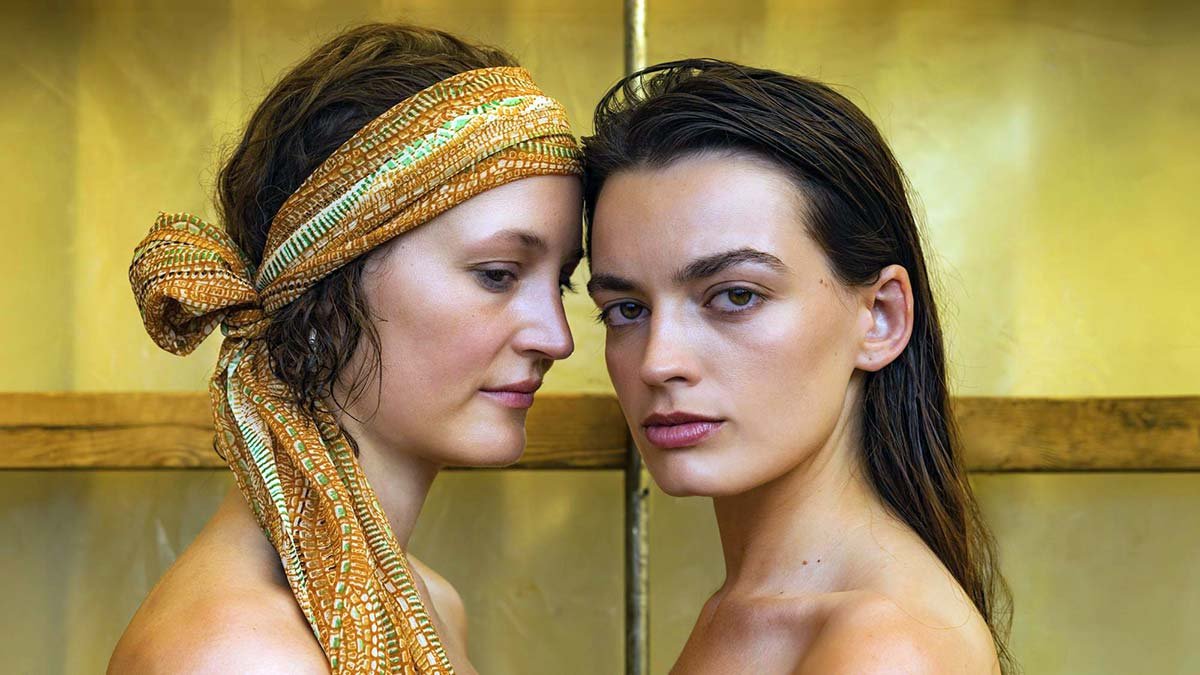
A crucial figure in Sofia’s self-awakening is Ingrid, portrayed by Vicky Krieps. Ingrid rides into Sofia’s life on horseback, an almost mythical figure embodying freedom and unrestrained desire. She is a German seamstress with a bohemian spirit, a woman untethered to convention or familial obligations.
Their relationship, tender and erotic, offers Sofia a glimpse of another way of living — one ungoverned by duty or guilt. Ingrid’s presence is a liberation, a seductive alternative to the stifling love Sofia shares with her mother. Through Ingrid, Sofia discovers the possibility of an identity defined by pleasure rather than sacrifice.
Krieps infuses Ingrid with a luminous authenticity. Her performance feels spontaneous and grounded, offering a perfect counterpoint to the tightly coiled energy of Mackey’s Sofia. In their scenes together, Lenkiewicz allows the camera to linger, capturing the slow unfurling of desire and the quiet, intoxicating shifts in power.
Casting and Performances
The casting of Hot Milk is nothing short of inspired. Fiona Shaw, a performer known for her emotional range and intensity, brings Rose to life with a mix of vulnerability and ironclad will. Her portrayal avoids easy villainization; Rose is deeply human, her manipulations stemming from her own fears and frustrations.
Emma Mackey delivers a career-defining performance as Sofia. Known to many for her role in Sex Education, Mackey brings depth and rawness to a character constantly oscillating between yearning and resignation. Sofia’s silences speak volumes, and Mackey imbues her with a restless energy that makes her moments of connection and rebellion all the more poignant.
Krieps, meanwhile, embodies a kind of quiet revolution. Her Ingrid is not a savior but a mirror, reflecting back to Sofia the life she might choose if she dares. Their chemistry feels organic, a testament to Lenkiewicz’s skill in fostering authentic intimacy on screen.
Directing Her Own Words
For Lenkiewicz, Hot Milk marks her first foray into directing a feature film. While she has spent years shaping stories for others to bring to life, stepping behind the camera herself meant assuming total creative responsibility — a thrilling and terrifying prospect.
“It feels like raising a child,” she said. “You’re there from the beginning, nurturing every aspect, and then suddenly you have to let it go into the world.” This metaphor resonates deeply with the film’s themes of maternal attachment and the painful necessity of separation.
Lenkiewicz’s directorial style is understated yet precise. She favors natural light, long takes, and compositions that allow the actors space to inhabit their emotional landscapes fully. Her use of the Spanish setting is both literal and symbolic, the landscapes becoming characters in their own right. The sea is ever-present, a shimmering symbol of escape and danger, echoing Sofia’s internal push and pull between entrapment and liberation.
Sound, Silence, and Sensation
Sound design plays a subtle but critical role in Hot Milk. The rhythmic crash of the waves, the incessant hum of cicadas, the sudden silences — all serve to heighten the film’s sensory impact. These elements create an atmosphere where the audience is not just observing Sofia’s journey but experiencing it viscerally.
Music is used sparingly, allowing natural sounds and silences to dominate. This choice underscores Lenkiewicz’s commitment to emotional authenticity. Rather than manipulating viewers through overt musical cues, she trusts the raw power of performance and environment to carry the narrative.
A Long Gestation
The path to realizing Hot Milk was long and winding. Lenkiewicz began working on the adaptation over seven years ago, a period marked by script revisions, casting changes, and logistical challenges. Throughout, she remained steadfast in her vision, a testament to her dedication to the story and its characters.
“I felt like I owed it to Sofia to see this through,” she reflected. “There’s something profoundly universal about her journey — that longing to break free, to define oneself outside of inherited roles.” This sense of duty to her protagonist mirrors the complex maternal ties explored in the film, adding another layer of emotional resonance.
Themes That Linger
At its core, Hot Milk is about the struggle for autonomy — from mothers, from lovers, from the roles we’re assigned. It interrogates the often unspoken contracts that govern familial love, asking whether true independence is possible or merely an illusion.
The film also engages deeply with ideas of femininity and bodily autonomy. Rose’s illness, whether psychosomatic or real, represents the way women’s bodies are sites of both vulnerability and control. Sofia’s own sexual awakening and eventual confrontations with her mother highlight the painful yet necessary process of reclaiming one’s body and desires.
Lenkiewicz does not offer easy answers. Instead, she invites viewers into a space of ambiguity, where love and resentment coexist, and freedom is both exhilarating and terrifying. It is a film that demands contemplation long after the credits roll.
Looking Ahead
For Lenkiewicz, Hot Milk is not just a culmination but a beginning. Having now directed her own feature, she has expanded her artistic vocabulary, merging her writer’s sensitivity with a director’s visual and auditory sensibility.
As she continues to craft stories — whether behind the pen or the camera — one thing remains clear: her unwavering commitment to telling women’s stories with honesty, complexity, and care. Hot Milk stands as a bold, intimate testament to that mission, a film as beautiful and uncomfortable as the truths it seeks to uncover.
In a landscape where stories about women are still too often simplified or sidelined, Lenkiewicz offers a scorching corrective. With Hot Milk, she invites us to sit under the blinding sun and truly see — the wounds, the desires, the messy humanity of her characters. And in doing so, she reveals not just Sofia and Rose, but perhaps something of ourselves.
Related Articles
Modigliani’s Limestone ‘Tête’
Carved from a single block of limestone in Montparnasse more than a century ago, one of Modigliani's rare stone heads goes to auction for the first time…