DRIFT AUDIO
Listen to this story
Choose a voice, then press play.
Dondi Schwartz, an accomplished Israeli-Canadian artist, has captivated art enthusiasts worldwide with her evocative landscape paintings. Her works often depict serene natural environments, exploring the delicate interplay of light, texture, and atmosphere.
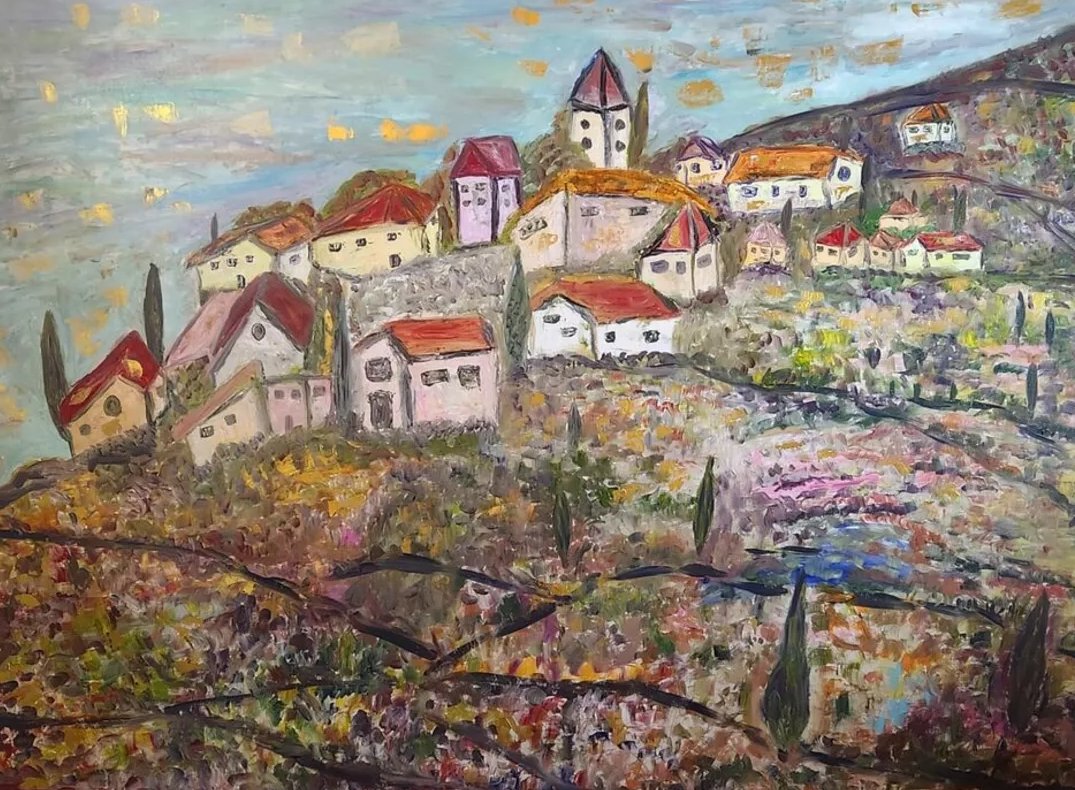
One of her most celebrated pieces, “The Village in the Mountains” (2025), exemplifies her signature style and ability to transport viewers into tranquil, almost ethereal landscapes.
Through her masterful use of color and composition, Schwartz creates a piece that resonates deeply with those who seek solace in the quiet beauty of nature.
The Artist Behind the Masterpiece
Dondi Schwartz was born in Canada in 1961 and later relocated to Israel, where she established herself as a prominent contemporary artist. Her early exposure to the diverse landscapes of both North America and the Middle East profoundly influenced her artistic sensibilities.
She pursued her formal art education at the Avni Institute of Art and Design in Tel Aviv, a prestigious institution known for fostering some of Israel’s most prominent modern artists. Schwartz’s education provided her with a strong foundation in traditional painting techniques, but it was her personal exploration of light, color, and movement that truly set her apart.
Currently, she resides and works in Kibbutz Beeri, Negev, Israel, a setting that deeply inspires her landscape-driven artwork. Her ability to capture the essence of both rural and mountainous environments stems from her profound connection to nature and her meticulous observation of light variations across different terrains.
“The Village in the Mountains” (2025): Analyzing the Artwork
Schwartz’s “The Village in the Mountains” presents an idyllic mountaintop village, nestled among rolling hills and enveloped in a luminous, almost dreamlike atmosphere. The composition follows a classical triangular structure, with the village positioned as the central focal point.
• The foreground features lush vegetation and winding footpaths, guiding the viewer’s eye toward the heart of the painting.
• The middle ground is dominated by quaint cottages with sloping roofs, reminiscent of European and Mediterranean mountain villages.
• The background showcases majestic peaks shrouded in mist, adding depth and a sense of isolation to the scene.
Schwartz masterfully employs perspective to create a feeling of immersion, allowing the viewer to feel as if they are standing at a vantage point, gazing down upon the tranquil village.
Use of Light and Color
One of Schwartz’s defining artistic strengths is her ability to manipulate light to create a sense of warmth and movement. In “The Village in the Mountains,” she uses:
• Soft, golden hues to illuminate the village, suggesting early morning or late afternoon light.
• Cooler blues and purples in the distant mountains to enhance atmospheric depth.
• Earthy greens and browns in the foreground, grounding the composition with natural tones.
The juxtaposition of warm and cool tones creates a dynamic yet peaceful scene, emphasizing the relationship between human settlements and nature.
Brushwork and Texture
Schwartz’s brushwork in this piece blends impressionistic strokes with realistic detailing.
• The sky and distant mountains are painted with soft, blended strokes, creating a dreamy, almost intangible quality.
• The village structures feature more defined brushwork, emphasizing their solidity amidst the natural surroundings.
• The foliage and terrain incorporate thicker, textured paint applications, adding a tactile, three-dimensional effect.
By varying her brush techniques, Schwartz achieves a harmonious balance between realism and artistic expression, making the painting both visually engaging and emotionally evocative.
Themes and Symbolism
“The Village in the Mountains” is not merely a landscape painting—it is a reflection of humanity’s connection to the natural world. The small, humble village nestled within the grandeur of the mountains suggests a harmonious coexistence between people and nature.
Schwartz subtly portrays the idea that humans are not separate from nature but rather an intrinsic part of it. The soft lighting and organic integration of the buildings within the landscape reinforce this symbiotic relationship.
Solitude and Tranquility
Another prevalent theme in Schwartz’s work is solitude—not in a lonely or isolating sense, but rather as a state of peaceful introspection. The mountain village, seemingly untouched by modern distractions, evokes a longing for simpler, quieter living.
This theme is particularly relevant in today’s fast-paced digital world, where many seek refuge in nature. Schwartz’s painting serves as a reminder of the healing power of remote landscapes.
Timelessness and Nostalgia
While “The Village in the Mountains” is a contemporary piece, it evokes a sense of timelessness. The absence of modern elements such as cars, electricity poles, or urban expansion makes it difficult to pinpoint a specific time period.
This universal quality allows viewers from different backgrounds to project their own memories or dreams onto the scene, making it a deeply personal experience for each observer.
Impressionism and Post-Impressionism
Schwartz’s handling of light and color is reminiscent of Impressionist painters such as Claude Monet and Camille Pissarro. Her ability to capture fleeting moments of atmospheric light and expressive brushwork aligns with the Impressionist movement’s core principles.
Additionally, her bold color contrasts and thicker paint applications echo elements of Post-Impressionism, particularly in the tradition of Van Gogh and Cézanne.
Mediterranean and Middle Eastern Landscapes
Having lived in Israel for most of her career, Schwartz’s work is heavily influenced by the Mediterranean and Middle Eastern landscapes. The rustic charm of the mountain village in this painting shares similarities with:
• Italian hilltop towns in Tuscany and Umbria.
• Greek mountain villages with white-washed houses.
• Israeli and Palestinian countryside settlements with their stone architecture and rolling hills.
This blend of cultural inspirations gives the painting a universal appeal, allowing it to resonate with viewers from different regions.
The Growing Appreciation for Nature-Inspired Art
In the modern art scene, there is a resurgence of interest in landscape painting, especially in the context of climate change, sustainability, and nature conservation. Works like “The Village in the Mountains” remind audiences of the beauty and importance of preserving natural landscapes.
Popularity Among Collectors and Galleries
Schwartz’s art is highly sought after, with her works displayed in:
• Prominent online art platforms such as Artsper and Artnet.
• International galleries in Europe, the U.S., and the Middle East.
• Private collections, where they are valued for their meditative and timeless appeal.
“The Village in the Mountains” is listed for approximately $8,000, reflecting its value within the contemporary art market.
Dondi Schwartz’s “The Village in the Mountains” (2025) is a masterclass in landscape painting, blending technical expertise, emotional depth, and cultural richness. Through its stunning composition, expressive light play, and thoughtful themes, the artwork offers viewers a moment of peace and introspection.
In a world that often feels chaotic, Schwartz’s vision provides a visual sanctuary, inviting us to reconnect with nature and appreciate the quiet beauty of mountain villages. As her reputation continues to grow, so does the legacy of her art—one that speaks to the universal human longing for tranquility, connection, and timeless landscapes.
Related Articles
Modigliani’s Limestone ‘Tête’
Carved from a single block of limestone in Montparnasse more than a century ago, one of Modigliani's rare stone heads goes to auction for the first time…